
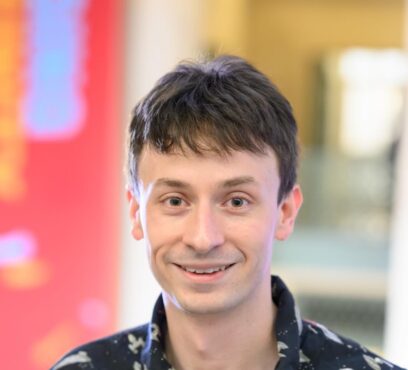
Kevin Burdgeمشاهده پروفایل
استادیار
Kevin Burdge is an Assistant Professor of Physics at the Massachusetts Institute of Technology (MIT), affiliated with the MIT Binary Star Astrophysics Group and the Kavli Institute for Astrophysics and Space Research (MKI). He conducts observational astrophysics research focused on compact binary systems, including white dwarfs, neutron stars, and black holes, using time-domain and multi-messenger techniques. His research spans: Discovery and characterization of compact binaries Gravitational-wave and electromagnetic multi-messenger astrophysics Development of high-speed astronomical instrumentation Stellar evolution and accretion processes Observations with LISA, Rubin Observatory, JWST, and AXIS Burdge's recent work emphasizes identifying rare and exotic binary systems, such as the first known black hole in a triple-star system, and expanding the population of LISA-detectable sources. His group develops GPU-based algorithms for rapid data analysis and operates the 'Lightspeed' camera on the Magellan telescopes for high-speed photometry. The publication trends reflect a strong focus on ultra-compact binaries, orbital dynamics, gravitational-wave emission, and multi-wavelength follow-up. His research combines theoretical modeling with cutting-edge observational tools across optical, X-ray, and gravitational-wave domains. Scientific honors include: Pappalardo Fellowship, MIT (2021) Burdge advises students through his research group and has secured support through major collaborations like LISA and AXIS. He has been instrumental in designing the proposed Galactic-plane survey for AXIS, expected to uncover over a million new X-ray sources. His grants and research are supported by MIT, NASA, and NSF-level initiatives. He leads the MIT Binary Star Astrophysics Group, which focuses on discovery-driven astrophysics using next-generation observatories. The team integrates instrumentation development, data science, and theoretical astrophysics to explore binary evolution and compact object physics.