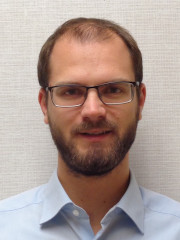
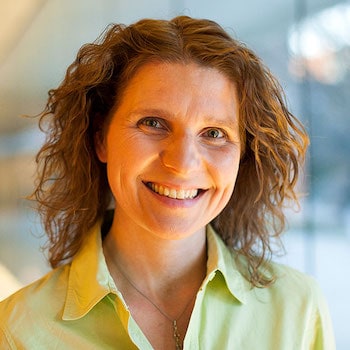
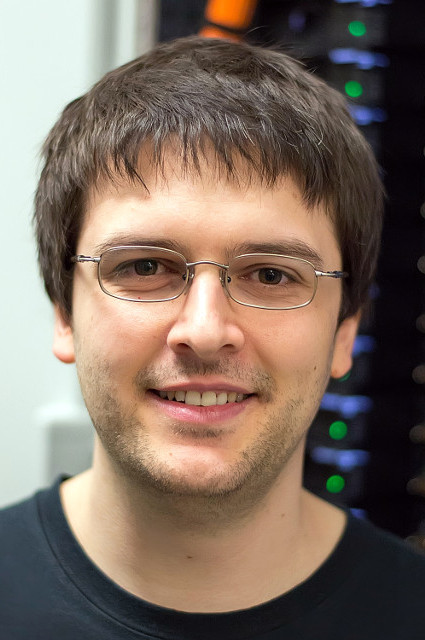
Dr. Philipp Grete is a postdoctoral research associate at the Hamburg Observatory (University of Hamburg), previously holding a Marie Skłodowska-Curie Fellowship at the same institution and a postdoctoral position at the Department of Physics & Astronomy, Michigan State University . His interdisciplinary research bridges astrophysics and computational methods , focusing on: Magnetohydrodynamic turbulence in astrophysical systems Performance-portable exascale simulation frameworks (Parthenon, AthenaPK) Cosmic ray transport mechanisms Anisotropic transport processes in weakly collisional plasmas Supercomputer-driven AGN feedback analysis He leads the XMAGNET project using DOE INCITE allocations on exascale systems and recently secured DFG funding for three years. His work has been recognized with the Postdoctoral Excellence in Research Award (MSU), SC23 Best Paper nomination, and CUG23 Best Paper Runner-up award.
Christiane Jablonowski is a Professor in the Department of Atmospheric, Oceanic and Space Sciences (AOSS) at the University of Michigan's College of Engineering. She serves on the NCAR Community Earth System Model (CESM) Scientific Steering Committee, the AMS Committee on Artificial Intelligence Applications to Environmental Science, and represents U-M at the University Corporation for Atmospheric Research (UCAR). Her educational background includes: Ph.D. in Atmospheric & Space Sciences and Scientific Computing, University of Michigan M.S. in Meteorology, University of Bonn, Germany B.S. in Physics, Aachen University of Technology, Germany Professor Jablonowski specializes in atmospheric dynamics, focusing on baroclinic waves, tropical cyclones, and stratospheric phenomena. She pioneers idealized test cases for dynamical cores of General Circulation Models (GCMs) and leads the Dynamical Core Model Intercomparison Project (DCMIP). Her research integrates machine learning with high-resolution modeling for weather prediction and climate simulation, with significant work on Great Lakes coupling and volcanic eruption impacts. Her recent publications reveal strong trends toward machine learning applications in physical parameterizations and ultra-high-resolution modeling, with recurring themes in stratospheric dynamics, tropical cyclone simulation, and dynamical core evaluation across 15 recent articles spanning volcanic aerosol impacts, QBO modeling, and Great Lakes ice forecasting. Her scientific accolades include the Presidential Early Career Award for Scientists and Engineers (PECASE) and Department of Energy Early Career Award, alongside the 2023 UCAR Outstanding Accomplishment Award. Additional honors recognize her methodological innovations and graduate fellowship achievements. UCAR Outstanding Accomplishment Award in Publication (2023) AGU EOS publication highlights (2022) Presidential Early Career Award for Scientists and Engineers (PECASE) (2010) Department of Energy Early Career Award (2010) AOSS Faculty Award (2010) Distinguished Achievement Award, U-M College of Engineering NCAR Advanced Study Program Fellowship She directs major federally funded initiatives including the NOAA Unified Forecast System Short-Range-Weather team and CESM Atmospheric Model Working Group, mentoring numerous graduate students through DOE and NASA grants while leading the Dynamical Core Model Intercomparison Project. As founder of the Dynamical Core Model Intercomparison Project (DCMIP) and co-chair of NOAA's Unified Forecast System team, she coordinates international collaborations developing next-generation atmospheric modeling frameworks at the Climate and Space Research Building.
Lai-yung Ruby Leung is a Battelle Fellow at Pacific Northwest National Laboratory (PNNL) working in Earth Systems Analysis & Modeling. She serves as Chief Scientist of the Energy Exascale Earth System Model (E3SM) supported by the U.S. Department of Energy, leading major efforts to develop state-of-the-art capabilities for modeling human-Earth system processes on high-performance computers. Dr. Leung's research broadly spans climate and hydrological cycle modeling with expertise in land-atmosphere interactions, orographic processes, monsoon climate, and climate extremes. Dr. Leung earned her educational credentials from prestigious institutions: Ph.D., Atmospheric Science, Texas A&M University M.S., Atmospheric Science, Texas A&M University B.S. (Honors), Physics & Statistics, Chinese University of Hong Kong Her research interests focus on regional and global climate modeling , land-atmosphere interactions , and the regional hydrologic cycle . She investigates orographic precipitation mechanisms, climate extremes, climate variability and change, and aerosol-cloud interactions. Her work integrates advanced modeling techniques with observational data to understand complex Earth system processes, with research featured in Science , Popular Science , Wall Street Journal , and National Public Radio . Dr. Leung has published over 500 peer-reviewed papers and serves as an editor for the American Meteorological Society's Journal of Hydrometeorology . Analysis of Dr. Leung's recent publications reveals her leadership in developing and applying the Energy Exascale Earth System Model (E3SM), with significant contributions to understanding mesoscale convective systems, soil moisture dynamics, urban hydrology, and climate extremes. Her work demonstrates increasing integration of machine learning techniques with traditional climate modeling approaches, particularly in model evaluation frameworks and high-resolution simulations. She maintains strong focus on practical applications of climate science for understanding water resources, extreme weather events, and climate change impacts. Dr. Leung's scientific recognition includes: Election to the National Academy of Engineering (NAE) Election to the Washington State Academy of Sciences (WSAS) Fellow of the American Geophysical Union (AGU) Fellow of the American Meteorological Society (AMS) Fellow of the American Association for the Advancement of Science (AAAS) AMS Hydrologic Sciences Medal (2022) U.S. Department of Energy Office of Science Distinguished Scientist Fellow (2021) Reuter's Hot List of top 1,000 most influential climate scientists (2021) AGU Jacob Bjerknes Lecture (2020) AGU Bert Bolin Global Environmental Change Award (2019) As Chief Scientist of E3SM, Dr. Leung leads major research initiatives funded by the Department of Energy and has organized key workshops sponsored by DOE, NSF, NOAA, and NASA. She has served on numerous advisory panels and National Academies committees that define future priorities in Digital Twin, AI/ML, climate modeling, hydroclimate, and water cycle research. Her professional service includes membership on the Board on Atmospheric Sciences and Climate of the National Academies, council membership with the American Meteorological Society, and editorial roles for prominent journals. Dr. Leung directs research within PNNL's Earth Systems Analysis & Modeling group, collaborating with national and international climate research teams. She leads efforts to advance the Energy Exascale Earth System Model (E3SM), which represents cutting-edge capabilities in modeling human-Earth system processes. Her work connects with multiple PNNL research areas including atmospheric science, global change, and coastal science, contributing to the laboratory's mission of addressing complex environmental challenges through scientific innovation.
Prof. Dr. Michael Kuhn is a Professor in the Faculty of Computer Science at Otto von Guericke University Magdeburg since 2020, leading the Parallel Computing and I/O Group. His work bridges theoretical parallel computing concepts with practical high-performance computing implementations. His academic journey includes: Bachelor's degree in Computer Science from Heidelberg University (2007) Master's degree in Computer Science from Heidelberg University (2009) Doctorate from Hamburg University (2015) with dissertation on "Dynamically Adaptable I/O Semantics for High Performance Computing" Prof. Kuhn's research tackles critical challenges in modern computing infrastructure where systems scale to millions of processor cores. He investigates fundamental improvements to storage architectures, I/O interfaces, and programming models that enable efficient data processing at exascale levels. His development of the JULEA storage framework provides dynamically adaptable solutions for high-performance computing environments, addressing the growing mismatch between computational power and data movement capabilities. As faculty public relations officer, he maintains the Faculty of Computer Science's digital presence while actively teaching courses that equip students with practical parallel programming skills. His group's work demonstrates how breaking computational problems into parallelizable components—like the matrix processing example reducing runtime to a quarter—enables scientific breakthroughs requiring massive computational resources. The Parallel Computing and I/O Group serves as a hub for advancing storage technologies and parallel processing methodologies, with applications spanning scientific computing, big data analytics, and next-generation supercomputer architectures.
Vladimir Getov is a Professor at the University of Westminster with extensive international affiliations including Honorary Professor at Technical University of Sofia and Visiting Lab Fellow at Pacific Northwest National Laboratory. His leadership roles span the IEEE Computer Society (Governor since 2015), CoreGRID/ERCIM Working Group (Topic Leader 2009-2015), and multiple editorial positions including Area Editor for High Performance Computing at IEEE Computer. His research centers on Performance Analysis and Engineering, Energy Efficient Computing, and Parallel and Distributed Architectures with significant contributions to cloud computing, wireless sensor networks, and component-oriented design. Recent work focuses on energy-drain attack prevention in MAC protocols and application-specific thermal modeling for multi-core processors. Key awards include the Bulgarian National Scientific Award 'Pythagoras' (2009), IEEE Computer Society Certificates of Appreciation (2008, 2010), and CoreGRID Outstanding Contribution Award (2008). His publication record spans 35+ years with over 100 papers including the 2024 IEEE ICAI conference paper on electronic digital computing history. As leader of the Distributed and Intelligent Systems Research Group since 1996, he has supervised 7 PhD students to completion with frameworks like AGOCS cloud simulator and TunableMAC protocol. His EU project leadership includes CoreGRID (2004-2009) and GridCOMP (2006-2010), securing sustained research funding including Daiwa Foundation support (2017) for low-energy co-design methodology.