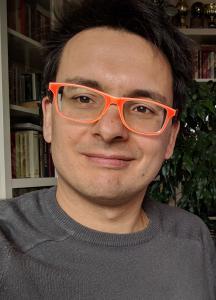
Alessandra Pesce is an Associate Professor at the Department of Physics (DIFI) of the University of Genoa, Italy. Her research focuses on structural biology of globins, protein aggregation, and cold-adapted enzymes, with applications in life sciences, environmental monitoring, and cultural heritage preservation. She teaches Applied Physics and Biophysics at both undergraduate and graduate levels in Physics and Biological Sciences. Her work spans from atomic-level characterization of protein crystals using Atomic Force Microscopy to large-scale ecological projects like the LIFE+ WHALESAFE initiative for sperm whale conservation through acoustic monitoring. Email: alessandra.pesce@unige.it Phone: +39 010 33 56243 Research Interests: Structural characterization of hexa-coordinated globins in marine organisms Thermodynamic and kinetic analysis of truncated hemoglobins in pathogenic bacteria Quaternary structure adaptations in Antarctic enzymes Development of acoustic monitoring systems for marine mammal conservation Protein aggregation mechanisms in amyloid-related diseases Publication Trends: Over 15 years, her research demonstrates expertise in combining X-ray crystallography with biophysical techniques to study globin family proteins across diverse species (from nematodes to whales). Key themes include heme reactivity modulation, ligand diffusion pathways, and structure-function relationships in extremophile proteins, with recent emphasis on marine conservation technology.
Raffaele Calabretta is an Associate Professor of Psychology of Communication at the International Telematic University UniNettuno and a Permanent Researcher at the Italian National Research Council's Institute of Cognitive Sciences and Technologies. He holds a Ph.D. in Computer Science from Stanford University (2012). His interdisciplinary research spans evolutionary modularity in artificial neural networks, intra-party democratic innovations, and cognitive modeling. Dr. Calabretta developed 'doparies'—a post-election participatory mechanism for political parties that combines deliberation and voting to enhance citizen engagement. In artificial life, he has modeled how modularity evolves in neural networks to solve complex tasks. He authored the science-in-fiction novel 'Il film delle emozioni' (2006) and 'Doparie, dopo le primarie' (2010) on democratic innovations.
Pietro Rosatti is a Research Fellow at the Department of Industrial Engineering, University of Trento, specializing in electromagnetic systems and artificial intelligence applications. His research focuses on: Antenna Design for automotive radar and communication systems Microwave Engineering and mm-wave technologies Artificial Intelligence integration in electromagnetic problem-solving Inverse Problems and electromagnetic imaging System-by-Design optimization frameworks Real-world applications in medical imaging and radar systems Analysis of his 17 publications (2018-2025) reveals a dominant trend toward AI-driven solutions for electromagnetic challenges, particularly in automotive radar antenna design (77 GHz systems), microwave medical imaging, and ground-penetrating radar. His work consistently employs multi-objective evolutionary optimization and system-by-design methodologies to overcome the curse of dimensionality in inverse scattering problems, with increasing emphasis on real-time deep learning frameworks since 2021.
Giovanni Iacca is an Associate Professor at the University of Trento's Department of Information Engineering and Computer Science (DISI), where he serves as Coordinator of the Master's Degree in Computer Science and Deputy Director of the Information Engineering and Computer Science Doctoral School. He leads the Distributed Intelligence and Optimization Lab (DIOL) and teaches courses including Computer Architectures, Introduction to Machine Learning, Bio-Inspired Artificial Intelligence, and Optimization Techniques across multiple academic programs. PhD in Computer Science, University of Jyväskylä, Finland (2011) MSc in Computer Engineering, Technical University of Bari, Italy (2006) Professor Iacca's research focuses on the intersection of evolutionary computation, machine learning, and optimization with applications in distributed systems and robotics. His work spans from theoretical foundations of memetic computing and multi-objective optimization to practical implementations in soft robotics, embedded systems, and healthcare applications. Recent efforts emphasize interpretable AI, particularly in reinforcement learning contexts, where his team develops methods to make decision processes transparent while maintaining performance. His research bridges the gap between fundamental algorithmic development and real-world engineering challenges, with over 15 years of industrial experience in optimization applied to engineering, logistics, and scheduling. Analysis of his recent publications reveals a strong trend toward interpretable AI systems, particularly in reinforcement learning contexts, with significant contributions to federated learning optimization, evolutionary neural architecture search, and applications in healthcare scheduling. His work consistently combines evolutionary algorithms with modern machine learning techniques to solve complex optimization problems across diverse domains including soft robotics, batteryless edge computing, and supply chain management. Scientific Awards: EvoApplications Best Paper Award (2017) UKCI AWARENESS Best Paper Award (2012) IEEE CIS Outstanding Student-Paper Award (2011) Professor Iacca actively supervises a large research group with numerous PhD students across multiple doctoral programs, including Information Engineering and Computer Science, Industrial Innovation, and the National PhD in Artificial Intelligence for Society. His lab has secured significant research funding through collaborations with industry partners and international research consortia. Recent grants support work on interpretable reinforcement learning, federated optimization, and applications of evolutionary computation in healthcare and robotics. He has also been appointed to editorial roles for prestigious journals including IEEE Transactions on Evolutionary Computation and Evolutionary Intelligence. The Distributed Intelligence and Optimization Lab (DIOL) under Professor Iacca's leadership comprises over 30 researchers including postdocs, PhD students, and master's students. The lab maintains strong international collaborations and has developed specialized expertise in evolutionary computation, interpretable AI, and optimization for embedded systems. Current projects include work on the EIC Pathfinder Challenge "Awareness Inside," development of methods for batteryless edge intelligence, and applications of evolutionary algorithms to healthcare scheduling problems.
Alessandro Petraglia is an Associate Professor (Researcher) at the Department of Chemical, Life and Environmental Sustainability Sciences, University of Parma. His career spans over two decades, focusing on plant biodiversity in mountain environments, particularly alpine and Apennine regions. Education: PhD in Plant Biology (2005), University of Parma; Degree in Natural Sciences (2001), University of Parma. Research: Investigates climate change impacts on alpine snowbeds, bryophyte-dominated ecosystems, and peat bogs, with key projects in GLORIA, ITEX, and DROUGHT-NET. Publications: 28 international journal articles, 17 national refereed papers, 3 book chapters, and 15 vegetation maps. Teaching: Delivered courses in Systematic Botany and Plant Biodiversity at the University of Parma (2005–2018). Collaborations: Engaged in national and international projects, including the Stelvio National Park and the Tuscan-Emilian Apennines National Park. Recent Trends: His 15 most recent articles focus on climate change effects (warming, drought, nutrient shifts), plant phenology, bryophyte adaptations, and ecosystem-level responses in alpine habitats.
Eric Medvet is an Associate Professor of Computer Engineering at the Department of Engineering and Architecture (DIA), University of Trieste, Italy. He leads the Evolutionary Robotics and Artificial Life Lab and co-leads the Machine Learning Lab. His research focuses on Evolutionary Computation, Machine Learning, and their applications to robotics, including Grammatical Evolution, Genetic Programming, and soft robotics. He received the Google Faculty Research Award 2019 for a project on modular soft robots and co-authored a best paper at EuroGP 2024. His recent work emphasizes interpretable control policies, quality-diversity optimization, and evolutionary learning of formal specifications. Medvet teaches advanced courses on machine learning, evolutionary robotics, and programming, consistently updating curricula to reflect cutting-edge research. His labs are hubs for interdisciplinary projects, blending theory with practical implementations in robotics and AI. Research Interests: Medvet’s research spans evolutionary algorithms applied to robotics, with a focus on modular systems. He explores how genetic programming and grammatical evolution can optimize robotic designs and controllers. His work on ‘totipotent neural controllers’ and ‘body-brain co-evolution’ exemplifies efforts to create adaptable, specialized robots. He also investigates formal methods (e.g., STL specifications) for system validation and interpretable AI models. Recent trends in his publications reflect a shift toward practical applications, such as wearable movement analysis and sim-to-real transfer in robotics. Awards: Google Faculty Research Award 2019, EuroGP 2024 Best Paper Award Labs: Evolutionary Robotics and Artificial Life Lab, Machine Learning Lab Teaching: Courses include Advanced Programming, Introduction to Machine Learning, and Evolutionary Robotics, with a focus on Java and practical software development. Medvet’s approach integrates theoretical rigor with hands-on experimentation, emphasizing open-source tools like JGEA and 2D-VSR-Sim. His work bridges computational intelligence and real-world robotics challenges, driving innovation in both fields.