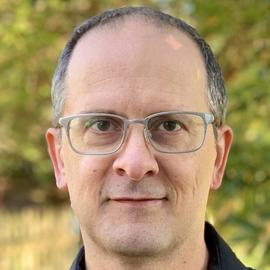
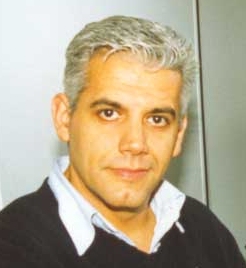
Dr. Andrew King is an Associate Professor in Biosciences at Swansea University's Faculty of Science and Engineering, leading the SHOALgroup. His research focuses on animal social behavior, collective decision-making, and socioecology, with applied themes in conservation and human-wildlife interactions. He has held fellowships and visiting roles globally and is an experienced journal editor. Recognized for teaching excellence, he has developed acclaimed postgraduate programs and leads the Faculty's Equality, Diversity, and Inclusion initiatives. His work bridges ecology, robotics, and leadership, with a strong presence in media and corporate workshops. Research interests include primate behavior, collective animal movement, and the application of technology in ecology. Key projects involve studying baboon urban adaptation, dairy calf behavior, and biohybrid robotics. Over 150 scientific publications span topics like group coordination, stress physiology, and conservation strategies. Notable awards include the University Excellence in Teaching Award and Fellow of the Higher Education Academy. Supervised PhD topics include collective behavior, cortisol coregulation in animals, and primate natal coat function. Active in public engagement, he contributes to science festivals, media outlets, and corporate leadership workshops.
Professor Jon Kerridge is a distinguished academic at the School of Computing, Edinburgh Napier University, where he has made significant contributions to parallel programming, software systems, and database applications. With a career spanning several decades, he has published extensively in the field of computer science and has supervised numerous PhD students. BSc, MSc, PhD Fellow of the British Computer Society (FBCS) Chartered IT Professional (CITP) Fellow of the Higher Education Academy (FHEA) Chartered Engineer (CEng) Professor Kerridge's research primarily focuses on parallel programming models, particularly through his work on the Groovy Parallel Patterns Library and Communicating Sequential Processes (CSP). His research spans multiple domains including software engineering, database systems, and interdisciplinary work in neuroscience related to dyslexia. He has also made significant contributions to pedestrian movement modeling and evolutionary algorithms. His publications demonstrate a consistent focus on practical software engineering solutions for parallel and distributed systems. The research trajectory shows progression from foundational work in computer architecture education in the 1980s through database systems in the 1990s-2000s to modern parallel programming frameworks. His interdisciplinary work connecting computer science with visual processing in dyslexia represents an innovative application of computational approaches to neuroscience problems. Fellow of the British Computer Society (FBCS) Chartered IT Professional (CITP) Fellow of the Higher Education Academy (FHEA) Chartered Engineer (CEng) Professor Kerridge has supervised several PhD students to completion, including Kevin Chalmers (Investigating communicating sequential processes for Java to support ubiquitous computing) and Robert Kukla (A software framework for the microscopic modelling of pedestrian movement). His research has been supported by Edinburgh Napier University funding, with applications ranging from healthcare systems to pedestrian flow optimization. He is a key member of the Centre for Algorithms, Visualisation and Evolving Systems at Edinburgh Napier University, where his work continues to influence both theoretical and applied aspects of computing.
Tim Triche, Jr., Ph.D., is an Associate Professor at the Van Andel Institute in the Department of Epigenetics . He earned his A.B. in chemistry from Cornell University , followed by an M.S. in biostatistics and a Ph.D. in statistical genetics from the University of Southern California . Before joining Van Andel in 2017, he was a postdoctoral fellow at USC's Norris Comprehensive Cancer Center focusing on cellular senescence in blood disorders. As a key member of The Cancer Genome Atlas Research Network since 2011 with over a dozen high-impact publications in Nature , Cell , and NEJM , Dr. Triche specializes in epigenetics , biostatistics , and computational biology . His lab develops innovative approaches for pediatric AML research, integrating next-generation sequencing with clinical trial design to improve patient outcomes. His work emphasizes statistical learning for patient stratification, molecular profiling of hematological cancers, and interpretable machine learning in biomedical contexts. He leads the Bioinformatics and Biostatistics Core as faculty advisor and maintains active collaborations across institutions. 2025 Nature Cancer study on developmental heterogeneity in cancer susceptibility 2024 NAR methods paper on BISCUIT multi-omics tools 2023 PLOS One validation of MAX regulation in pituitary adenomas 2022 Nature Metabolism obesity subtyping analysis Scientific contributions include: Chan Zuckerberg Initiative grant (2022) for biomedical computing NCI SPORE grant (2021) as co-recipient Key role in Pediatric AML molecular mapping (2017)
Marco Pizzolato is an Associate Professor in the Department of Applied Mathematics and Computer Science at the Technical University of Denmark (DTU), specializing in Visual Computing with a focus on Magnetic Resonance Imaging (MRI), particularly diffusion MRI and biophysical modeling. He is also affiliated with the inter-departmental Microstructure & Plasticity (MAP) research group and has held visiting positions at the University of Verona, EPFL, and DRCMR. His educational background includes a PhD in Signal and Image Processing from INRIA Sophia Antipolis, a Master’s in Bioengineering from the University of Padua, and a Bachelor’s in Biomedical Engineering from the same institution. He previously served as an Assistant Professor at DTU and was a postdoctoral researcher under the Marie Curie COFUND Eurotech programme. Dr. Pizzolato's research centers on image and signal denoising, inverse problems, optimization, diffusion MRI, tractography, and Monte Carlo simulations. He actively contributes to the development of microstructural models for brain imaging, with applications in neurodegenerative diseases and brain connectivity. His work aligns with UN Sustainable Development Goals, particularly in advancing education and health through imaging technology. The recent publications reflect a strong trend in advancing diffusion MRI techniques, including ACID imaging, microscopic propagator modeling, myelin integrity mapping, and multi-scale white matter organization. These works emphasize biophysical accuracy, model validation, and integration across imaging modalities and species. Magna Cum Laude , ISMRM 2020 Magna Cum Laude , ISMRM 2022 First Place , Macaque Validation Challenge at ISBI 2018 First Place (Overall and HCP) , IronTrack Challenge 2019 (MICCAI) MICCAI Student Travel Award 2015 He has supervised PhD students such as Thøgersen, T. L. and Corral Bolaños, M. in projects related to microstructure MR imaging and myelin mapping. He has also been involved in significant grants and collaborative projects, including the Multimodal Microstructure-Informed Connectivity (MMINCARAV) initiative between Inria and EPFL, and the Sinergia consortium for Brain Communication Pathways . He co-organized multiple international events, including the MICCAI CDMRI workshops and challenges (2019–2021), and the ESMRMB Leaps in Microstructure Imaging workshop (2024). Dr. Pizzolato is an active member of the scientific community, serving as an editor for MICCAI workshop proceedings, a reviewer for major journals and conferences, and an invited speaker at ISMRM 2025. He leads and participates in several ongoing research projects at DTU focused on quantitative imaging, myelin mapping, and MRI-based connectivity, demonstrating sustained research leadership and external funding success.
Matthew Lewis is an Associate Professor in the Department of Design at The Ohio State University with joint appointments in the Advanced Computing Center for the Arts and Design (ACCAD) and Translational Data Analytics Institute (TDAI). His research explores the intersection of emerging technologies, computer graphics, and generative design, with applications in visualization, digital art, and interactive tools. Education: PhD, Computer and Information Science, The Ohio State University, 2001 MS, Computer and Information Science, The Ohio State University, 1993 BSE, Computer Science Engineering & BA, Philosophy, University of Pennsylvania, 1991 His work focuses on developing procedural animation, virtual environments, and augmented reality applications. Key projects include digital humanities prototyping, neighborhood disorder visualization using VR, and silent film reconstruction through AR technology. Teaching: Courses include Graduate Design Studio, Procedural Animation, and Programming Concepts for Artists. His pedagogical approach emphasizes collaborative and technology-integrated studio learning.
Raquel Dias is an Assistant Professor in the Department of Microbiology & Cell Science at the University of Florida. Her research focuses on integrating computational biology, genomics, and machine learning to address challenges in agriculture, microbial ecology, and human health. Key areas include genomic sequence analysis, protein structure-function relationships, and the application of AI in clinical diagnostics. Education details are not explicitly provided in the text, but her publications suggest advanced training in computational biology, bioinformatics, and microbiology. Her work spans diverse topics such as soil microbiome dynamics in agricultural systems, genetic risk prediction for hearing disorders, and developing novel machine learning models for genotype imputation. Research interests emphasize interdisciplinary approaches, including: Machine learning applications in genomics and proteomics Microbial community analysis in environmental and clinical contexts Development of predictive models for disease progression and genetic associations Her recent publications highlight trends in AI-driven genomic analyses, polygenic risk scoring, and the functional characterization of uncharacterized proteins. Notable projects include the STICI and InteracTor tools for genomic and protein analysis. No scientific awards or grants are explicitly listed in the provided text. She maintains an active lab focused on computational biology and microbial genomics, collaborating with institutions in Brazil and the U.S. on projects related to crop improvement, soil health, and human health informatics.
Professor Palle Dahlstedt is affiliated with the University of Gothenburg's Interaction Design department. His work bridges music technology, live coding, and interdisciplinary performance. He specializes in gestural interactions, algorithmic creativity, and systems for collaborative improvisation. Key projects include the Bucket System, OtoKin, and research on live coding frameworks. Research interests focus on creative technologies in music and performance, with emphasis on real-time systems, human-computer interaction, and artistic collaboration. Dahlstedt has published extensively in venues like NIME, ICLC, and Evolutionary Intelligence, addressing topics ranging from hybrid piano design to generative storytelling. Notable contributions include the Biosphere Code Manifesto (2015), exploring algorithms in environmental contexts, and the Electroacoustic Modular Ecosystem (2020). His work often involves cross-disciplinary collaborations with dancers, musicians, and technologists. Performance highlights include jury-selected NIME performances (2015) and collaborations with artists like Gino Robair and Tim Perkis. Dahlstedt actively participates in international festivals and conferences, advancing the field of computational creativity and artistic research.
Dr. Torsten Reiners is a Senior Lecturer at Curtin University's School of Management and Marketing, part of the Faculty of Business and Law. His research focuses on Supply Chain Management, Operations Optimization, Emerging Technologies (IoT, Mixed Reality), and Decision Support Systems. He holds a PhD in Information Systems/Education and has expertise in programming and development related to virtual reality and IoT. Key research areas include end-to-end supply chain transparency, urban logistics, cyber-physical systems, and gamification in training. His work bridges Computer Science and Business, with over 50 publications in journals like International Journal of Production Economics and Australasian Journal of Information Systems . He has led projects funded by OLT grants and industry partnerships, including the nDiVE VR training environment for Logistics education. Reiners' contributions span gamification design, virtual world pedagogy, and sustainable supply chain analytics. His current projects explore IoT adoption impacts and agricultural logistics optimization. He advises on digital ecosystems, geospatial analytics, and mental health systems in pandemic contexts.
Dr. Mike Katchabaw is an Associate Professor in the Department of Computer Science at The University of Western Ontario. His research focuses on game design and development, including adaptive game systems, believable agents, algorithmic music composition, and networked game optimization. He holds a Ph.D. from Western (2002) and has been with the department since 2002. Teaching responsibilities include courses on open-source projects, software maintenance, game development, and game design. He is affiliated with the Digital Recreation, Entertainment, Art, and Media (DREAM) Group. Key research areas include psychosocial behavior modeling in NPCs, automated difficulty adjustment, and latency management in multiplayer games. Publications span over 30 refereed journal/conference papers, book chapters, and technical reports. Notable achievements include the Best Paper Award at GameOn 2011 and a patent for a flexible music composition engine. He has contributed to commercial games like 'To The Moon' and 'Animal Planet Vet Life' as a consultant/lead programmer.
Dr. Zia Ush Shamszaman is a Senior Lecturer in Computer Science at Teesside University's School of Computing, Engineering & Digital Technologies (SCEDT). He holds a PhD in Computer Science from the University of Galway and a Master's from Hankuk University of Foreign Studies. His research focuses on Cybersecurity, AI Ethics, IoT Resilience, and Game Theory applications, with a strong emphasis on bridging academic research with industry applications. Teaching responsibilities include postgraduate modules on AI Ethics, Cyber Risk Management, and Ethical Hacking, alongside undergraduate courses in Secure Data Acquisition and Ethical Hacking. He actively supervises five PhD students in cybersecurity and AI, advocating for inclusive technology education and societal impact. Professional memberships include IEEE (Senior Member), Elsevier Advisory Panel, and W3C. He has organized conferences like the International Conference on Suitable Technologies 4.0 and served on program committees for major events. Recognized for exceptional peer reviewing, he has received awards from leading journals like the Journal of Network and Computer Applications and Future Generation Computer Systems. Current projects funded by Innovate UK include CyberPathway (diversity in cybersecurity education), SafeSCMS (AI-driven supply chain security), and Opera-CyberThemis (trustworthy AI frameworks). Past industry roles include technical leadership in Bangladesh's government projects like the Machine Readable Passport system and World Bank-funded Bangladesh Automated Clearing House initiative. Shamszaman's work spans industry collaborations, academic leadership, and community engagement, with recent media contributions on GenAI governance and cyber resilience strategies. His research integrates theoretical advancements with practical solutions for SMEs, healthcare systems, and underserved communities.
Terry Soule is a Professor in the Department of Computer Science at the University of Idaho, College of Engineering. He holds a Ph.D. in Computer Science from the University of Idaho (1998), an M.S. in Physics from Washington State University (1994), and a B.A. in Physics from Reed College (1991). His research focuses on Artificial Intelligence and Evolutionary Computation, with courses taught including Theory of Computation and Evolutionary Algorithms. His work bridges computational thinking and applied problem-solving in areas like evolutionary video game design. No awards or student advisees are listed in the provided text.
Dr. Vahid Rafe is Lecturer and co-program lead for Computer Science at Goldsmiths, University of London. His research focuses on search-based software engineering and blockchain technology, with additional expertise in formal verification and model transformation. Research integrates artificial intelligence with software engineering practices including automated testing techniques, bug localization, and formal verification. Recent work applies machine learning to software quality assurance, combinatorial testing optimization, and blockchain security analysis. Publications demonstrate consistent innovation in AI-enhanced software engineering methods, particularly hybrid algorithms for test generation and deep learning approaches for software maintenance. Recent work addresses security vulnerabilities in cryptographic systems.
Katherine St. John is a Professor of Computer Science at Hunter College, CUNY. She holds doctoral faculty appointments in Anthropology and Computer Science at the CUNY Graduate Center. She is also a Research Associate at the American Museum of Natural History. Her research focuses on computational biology, phylogenetic tree analysis, algorithms for tree structures, and their applications in evolutionary biology. She earned her PhD from UCLA, MA from Johns Hopkins University, and AB from Smith College. Research Interests : Phylogenetic Tree Reconstruction Geometric Analysis of Treespace Algorithms for Tree Comparison Hierarchical Character Analysis Evolutionary Algorithms Grants & Awards : Recipient of multiple NSF grants (e.g., CCF-1813575, IIS-1116921) and a Simons Foundation Collaboration Grant (2014-2022). Supported by the CUNY RecoveryCorps and Hunter College faculty development programs. Teaching & Service : Course coordinator for introductory programming courses Directed the CUNY RecoveryCorps Research Experience for Undergraduates (2021) Associate Academic Director of BridgeUp: STEM at AMNH (2015-2017) Labs & Teams : Leads the Treespace Research Group, collaborating with institutions like the American Museum of Natural History and NYCEP. Active in organizing workshops on phylogenetics and data science education.
Sahar Validi serves as Senior Lecturer and Deputy Head of the Strategy, Operations and Entrepreneurship (SOE) group at Essex Business School, University of Essex since June 2024, following her role as Associate Director of Education from October 2023 to June 2024. She joined the institution in October 2022 after eight years at the University of Huddersfield. Her academic credentials include: PhD in Management Science (Dublin City University) Master's in Industrial Management-Operational Research Postgraduate Certificate in Higher Education Bachelor's in Business Management Validi's research bridges Operational Research and Supply Chain Management with a critical focus on sustainability-driven digital transformation. Her work integrates evolutionary algorithms, AI, and multi-criteria decision analysis to develop low-carbon logistics systems and intelligent decision support frameworks. She emphasizes real-world impact through industry collaboration, particularly in supply chain risk management and net-zero transition strategies. Analysis of her 15 most recent publications reveals a dominant trajectory toward AI-enhanced sustainable supply chain design, with 73% of works since 2018 focusing on carbon reduction, circular economy integration, and resilience engineering. Her research increasingly combines metaheuristic optimization with real-time data analytics for dynamic decision support in complex logistics networks. Validi has secured over £2 million in research funding through competitive grants: AI for Net Zero (UKRI, 2023, PI) Management KTP for ERP Implementation (Innovate UK, 2022, PI) Cloud-Based Supply Chain Control Tower (Huddersfield, 2021, PI) Net Zero Innovation Programme (UCL, 2022, PI) Multiple Innovate UK Knowledge Transfer Partnerships She maintains active industry partnerships with Local Enterprise Partnerships, SMEs, and manufacturing firms including Wealmoor Limited and Swann Engineering Group, driving knowledge transfer in digital transformation and sustainable operations.
Raffaele Calabretta is an Associate Professor of Psychology of Communication at the International Telematic University UniNettuno and a Permanent Researcher at the Italian National Research Council's Institute of Cognitive Sciences and Technologies. He holds a Ph.D. in Computer Science from Stanford University (2012). His interdisciplinary research spans evolutionary modularity in artificial neural networks, intra-party democratic innovations, and cognitive modeling. Dr. Calabretta developed 'doparies'—a post-election participatory mechanism for political parties that combines deliberation and voting to enhance citizen engagement. In artificial life, he has modeled how modularity evolves in neural networks to solve complex tasks. He authored the science-in-fiction novel 'Il film delle emozioni' (2006) and 'Doparie, dopo le primarie' (2010) on democratic innovations.