Gwenda van der Vaart is a researcher at the University of Groningen, Faculty of Spatial Sciences, focusing on community development, arts & culture, and creative research methods. Her work aligns with UN Sustainable Development Goals, particularly SDG 11 (Sustainable Cities and Communities) and SDG 13 (Climate Action) . She has contributed to projects like the Campus Eemsdelta initiative and the SUSPLACE program on sustainable place-shaping. Research Themes : Community resilience, participatory planning, arts-based methods, rural transitions, and place identity. Collaborations : Active in Dutch research networks, with expertise in rural communities (Groningen, Limburg, Friesland) and coastal regions. Supervision : Co-supervisor for PhD research on art and democracy, and involved in multiple thesis committees. Activities : Keynote contributor at the RTLG Webinar on rural transitions, speaker at YAG Mini Lectures, and participant in knowledge-sharing events like Kenniscafé Jouw Groningen. Her publications blend geography, urban planning, and social sciences, emphasizing community engagement and cultural participation in shaping sustainable futures.
Dr. Tobias Lausch is a researcher in the Department of Physics at RPTU Kaiserslautern-Landau, affiliated with the research group led by Professor Artur Widera. His work focuses on quantum physics, atomic physics, and ultracold gases, with significant contributions to quantum dynamics, impurity interactions, and Bose-Einstein condensates. He collaborates with colleagues like Quentin Bouton, Felix Schmidt, and Michael Fleischhauer, producing high-impact publications in journals such as Physical Review X and Nature Physics . Research Interests: Quantum spin dynamics in ultracold systems Single-atom manipulation and thermometry Impurity interactions in Bose-Einstein condensates Non-equilibrium quantum processes Molecular rotational cooling in quantum gases Contact: Email: lausch@uni-kl.de Office: Room 46-405 Phone: +49 (0)631 205-3024
Kyle Madden serves as a Research Fellow at Ulster University within the School of Computing, Engineering and Intelligent Systems at the Derry~Londonderry campus. His work bridges theoretical computer science with industrial applications, focusing on intelligent systems development for manufacturing and IoT environments. Education: PhD in Computer Science (awarded June 2025) from Ulster University with thesis: “Spiking neural networks for detecting denial-of-service attacks in networks-on-chip” supervised by Dr. Jim Harkin and Dr. Liam Mc Daid. Dr. Madden’s research spans cutting-edge domains in neuromorphic engineering and industrial IoT. He pioneers frameworks for translating spiking neural networks to FPGA hardware while optimizing power efficiency, develops cloud-based IoT systems for industrial decision-making, and applies computational intelligence to 3D printing quality control. His work integrates user experience considerations in smart manufacturing interfaces and advances event-based sensor data processing through neuromorphic event alarm systems. Recent publications (2024-2025) reveal strong thematic focus on deploying AI solutions in real-world industrial contexts. Key trends include hardware acceleration of neural networks for manufacturing, cloud-IoT integration using AWS infrastructure, and human-centered design for industrial IoT applications. His research consistently addresses practical implementation challenges in sensor data processing and neural network deployment. Scientific Awards: No awards documented in available information Dr. Madden has no listed advisees in the provided materials. His research outputs indicate collaborative project involvement, particularly in EU-funded industrial IoT initiatives and neuromorphic computing consortia, though specific grant details aren’t disclosed. Current work appears integrated within Ulster University’s Computer Science research group focusing on intelligent systems. He actively contributes to research teams developing neuromorphic event-based processing systems and industrial IoT frameworks. Recent work on FrostRune demonstrates leadership in creating asymmetric translational pipelines from high-level neural models to FPGA deployment, positioning him within hardware-aware AI research communities.
Daniel Contreras is an Associate Professor in the Department of Anthropology at the University of Florida, within the College of Liberal Arts and Sciences. His work bridges anthropological geoarchaeology with computational approaches to understanding human-environment interactions across diverse landscapes and time periods. Dr. Contreras received his PhD in Anthropological Sciences from Stanford University in 2007, an MA in Latin American Studies from Stanford University in 1998, and a BA in Religion with a Certificate in Latin American Studies from Amherst College in 1996. His research focuses on anthropogenic components of dynamic landscapes and environmental change, with field-based and modeling projects spanning Peru, Utah, Jordan, France, and Greece. Contreras examines landscape change and its relationship to long-term human occupation, investigating how humans have both adapted to and caused environmental changes over millennia. His work integrates archaeological and geomorphic data to improve reconstruction of past population dynamics while accounting for landscape taphonomy. His recent publications reveal a strong emphasis on methodological innovations in radiocarbon dating, landscape taphonomy, and the integration of geospatial technologies with archaeological inquiry. Contreras frequently applies Bayesian modeling to radiocarbon data to address chronological questions in Andean archaeology, particularly concerning the Chavín Phenomenon. His work also explores the relationship between past climate and prehistoric Mediterranean agriculture using process-based dynamic vegetation models. Dr. Contreras leads or contributes to multiple international research projects including CHEAP (Chavín Human-Environment Project), SNAP (Stelida Naxos Archaeological Project), SCA (Scaling the Central Andes), GB14C, PIACCH, and RAPT. These projects investigate landscape taphonomy, paleoclimate data downscaling, communal action problems at Chavín de Huántar, and pastoral archaeology in Tanzania. He has developed innovative approaches to archaeological data analysis, including the QuARI R Shiny Database Interface for lithic analysis and applications of Google Earth Engine for archaeological remote sensing. His teaching includes courses on R for archaeological data analysis and visualization, emphasizing statistical methods and data architecture for archaeological research.
Amit Ashok is a Professor of Optical Sciences at The University of Arizona's Wyant College of Optical Sciences and an Assistant Professor in the Department of Electrical and Computer Engineering. His research focuses on computational sensing and quantum-inspired imaging. Education: Ph.D. (2008), University of Arizona; M.S. (2001), University of Cape Town; B.Sc. (1998), University of Swaziland Professional Affiliations: Senior Member of The Optical Society (OSA), Member of IEEE, SPIE Senior Member His research leverages physical optics, machine learning, and information theory to design optical imagers and sensors. Key areas include inverse problems, compressive imaging, and quantum-limited resolution. The Intelligent Imaging and Sensing Lab (I2SL), led by Professor Ashok, develops computational sensing frameworks using reconfigurable optics and parallel computing architectures for applications in high-dimensional imaging and X-ray anomaly detection. Scientific Awards: SPIE Best Paper Award (2010), University of Cape Town Scholarships (1999, 2000), University of Swaziland Dean's, Vice-Chancellor, and Sino-Swazi awards (1995-1998)
Vita Kraft is a Research Fellow at the Institute of German Philology , University of Würzburg, focusing on German linguistics and language variation. Since 2021, she has contributed to empirical studies on revising speech activity and grammatical variation, with her dissertation work titled "Revidierende Sprachtätigkeit kompetenter Sprecher. Eine empirische Untersuchung". PhD in German Linguistics (ongoing, based on dissertation theme) M.A. in German as a Foreign Language (University of Würzburg, 2020) Magister in Philology (German/English, Kyiv National Linguistic University, 2008) Master in International Financial Management (Kyiv National Hetman Vyhovsky University, 2011) Her research explores revision mechanisms in language, dialectal variation, and digital humanities applications through projects like the Würzburg Dialect Database . She teaches courses on German language structure, orthography, and variation, and contributes to the organization of academic events like the "Was prägt die deutsche Sprache" conference. Scientific Recognition Eberhard Schöck Scholarship
Dr. Peter Butcherine serves as a Research Fellow at the National Marine Science Centre within Southern Cross University's Faculty of Science and Engineering. His interdisciplinary work bridges ecotoxicology, oceanography, and marine biology to address critical challenges in coastal and reef ecosystems. His educational background includes: Bachelor of Environmental Science (BEnvSc) from Southern Cross University Bachelor of Science with Honors (BSc(Hons)) from Southern Cross University PhD from Southern Cross University Butcherine's research employs integrated field and laboratory methodologies to investigate ecosystem responses to anthropogenic stressors. He pioneers the use of airborne remote sensing for monitoring solar radiation management interventions and coral stress dynamics, developing predictive models for bleaching events. His work spans pesticide ecotoxicology in crustaceans, climate change impacts on marine species nutrition, and atmospheric studies supporting reef conservation. Analysis of his 2020-2024 publications reveals three dominant research trajectories: 1) Coral bleaching mitigation through shading and nutritional interventions; 2) Ecotoxicological impacts of neonicotinoids on commercially important crustaceans; and 3) Atmospheric interactions relevant to marine cloud brightening for Great Barrier Reef protection. These studies consistently address climate adaptation in marine systems. His scientific recognition includes: University Medal from Southern Cross University (2018) Butcherine actively supervises research students through Southern Cross University's higher degree programs and contributes to the Reef Restoration and Adaptation Program. While specific grant details aren't documented, his work aligns with national initiatives for reef resilience. He maintains collaborative networks through the National Marine Science Centre and participates in interdisciplinary marine conservation efforts. Based at the National Marine Science Centre in Coffs Harbour, he leads field campaigns and remote sensing operations focused on real-time ecosystem monitoring and intervention assessment for reef management.
Marine Gouezo is a Postdoctoral Coral Researcher at the Faculty of Science and Engineering, Southern Cross University, Australia, contributing to the Reef Restoration and Adaptation Program for the Great Barrier Reef. Her work focuses on coral larval supply and recruitment dynamics to advance reef restoration science. Her academic credentials include: Bachelor of Marine Studies from the University of Queensland Master in Marine Conservation from Victoria University of Wellington PhD from Southern Cross University Gouezo investigates how environmental gradients and biophysical attributes influence coral reef recovery processes, particularly larval dispersal, recruitment, and community reassembly. Her multidisciplinary approach integrates field ecology with hydrodynamic modeling to develop context-specific restoration strategies for climate-threatened reefs. Analysis of her 2020-2025 publications reveals a dominant focus on larval dispersal modeling and recruitment monitoring, leveraging partnerships with CSIRO to refine hydrodynamic simulations. Her research bridges field sites in the Great Barrier Reef and Palau, emphasizing scalable restoration techniques and cryptic recruitment mechanisms. She collaborates with CSIRO Oceans and Atmosphere on larval transport modeling and pioneers high-resolution benthic monitoring methods. While no current students are documented, Gouezo welcomes research supervision opportunities in marine ecology. Her work is funded by the Reef Restoration and Adaptation Program, targeting ecological restoration at submillimeter scales.
Bryant Chow is an Assistant Professor of Seismology at the University of Alaska Fairbanks, affiliated with the Geophysical Institute and Department of Geosciences. His research spans multiple areas of seismology, with particular focus on adjoint tomography, planetary seismology (especially Venus), cryoseismology, and nuclear treaty monitoring. Chow's research interests include using seismic waves to understand Earth structure, characterize unique seismic sources, and develop open-source software for seismic research. He has developed several Python packages including SeisFlows, Pyatoa, PySEP, and Pyflex that facilitate seismic data analysis and adjoint tomography workflows. His work often involves field deployments, particularly in Alaska, and he maintains active collaborations with NASA on planetary seismology projects. His recent publications reveal a strong focus on adjoint tomography applications across various regions including New Zealand, Alaska, and Japan, with particular emphasis on subduction zone imaging. He has also made significant contributions to computational seismology through open-source software development and educational workshops. Chow actively mentors graduate students, including Bella Seppi (PhD student working on Venus seismology) and Kitsel Lusted (MSc student working on cryoseismology with relevance to treaty monitoring). He is committed to science outreach, conducting public talks and art-science collaborations, such as those with Klara Maisch featured at the Mather Library First Friday event. His educational efforts include developing and hosting workshops such as the SPECFEM Users Workshop 2022, which taught up to 180 participants about seismic simulations using Docker containers and Jupyter notebooks. He also teaches graduate and undergraduate courses on geophysics and seismology at the University of Alaska Fairbanks. Chow describes himself as a 'computational seismologist who likes to go outside,' reflecting his dual focus on computational work and field deployments. His research has led to the development of the New Zealand Adjoint TOMography model (NZ_ATOM), a 3D velocity model of the North Island of New Zealand derived using earthquake-based adjoint tomography.
Professor Andreas Hotho leads the Data Science Chair at the University of Würzburg's Faculty of Mathematics and Computer Science, while serving as founding spokesman of the Center for Artificial Intelligence and Data Science (CAIDAS). His academic journey includes senior researcher roles at the University of Kassel and research positions at the AIFB Institute (University of Karlsruhe) and L3S Research Center (Hannover). Research Focus: Machine Learning, Large Language Models, Climate Modeling, Semantic Web, and Knowledge Graphs Methodologies: ConvMOS architecture, DenseLoss approach, LanZ-DML, and BibSonomy system Applications: Environmental monitoring, Digital Humanities, Smart Beehive Analysis, and Social Media Analytics With over 15 recent publications, his work spans climate model output statistics, zero-shot metric learning, imbalanced regression techniques, and German language model development. He serves as editor-in-chief for the Transactions on Graph Data and Knowledge and maintains active roles in academic governance through PC memberships at ECML-PKDD, WWW, and other major conferences. Scientific awards include: NAACL 2024 Best Paper Honorable Mention ICDM 2023 Best Paper Award NeurIPS 2020 Best ML Innovation Award ISWC 2018 SWSA Ten-Year Award WWW 2015 Best Paper Award FAIML 2020 Best Student Paper His research group includes doctoral researchers like Jan Pfister, Julia Wunderle, and Albin Zehe. Key projects include LitBERT for literary analysis, BigData@Geo series for climate modeling, and BeeConnected for ecosystem monitoring.
Alexandra Branzan-Albu is a Professor in the Department of Electrical and Computer Engineering at the University of Victoria, BC, Canada. Her work spans research, teaching, and service in computer vision, image processing, and machine learning, with applications in healthcare, marine monitoring, and document analysis. Research Interests: Her research is centered on computer vision and artificial intelligence, with a focus on pattern recognition from image and video data. She addresses societal challenges such as environmental monitoring, medical diagnostics, and big data analysis. Key areas include motion analysis, medical imaging, underwater vision, and document image understanding. Her work combines theoretical depth with practical applications. Recent Research Trends: Her recent publications (2022–2024) highlight a strong focus on underwater imaging, including fish and krill detection in echograms using U-Net variants, anomaly detection in non-stationary image streams, and enhancement of underwater visuals. She also explores document image retrieval, handwritten annotation classification, and biomedical applications like heart valve durability analysis. These works reflect a blend of deep learning, attention mechanisms, and domain-specific adaptation. Scientific Awards: NSERC University Faculty Award (2003–2006) Advising and Grants: She has supervised numerous students and collaborators, evident from asterisked co-authors on recent publications. Her research is supported by competitive grants, including an NSERC Discovery Grant on real-time event detection, FQRNT funding for medical imaging, and participation in team grants from CFI, PRECARN, and FQRNT. Her projects involve collaborations with ASL Environmental Sciences, Ocean Networks Canada, and industry partners like Quirklogic and VIVITRO Labs. Labs and Teams: She is affiliated with the Computer Vision and Systems Laboratory at UVic, contributing to a collaborative environment for innovation in visual computing and AI applications.
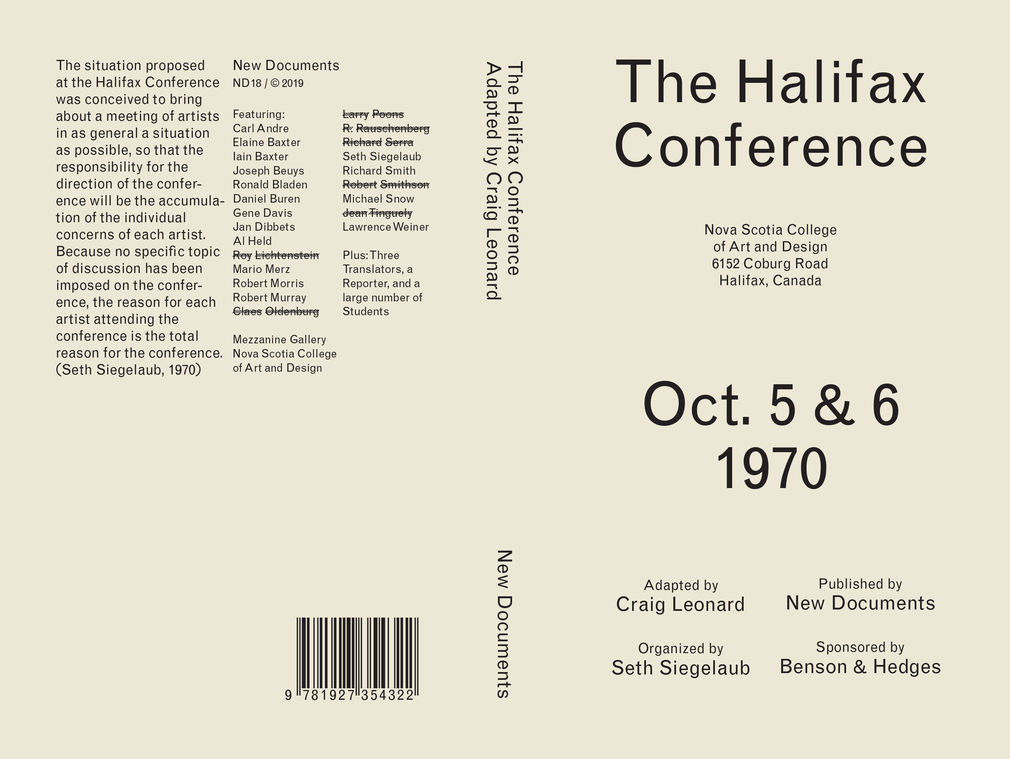
Craig Leonard is a Professor at NSCAD University in Halifax, Canada, with strong affiliations to the School of Art at HfG Offenbach (University of Art and Design Offenbach), Germany. His work bridges academic scholarship and artistic practice, focusing on aesthetics, critical theory, and conceptual art. His research centers on aesthetics after Marcuse , exploring anti-art, surrealism, institutional critique, and the political dimensions of artistic expression. He investigates how art defamiliarizes everyday experience and challenges neoliberal rationality, drawing on Adorno, Bakhtin, and Breton. Leonard’s recent publications and installations reflect a deep engagement with language, materiality, and performance . His 2022 book Uncommon Sense: Aesthetics after Marcuse (MIT Press) is a key contribution, synthesizing decades of research. His artistic output includes solo and group exhibitions internationally, sound works, and curated projects such as the Halifax Conference and NoiSeCAD . His artistic and scholarly trends reveal a sustained inquiry into the boundaries of meaning, the role of ambiguity, and the political potential of aesthetic form , often using experimental formats like artist books, sound, and performative installations. International Residency Grant, Canada Council for the Arts (2012) Long-list for Sobey Art Award (Atlantic Region, 2008) Chalmers Art Fellowship, Ontario Arts Council (2005) Grant for Emerging Media Artist, Ontario Arts Council (2007) Academic Fellowship, University of Toronto (2004) David Buller Memorial Scholarship, University of Toronto (2004) Leonard has curated numerous projects and received significant grants supporting his research and residencies. He has been involved in artist-run initiatives and collaborative sound projects, including Catbag and HHH. His work is supported by major Canadian arts funding bodies, indicating sustained recognition. He is affiliated with NSCAD University and has exhibited and resided at institutions such as MASS MoCA, Acme Studios (London), and Raid Projects (LA) . He has also curated events like Velcro Gallery and Tone Deaf , contributing to experimental music and artist-run culture.
Dr Stuart Middleton is an Associate Professor at the University of Southampton, affiliated with the School of Electronics and Computer Science within the Faculty of Engineering and Physical Sciences. He is a member of the Agents, Interaction and Complexity research group, the Centre for Machine Intelligence, and the Centre for Democratic Futures. His research focuses on Natural Language Processing (NLP), particularly information extraction and human-in-the-loop NLP, with applications in law enforcement, defence, mental health, and environmental science. His research interests include Natural Language Processing , Information Extraction , Human-in-the-loop NLP , Active Learning , Adversarial Training , Rationale-based Learning , and Argument Mining . He specializes in scenarios with limited or fragmented data, developing methods for few/zero-shot learning, graph-based models, and multimodal analysis. His work spans domains such as mental health, digital ethics (e.g., sharenting), defence, and climate science. The recent publications highlight a strong trend in applying NLP to societal challenges, including mental health monitoring through social media, ethical AI, multimodal argumentation in political debates, and climate data analysis. His work combines technical innovation in prompt engineering, summarization, and graph-based modeling with real-world impact. AI for defence: readiness, resilience and mental health (2024) Extraction and summarization of suicidal ideation evidence (2024) Sharenting and social media properties (2024) Implementing responsible innovation (2024) ConversationMoC: mood change detection (2024) Dr Middleton is actively involved in PhD supervision and academic leadership as Deputy Director of the UKRI MINDS Centre for Doctoral Training. He supervises multiple PhD students working on NLP and AI projects. He has secured research funding from ESRC and EPSRC for projects such as ProTecThem2.0 , SafeSpacesNLP , and GloSAT . He leads the Natural Language Processing modules COMP3225 (UG) and COMP6253 (PG) and mentors students in NLP research. He is a Fellow of The Alan Turing Institute and a member of the EPSRC peer review college, contributing to national research strategy and evaluation. His research is conducted within interdisciplinary teams, including collaborations with criminologists, social scientists, and environmental researchers. He is part of the Agents, Interaction and Complexity group and contributes to the Centre for Machine Intelligence and Centre for Democratic Futures , focusing on AI systems that interact meaningfully with humans and society.
Saining Xie is an Assistant Professor of Computer Science at NYU Courant Institute of Mathematical Sciences and affiliated with the NYU Center for Data Science. He leads the CILVR research group and teaches courses including Computer Vision, Machine Learning, and Learning with Large Language and Vision Models at the graduate level. His educational background includes a Ph.D. and M.S. from UC San Diego's CSE Department under Zhuowen Tu's supervision, and a bachelor's degree from Shanghai Jiao Tong University. During his doctoral studies, he interned at NEC Labs, Adobe, Facebook, Google, and DeepMind. Dr. Xie's research focuses on advancing robust visual intelligence through scalable and reliable systems that interpret visual events and develop common sense understanding of the world. His work spans computer vision, machine learning, representation learning, and multimodal systems, with particular emphasis on developing architectures that bridge vision and language understanding. His publications demonstrate significant contributions to vision-language models, diffusion models, convolutional neural networks, and 3D scene understanding, with numerous papers appearing at top conferences including NeurIPS, CVPR, and ICCV, often receiving recognition as oral or spotlight presentations. Oral Presentation at NeurIPS 2024 Oral Presentation at CVPR 2024 Spotlight Presentation at ICLR 2023 Oral Presentation at ICCV 2023 Best Paper Nomination at CVPR 2020 Dr. Xie actively mentors PhD students including Ellis Brown, Fred Lu, Xichen Pan, Peter Tong, and others. He has organized major tutorials at CVPR and ECCV on Visual Recognition for Images, Video, and 3D, and his research has practical applications in visual grounding, multimodal reasoning, and robust AI systems. His lab maintains strong connections with industry research labs including FAIR, where he previously worked as a research scientist.
Professor Gareth Phoenix is based at the School of Biosciences, University of Sheffield . His research focuses on plant-environment interactions in Arctic, boreal, and upland ecosystems, with particular emphasis on climate change impacts (warming, extreme events, snow regime change, precipitation), UV-B radiation , and pollution . He investigates effects on biodiversity , carbon-nitrogen-phosphorus cycling , and climate feedbacks , while extending his work to sustainable agriculture and green roof technologies . Academic Affiliation : Professor of Plant and Global Change Ecology Research Themes : Arctic browning/greening, nutrient cycling, plant stress physiology, permafrost dynamics Research Interests span from fundamental Arctic ecosystem responses to climate change to applied urban horticulture sustainability . His team examines plant-microbe nutrient competition , extreme winter warming effects , and greenhouse gas fluxes in tundra systems. Recent work includes carbon-nitrogen-phosphorus stoichiometry and remote sensing of Arctic vegetation . Professional roles include NERC Training Advisory Board membership , Global Change Biology editorial board , and leadership in CAPER (Committee on Air Pollution Effects Research) . Teaching spans ecosystem dynamics , Arctic plant adaptations , and field-based ecological research in Abisko. Current research groups involve Murk Memon (Arctic browning), Kassandra Reuss-Schmidt (Arctic greenhouse gas emissions), and Chris Taylor (grassland carbon-nutrient interactions).