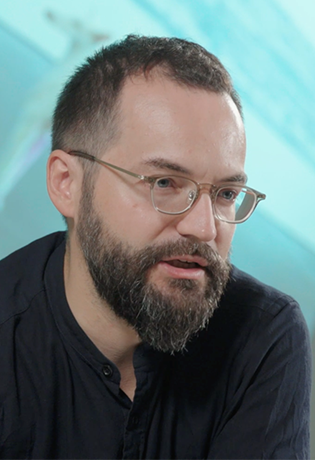
Dr. Damien Charrieras is an Associate Professor at the School of Creative Media , City University of Hong Kong, where he serves as Program Leader for the Master of Art in Creative Media and deputy program leader for the PhD in Creative Media. His work bridges cultural studies, new media theory, and the intersection of financial technologies with artistic practices through the ACIM Laboratory for Interventions in Speculative Finance . Doctoral research on digital artists' trajectories in Montreal FRQSC Postdoctoral Fellowship at McGill University Research spans game engine design , datafication of creativity , blockchain in art , and post-anthropocentric creative processes . With over HK$3.14M in grants as Principal Investigator, he explores situated digital creativity in urban contexts, critical worldbuilding pedagogy , and the mediation of technical systems in cultural production. His publications in Cities , Organized Sound , and Human Relations analyze the reconfiguration of artistic practices through software infrastructures and automation paradigms. Scientific awards include: FRQSC Postdoctoral Fellowship
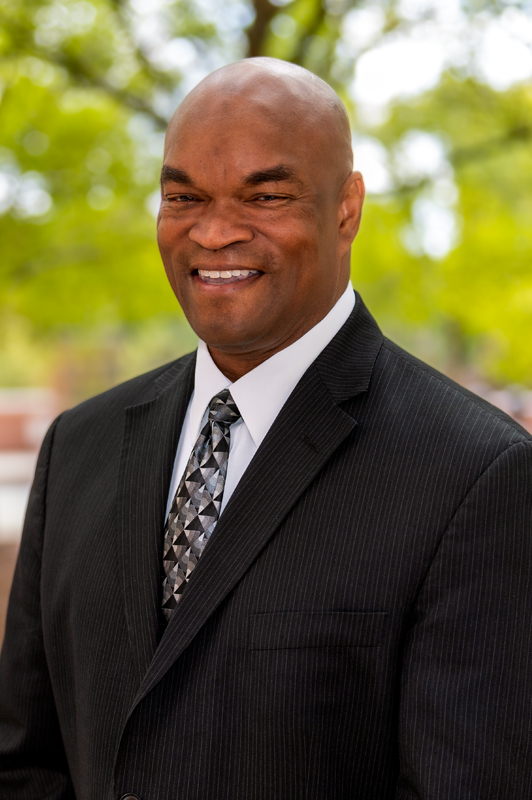
Stephen Sher is an Assistant Professor of Computer Science and Software Engineering at Rose-Hulman Institute of Technology. His research focuses on applying ethnographic methods to Human-Computer Interaction (HCI) and Computer-Supported Cooperative Work (CSCW), with particular interest in gaming communities and computer science education. He co-authored a seminal 2019 paper examining the social dynamics of video game charity marathons like Games Done Quick, which raised millions for charity through live-streamed events. Dr. Sher earned his Ph.D. in Informatics from Indiana University Bloomington, specializing in HCI Design, and holds degrees in computer engineering and computer science from the University of Southern California. His teaching spans computer architecture, software requirements engineering, and human-centered computing. He directs the Ethnography Research Group at Rose-Hulman, exploring how collaborative practices in gaming and livestreaming communities can inform interactive technology design. His work bridges academic research with real-world applications in digital communities and charitable fundraising.
Jim Thatcher is an Assistant Professor at the College of Earth, Ocean, and Atmospheric Sciences (CEOAS) at Oregon State University. He serves as editor of Cartographic Perspectives , a leading journal in cartography. His research focuses on the intersection of technology, society, and environment, particularly examining how data and spatial technologies operate within capitalist systems. Key areas include Critical GIS, Critical Cartography, and Digital Political Ecology. Thatcher's current projects explore equitable coastal flood risk modeling using topological data analysis, mapping infrastructural legacies of slavery in the Pacific Northwest, and creating accessible disaster response maps for non-English speakers in Oregon. He also investigates spectral governance for rural internet access, cartography's societal role, climate education through board games, and geographic influences on electoral districting. His research emphasizes critical approaches to spatial data, questioning representational practices and power dynamics embedded in geospatial technologies. Recent work includes analyzing Bitcoin mining's environmental impacts on hydropower systems and examining the World Bank's renewable energy mapping through Critical Data Studies. Thatcher actively mentors graduate students and encourages interdisciplinary inquiries blending critical social theory with computational methods. Thatcher has authored numerous articles and co-authored Data Power (Pluto Press, 2022), an open-access exploration of data's role in societal control and resistance. His scholarship bridges critical geography with emerging technologies, advocating for ethical and equitable spatial practices in an increasingly data-driven world.
Morgan G. Ames is an Assistant Adjunct Professor at the UC Berkeley School of Information and serves as Associate Director of Research for the Center for Science, Technology, Medicine & Society. She chairs the Designated Emphasis in Science and Technology Studies and is affiliated with multiple research centers including the Algorithmic Fairness and Opacity Working Group, the Center for Science, Technology, Society and Policy, and the Berkeley Institute of Data Science. Her educational background includes a Ph.D. in Communication with a minor in Anthropology from Stanford University (2013), an M.S. in Information Management and Systems from UC Berkeley (2006), and a B.A. in Computer Science from UC Berkeley (2004). Prior to her academic career, she worked as a researcher at Google, Yahoo!, Nokia, and Intel. Ames researches the ideological origins of inequality in the technology world, with a focus on utopianism, childhood, and learning. Her work critically examines how technology design practices shape identities and social structures. Current projects include 'Seeing Like a Valley: the Moral Visions of Silicon Valley,' 'Algorithms in Culture,' and 'Countercultures of Technology Use.' She has published extensively on One Laptop per Child, Minecraft, and the social implications of algorithmic systems. Her publication record shows a consistent focus on the cultural dimensions of technology, particularly examining how utopian visions shape technology design and implementation. Recent work increasingly addresses algorithmic systems and their cultural impacts, while maintaining her longstanding interest in educational technology and youth technology practices. Ames has received significant recognition for her scholarship, including: 2020 Best Information Science Book Award 2020 Sally Hacker Prize 2021 Computer History Museum Prize She advises students on interpretive research methods, particularly ethnography, and serves on doctoral committees though cannot be a primary advisor for PhD students. Her research has been supported by multiple interdisciplinary collaborations, including the 'Algorithms in Culture' conference series she co-organized through the Center for Science, Technology, Medicine & Society. Ames leads the 'Seeing Like a Valley' research collective that brings together scholars from across UC Berkeley and Silicon Valley to examine how the region's industrial practices shape moral visions that influence global technological development and social values.
Gerry Dozier is the Charles D. McCrary Eminent Chair Professor in the Department of Computer Science and Software Engineering at Auburn University's College of Engineering. His research focuses on artificial intelligence, computational intelligence, cybersecurity, identity science, and cyber identity protection. He leads initiatives like the Center for Artificial Intelligence and Cybersecurity Engineering and contributes to Alabama's AI policy through the state commission. Dr. Dozier holds a Ph.D. from North Carolina State University and has pioneered work in adversarial machine learning, biometric security, and low-resource language NLP. Education: Ph.D. Computer Science, North Carolina State University (Raleigh) M.S. Computer Science, North Carolina State University (Raleigh) B.S. Computer Science, Northeastern Illinois University Research Themes: Combines AI with cybersecurity to address modern digital challenges. Specializes in adversarial attacks/defenses, biometric authentication systems, and ethical NLP applications in multilingual contexts. Active in developing tools for sentiment analysis in underrepresented languages and mitigating biases in automated systems. Impact: Spearheaded Auburn's AI@AU initiative with lecture series and forums. Collaborates internationally on facial recognition, malware detection, and medical AI applications like bacterial vaginosis diagnosis. His work bridges theoretical CS advancements with real-world security and ethical considerations. Labs/Teams: Directs Auburn's AI & Cybersecurity Engineering Center and contributes to interdisciplinary groups like the McCrary Institute for Cyber and Critical Infrastructure Security.
Etienne Ollion is a Professor of Sociology at École Polytechnique and a Research Director at the Centre national de la recherche scientifique (CNRS). He maintains dual appointments that position him at the intersection of traditional political sociology and emerging computational methods. His academic work spans both French and international institutions, with teaching invitations at ENS-Paris, Berkeley, University of Chicago, Sciences Po Paris, and other leading universities worldwide. His research program focuses on two interconnected domains: the sociology of politics and power, and computational social sciences. Ollion's work examines political professionalization, parliamentary dynamics, and the transformation of political fields, particularly through his ethnographic study of the 2017 French National Assembly documented in his book The Candidates: Amateurs and Professionals in Politics (Oxford University Press, 2024). Simultaneously, he pioneers methodological innovations applying machine learning and natural language processing to social science research. Ollion's recent publications reveal a trajectory increasingly focused on the intersection of AI and social science methodology, with numerous 2024-2025 publications addressing LLM applications, text annotation, and the ethical considerations of proprietary AI systems in research. His work demonstrates how computational methods can enhance traditional social science approaches while maintaining critical awareness of technological limitations. As an academic leader, Ollion directs the Computational Social Sciences initiative at the IPP and has developed educational resources including online courses and the aweSOM software for data analysis. He regularly organizes summer schools (SICSS-Paris) and workshops to disseminate computational methods across the social sciences. Ollion serves on the editorial board of Actes de la recherche en sciences sociales and maintains an active public presence through media appearances, including a notable interview on France Inter about AI and Social Sciences in September 2024. His upcoming book talk at The Seminary Co-op in Chicago on March 7, 2025 further demonstrates his active engagement with the international academic community.
Dr. Jeffrey Morgan is a Researcher at Cardiff University's School of Social Sciences, specializing in multidisciplinary research at the intersection of computer science, social science, and geography. His work emphasizes human-computer interaction, visualization, and big data analytics. He holds a Research Software Engineer role, combining technical expertise with academic inquiry. Key research interests include AI-driven patent analysis, IoT applications in rural citizen science, and geospatial Twitter demographics. He has contributed to studies on Hadoop infrastructure optimization and social media conflict detection, often collaborating with institutions like Xiamen University and the University of Bremen. His publications span topics like energy-efficient big data processing, digital geography of Welsh identity, and scalable social media analysis frameworks. Notable projects include COSMOS (a cloud-based social media analysis platform) and studies on post-devolution cultural narratives in Wales. Award-winning work includes computational Twitter analysis for detecting online community tensions and geotagging behavior patterns. His research often bridges technical innovation with societal impact, addressing challenges in rural technology deployment and digital sociology.
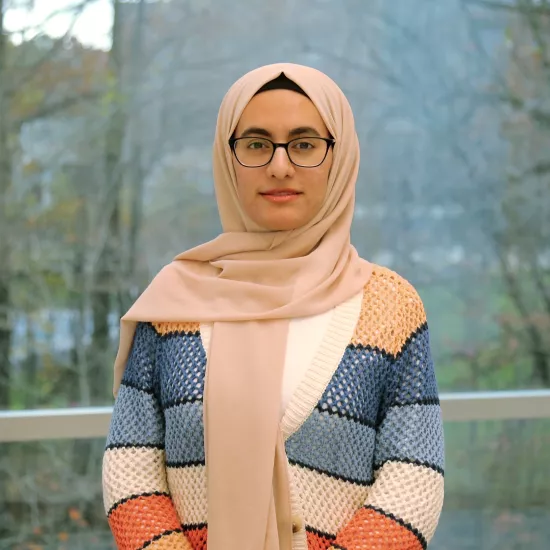
Samar Sabie is an Assistant Professor at the Institute of Communication, Culture, Information and Technology (ICCIT) at the University of Toronto, where she also serves as Program Director for the Technology, Coding, and Society (TCS) program. She holds a graduate appointment at the Daniels Faculty of Architecture, Design, and Landscape, reflecting her interdisciplinary work bridging technology, design, and social justice. She leads the Open Design Collaboratory, a research space focused on critical and community-centered design practices. Education: Doctor of Philosophy, Department of Information Science, Cornell University/Cornell Tech, 2022 Master of Science, Department of Computer Science, University of Toronto, 2017 Master of Architecture, John H. Daniels Faculty of Architecture, Landscape, and Design, University of Toronto, 2015 Honors Bachelor of Science (Architecture and Computer Science), University of Toronto, 2011 Her research investigates design as a socio-material practice that fosters community adaptive capacity toward sustainable change. Drawing from architecture, software engineering, ethnography, and philosophy, she explores participatory design , unmaking , and design for social justice . Her work critically engages with how communities resist, adapt, and reimagine technology in contexts of displacement, scarcity, and inequality. Her recent publications, appearing in top venues like CHI , CSCW , and DIS , reveal a strong thematic focus on unmaking as a design strategy for emancipation and agonism, mobility justice , e-waste practices , and cultural memory through design. These works collectively emphasize community agency, ethical ambiguity, and the political dimensions of design. Scientific Contributions: Director, Open Design Collaboratory Program Director, Technology, Coding, and Society (TCS) Graduate Faculty, Daniels Faculty of Architecture, Design, and Landscape Current Courses: CCT204 Design Thinking I, CCT477 Understanding Users Samar Sabie actively mentors students and collaborates on research focused on humanitarian technology, critical making, and design education. Her projects often involve community engagement, participatory methods, and interdisciplinary teams. She has collaborated with and advised early-career researchers such as Dina Sabie, Awais Hameed Khan, and Taneea Agrawal on topics ranging from IDP shelter dynamics to mobility justice advocacy. Her research is supported by her deep engagement with socio-technical challenges in marginalized contexts, and she continues to push the boundaries of how design can serve as a tool for equity, care, and resistance. Future work appears to be evolving toward deeper philosophical inquiries into destruction, care, and the limits of technology.
Pablo Aragón is a Research Scientist at the Wikimedia Foundation and an Adjunct Professor at Universitat Pompeu Fabra. His work bridges computational social science, civic technology, and technopolitics, with a focus on Wikipedia's governance, digital democracy tools, and participatory systems. He co-founded the Democratic Innovation Lab in Barcelona and the DatAnalysis15M research network. Key research interests include analyzing knowledge integrity in Wikipedia, configuring digital participatory budgeting systems, and studying platform effects in civic technologies. He has led projects like DECODE (decentralized citizen engagement) and contributed to platforms like Decidim, which empower participatory democracy in cities like Barcelona. Recent conference engagements include KDD 2024 (data mining), ICWSM 2024 (social media analysis), and Wikimedia CEE Meeting 2024. His work emphasizes cross-cultural collaboration, with studies published in ACM Transactions on Computer-Human Interaction and peer-reviewed conferences like CIKM and ACM SIGKDD. Professional affiliations include the Decidim association, Amnistía Internacional España, and the open knowledge advocacy group Civio. His research often intersects with open science, free culture movements, and gender equity in urban mobility.
Pernille Bjørn is a Professor in Computer Supported Cooperative Work (CSCW) at the Department of Computer Science , University of Copenhagen (DIKU), where she has been since May 2015. Her research investigates collaborative work practices to design cooperative technologies, focusing on domains like healthcare, global software development, startup companies, and digital fabrication. Faculty of Science, University of Copenhagen Human-Centred Computing Section Research Interests : Bjørn’s work spans CSCW , Human-Computer Interaction , and Digital Fabrication , with applications in healthcare systems, cross-cultural software development, and inclusive technology design. She explores collaborative virtual reality training, FemTech, and crisis computing. ACM Distinguished Member (2024) Publications : Published in top venues like ACM Transactions on Computer-Human Interaction , CSCW , and CHI , her recent work examines hybrid work asymmetry, neurodiverse accessibility, and art-driven collaborative research.
Eamonn Bell is an Assistant Professor in the Department of Computer Science at Durham University, with affiliations to the Institute of Advanced Study. His research focuses on digital humanities, applying computational methods to musicology and examining the history of digital technology in music production. He leads projects like CCP-AHC and DISKAH to enhance digital infrastructure for arts researchers. Previously, he was a postdoctoral Research Fellow at Trinity College Dublin, studying the cultural impact of the Compact Disc. He holds a PhD in Music Theory from Columbia University (2019) and a joint degree in Music and Mathematics from Trinity College Dublin (2013). His educational background includes advanced studies in music theory, digital humanities, and mathematics. He teaches courses on algorithms, software engineering, and music processing within Durham’s Computer Science curriculum. Supervision includes postgraduate students focusing on music technology and computational analysis. Research interests span digital musicology, the history of technology, and accessibility of computational tools for non-specialists. Awards include the Government of Ireland Postdoctoral Fellowship (2019–2021). His work addresses ethical issues in genetic studies of musicality and explores emerging digital tools for music analysis, such as time-coded YouTube comments and CD data extraction techniques. Key initiatives include designing DRI projects for UK-based researchers and advancing digital skills through collaborative frameworks. He actively participates in academic conferences and has published widely on topics ranging from media archaeology to interdisciplinary computational research.
Nigel Bosch is an Assistant Professor in the School of Information Sciences (iSchool) at the University of Illinois Urbana-Champaign, with a joint appointment in the Department of Educational Psychology. He is also a faculty affiliate at the National Center for Supercomputing Applications (NCSA) and Illinois Informatics. His primary research focuses on machine learning and human-computer interaction applications in education, with particular emphasis on affective computing, metacognition, and online learning environments. Bosch holds a PhD in Computer Science from the University of Notre Dame, followed by a postdoctoral research position at the National Center for Supercomputing Applications. His research explores machine learning applications in education, including automatic emotion measurement in programming education, metacognition analysis through natural language processing, and ethical implications of AI in learning. He also investigates wearable technologies for health monitoring and algorithmic bias mitigation in educational data. Bosch’s work is supported by grants from the National Science Foundation (NSF), the Institute of Education Sciences (IES), and the University of Illinois. He leads the (Human + Machine) Learning lab, which develops innovative technologies for educational analytics, AI ethics, and human-centered computing.
Professor Dr. Johannes Ismaiel-Wendt is a faculty member at the Institute for Music and Musicology , part of the University of Hildesheim ’s School of Cultural Studies & Aesthetic Communication. He earned a doctorate in cultural studies, sociology, and musicology from the University of Bremen (supervised by Prof. Dr. Sabine Bröck and Prof. Dr. Alexander Weheliye) with his dissertation tracks'n'treks. Popular Music and Postcolonial Analysis (2011). Ismaiel-Wendt is a certified educator, known for blending research with live drum machine performances and sound lectures. From 2012 to 2018, he served as Junior Professor for Systematic Musicology and Music Sociology before being appointed University Professor in 2018.
Steffen Becker is a Professor at the University of Stuttgart's Faculty of Computer Science, Electrical Engineering and Information Technology, affiliated with the Institute for Software Engineering's Software Quality and Architecture group. His work focuses on software engineering, cloud systems, model-driven engineering, and cybersecurity. He leads research in architectural modeling tools like Slingshot, GUI testing frameworks (ViMoTest), and hardware security analysis. Recent studies explore AI integration in testing, education, and automotive systems (CARISMA). Research interests include elasticity modeling, self-adaptive systems, and educational technology. His 2025 publications address issues like end-user hardware comprehension, FPGA security, and LLM-driven test generation. Notable tools developed include the Slingshot Simulator for cloud-native systems and Gropius for cross-component issue management. Becker contributes to both theoretical advancements and practical implementations in software quality, security, and cloud infrastructure. Key Areas: Software Architecture, Cyber-Physical Systems, Testing, Reverse Engineering Tool Developments: ViMoTest, Slingshot, Gropius Education Focus: Online programming pedagogy and curriculum innovation His work bridges foundational research with industry applications, addressing challenges in automotive computing, cloud elasticity, and human-centric security awareness. Recent efforts emphasize explainable hardware (XHW) and AI's role in qualitative analysis automation.
Paul Théberge is a Professor at Carleton University, cross-appointed to the Institute for Comparative Studies in Literature, Art and Culture and the School for Studies in Art and Culture (Music). He teaches graduate courses in Cultural Mediations (technologies of culture), Film Studies (sound in visual media), and Music (sound studies), reflecting his interdisciplinary academic home within Ottawa's major research institution. His research interrogates the material and cultural dimensions of sound technologies, with core expertise in music-technology-culture intersections, internet-mediated musical practices, and sonic applications in film/television. Théberge's scholarship bridges musicology, media studies, and science and technology studies, examining how recording technologies reshape creative practice and auditory experience across historical periods from analog tape to digital streaming platforms. Analysis of his 15 most recent publications reveals persistent engagement with sound's materiality—from multichannel audio histories to the embodied nature of listening—and consistent exploration of technological transitions, particularly the internet's disruption of traditional music production/distribution models. His work demonstrates deep methodological versatility spanning archival research, ethnographic observation, and creative composition. Scientific recognition includes: International Association for the Study of Popular Music (US branch, 1998) Society for Ethnomusicology (2000) While the source text doesn't specify current advising activities, his extensive editorial work (e.g., co-editing Living Stereo ) and composition output suggest significant mentorship through collaborative projects. His research has been supported through Canada Research Chair funding and industry partnerships like Sony Classical International.