Sewon Min is an Assistant Professor at UC Berkeley's Electrical Engineering and Computer Sciences (EECS) department and a research scientist at the Allen Institute for AI. Her research focuses on Natural Language Processing (NLP) and Machine Learning, particularly Large Language Models (LLMs), emphasizing data-centric approaches and ethical AI practices. She holds a Ph.D. from the University of Washington (2024) and a B.S. from Seoul National University (2018). Her work includes advancements in retrieval-based models, mixture-of-experts architectures, and data privacy in LLMs. Notable projects include FlexOlmo (flexible data use in LLMs) and OLMoE (open mixture-of-experts models). She has been recognized with the ACM Doctoral Dissertation Award Honorable Mention (2025) and WAGS/ProQuest Innovation in Technology Award. Recent articles highlight her contributions to reasoning models, data tracing (OLMoTrace), and scalable retrieval systems (MassiveDS). She leads the Berkeley NLP Group and collaborates with BAIR, exploring topics like model transparency and ethical data usage.
Dominic Thibault is an Assistant Professor at the Faculty of Music, Université de Montréal . His research-creation explores human-machine interaction in musical contexts, focusing on embodied cognition through electroacoustic compositions, audiovisual performances, and musical software development. Co-director, Laboratoire Formes·Ondes Active member, CIRMMT (Centre for Interdisciplinary Research in Music Media and Technology) Research axis leader, Expanded Musical Practice (CIRMMT) Member, Québecor Millénium entrepreneurship committee Scientific committee member, ACFAS
Dr. Changyou Chen is an Associate Professor in the Department of Computer Science and Engineering at the University at Buffalo, State University of New York. His research focuses on Multi-Modal Learning Foundation Models Deep Generative Models Large-scale Bayesian Sampling with applications in document understanding, music-AI integration, and molecular representation learning. Research Trends revealed through his recent publications include Optimizing Multimodal Large Language Models Developing Novel Retrieval-Augmented Generation Frameworks Creating Benchmark Datasets for Visual Text Understanding Advancing Diffusion Models with Domain-Specific Constraints across domains from music sheets to biomedical documents. Scientific Contributions : UB Young Investigator Award (2020) Architect of LoCAL Framework for Long Document Understanding Co-developer of MusiXQA Benchmark Pioneering Work in Probability Contrastive Learning Academic Leadership includes mentoring 10+ graduate students and serving as Area Chair for major AI conferences (ICML, NeurIPS, AAAI, IJCAI). His Labs develop scalable solutions for multimodal reasoning, with recent work demonstrating practical GPU memory optimization through LoRA adapter sharing.
Prof. Dr. Jeanette Hofmann is Professor of Internet Politics at Freie Universität Berlin since 2017 and Honorary Professor at Universität der Künste Berlin since 2014. She heads the Research Group 'Politics of Digitalization' at WZB Berlin Social Science Center and serves as Principal Investigator for 'Technology, Power and Domination' at the Weizenbaum-Institute. Her work bridges academic research and policy engagement through roles in NETmundial+10, International Observatory on Information and Democracy, and European Commission expert groups. Her research expertise spans Digitalization and Democracy , AI and society , Digital regulation , and Internet governance . Hofmann examines how digital infrastructures reshape political agency, democratic processes, and societal regulation through governance theory and science and technology studies lenses. Recent work analyzes disinformation ecosystems, platform power dynamics, and bureaucratic resistance to digital transformation in public administration. Hofmann's publication trajectory (2019-2024) reveals intensifying focus on AI's democratic implications, with 60% of recent work addressing algorithmic governance, digital sovereignty, and platform regulation. Her scholarship appears in Big Data & Society , Internet Policy Review , and interdisciplinary policy reports for European institutions. Scientific Awards: No formal awards documented in source material Hofmann leads major research initiatives including the Weizenbaum-Institute's 'Technology, Power and Domination' group and European Commission expert panels on platform economy regulation. Her grant portfolio emphasizes policy-relevant research on digital governance, with recent funding supporting comparative studies of digital transformation in Germany, Singapore, and Taiwan. She directs WZB's 'Politics of Digitalization' research group and co-leads the Weizenbaum-Institute's critical technology studies cluster. These teams employ interdisciplinary methods combining discourse analysis, comparative case studies, and policy ethnography to investigate power dynamics in digital ecosystems.
Daniel B. Szyld is a Professor in the Department of Mathematics at Temple University's College of Science and Technology. He is co-Director of the High-Performance Computing for Scientific Applications Professional Science Master’s program and a member of the Center for Computational Mathematics and Modeling. He holds leadership roles as President of the International Linear Algebra Society (ILAS, 2020–2026) and as a Board of Trustees member at ICERM (2024–2028), and previously served as Vice-President of SIAM (2014–2015). His research interests include Numerical Analysis , Scientific Computing , Numerical Linear Algebra , Iterative Methods , Preconditioning , Domain Decomposition , and High-Performance Computing . His work often focuses on Krylov subspace methods like GMRES, block solvers, and asynchronous algorithms, with applications in large-scale scientific simulations. The 15 most recent publications reflect a strong focus on enhancing the stability, convergence, and performance of iterative solvers, especially GMRES variants and domain decomposition methods. Topics include random sketching, deflation, weighted norms, multisketching in QR factorization, and asynchronous Schwarz methods. These works appear in top journals such as SIAM Journal on Matrix Analysis and Applications , Numerische Mathematik , and Electronic Transactions on Numerical Analysis , often in collaboration with leading researchers in the field. Scientific Awards and Recognitions: Commemorative medal, Charles University of Prague, 1997 Featured in Hall of Fame by Henk van der Vorst, SARA, 2010 Dean's Distinguished Award for Excellence in Research, Temple University, 2011 Fellow, American Mathematical Society, 2017 Fellow, Society for Industrial and Applied Mathematics, 2017 Achievement in Mathematics Award, Temple University, 2018 Faculty Senate Outstanding Service Award, Temple University, 2021 Daniel B. Szyld has served on the editorial boards of numerous prestigious journals, including Mathematics of Computation , Linear Algebra and its Applications , Numerical Linear Algebra with Applications , and was Co-Editor-in-Chief of Electronic Transactions on Numerical Analysis (2005–2013) and Editor-in-Chief of SIAM Journal on Matrix Analysis and Applications (2015–2020). His research has been supported by the National Science Foundation and the Department of Energy. He has advised students and postdocs, though specific names are not listed in the provided text. He is also involved in professional service through societies such as SIAM, AMS, ILAS, and NAM, and advocates for equity and ethical engagement in mathematics. Labs and Research Groups: He is a member of the Center for Computational Mathematics and Modeling at Temple University and co-Director of the High-Performance Computing for Scientific Applications Professional Science Master’s program, indicating active leadership in computational research and training.
Nazli Cila is a researcher at the Faculty of Industrial Design Engineering (IDE) at Delft University of Technology, specializing in Human-Centered Design and Human-Technology Relations. Her work lies at the intersection of design, artificial intelligence, and robotics, with a strong emphasis on ethical and human-centered approaches. Her research focuses on Human-AI collaboration , Responsible AI , and More-than-human design , exploring how intelligent systems can be designed to align with human values and lived experiences. She investigates design methods for AI and robotics, particularly in contexts such as mental health, smart homes, and agricultural automation. Nazli Cila’s recent publications reveal a strong trend toward integrating ethical considerations and aesthetic experience into AI systems, especially in diagnostic tools and human-robot ecologies. Her work often employs speculative and participatory methods to uncover value conflicts and envision alternative futures for technology. Involved in research projects: AI DeMoS Lab, DCODE Network Teaches course: Research to/for/through… She actively contributes to the academic community through publications and interdisciplinary collaborations, advancing the field of human-centered design in the age of AI.
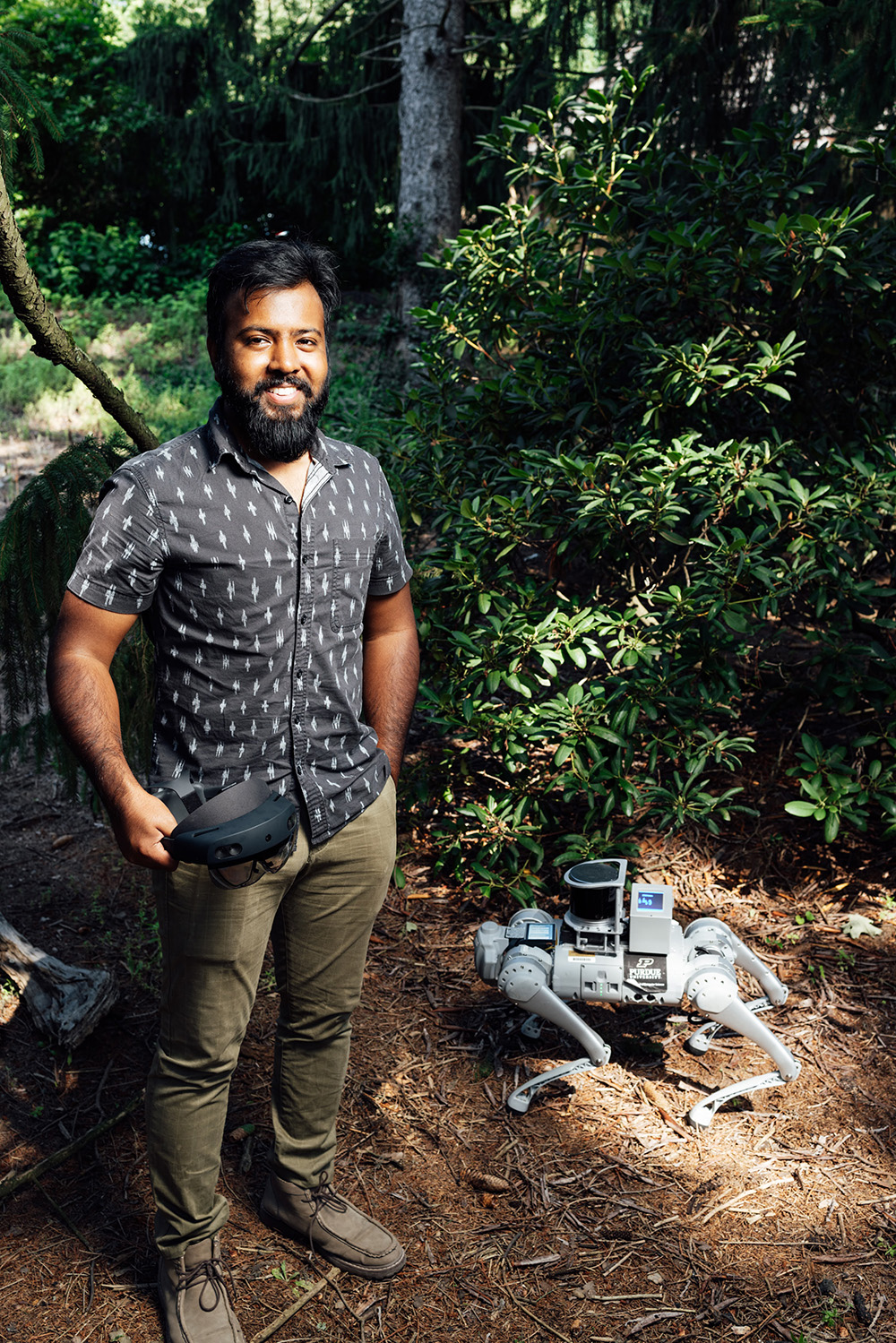
Dr. Aniket Bera is an Associate Professor in Computer Science at Purdue University and holds an Adjunct Associate Professor role at the University of Maryland at College Park (UMIACS). He directs the IDEAS Lab at Purdue and previously served as a Research Assistant Professor at UNC Chapel Hill. His research focuses on Affective Computing, Computer Graphics (AR/VR), AI & Robotics, Social Robotics, and medical AI applications for mental health diagnostics. Affiliations: Purdue University (Primary), University of Maryland (Adjunct), UMIACS Career: Joined Purdue in 2017, extensive industry collaborations with Disney Research, Intel, and C-DAC Research Interests: Affective Computing: Emotion perception via gait analysis, speech, and facial/body expressions AR/VR: Redirected walking, virtual environments, and human motion modeling Medical AI: AI-driven mental health detection systems (e.g., VidSole dataset) in collaboration with medical schools Key Contributions: Developed Project Dost (mental health initiative) Received 2020 Brain & Behavior Seed Grant ($X) for emotion-gait research Authored 65+ papers (1,800+ citations) with awards at IEEE VR 2021 Funding & Leadership: Serves as Senior Editor for IEEE RA-L (Planning/Simulation) Conference Chair for ACM SIGGRAPH MIG 2022 Labs/Teams: IDEAS Lab (Purdue), UMD GAMMA Group
Dr. Matthew Jones is a Senior Lecturer in Criminology at Swinburne University of Technology’s School of Social Sciences, Media, Film and Education. With a career spanning institutions in the UK and Australia, Matthew’s research bridges interdisciplinary domains including policing, sociology, law, and organizational studies. He is a Senior Fellow of the Higher Education Academy, emphasizing evidence-informed pedagogy and curriculum innovation. Affiliation: Swinburne University of Technology (2022–Present) Previous Roles: The Open University (2017–2022), Northumbria University (2014–2017), Cardiff Metropolitan University (2013–2014). Research Themes: Matthew’s work focuses on three core areas: Policing: Police visibility, digital strategies, occupational culture, diversity, and leadership. LGBTQI+ Criminology: Workplace discrimination, hate crimes, community-police relations, and victimology. Digital Criminology: Technology’s role in policing, crime prevention, and digital victim support systems. Publications: His 15 most recent articles highlight evolving trends in digital policing, police visibility, academic standards in policing education, and LGBTQI+ workplace experiences. These works span qualitative studies, policy analysis, and interdisciplinary collaborations, reflecting his commitment to visual criminology and semiotics. Scientific Awards: Senior Fellow of the Higher Education Academy (2022) Fellow of the Higher Education Academy (2013) Professional Activities: Matthew served as Chair (2019–2022) and Board Member (2013–2019) of the British Society of Criminology’s Policing Network. He led curriculum development for police apprenticeships (2017–2019) and contributed to the first UK Subject Benchmark Statement for Policing (2022). He supervises PhD students on topics like community policing, child maltreatment resilience, and crime drama narratives. Education: He holds an LLB in Law, an MSc in Social Science Research Methods, a PhD in Socio-Legal Studies, a PGCert in Higher Education pedagogy, and an MBA in Leadership Practice.
Mark d'Inverno is a Professor in the Department of Computing at Goldsmiths, University of London, where he has established himself as a leading researcher at the intersection of artificial intelligence, multi-agent systems, and creative applications. His academic journey began with foundational work in formal methods and agent-based systems, culminating in his 1998 PhD thesis 'Agents, Agency and Autonomy: A Formal Computational Model' from University College London, and has evolved toward practical applications in music technology and ethical AI systems. Professor d'Inverno's research interests span multiple interconnected domains, with a particular focus on computational creativity, multi-agent systems, and the application of AI in musical contexts. His work explores how artificial intelligence can enhance creative processes, particularly in music composition and performance, while maintaining ethical considerations in social AI systems. He has made significant contributions to understanding how agents can interact meaningfully in social contexts, how ethical frameworks can be embedded in online systems, and how technology can support creative learning experiences. His recent scholarly output demonstrates a clear trajectory toward applied research with social impact, as evidenced by his 2021-2024 publications which increasingly address ethical considerations in AI, human-AI collaboration in creative domains, and educational applications of technology. These works reveal a researcher deeply engaged with both theoretical foundations and practical implementations, bridging the gap between abstract computational models and real-world creative and educational applications. Professor d'Inverno maintains an extensive collaborative network, frequently working with Matthew Yee-King on music technology applications, with Pablo Noriega on ethical AI frameworks, and with Jon McCormack on computational creativity. His research has been supported through various projects that connect theoretical computer science with practical creative applications, particularly in the development of systems that facilitate human-AI creative collaboration.
Jim Torresen is a Professor at the Norwegian University of Science and Technology (NTNU), specializing in Computer Science, Artificial Intelligence, and Robotics. He earned his M.Sc. and Dr.ing. (Ph.D.) in computer architecture and design from NTNU in 1991 and 1996 respectively, followed by industry experience in hardware design before transitioning to academia in 1999. Research Interests: His work spans Machine Learning, Evolvable Hardware, and Ethical AI, with notable contributions to music technology, facial expression recognition, and healthcare monitoring systems. He actively explores interdisciplinary applications of AI in creative domains and clinical environments. Publications & Editorial Roles: Torresen has published extensively in journals like Frontiers in Artificial Intelligence and Genetic Programming and Evolvable Machines . He serves as a Topic Editor for Frontiers in Explainable AI and has editorial roles in robotics and biomedical AI domains.
Kathleen M. Carley is a full professor at Carnegie Mellon University's School of Computer Science with courtesy appointments in Engineering and Public Policy, Heinz School, and Electrical and Computer Engineering. As director of the Center for Computational Analysis of Social and Organizational Systems (CASOS) and the Center for Informed Democracy and Social-Cybersecurity (IDeaS) , she leads interdisciplinary research at the intersection of network science, cognitive modeling, and cybersecurity. Ph.D. in Sociology from Harvard University SB degrees in Economics and Political Science from MIT Her research focuses on Dynamic Network Analysis (DNA) and Social-Cybersecurity (SC) , developing tools like ORA (network analysis), AutoMap (semantic mining), Construct (influence simulation), and BotHunter (bot detection). She has over 400 publications and 15+ active research projects addressing disinformation, cognitive security, and organizational resilience. Recent work examines LLM-powered bots , multi-platform misinformation dynamics , and public health analytics . As an IEEE Fellow, she contributes to standards in computational social science while teaching courses on network analysis and complex socio-technical systems.
Nicholas Ng-A-Fook is a Full Professor in the Faculty of Education at the University of Ottawa, where he has served as former Associate Dean of Graduate Studies and Director of Teacher Education and Indigenous Teacher Education Programs. His work is deeply engaged with the Truth and Reconciliation Commission's 94 Calls to Action, working in partnership with Indigenous communities and school boards to disrupt colonialism, systemic racisms, and inequalities in educational curricula. Dr. Ng-A-Fook's educational background includes a Ph.D. in Curriculum and Instruction from Louisiana State University (2006), an M.A. in Education (Multicultural Education) from York University (2001), a Graduate Diploma in Education (Secondary Science and History) from the University of Western Sydney (1998), and a B.A. in Classical Studies from the University of Ottawa (1996). His research interests span Curriculum Studies, History of Education (particularly oral history), Life-writing research (autobiography and narrative inquiry), Critical Youth Studies (focusing on first-generation immigrant and Indigenous youth), Community-based research, and Contemporary perspectives in philosophy, science and technology including AI, genomic education, and anti-racist science education. Dr. Ng-A-Fook approaches his work as a curriculum theorist who draws on life writing research methodologies to co-create culturally responsive, relevant, and relational curriculum with educators. Dr. Ng-A-Fook's publications reveal a strong focus on reconciliation education, decolonizing curriculum, and addressing systemic racism in educational contexts. His work increasingly engages with digital technologies and artificial intelligence from a critical, decolonial perspective, examining how these technologies intersect with historical and ongoing colonial structures. His research shows a clear evolution toward more interdisciplinary work connecting curriculum studies with Indigenous knowledge systems, technology studies, and social justice movements. Among his notable honors are the 2024 Coutts Prize, the Ted T. Aoki Distinguished Service Award (2018), and the R.W.B. Jackson Award for an outstanding article in the Canadian Journal of Education. He also serves as Director of the EdCan Network and was Past-President of the Canadian Society for the Study of Education. As a supervisor, Dr. Ng-A-Fook currently mentors several graduate students including Melissa Daoust, Lisa Ambaye, Bahareh Samsamiardekani, and Madelaine McCracken. He created the FooknConversation podcast to address educational challenges with colleagues, community activists, artists, education leaders, teachers, and politicians, and maintains the Canadian Curriculum Theory Project website as a resource for his research.
Luís Miguel Mendonça Rato is an Associate Professor at the Universidade de Évora and a Senior Researcher with a PhD at Centro ALGORITMI. He is affiliated with the CST R&D Group and VISTA Lab R&D Lab, focusing on interdisciplinary research at the intersection of Electrical Engineering, Computer Science, and Agricultural/Biomedical applications. Academic Degree: PhD Current Position: Associate Professor Labs: VISTA Lab Researcher IDs: ORCID 0000-0003-4492-7548, ResearcherID A-9152-2013, CiênciaID A914-6344-CD2D His research spans machine learning applications in Agricultural Engineering (Sentinel-2 satellite data for nutrient analysis), Biomedical Imaging (MRI-ADC texture analysis for tumor classification), and Control Systems (predictive control algorithms for water delivery canals and solar fields). With an h-index of 11 and 51 publications, his work emphasizes hybrid systems combining traditional engineering with computational innovation. Recent publications highlight trends in SLAM efficiency (2024), cloud service optimization (2022), and deep learning for medical imaging (2022-2023). He has contributed to Smart Cities initiatives through projects like M-Traffic (2006) and NanoSen-AQM (2020). As a senior researcher, he leads projects in the CST R&D Group and VISTA Lab , with notable work in the Universidade de Évora ecosystem.
Prof. Dr. Michael Amberg is a full-time Professor of Business Informatics, specializing in IT Management, at Friedrich-Alexander University Erlangen-Nuremberg (FAU) . He has held this chair since 2001 and serves as director of the Dr. Theo and Friedl Schöller Research Center for Business and Society since 2010. Formerly, he occupied a professorship at RWTH Aachen University (1999–2001) and served as Vice Dean and Dean of FAU's Faculty of Law and Economics (2007–2012). Education: Computer Science at RWTH Aachen and FAU Erlangen-Nuremberg (1989) Research Focus: Systems development, IT management, and digitalization trends including AI, Industry 4.0, and smart services Leadership Roles: Spokesperson for the Department of Business and Social Sciences, Dean of Faculty (2007–2012), Research Center Director (since 2010) Key Collaborations: Interdisciplinary work with FAU's digitalization and innovation research cluster His recent publications address Explainable AI (XAI) integration into software development (2023) and human-centric work design in SMEs during Industry 4.0 transformations (2018). Current research emphasizes empirical methodologies for IT governance in digital ecosystems.
Charles Walter is an Assistant Professor of Computer and Information Science at the University of Mississippi, joining in Fall 2019. He holds a PhD in Computer Science from The University of Tulsa (2018), with prior degrees from the same institution (M.Sc 2016; B.S. 2014). His research focuses on Mobile and Wearable Security, Adversarial Machine Learning, Privacy, Malware Analysis, Fog Computing, and Self-Adaptive Systems. He leads the SPARC Lab, exploring cutting-edge topics like data privacy, malware detection, and security in fog computing environments. Education: B.S. Computer Science, University of Tulsa (2014) M.Sc Computer Science, University of Tulsa (2016) Ph.D. Computer Science, University of Tulsa (2018) Research Interests: His work addresses critical challenges in cybersecurity, including securing low-power wearable devices through fog computing architectures, developing adversarial machine learning defenses, and investigating human factors in code trustworthiness. Recent projects include studying privacy threats in diffusion models and creating frameworks for robust stability estimation in AI systems. Lab Activities: The SPARC Lab actively researches topics such as adversarial ML attacks, privacy-preserving video processing, and adaptive system security. Collaborative efforts focus on real-world applications like improving university transportation systems through smart bike rental programs.