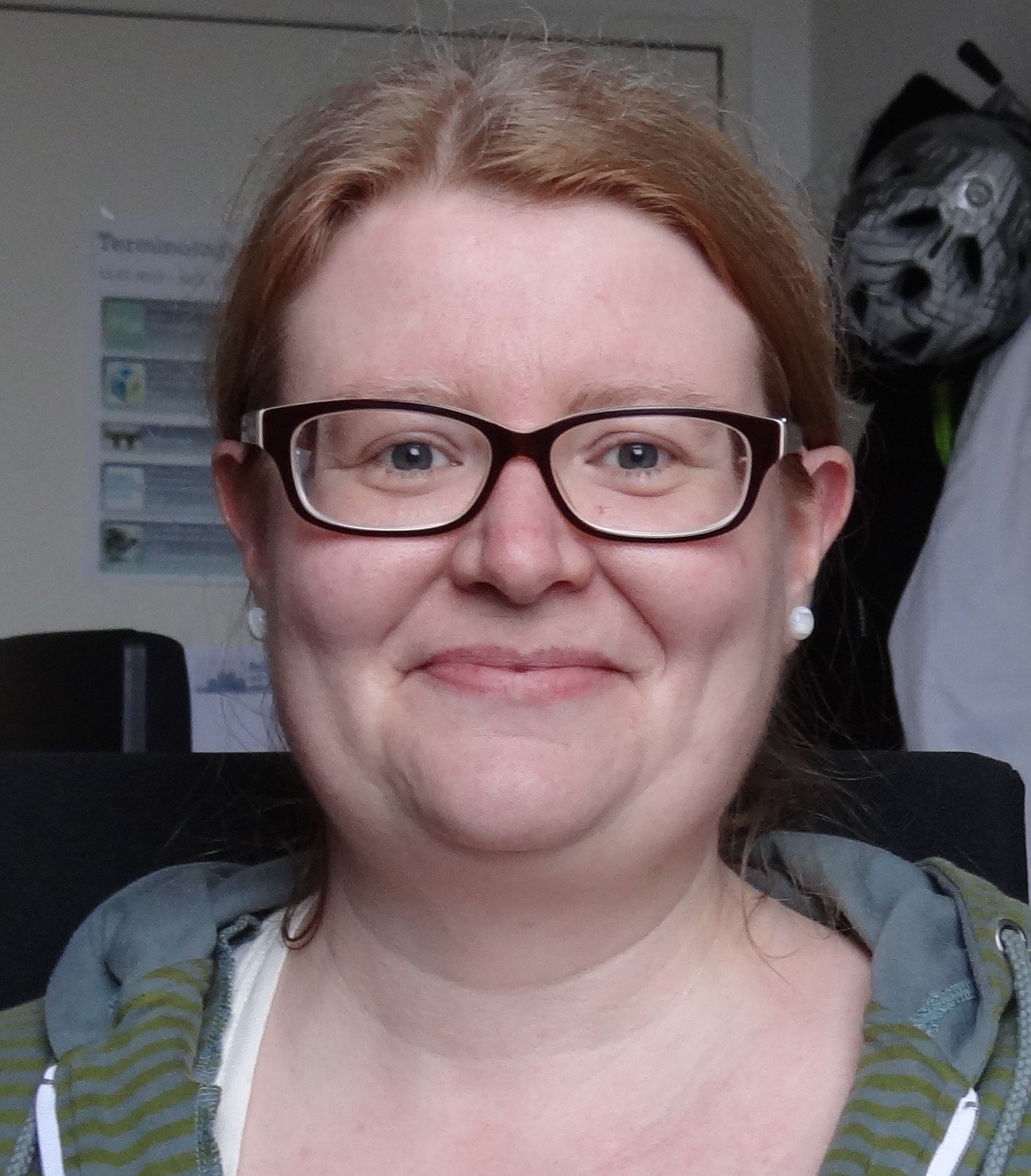
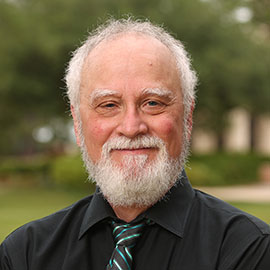
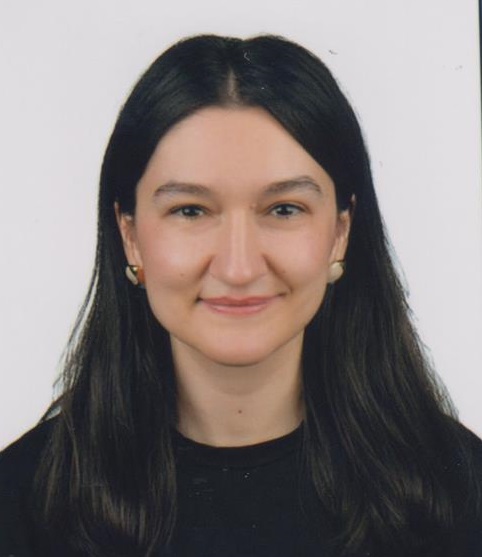
Dr. Andrea Wurm is a Researcher at Saarland University , affiliated with the Department of Applied Linguistics and Translation and Interpreting . Her work bridges Translation Studies with cross-border cultural history , focusing on empirical methodologies through the KOPTE Corpus – a longitudinal translation learner corpus for analyzing translation competence and evaluation. She also contributes to the MUST network and UniGR Center for Border Studies . Her research spans corpus linguistics , cultural realia in translation , and historical translation effects . Key projects include the KOPTE corpus , enabling studies on translator biographies, annotation schemes, and statistical correlations between text features and translation quality. She teaches French-German translation practice , text analysis , and language-culture interfaces . Academic Appointments: 2001–2021: Lecturer in French and Francophone Department Since 2012: Head of French Section Since 2021: Researcher Research Networks: UniGR Center for Border Studies MUST Network (Multilingual and Specific Translation)
Larry Beason is a Professor at the University of South Alabama within the College of Arts and Sciences, Department of English. His expertise spans rhetorical analysis, composition pedagogy, grammar, and science fiction. He is renowned for his book Eyes Before Ease , which delves into the cultural and communicative significance of spelling, and has co-authored several influential grammar and usage guides. Research Focus: Rhetorical analysis, writing assessment, ethics in writing instruction, and intersections of digital communication with pedagogy. Notable Publications: Eyes Before Ease , A Commonsense Guide to Grammar & Usage , and The McGraw-Hill Handbook of English Grammar and Usage . His scholarly work addresses topics such as grammar standards in gaming forums, writing assessment methodologies, and the role of ethics in composition instruction. He has contributed to journals like College Composition and Communication , WPA: Journal of the Council of Writing Program Administrators , and Research in the Teaching of English .
Terry McLean is a Lecturer at the School of Continuing Education, MacEwan University, Edmonton, Alberta. His expertise spans ESL curriculum design, pragmatic awareness, and pedagogical innovation in language education. McLean has contributed extensively to discussions on cross-cultural communication challenges, online learning strategies, and grammar instruction techniques. Current affiliation: MacEwan University (2025) Research focus: Pragmatics in L2 acquisition and pedagogical adaptation McLean’s research explores pragmatic awareness in language learning, cross-cultural misinterpretations of silence, and innovative teaching methods. He has developed frameworks for using breakout rooms in remote instruction, gamified learning activities (e.g., "Games of Lies"), and strategies to bridge sentence-level grammar to paragraph-level writing. His work often integrates humor and cultural narratives to enhance engagement. From 2001 to 2025, McLean published 20+ pedagogical articles. Recent works (2025) address asynchronous learning tools like "Flip and TILT" and writing instruction through thought-group analysis. Earlier studies (2020–2018) focus on managing virtual classrooms and pragmatic discourse tasks. Older publications (2006–2004) examine cultural context in debates and sentence variety in ESL writing.
Arzu Atasoy serves as Associate Professor in the Department of Turkish and Social Sciences Education at Gaziantep University's Faculty of Education since 2024, following progressive academic appointments including Doctor Lecturer (2020-2024) and Research Assistant positions at both Gaziantep and Hatay Mustafa Kemal Universities. Her academic credentials feature a Doctorate in Turkish Education from Hatay Mustafa Kemal University (2015-2019), Master's degree in Turkish Education from Mustafa Kemal University (2013-2015), and Bachelor's in Turkish Language Teaching from Erciyes University (2008-2011). Professor Atasoy's research centers on writing education with specialized focus on writing alienation phenomena, AI-assisted text evaluation, and sociocultural dimensions of writing development. Her methodological repertoire combines mixed-methods designs with bibliometric analyses to investigate writing instruction across Turkish educational contexts. Recent publications demonstrate accelerating integration of artificial intelligence in language assessment, particularly through ChatGPT applications for student text evaluation, alongside systematic reviews mapping writing education research evolution. Her scholarly recognition includes: TÜBİTAK 2211-E Direct Domestic PhD Scholarship TÜBİTAK 2210-A General Domestic Master's Scholarship She actively supervises master's research including completed studies on Turkish teachers' writing practices and ongoing projects analyzing AI-generated texts and developing mobile writing applications. Her extensive teaching portfolio spans undergraduate Creative Writing and Turkish Language courses through graduate-level Writing Education Research Design seminars across all academic levels.
Rainu Kaushal, MD, MPH, is a distinguished academic leader at Weill Cornell Medical College , serving as the Senior Associate Dean of Clinical Research , Chair of Population Health Sciences , and Nanette Laitman Distinguished Professor . Her work focuses on pediatric patient safety , health information technology , and value-based healthcare delivery , with particular emphasis on interoperable systems and the economic value of EHRs. Physician-in-Chief of Population Health Sciences at NewYork-Presbyterian Hospital Principal Investigator of the INSIGHT Clinical Research Network Leader of RECOVER Program research on Long COVID Dr. Kaushal has pioneered the creation of the largest urban clinical database in the U.S. with 22 million patients, instrumental in national research efforts. Her studies on telemedicine effectiveness during the pandemic and mobile stroke units have reshaped healthcare delivery strategies. She serves on advisory boards for organizations including PCORI and National Institutes of Health . She has received numerous accolades including National Academy of Medicine membership and Crain's Notable Women in Healthcare recognition. Her research portfolio includes over 200 publications spanning EHR safety , telehealth disparities , and pediatric medication errors .
Joke Torbeyns is a Senior Lecturer at the Faculty of Psychology and Educational Sciences, KU Leuven, within the department of Instructional Psychology and Technology. She serves as Head of the Instructional Psychology and Technology unit and contributes to research and education in early childhood mathematics and language development. Chair of Educational Sciences (OE) Member of LC&Y (KU Leuven Institute for Child and Youth) Member of LILI (Interdisciplinary Language Institute) Member of LIVO (Institute for Educational Research) Her research focuses on shaping educational environments for young children using educational technology, teacher competencies in early mathematics, and multilingual development. She leads projects such as Stimulating the mathematical development of Ecuadorian preschool teachers and Interactive book reading for mathematical development . Her recent work explores patterning competences, problem-solving behaviors, and math-language links in preschoolers. Torbeyns has published extensively in 2025, including studies on the PROSPER instrument for problem-solving assessment and longitudinal analyses of patterning errors. She frequently presents at the European Association for Research on Learning and Instruction (EARLI) and Onderwijsresearchdagen (ORD) conferences. She holds memberships in the PPW Faculty Council (ZAP representative), POC Bachelor Onderwijskunde, and other academic networks. Her teaching roles include courses like Designing Learning Environments and Mathematics and Language Education .
Assoc. Prof. Dr. Yanka Koeva is affiliated with the University of Veliko Tarnovo (St. Cyril and St. Methodius University) as a faculty member of the Faculty of Modern Languages , specifically in the Department of Methodology of Linguistic and Literary Education . Her academic rank is Associate Professor in the field of German language pedagogy. Her research interests focus on foreign language education , with emphasis on self-assessment , error correction , multilingualism , and pedagogical methodology . She has explored the integration of digital media , intercultural communication , and student motivation in language learning contexts. Key trends in her 15 most recent articles include: Analysis of error correction techniques in pair/small-group settings Development of self-evaluation practices for language learners Challenges in multilingual education and curriculum design Innovations in German language teaching (DaF) Role of technology in modern language instruction Psychological and pedagogical frameworks for language acquisition Contact details: University email: ya.koeva@ts.uni-vt.bg Personal email: j.koeva@outlook.com
Iliyana Dimitrova is a Senior Lecturer at the Department of Modern Bulgarian Language within the Faculty of Modern Languages at St. Cyril and St. Methodius University of Veliko Turnovo in Bulgaria. She holds a PhD and has established herself as a prominent researcher in Bulgarian linguistics with a specialization in the relationship between language, culture, and cognition. Her research interests span Bulgarian Linguistics, Sociolinguistics, Language and Culture, Second Language Acquisition, Intercultural Communication, Cognitive Linguistics, and Contrastive Linguistics. Dr. Dimitrova's work extensively examines how cultural concepts are encoded in language, with particular focus on the Bulgarian linguistic picture of the world, sociocultural competence in language learning, oral communication patterns, and language contact phenomena, especially between Bulgarian and English. Her research bridges theoretical linguistic frameworks with practical applications in language teaching, particularly for Bulgarian as a foreign language. Analysis of her publication trends reveals consistent focus on conceptual domains like cleverness/intellect, success/failure, hospitality, and collective vs. individual identity in Bulgarian culture. Her work demonstrates sophisticated integration of cognitive linguistic approaches with empirical research on language use, often employing contrastive analysis (particularly Bulgarian-English comparisons) and discourse analysis. A significant portion of her research addresses the challenges of teaching Bulgarian language and culture to non-native speakers, including frameworks for incorporating sociocultural competence into language curricula. Dr. Dimitrova actively participates in research projects including 'Integration of Students and Doctoral Students into Research Initiatives and Practices of the Faculty of Philology at VTU' (2025), 'Oral Communication in the Digital Age – Problems and Perspectives' (2023), and 'Oral Communication – Current Problems and Scientific Solutions' (2020). These projects reflect her commitment to advancing research in linguistic communication, digitizing linguistic resources, and mentoring the next generation of scholars. Through her ongoing involvement in the 'Problems of Oral Communication' conference series and other academic initiatives, she maintains an active role in the Bulgarian and international linguistics community.
Rohit Singh is an Assistant Professor at Duke University with appointments in the Departments of Biostatistics & Bioinformatics, Cell Biology, Computer Science, and Electrical and Computer Engineering. He is a member of the Duke Cancer Institute and the Division of Integrative Genomics. Academic Rank : Assistant Professor Departments : Biostatistics & Bioinformatics, Cell Biology, Computer Science, Electrical and Computer Engineering University Affiliations : Duke Cancer Institute, Division of Integrative Genomics His research focuses on computational biology, machine learning for drug discovery, and decoding disease mechanisms through single-cell genomics and protein language models. Current projects include SAME, Velorama, Raygun, and Allo-Allo. Recent publications span single-cell analysis, protein language models, and causal inference. He develops tools like Schema , D-SCRIPT , and Sceodesic . Grants : NIAID, Chan Zuckerberg Initiative, Foundation for Prader-Willi Research Awards : MIT Sprowls Award, Stanford Stephenson Award, RECOMB Test of Time Award He advises students in computational biology and has contributed to patents in protein interaction modeling and viral detection. The lab welcomes postdocs, rotation students, and collaborators.
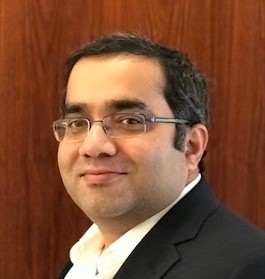
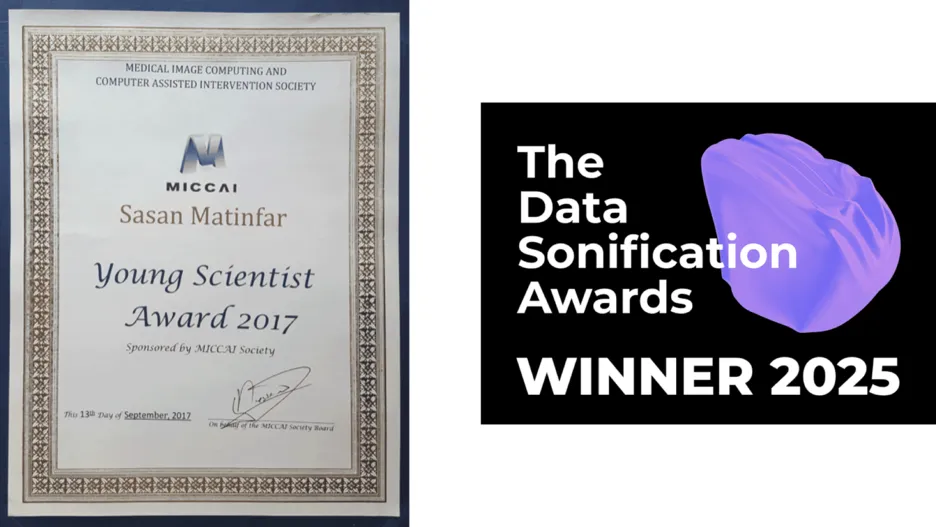
Sasan Matinfar is a research scientist at the Technical University of Munich (TUM), affiliated with the Chair of Computer Aided Medical Procedures (Prof. Navab) and the Munich Center for Machine Learning (MCML). He serves as scientific staff at Rechts der Isar Hospital, developing XR and sonification systems for surgical environments since 2020. His educational background includes: Master’s and Bachelor’s in Computer Science, Ludwig Maximilian University of Munich (LMU) Musicology, Franz Liszt University of Music, Weimar Piano Interpretation, Art University of Tehran Matinfar pioneers medical sonification and multisensory XR, creating auditory interfaces that convert tissue properties into sound for surgical guidance. His work in user-centered design produces clinically viable tools like the Ocular Stethoscope for retinal procedures and physics-based BioSonix frameworks, merging computer vision with perceptual audio engineering to enhance intraoperative precision without visual overload. Analysis of his 12 recent publications (2017-2025) reveals an evolving research arc from foundational surgical soundtracks to sophisticated context-aware sonification. Current work integrates generative AI with real-time tissue deformation modeling, focusing on multimodal frameworks where auditory feedback complements visual navigation in complex surgeries like cardiac interventions and retinal peeling. Key recognitions include: The Data Sonification Award (2025) MICCAI 2023 Best Paper Nominee (top 3% of submissions) MICCAI Young Scientist Award (2017, top 2% of papers) As an educator, Matinfar mentors students through TUM courses including Medical Augmented Reality (WS 2025/26) and Surgical Robotics, while co-organizing the Medical Augmented Reality Summer School and IEEE ISMAR 2025’s MIX Workshop. His patented technologies emerge from collaborations with Politecnico di Milano, TU Dresden’s CeTI, and Balgrist Hospital Zurich, securing interdisciplinary grants in surgical data science. Matinfar operates within TUM’s NARVIS Lab for medical image analysis and RobUSt for robotics-ultrasound integration, leveraging the German Heart Center Munich (DHM) infrastructure to validate XR systems in live surgical workflows and advance vision-language models for intraoperative decision support.
Tuhin Chakrabarty is an Assistant Professor in the Department of Computer Science at Stony Brook University. His research focuses on developing AI systems that address implicature, ambiguity, and human-aligned requirements, with applications in natural language processing and human-AI collaboration. Education: Ph.D. in Computer Science from Columbia University Research Interests: Tuhin explores methods to enhance AI reliability through Long Form Text Generation Evaluation, Benchmarks for Reasoning and Explainability, and Human-AI Collaboration frameworks. His work bridges computational linguistics, machine learning, and creative applications of AI. Scientific Awards: Columbia Center of Artificial Intelligence & Technology (CAIT) Research Support Amazon Science Ph.D. Fellowship Computational Journalism Fellow at NYTimes R&D (2021-2022) Publications Trends: His recent work spans AI safety, creativity support, figurative language understanding, and multimodal systems. Key themes include human-AI alignment, ethical considerations, and empirical studies on generative models. Additional Contributions: Tuhin collaborates with Stony Brook’s Institute for AI-Driven Discovery and Innovation, advancing interdisciplinary research in AI applications.
Saleh Hadi Mohammed is an Associate Professor at the Faculty of Computer Science , National Research University Higher School of Economics (HSE), where he has worked since 2015. With over 10 years of academic experience, his expertise spans software engineering, blockchain systems, and intelligent transport technologies. Candidate of Technical Sciences (2013) Engineer in 'Computers, Complexes, Systems and Networks' (2008) Professional training in Moodle-based distance learning Research interests include: Intelligent transport systems and location-based services Software/hardware navigation integration and blockchain applications Cloud services, mobile app development, and MLOps platforms His recent publications analyze MLOps scalability, blockchain donation tracking, and AI-driven navigation for visually impaired users. Notable collaborations involve Springer, IEEE, and CEUR Workshop Proceedings. Scientific awards : Gratitude from HSE Faculty of Computer Science (2024) As a thesis supervisor , he has guided 15+ students in projects ranging from fraud detection to mobile education apps. He also leads SmartMLOps , HSE’s AI service deployment platform (2024), and participated in the Administrative Personnel Reserve Program (2024-2025).
Ingebjørg Tonne is a Professor of Nordic languages/Norwegian as a second language at the Department of Linguistics and Nordic Studies (ILN) at the University of Oslo. She previously served as deputy head of MultiLing, center for multilingualism (a Center for Excellence in Research funded by the Norwegian Research Council) from January 1, 2022 to May 1, 2024. Earlier, from December 1, 2015 to June 30, 2017, she was head of teaching at ILN. Her academic career spans multiple institutions including the University of Oslo, Oslo Metropolitan University (where she taught from 2002-2014), and NTNU. Tonne holds a doctorate in linguistics from the University of Oslo (2001), with a contrastive dissertation on aspect in Norwegian-Spanish-English. Her educational background prepared her for extensive work in linguistics and language education. Professor Tonne's research focuses on the relationship between grammar teaching and writing development in school students, and the interplay between linguistic factors related to reading and writing skills. She is particularly interested in grammatical contrasts between different languages and how contrastive work can contribute to increased metalinguistic awareness in students. Her methodological approaches span corpus studies, ethnographically oriented studies, interview-based research, conceptual discussions about language concepts like "mother tongue," and qualitative studies of teachers' written assessments of student texts. She has made significant contributions to understanding how grammar instruction impacts literacy development among second language learners. Her publication record shows a consistent focus on second language acquisition, particularly Norwegian as a second language, with emphasis on grammar instruction, writing development, and literacy. Over the past decade, her work has increasingly examined teacher responses to student writing, the role of literature in language education, and the conceptual frameworks that shape our understanding of language learning. Her research often bridges theoretical linguistics with practical classroom applications, demonstrating how linguistic insights can improve language teaching methodologies. Professor Tonne has supervised students in the master's program in multicultural and international education at OsloMet, focusing on sociolinguistic topics related to human rights, language rights, and the multicultural school in Norway. She was part of the "Multiplicity Project" at OsloMet, which investigated how increased reading of literature could improve students' reading and writing skills compared to ordinary textbook use. Her teaching responsibilities at the University of Oslo include courses NOAS1100, NOAS2101, NOAS2102, NOAS4101, and NOAS4103, all related to Norwegian language education. She is an active member of MultiLing, the Center for Multilingualism in Society across the lifespan, which was designated as a Center of Excellence by the Norwegian Research Council. This center brings together researchers from multiple disciplines to study multilingualism from various perspectives, including linguistic, cognitive, social, and educational dimensions. Professor Tonne's work contributes significantly to the center's focus on how multilingualism develops and functions in different societal contexts.
Chiara Epifanio is a researcher (INFO-01/A) at the University of Palermo , based in the Department of Mathematics and Computer Science . She holds regular office hours on Tuesdays 14:30–17:00 in Room 104, first floor, Via Archirafi 34, and can be reached at chiara.epifanio@unipa.it . Over the past fifteen years she has designed and taught a diverse portfolio of courses spanning Programming , Bioinformatics , Advanced Programming , Teaching Methodologies and Techniques for Computer Science and Pattern Discovery for Life Sciences . These offerings serve degree programmes in Mathematics, Computer Science, Statistics & Data Science, and the recently launched curricula in Data, Algorithms & Machine Intelligence and Computer Science & Artificial Intelligence . Her research lies at the intersection of combinatorics on words , string algorithms , and bioinformatics . She has made sustained contributions to the design of alignment-free distances for biological data, the theory of Sturmian words and their associated graphs, suffix automata tolerant to mismatches, and compact data structures such as linear-size suffix tries. The work repeatedly draws on deep results from formal language theory, automata theory, and discrete mathematics to solve practical problems in sequence analysis. Publications trend: From 2004 onward she has produced a steady stream of peer-reviewed articles that move from foundational combinatorial results on Sturmian words and critical factorization theorems toward application-driven studies on approximate string matching and genomic data mining. A marked acceleration is visible in the 2023 publications addressing k-Hamming and k-edit distances, reflecting current demands in large-scale biological data analytics. Scientific awards: None explicitly mentioned in the provided material. Advising & grants: No PhD or Master’s students are listed in the supplied pages, and no funded project descriptions are available. Laboratories & teams: While no specific lab is named, her teaching and research are embedded within the Department of Mathematics and Computer Science, which hosts groups in algorithms, discrete mathematics, and bioinformatics, and provides access to the university’s ATeN Center and other research infrastructures.
Manabu Kobayashi is a Professor at the Center for Data Science of Waseda University, with previous faculty roles at Shonan Institute of Technology (1998-2014). His research spans data mining, machine learning, and information theory, with a focus on applications in document classification, ECOC frameworks, and latent structural models. Current Affiliation: Waseda University (2018-present) Previous: Shonan Institute of Technology (2002-2014) Research Interests: Specializes in distance metric learning, latent class modeling, and fault diagnosis systems using probabilistic frameworks. Key areas include: ECOC (Error-Correcting Output Codes) optimization Collaborative filtering for recommendation systems Reconfigurable logic circuits using DG-CNTFETs Privacy-preserving distributed linear regression Scientific Awards: PC Conference Best Paper Award (2025) World CIST'18 Best Paper Award IEICE Achievement Award (2017) 74th Information Processing Society of Japan Conference Excellence Award (2012) Article Trends: Recent work focuses on latent structure analysis for relational data (2025), ECOC performance with noisy classifiers (2023), and flipped classroom effectiveness through log-based grouping (2022-2025). Earlier contributions include reconfigurable logic circuits (2013-2014) and probabilistic fault diagnosis (2011-2012).