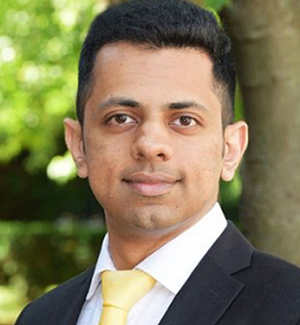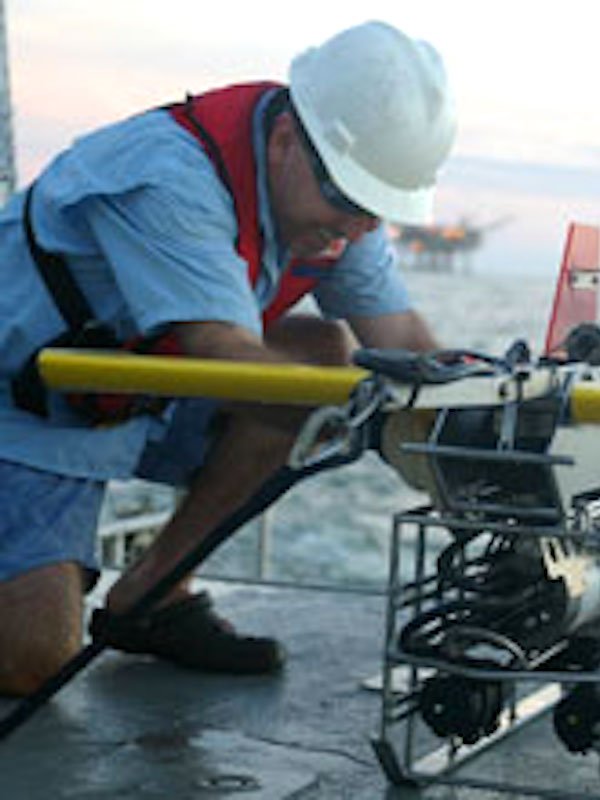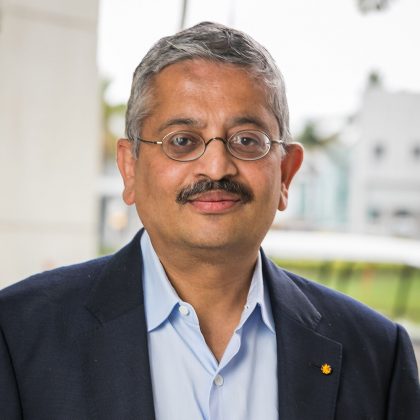
Dr. Shekhar Bhansali is the Alcatel-Lucent Professor and Chair of the Department of Electrical & Computer Engineering (ECE) at Florida International University (FIU) since 2011. He holds a BS in Metallurgical Engineering (1987), MS in Aircraft Production Engineering (1991), and PhD in Electrical Engineering (1997). His research focuses on bio sensing, nanotechnology, alternative energy, and oceanographic sensing. He leads the Bio-MEMS and Microsystems Lab, holds 36 U.S. patents, and has secured funding from NSF, industry partners, and national labs like Sandia and Los Alamos. Dr. Bhansali has grown the ECE department by launching programs like the online Master of Science in Network Security and the B.S. in Internet of Things (first in the U.S.). He co-directs FIU’s Bridge to the Doctorate program, fostering STEM diversity. Awards include the 2014 FIU Top Scholar Award and 2018 AAAS Fellowship. Education: PhD in Electrical Engineering, RMIT University (1997) MS in Aircraft Production Engineering, IIT Madras (1991) BS in Metallurgical Engineering, MREC, Jaipur (1987) Research Interests: Bio-sensing, nanotechnology, alternative energy, oceanographic sensors, and materials science. Key Achievements: 36 U.S. patents and 7 invention disclosures Co-authored 139 journal papers and 200+ conference papers Recruited 14 faculty members and expanded doctoral programs Partnership with Florida Power & Light for solar energy research His work bridges innovation and societal impact, with sensors for wound monitoring, environmental sensing, and energy efficiency. Recent studies include AI-driven sensor networks for precision agriculture and wearable devices for real-time health diagnostics. Awards & Recognition: 2018 AAAS Fellow 2014 FIU Top Scholar Award Multiple mentorship awards (2003–2011) Advising & Grants: Oversaw education of over 150 graduate students via NSF-IGERT and Sloan programs. Secured grants totaling millions for interdisciplinary research. Expanded FIU’s engineering programs and faculty size. Labs & Teams: Leads the Bio-MEMS Lab, advancing micro/nano sensors and lab-on-a-chip technologies. Collaborates with industry and national labs on sensor development and energy projects.