Jasper Goseling is an Associate Professor at the Digital Society Institute and affiliated with the Mathematics of Operations Research department. His research spans differential privacy, network coding, optimization, and wireless systems, often bridging theoretical and applied domains. Key research areas: Differential Privacy, Network Coding, Optimization, Wireless Sensor Networks, Machine Learning His recent work focuses on robust optimization techniques for local differential privacy, addressing trade-offs between data utility and privacy preservation. Earlier contributions include studies on energy-efficient data collection in sensor networks, caching strategies in wireless environments, and entropy-based analysis of hydrothermal systems. Article trends reveal a strong emphasis on privacy-preserving algorithms (2022-2024) and historical expertise in network coding, queueing theory, and thermodynamic entropy. His research integrates mathematical rigor with practical applications in wireless communication and data management. Activities include organizing the 45th Symposium on Information Theory and Signal Processing (2025) and leadership roles in the IEEE Benelux Chapter on Information Theory (Chair, 2017; Member, 2012-2017). He also contributed to the 2015 European School of Information Theory.
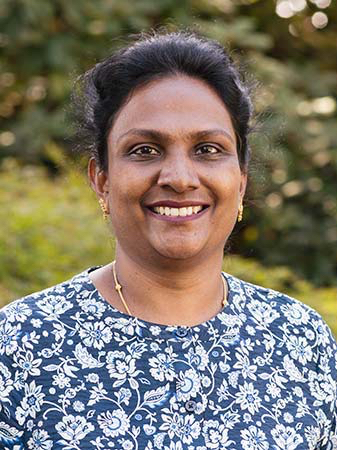
Jasmine Gnanadurai serves as an Associate Professor in the Department of Electrical Engineering & Computer Science at George Fox University's College of Engineering. She teaches a range of courses including Introduction to Computer Science, Software Engineering, Servant Engineering, and Senior Design. Her office is located in Wood-Mar 222, where she holds regular office hours for student consultation. Dr. Gnanadurai's educational background includes: Ph.D. in Computer Science (2017) from Anna University, Chennai, India M.Phil (2006) from Bharathidasan University, Tiruchirappalli, India M.C.A. (2000) from Bharathidasan University, Tiruchirappalli, India B.Sc. in Computer Science (1997) from Bharathidasan University, Tiruchirappalli, India Dr. Gnanadurai's research spans multiple cutting-edge domains in computer science and engineering. Her work in wireless sensor networks has focused on optimization algorithms for zone-based networks, particularly using techniques like DBSCAN clustering and particle swarm optimization. She has made significant contributions to cloud computing architecture, especially in resource allocation and load balancing for peer-to-peer networks. Her expertise extends to machine learning applications across diverse fields including agriculture productivity, student feedback analysis, and crowd behavior recognition. Her recent publications demonstrate a strong interdisciplinary approach, bridging computer science with practical applications in healthcare, education, smart cities, and transportation. She has published extensively on deep learning techniques for EMG-based hand gesture recognition, blockchain applications for electric vehicle charging infrastructure, and immersive technologies for educational settings. These works reflect her commitment to addressing real-world challenges through technological innovation. Dr. Gnanadurai actively contributes to the engineering education mission at George Fox University through multiple channels. She teaches foundational computer science courses, advanced software engineering, and participates in the university's distinctive Servant Engineering program where students develop solutions to humanitarian needs. She also guides senior engineering students through their capstone Senior Design projects, which partner with industry sponsors to solve real-world problems. As part of the College of Engineering, Dr. Gnanadurai works within interdisciplinary teams that collaborate on projects addressing humanitarian needs through the Servant Engineering program. This program connects students with community partners to develop engineering solutions that serve vulnerable populations, reflecting the university's Christian mission of service. Her involvement in Senior Design connects students with industry partners including Xerox, Intel, Garmin, and numerous regional companies, providing students with valuable real-world experience.
Professor Dagou Zeze is a Professor of Nanotechnology & Microsystems and Director of International Engagement in the Department of Engineering at Durham University. He also serves as Deputy Executive Dean for Research in the Faculty of Science. Professor Zeze has established himself as a leading researcher in nanotechnology and microsystems, with significant contributions to the field of nanomaterials device integration. His educational background includes a BSc in Physics from the University of Abidjan, Ivory Coast (1990), followed by MPhil and PhD in Electronics from the Université of Clermont-Ferrand, France (1996). He completed postdoctoral research at the University of Ulster (2000) on thin amorphous carbon films and at the University of Surrey (2003) on microfabrication. Professor Zeze's research focuses on nanostructured materials, micro and nanofabrication, and the integration of nanomaterials (particularly carbon nanotubes and semiconductor nanowires) in devices. His current research themes include integration of nanostructured materials in device fabrication, nanofabrication & microfabrication, carbon nanotubes, smart devices, semiconductor nanowires, and multifunction devices. He has also explored thin films technology, organic electronics, and liquid handling robotic system design. His publication record shows a strong focus on nanomaterials for electronic and sensing applications, with recent work emphasizing piezoelectric sensors, ZnO nanowires, metasurfaces for structural color, and in-materio computing approaches. His research demonstrates a consistent trajectory toward practical applications of nanotechnology in sensors, electronics, and energy conversion devices. Senior Research Fellow of the Royal Academy of Engineering/The Leverhulme Trust (2013-14) Fellow of the World Academy of Materials and Manufacturing Engineering (2015-) Fellow of the Institute of Engineering and Technology External Degree Programme Examiner: University of Exeter (2016-2020) External Degree Programme Examiner: University of Bangor (2017-21) Professor Zeze has supervised numerous postgraduate students including Grainne Gilleece, Luis Ceron Oliver, Mana Saeed, and Shixian Sun. He has secured substantial research funding, having contributed to seven European Framework programme FP7 and Horizon 2020 projects totaling over €12.5 million. He serves as the scientific coordinator for three Marie Curie Actions international consortia on semiconductor nanowires (FUNPROB, NanoEmbrace, and H2020 INDEED ITN), which involve significant international academic and industrial collaboration across Europe. His leadership extends to his role as Chair of the Durham University EU Liaison Group (2018-2023) and as Director of Postgraduate Studies (2014-2017). Professor Zeze leads research activities in the Next Generation Materials & Microsystems Research Challenge and has established collaborative networks across Europe through his involvement in major EU-funded projects.
Ulrik Dam Nielsen is an Associate Professor in the Section for Fluid Mechanics, Coastal and Maritime Engineering at the Department of Civil and Mechanical Engineering, Technical University of Denmark (DTU). He also held an external position as Associate Professor II at the Norwegian University of Science and Technology (NTNU) from 2014 to 2023, reflecting strong international collaboration. His work contributes to UN Sustainable Development Goals related to sustainable maritime operations and clean energy. His research focuses on naval architecture and ship motion dynamics , particularly in the context of sea state estimation , added resistance in waves , and real-time prediction of vessel responses . He integrates data analytics , estimation theory , and machine learning to develop methods for monitoring hydrodynamic performance and enhancing maritime safety and energy efficiency. A central theme of his work is using ships as mobile wave sensors—transforming operational vessels into 'sailing wave buoys' for environmental monitoring. His recent publications show a clear shift toward data-driven methodologies, especially machine learning applications in sea state estimation, added resistance modeling, and performance monitoring. These works span journals like Ship Technology Research and Journal of Offshore Mechanics and Arctic Engineering , and conferences such as IEEE MetroSea, highlighting interdisciplinary innovation at the intersection of classical marine engineering and modern AI. Best Paper Presented by a Young Researcher Award (First Classified), 2024 (jointly awarded) He actively supervises PhD students—such as R. E. G. Mounet, M. Mittendorf, J. P. Tomy, and A. Oikonomakis—on projects funded by DTU and collaborative initiatives. His leadership in projects like WEFOSWAB (Wave Estimation and Forecasting Using Ships as Buoys) and data-driven added resistance modeling underscores his role in advancing smart maritime technologies. He also contributes to open science through the public release of datasets such as NetSSE . He teaches core courses including Introduction to Ships and Floating Structures , Marine and Ocean Engineering , and Ship Operations , shaping the next generation of maritime engineers.
Thomas Little is a Professor in the Department of Electrical & Computer Engineering and Systems Engineering at Boston University, serving as the Associate Dean of Educational Initiatives. He holds a PhD from Syracuse University (1991) and leads the Multimedia Communications Laboratory. His research focuses on smart systems, visible light positioning, MANETs, pervasive computing, and optical wireless communications. Key honors include the Kern Faculty Fellow, NSF CAREER Award, and Senior Member of IEEE. His teaching spans courses like EC444 (Smart Systems) and EC744 (Mobile Ad Hoc Networking). He is affiliated with the Center for Information and Systems Engineering and Clean Energy Sustainability Initiative. Recent publications emphasize optical wireless networks, interference mitigation, and 3D localization. Over 150 articles showcase advancements in VLC systems, hybrid RF/VLC networks, and smart lighting integration with 5G frameworks. His work bridges communication technologies and environmental sustainability.
Marko Beko is a researcher affiliated with Lusofona University in Lisbon, Portugal. He is actively involved in projects related to wireless sensor networks, localization algorithms, and machine learning applications in telecommunications. His work spans areas such as GNSS-denied navigation, federated learning, and IoT network optimization. Research Interests Localization in wireless networks Machine learning for IoT UAV navigation systems Signal processing and network optimization Stochastic geometry in massive IoT Energy-efficient communication protocols Recent publications focus on deep learning methods for unmanned aerial vehicle (UAV) navigation, linear precoding for MIMO systems, and federated learning in rural environmental monitoring. His work demonstrates strong interdisciplinary connections between computer science, telecommunications, and aerospace engineering.
Luca Catarinucci is affiliated with the University of Salento in Lecce, Italy. His research focuses on RFID technology, IoT systems, wireless sensor networks, and antenna design. He has collaborated extensively with researchers like Riccardo Colella and Luciano Tarricone, producing impactful work in smart healthcare systems, energy-autonomous sensors, and 3D-printed electromagnetic devices. His contributions span theoretical advancements in circuit design and practical applications in fields like environmental monitoring and biomedical research. Recent work emphasizes energy-efficient solutions and integration of AI-driven microcontrollers. Key research interests include improving RFID tag performance, developing IoT-aware architectures for healthcare, and advancing additive manufacturing techniques for antenna prototyping. His publications reflect a deep engagement with both hardware innovation and system-level integration of smart technologies. Notable projects include energy-autonomous parking sensors and novel RFID-based medical monitoring systems. Collaborations involve cross-disciplinary efforts in electrical engineering, computer science, and biomedical engineering, with applications ranging from industrial automation to personalized healthcare solutions. While no formal awards are listed, his prolific publication record and repeated funding of experimental platforms indicate significant academic influence.
Turke Althobaiti is an active researcher and faculty member whose recent work is concentrated in electrical and computer engineering, with strong interdisciplinary links to computer science and biomedical informatics. Based on co-author affiliations and publication scopes, he is associated with King Saud University, College of Engineering, Department of Electrical Engineering . Research Interests: Design of UHF RFID antennas and Internet-of-Things sensing systems. Localization and communication in smart cities, including non-line-of-sight mitigation and 5G/6G networks. Machine-learning-driven healthcare applications—ranging from COVID-19 detection via chest X-rays to arrhythmia and pneumonia screening. Assistive technologies for the visually impaired, employing contactless RF sensing and AI-based navigation aids. Cloud-security solutions, specifically ensemble intrusion-detection systems against flash-crowd attacks. Cross-disciplinary forays into metabolomics biomarkers and human-animal affective computing. Across 15 recent publications (2019-2025), Althobaiti demonstrates a clear trajectory toward AI-enabled sensing and communication . Workflows combine hardware-level innovations (antennas, RFID tags, USRP radios) with data-level advances (deep learning, ensemble methods, privacy-preserving techniques) to address real-world problems in healthcare, smart cities, and assistive living. Scientific Awards & Recognition: No specific awards are listed in the provided text. Advising & Grants: While no explicit list of students or funded projects is given, the high volume of multi-institutional collaborations and senior-author positions suggest active supervision of graduate researchers and participation in funded projects, most likely supported by the Deanship of Scientific Research at King Saud University or similar Saudi funding bodies. Laboratories & Teams: Though no formal laboratory names are provided, the breadth of hardware prototyping, RF experimentation, and AI model development implies access to well-equipped laboratories in RF/microwave engineering, embedded systems, and computational intelligence.
Jorge Fernandes is a Full Professor at the Department of Electrical and Computer Engineering, Higher Technical Institute (Lisbon). His primary research focuses on analog and mixed-signal integrated circuits, with expertise in low-power design, energy harvesting, and CMOS technologies. He has led multiple national and international projects, including initiatives funded by the European Union, and has contributed significantly to advancements in ADCs, oscillators, and biomedical applications. Education: PhD in Electrical Engineering (2000), Instituto Superior Técnico MSc in Electrical Engineering (1993), Instituto Superior Técnico His research interests span analog circuit design, signal processing, and biomedical systems. He has authored or co-authored over 150 peer-reviewed publications and holds leadership roles in collaborative projects such as PULSARPLANE and IMAGIC. His work emphasizes practical applications in energy-efficient electronics and sensor technologies. Key Projects: Coordinator of EU-funded projects: PULSARPLANE (navigation systems), IMAGIC (spintronics-based implants) Researcher in national initiatives focused on ADC architectures, energy harvesting, and non-destructive testing Labs/Teams: Active in INESC-ID’s Analog and Mixed-Signal Circuits Group, collaborating with global partners on cutting-edge circuit design and biomedical applications.
George Goussetis is a Professor at Heriot-Watt University's School of Engineering & Physical Sciences, affiliated with the Institute of Sensors, Signals & Systems. His research focuses on microwave and antenna engineering with applications in satellite communication and IoT systems. Education includes a Diploma in Electrical Engineering from the National Technical University of Athens (1998), a Ph.D. from the University of Westminster (2002), and a B.Sc. in Physics from University College London (2002). Research interests span microwave components, antenna subsystems, satellite systems, and IoT applications, emphasizing practical implementations in communication technologies. Awards and fellowships: Onassis Foundation Fellowship (2001) Royal Academy of Engineering Fellowship (2006-2011) Marie-Curie Fellowship (2011-2012) European Space Agency Young Engineer of the Year (2011) Bell Labs Prize (2016) Leads the Microwave and Antenna Engineering Group and serves as Chair of EuCAP 2024.
Thomas Marzetta is a Distinguished Industry Professor in the Electrical and Computer Engineering Department at NYU Tandon School of Engineering and Director of NYU WIRELESS. He holds a Ph.D. and SB from MIT (Electrical Engineering) and an MS from the University of Pennsylvania (Systems Engineering). Prior to NYU, he worked at Schlumberger-Doll Research, Nichols Research Corporation, and Bell Labs, where he was elected a Bell Labs Fellow. He originated Massive MIMO, a cornerstone of 5G technology, and authored the book Fundamentals of Massive MIMO . Research Interests: Massive MIMO, Wireless Communications Technology, 6G Innovation, Antenna Systems, and Education. Affiliations: NYU WIRELESS (focusing on 6G and Terahertz technologies) and the Center for Advanced Technology in Telecommunications (CATT). His work has been recognized with awards including the IEEE Communications Society Industrial Innovation Award (2017), Stephen O. Rice Prize (2015), and an Honorary Doctorate from Linköping University (2015). He leads projects like GreenTouch’s Large Scale Antenna Systems and advises on EU-sponsored initiatives. Marzetta’s research emphasizes energy efficiency, spatial multiplexing, and novel MIMO configurations, with contributions to next-generation wireless systems and holographic communication techniques.
Emanuel Popovici is a Senior Lecturer in Electrical and Electronic Engineering at University College Cork (UCC), Ireland. He holds a Dipl. Ing. in Computer Engineering from the University Politehnica Timisoara, Romania, and a PhD in Microelectronics from UCC. His research focuses on AI at the edge, low-power embedded systems, and secure computing, with applications in healthcare, energy, and IoT. Notable projects include award-winning work in neonatal EEG monitoring, smart beehive systems, and energy-efficient wireless nodes. He has authored over 250 papers and received prestigious awards like the Qualcomm Faculty Award (2024) and three IEEE/IBM Smarter Planet Challenge titles. Education: Dipl. Ing. in Computer Engineering, University Politehnica Timisoara (Hardware Design focus) PhD in Microelectronics, UCC (National Microelectronics Research Centre) Research interests span AI-driven hardware, secure communications, and interdisciplinary collaborations across engineering, medicine, and environmental science. His work emphasizes practical solutions for real-world challenges, such as energy-efficient sensor networks and medical diagnostic tools. Scientific achievements include over 50 awards, including the Reed and Mallick Medal (2020) for urban planning contributions. His lab pioneered innovations like the neonatal EEG sonification system and blockchain-based IoT security frameworks. Collaborative projects span disciplines like anatomy, medicine, physics, and business. His group's work on ultra-low-power wireless nodes and FPGA-based cryptographic processors highlights their focus on energy efficiency and reliability.
Kamanashis Biswas is a Senior Lecturer at the Peter Faber Business School within the Faculty of Law and Business. His research focuses on blockchain technology, cybersecurity, IoT systems, federated learning, and healthcare applications. He has published extensively on topics such as blockchain interoperability, secure communication in wireless networks, and AI-driven healthcare solutions. Recent work includes studies on blockchain integration in UAV networks and explainable artificial intelligence. Key research areas include cross-blockchain protocols, energy-efficient wireless sensor networks, and blockchain-based frameworks for healthcare and finance. His contributions span both theoretical advancements and practical implementations, such as vaccine tracking systems and secure data-sharing mechanisms for wearable devices. Publications highlight interdisciplinary applications of blockchain in domains like smart cities, IoT platforms, and cybersecurity. Collaborations often involve addressing challenges in decentralized systems, privacy preservation, and system interoperability.
Mohamad Mroue is affiliated with the Laboratory at the Electrical and Electronic Engineering of Paris, focusing on cutting-edge research in Embedded Systems, FPGA, Electronics, IoT, and Wireless Communications. His work emphasizes FPGA-based solutions for power optimization, reconfigurable wireless systems, and low-power wide-area networks (LPWANs). He has contributed to advancements in partial reconfiguration techniques, machine learning integration for hardware monitoring, and secure mobility management protocols for IoT devices. His research spans multiple domains including UWB transceiver design, PAPR reduction in DVB-T2 systems, and innovative sensor networks. Collaborations with colleagues like Jean-Christophe Prevotet and Fabienne Nouvel highlight his interdisciplinary approach to solving complex engineering challenges. Mroue’s publications reflect a strong emphasis on practical implementations and real-world applications of embedded and wireless technologies. Key technical contributions include an ARM-FPGA platform for adaptive wireless communication, automated data generation systems, and energy-efficient solutions for IoT mobility. His work bridges theoretical research with hands-on prototyping, often leveraging FPGA capabilities for high-performance and flexible systems.
Issam Rais is an Associate Professor in the Department of Informatics at UiT The Arctic University of Norway, located in Tromsø. He is an active member of the Cyber Physical Systems (CPS) research group and contributes to the Distributed Arctic Observatory (DAO) project, focusing on sustainable and efficient distributed systems in extreme environments. His research centers on cyber-physical systems, Internet of Things (IoT), edge computing, and energy-efficient data dissemination. He investigates power modeling, wake-up mechanisms, and adaptation strategies for IoT and CPS nodes operating in resource-constrained Arctic conditions. His work integrates practical system design with analytical modeling and sustainability principles. His recent publications (2019–2024) reveal a strong trend in optimizing communication, energy usage, and deployment strategies for distributed systems in harsh environments. Topics include LoRa protocol adaptation, UAV-assisted networking, compression for data-intensive applications, and simulation frameworks like ESDS for Arctic tundra scenarios. His work is consistently published in IEEE venues and high-impact journals. Scientific Awards and Recognition: No specific awards mentioned in the provided text. Advising and Grants: While no formal list of students or grants is provided, his extensive collaborative research across multiple projects and publications suggests active involvement in research leadership and project-based funding. He is deeply involved in the Distributed Arctic Observatory, which likely involves external funding and team coordination. Labs and Research Teams: Dr. Rais is a key member of the Cyber Physical Systems (CPS) research group at UiT. His work is closely tied to the Distributed Arctic Observatory (DAO) project, which aims to develop sustainable IoT-to-Extreme-Edge infrastructure for environmental monitoring in the Arctic. His lab work involves real-world deployment, power monitoring, and simulation of distributed systems.