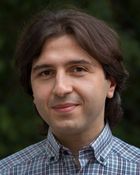
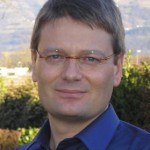
Prof. Laura Bégon-Lours is an Assistant Professor at ETH Zürich's Department of Information Technology and Electrical Engineering, specializing in neuromorphic electronics and AI hardware. Her research focuses on developing analog in-memory computing systems using novel materials like conductive-metal-oxide/HfOx ReRAM and ferroelectric nanolaminates. She explores applications in bio-inspired computing, low-power neuromorphic processors, and beyond-CMOS device integration. Her work bridges material science and electronics engineering, emphasizing scalable, energy-efficient computing architectures. Key contributions include crossbar operation of ferroelectric tunnel junctions, BEOL integration of synaptic weights, and unsupervised learning models leveraging memristive systems. Current projects target multi-timescale synaptic weights and photonic-electronic hybrid systems for next-generation AI acceleration. Publications highlight advancements in resistive switching mechanisms, ferroelectric field effects, and neuromorphic processor design. Her research has been published in top journals, with recent focus on 2023-2025 innovations in analog computing and neuromorphic circuits.
Yong Chen is a full Professor at the University of Macau within the State Key Laboratory of Analog and Mixed-Signal . He received his PhD in 2010 from the Chinese Academy of Sciences, Institute of Microelectronics . Prior to his current role, he held appointments at Nanyang Technological University (2010-2013) and Tsinghua University (2010). His research spans analog, mixed-signal, RF and mm-wave integrated circuits with emphasis on data converters, phase-locked loops, energy-harvesting systems, computing-in-memory accelerators, and silicon-photonics interfaces . He has consistently published in premier venues such as ISSCC, JSSC, TCAS-I/II, TVLSI , and CICC , demonstrating expertise from device-level circuits to system-level architectures. Recent work (2023-2025) showcases advances in: Ultra-high-speed DACs and ADCs (>16 GS/s) with record SFDR and FoM Computing-in-Memory processors achieving 258 TOPS/W for AI inference Energy-harvesting rectifiers with >22 dB dynamic range and >47 % peak PCE mm-wave/THz CMOS circuits for imaging and 5G/6G communications Ring-oscillator and sampling PLLs with sub-50 fs jitter and He serves on technical program committees and as guest editor for flagship journals, and collaborates extensively with leading groups worldwide, including those at Texas Tech University, Huazhong University of Science and Technology, and Nanjing University, among others.
Christian Herglotz is a researcher affiliated with the University of Erlangen-Nuremberg , Germany. His work focuses on energy efficiency in video coding and decoding systems, with a particular emphasis on HEVC and VVC standards. He has published extensively in IEEE journals and conferences like ICIP, ICASSP, and QoMEX, often collaborating with André Kaup and Matthias Kränzler. Key research themes: energy-aware video compression, decoding power optimization, rate-energy-distortion modeling. Co-edited special sections on deep learning-based video coding. Recent Publications (2022-2025): Explored power reduction in HDR video encoding, motion prediction for 360-degree video, and heterogeneous quantization for DNN accelerators. His studies integrate machine learning with traditional codec design to improve energy efficiency. Technical Contributions: Developed models for decoding energy estimation, analyzed carbon impact of streaming devices, and proposed methods for viewport-adaptive motion compensation. Collaborative work spans thermal imaging for power analysis and reliability-aware DNN hardware optimization.
Ove Edfors is a Professor at the Department of Electrical and Information Technology, Lund University, affiliated with the Faculty of Engineering (LTH). His primary research focuses on radio systems, statistical signal processing, and massive MIMO technologies. He is a core member of the LTH Profile Area: AI and Digitalization and the LU Profile Area: Natural and Artificial Cognition. Edfors leads the NEXTG2COM Vinnova Competence Centre and contributes to ELLIIT initiatives. His research spans multi-carrier systems, low-complexity algorithms, and wireless communication applications. Key projects include 6G radio testbed development and millimeter-wave channel characterization. He has co-authored over 225 publications and supervised 22 graduate students. Notable achievements include the IEEE Signal Processing Society Donald G. Fink Award (2023) and the IEEE Communications Society Best Tutorial Paper Award (2018). Recent work emphasizes indoor localization via multi-sensor fusion (LuViRA Dataset) and energy-efficient MIMO processors. Active collaborations involve global institutions and industry partners in 5G/6G infrastructure. Edfors' contributions align with UN SDGs for affordable and clean energy (Goal 7) through energy-efficient wireless systems and innovation (Goal 9).
Pınar Tözün is an Associate Professor at the IT University of Copenhagen (ITU) since 2018, where she leads the Data, Systems, and Robotics section and the Resource-Aware Data Systems (RAD) team. Her research focuses on optimizing modern hardware (processors and storage) for data-intensive systems, with recent emphasis on resource-aware machine learning, hardware-constrained data processing, and advancements in SSD/CXL technologies. Before ITU, she was a research staff member at IBM Almaden Research Center (2015–2018), contributing to the IBM Db2 Event Store development. She holds a PhD from École Polytechnique Fédérale de Lausanne (EPFL, 2014), where she worked on the Shore-MT storage manager under Prof. Anastasia Ailamaki. She earned her bachelor’s degree in Computer Engineering from Koç University (Turkey, 2009), advised by Prof. Serdar Taşıran. Her research interests span Resource-aware machine learning, Data management systems, Edge computing, High-performance storage, and sustainable AI practices. Her work bridges hardware and software optimization, addressing challenges in distributed systems and IoT environments. She actively contributes to academic communities through workshops like DBTest and diversity initiatives in database conferences.
Yunsi Fei is a Professor in the Electrical and Computer Engineering Department at Northeastern University, serving concurrently as Associate Dean of Faculty Affairs. She leads the Northeastern site of the NSF IUCRC Center for Hardware and Embedded System Security and Trust (CHEST). Her research focuses on hardware-oriented security, computer architecture, embedded systems, and IoT security, with significant contributions to mitigating side-channel and fault attacks on neural networks and hardware systems. Fei holds a PhD in Electrical Engineering from Princeton University (2004), and bachelor’s and master’s degrees in Electronic Engineering from Tsinghua University. She joined Northeastern in 2011 after faculty roles at the University of Connecticut. Her research interests span secure computer architecture, energy-efficient embedded systems, and underwater sensor networks. Notable projects include RINGS (a NSF-funded IoT resilience initiative) and secure RISC-V processor design. She has received the NSF CAREER Award and multiple best paper awards at top conferences. Fei’s work integrates hardware-software co-design to address vulnerabilities in AI accelerators and cryptographic systems. She leads the Energy-Efficient and Secure Systems (ENESS) Lab and collaborates with industry and academia through CHEST. Recent grants include $1.5M for cybersecurity in additive manufacturing and $1M for spectrum-agile IoT systems. Her awards include a 2023 Distinguished Paper Award (AsiaCCS) and 2022 Best Paper (Great Lake VLSI). She mentors students like Ruyi Ding, who joined LSU as faculty in 2025. Fei also chairs sessions on hardware security and is an affiliated faculty member with Northeastern’s Institute of Information Assurance.
Prof. Hussam Amrouch is a Full Professor of AI Processor Design at the Technical University of Munich (TUM), leading the TUM School of Computation, Information and Technology. His research focuses on ultra-efficient embodied AI, reliable designs in emerging technologies, and cryogenic circuits for quantum computing. He holds a Dr.-Ing. from Karlsruhe Institute of Technology (2015, Summa cum Laude) and previously led the "Dependable Hardware" group at KIT and the Chair of Semiconductor Test and Reliability at University of Stuttgart. He is affiliated with Munich Quantum Valley (MQV) and Munich Institute of Robotics and Machine Intelligence (MIRMI). Research interests include ferroelectric FETs, in-memory computing, cryogenic electronics, and neuromorphic systems. Key achievements include 10× HiPEAC Paper Awards, 3× DAC/DATE best paper nominations, and pioneering work on FeFET-based AI accelerators. His work bridges nanoelectronics with AI, addressing challenges in energy efficiency, reliability, and quantum integration. Publications span cutting-edge topics like cryogenic FinFETs, hyperdimensional computing, and monolithic 3D integration. He has developed novel testing methodologies, self-aware silicon systems, and energy-efficient architectures for edge-AI. Current projects explore cryogenic circuit design, radiation-resistant FeFETs, and carbon-efficient 3D neural networks. His awards reflect contributions to high-performance and embedded architectures. Research groups under his leadership focus on device-level innovations and system-level integration of emerging technologies. He actively contributes to interdisciplinary initiatives at MQV and MIRMI, advancing quantum computing and AI hardware frontiers.
Víctor Sánchez Martín is a researcher at the Department of Electronic Systems within the School of Electrical Engineering at Eindhoven University of Technology (TU/e). He serves as a Project Manager and Program Manager in initiatives related to Cyber Physical Systems (CPS), edge AI, and image/video processing pipelines. Key Affiliations : High Tech Systems Center, TU/e. Roles : Project Manager (e.g., FITOPTIVIS, COMP4DRONES), Managing Director (Electrical Engineering). His research focuses on Cyber Physical Systems , particularly image processing pipelines and edge-AI processors , with applications in real-time systems , forest monitoring , and sensitive environments . He explores dynamic environments , quality requirements , and energy-efficient design . Recent research trends include Deep Learning , Edge AI , 3D Change Detection , and Real-Time Systems . Publications emphasize hardware-software co-design and smart optimization for CPS and satellite imagery. He has contributed to 12 research outputs and 15 projects since 2012, with no explicit scientific awards listed in the provided data. Collaborations span institutions like TU/e, TU Delft, and international partners in AI and environmental monitoring.
Dirk Englund is a Professor in the Department of Electrical Engineering and Computer Science (EECS) at MIT, leading the QP-Group focused on quantum technologies, nanophotonics, and optical systems. His research spans quantum computing, quantum sensing, and photonic integration, with emphasis on silicon photonics and 2D materials. Englund joined MIT in 2013 after roles at Columbia University and Harvard. He has pioneered advancements in quantum networks, photonic neural networks, and optical AI accelerators. Education: BS in Physics from Caltech (2002), MS in Electrical Engineering and PhD in Applied Physics from Stanford (2008). Postdoctoral research at Harvard (2008–2010). Research Interests: Quantum-enhanced sensing, solid-state quantum memories, spin-photon interfaces, and photonic integrated circuits. Key areas include silicon photonics for quantum information processing, 2D material-based optoelectronics, and optical quantum networks. Awards: 2011 PECASE, 2017 Adolph Lomb Medal, 2018 Bose Fellowship, 2020 Humboldt Fellowship. Active in developing MIT’s quantum engineering curriculum, including the 6-5 Electrical Engineering with Computing track. Labs/Teams: QP-Group collaborates with researchers like Dr. Ryan Hamerly and Dr. Matt Trusheim. Current projects include high-definition quantum-limited optical bolometry and photonic AI processors. Grants/Positions: Recipient of DARPA Young Faculty Award (2012), NSF grants, and industry partnerships with companies like Q Tools. Oversees research positions in quantum networks, photonics for machine learning, and 2D quantum devices.
Andrew Nere serves as Assistant Professor of Computer Science in the Math & Computer Science Department at Western Colorado University, teaching courses including Introduction to Web Design, Computer Science I, and Software Entrepreneurship since joining the faculty in Fall 2022. His industry background includes co-founding Thalchemy (2013), a startup specializing in embedded machine learning for wearable and environmental sensor applications, alongside prior internships at IBM and Qualcomm. His educational credentials feature: PhD in Electrical Engineering from University of Wisconsin-Madison (2013) MS in Electrical Engineering from University of Wisconsin-Madison (2010) B.S. in Computer Engineering from St. Cloud State University (2007) Nere's research centers on hardware-software co-design for efficient AI deployment, with dual focus on neuromorphic computing architectures and practical embedded systems implementation. He bridges theoretical neuroscience with engineering solutions, particularly for resource-constrained environments like fitness trackers and environmental sensors where computational efficiency is paramount. His work emphasizes translating academic research into real-world applications rather than pure theoretical exploration. Analysis of his 2010-2013 publications reveals consistent innovation in brain-inspired computing hardware, with recurring themes of GPU-accelerated neural simulations, specialized cache architectures for AI workloads, and energy-efficient neuromorphic designs. The research demonstrates strong interdisciplinary collaboration across computer architecture, neuroscience, and machine learning communities, frequently targeting hardware acceleration for cognitive computing tasks. Scientific recognition includes: Best Paper Nomination at IEEE International Symposium on Workload Characterization (2012) Best Paper in Track at International Parallel and Distributed Processing Symposium (2011) Nere brings substantial industry experience to academia, having served as university collaborator on the DARPA/IBM SyNAPSE project modeling brain functionality in computing systems. His startup Thalchemy exemplifies his commitment to applied research translation, while his current Software Entrepreneurship course provides students with practical business development frameworks for technology ventures. He actively leverages Gunnison Valley's natural environment for both recreation and potential research applications, noting particular interest in environmental sensing opportunities afforded by the region's wilderness proximity and diverse ecosystems.
Ramon Canal Corretger is a Full Professor in the Department of Computer Architecture at the Faculty of Informatics of Barcelona (FIB), Universitat Politècnica de Catalunya (UPC). He previously served as Vice Dean of Postgraduate Studies at FIB and leads the VirtuOS (Virtualization and Operating Systems) research group. His work bridges computer architecture, hardware security, and system-level reliability. Doctorate from UPC, co-supervised at the University of Wisconsin-Madison Sabbaticals at Harvard University (2006–2007) and the University of Cyprus (2019–2020) Active leadership in EU-funded projects such as Vitamin-V (Horizon Europe) His research focuses on microarchitecture, processor and memory design, reliability under variability, and security at the hardware-software interface. He explores low-power multicore architectures, virtualization optimizations, and secure RISC-V-based systems. His recent work integrates AI for intrusion detection and privacy-preserving federated learning in fog computing environments. The most recent publications demonstrate a strong trend toward security, reliability, and trustworthy computing , particularly in RISC-V ecosystems and cloud/edge infrastructures. There is increasing emphasis on hardware-software co-design , attack detection via performance monitoring , and energy-efficient secure accelerators using emerging technologies like neuromorphic and photonic computing. Scientific Awards: HiPEAC Paper Awards (2017, 2010) IEEE Senior Member (2016) Fulbright Award (2006) IBM Faculty Award (2000) Best Student Paper at HPCA-6 (2000) Multiple teaching excellence recognitions from UPC and AQU Catalunya First Prize in Epson Foundation Rosina Ribalta Award (2001) He has advised several PhD students including Manish Rana, Zoran Jaksic, and Shrikanth Ganapathy, many of whom received honors such as the Intel Doctoral Student Programme recognition. His research is supported by competitive grants from the Spanish government, EU Horizon programs, and industry collaborations. He is actively involved in the design of secure, reliable, and efficient computing systems for future cloud and embedded applications. He leads the VirtuOS research group, which focuses on virtualization, operating systems, and hardware-software interface optimization. The group contributes to open-source RISC-V initiatives and participates in large-scale European R&D projects targeting trustworthy computing infrastructures.
Resit Sendag is a Professor and Director of Graduate Studies in the Department of Electrical, Computer and Biomedical Engineering at the University of Rhode Island. He serves as Director of both the URI Computer Architecture Laboratory and the URI Generative AI Development Group, leading cutting-edge research in computer architecture and high-performance computing. His academic credentials include: Ph.D. in Computer Engineering from the University of Minnesota (2003) B.Sc. in Electrical Engineering from Hacettepe University, Ankara (1994) Professor Sendag specializes in computer architecture with research interests spanning processor design, memory systems, parallel computing, and hardware acceleration. His work focuses on improving computational performance through innovative techniques in cache management, prefetching, branch prediction, and specialized hardware implementations using FPGAs and GPUs. Recent research has expanded into applying these architectural principles to solve complex optimization problems like vehicle routing. His publication record demonstrates a consistent evolution from fundamental computer architecture research toward practical applications of architectural techniques. The most recent work shows strong emphasis on implementing genetic algorithms for vehicle routing problems using specialized hardware platforms (FPGAs and GPUs), while maintaining his foundational research on memory access optimization through sophisticated prefetching techniques. Professor Sendag has secured research funding from the Office of Naval Research through collaborative projects with the University of Connecticut focused on advanced manufacturing, shipbuilding processes, and material tracking systems. He actively mentors graduate students, with current advisees working on challenging computer architecture projects. His former students have achieved notable success at leading technology institutions including ETH-Zurich, Intel, NVIDIA, AMD, and various research laboratories. Professor Sendag leads key research initiatives including the URI Computer Architecture Laboratory, the Generative AI Development Group, and the PatternFinder project (an NSF-funded open-source tool for program behavior analysis).
Pengbo Yu is a researcher at the Embedded Systems Laboratory (ESL) within the School of Engineering at École polytechnique fédérale de Lausanne (EPFL). His work focuses on developing energy-efficient hardware architectures for edge artificial intelligence applications, with particular emphasis on variable-precision computing techniques. His research interests span computer architecture, edge AI hardware acceleration, neural network quantization, memory systems, and low-power computing. Dr. Yu's work bridges the gap between algorithmic robustness in quantized neural networks and specialized hardware implementations that can dynamically adjust precision to maximize efficiency in resource-constrained environments. His recent publications demonstrate a strong focus on the SoftSIMD paradigm, Dynamic Bitwidth-Frequency Scaling techniques, and near-memory computing solutions that achieve significant energy savings (up to 67%) compared to state-of-the-art approaches. His work shows consistent output in top venues including IEEE Transactions on VLSI Systems and ACM Transactions on Embedded Computing Systems. Dr. Yu's research is supported by multiple funding agencies including EC H2020, H2020, and SNSF. He maintains active collaborations with researchers across Europe, including institutions like IMEC and National Technical University of Athens. His laboratory work centers around the Embedded Systems Laboratory at EPFL, where he develops and validates novel hardware architectures for energy-efficient AI acceleration. Current projects include silicon validation of his proposed architectures on open-source RISC-V platforms and integration of variable-precision computing techniques into memory systems.
Bruno Gaujal is a Research Professor at Inria Grenoble-Rhône-Alpes, affiliated with Université Grenoble Alpes. He obtained his PhD from the University of Nice in 1994 under François Baccelli's supervision and has held positions at AT&T Bell Labs, INRIA, and École Normale Supérieure de Lyon. He previously led the MESCAL (now POLARIS) research group focused on large-scale computing until 2015. His research interests center on performance evaluation, optimization, and control of discrete event dynamic systems with stochastic inputs. Specific areas include: Markov Chains and Markov Decision Processes Reinforcement Learning and stochastic optimization Queueing theory and scheduling algorithms Energy-efficient computing in distributed systems Game-theoretic approaches in network optimization Gaujal's recent publications show strong emphasis on reinforcement learning applications in queueing networks, energy optimization for real-time systems, and scalable algorithms for Markov Decision Processes. His work bridges theoretical frameworks like Whittle indices with practical implementations in cloud computing and distributed systems. He has supervised numerous PhD students including Nicolas Gast (now Inria researcher), Anne Bouillard (Huawei researcher), and Emmanuel Hyon (Paris Nanterre professor). Current students include Hélène Arvis and Romain Cravic. Gaujal co-founded RTaW, a startup specializing in real-time network design tools. At Inria, he leads research in the POLARIS group, focusing on optimization methods for large-scale distributed computing infrastructures. His work involves collaborations with 85+ co-authors across institutions globally.
John Morgan Sampson is an Associate Professor in the Department of Computer Science and Engineering. His research focuses on energy-efficient computing, neuromorphic systems, and memory safety. Active in energy harvesting systems and in-memory computing Specializes in dark silicon, non-volatile memory, and deep neural networks Collaborates on projects related to distributed sensor networks and secure architectures Research Trends: Recent articles highlight advancements in energy-efficient computer architecture , memory safety validation , and neuromorphic computing . Key subfields include spiking neural networks , edge-cloud partitioning , and heap memory protection .