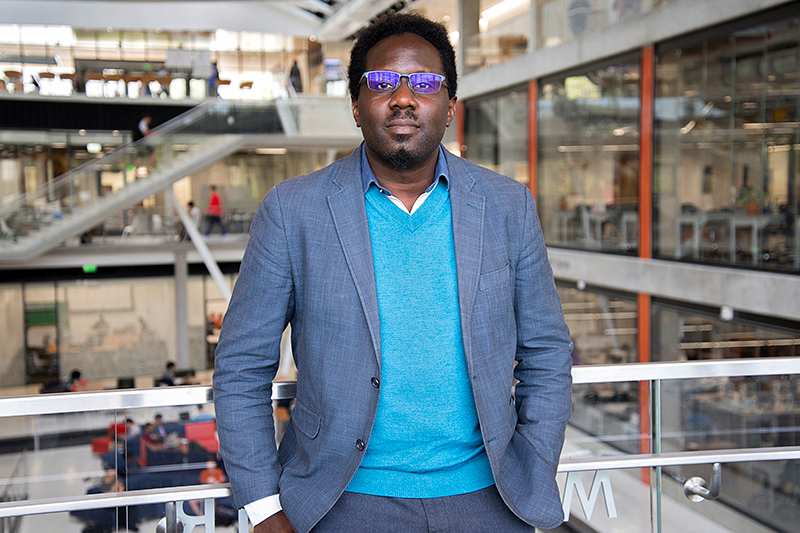
Deji Akinwande is a Professor and holds the Cockrell Family Regents Chair in Engineering #8 at The University of Texas at Austin's Chandra Family Department of Electrical and Computer Engineering. He earned his PhD in Electrical Engineering from Stanford University (2009) and an MS in Applied Physics from Case Western Reserve University. His research focuses on 2D materials, nanotechnology, and flexible electronics, with breakthroughs in atomristors, graphene-based biosensors, and wearable electronic tattoos. Key achievements include pioneering work on silicene, being elevated to IEEE Fellow (2021), and receiving the PECASE Award (Obama administration). His lab, the Akinwande Nano Research Group, explores nanoelectronics, bioelectronics, and RF systems for societal applications like health monitoring and 6G communications. Education: PhD, Electrical Engineering, Stanford University, 2009 MS, Applied Physics, Case Western Reserve University Awards: 2021 IEEE Fellow APS Fellow (2017) PECASE Award Moore Inventor Fellowship His research spans neuromorphic computing, flexible sensors, and energy-efficient memory devices. Over 100+ publications highlight his work on graphene, MXenes, and 2D material applications. He co-authored a textbook on carbon nanotubes and graphene (Cambridge University Press, 2011) and serves as an IEEE Distinguished Lecturer and editor for Nature NPJ 2D Materials . Lab and Collaborations: The Akinwande Nano Lab develops scalable 2D electronics, wearable health monitors, and next-gen RF components. Recent grants include NSF CHIPS Act funding and DoD support for 6G switches and neuromorphic hardware.
- 2D Materials
- Nanotechnology
- Flexible Electronics
- +۷ مورد دیگر