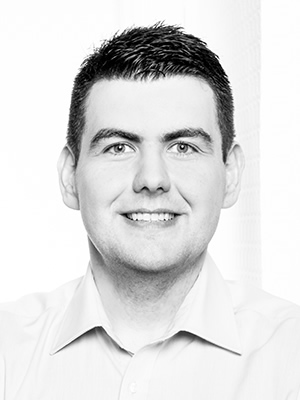
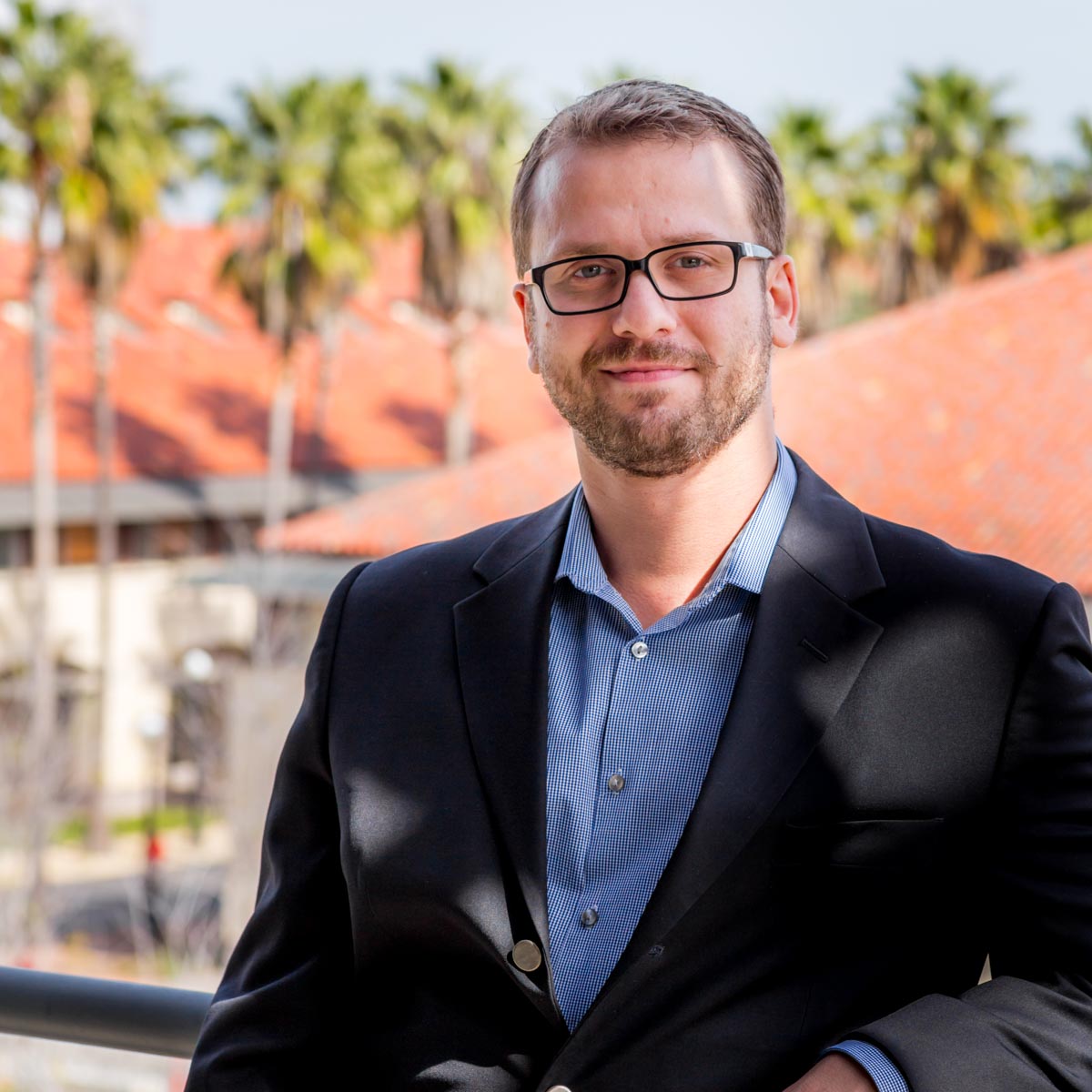
Giovanna Turvani is an Associate Professor at the Department of Electronics and Telecommunications (DET) at Politecnico di Torino, with affiliations in both the College of Electronic, Telecommunications and Physics Engineering and the College of Computer, Film, and Mechatronics Engineering. Scientific Branch: IINF-01/A - Electronics ERC Sectors: PE7_4, PE7_11, PE6_1, PE6_14, PE7_3 SDG Goals: Quality Education, Gender Equality, Affordable Energy, Industry Innovation Her research focuses on advanced electronics and quantum technologies, including: Logic-in-memory computing Quantum computing architectures Microwave imaging for medical and agricultural applications CAD tools for emerging nanotechnologies Embedded systems for bee health monitoring IoT solutions for bio-waste valorization Publications show strong expertise in quantum computing, nanocomputing, and microwave imaging, with recent trends emphasizing quantum optimization frameworks, in-memory architectures, and IoT-based agricultural technologies. She supervises PhD students in areas like quantum machine learning algorithms, predictive on-board systems, and quantum hardware design. Collaborations span multiple disciplines, including medical device development and agricultural electronics. Patents include innovations in microwave imaging, racetrack memory logic functions, and in-memory computing devices.
Professor Simon Robinson is a faculty member in the School of Mathematics and Computer Science at Swansea University, holding a position as a Professor of Computer Science. He serves as the Head of the Future Interaction Technologies (FIT) Lab and Director of the MSc year for the EPSRC Centre for Doctoral Training in Enhancing Human Interaction and Collaboration with Data-Driven Systems. His research focuses on devices and interactions designed for emergent users in low-connectivity regions, emphasizing participatory design and co-creation with underserved communities. Current projects include the EPSRC-funded UnMute initiative, which aims to empower marginalized language speakers through spoken language technologies. Key affiliations include leadership roles in the FIT Lab and the EPSRC CDT, alongside contributions to projects like Rethinking Public Technology in a Post-COVID Era, PV Interfaces, and Scaling the Rural Enterprise. His work spans ubiquitous computing, deformable devices, and inclusive interaction design for global south communities. Research interests center on Human-Computer Interaction (HCI), with a focus on low-resource settings. Recent work addresses speech technologies for unwritten languages, trust in human-robot interactions, and sustainable self-powered interfaces. His lab explores innovations like Light-In-Light-Out (Li-Lo) displays and community-driven smart materials (PV-Pix). Professor Robinson has supervised numerous PhD students across topics including AI ethics, predictive maintenance, and human-centric NLP. He teaches modules like Introduction to HCI and contributes to the Human-Centred Big Data and AI Dissertation program. His work integrates grants from EPSRC and collaborative projects with international partners, reflecting a commitment to socially impactful technology. Labs & Teams: Director of the FIT Lab, active in the EPSRC CDT, and collaborator in interdisciplinary teams focusing on rural technology, assistive AI, and sustainable interfaces.
Nicola Peserico is a Research Professor in the Department of Electrical & Computer Engineering at the University of Florida, affiliated with the College of Engineering. His primary research focus is on Integrated Optical Circuits and Silicon Photonics, with an emphasis on heterogeneous integration, hardware for Machine Learning/Neural Networks, and biosensing applications using integrated photonics. Education: Ph.D. (2018), M.S. (2014), and B.S. (2011) in Telecommunication Engineering from Politecnico di Milano. His research explores cutting-edge photonic technologies for accelerating neural networks, including Fourier-based convolution operations, reconfigurable circuits for solving PDEs, and energy-efficient optical interconnects. Recent work highlights advancements in photonic-electronic ICs, thermal management in photonic systems, and overcoming bottlenecks in memory and compute architectures. His publications emphasize photonic tensor cores, joint transform correlators, and silicon photonics integration for AI acceleration. Notable contributions include roadmap analyses for neuromorphic photonics and innovative packaging strategies for photonic neural network accelerators. No scientific awards or grants are explicitly listed in the provided texts. His advising record is not documented here. Labs/Teams: His work is part of broader efforts in photonic computing and AI hardware acceleration at the University of Florida, leveraging silicon photonics for next-generation computing systems.
Matthew J. Marinella serves as an Associate Professor in the School of Electrical, Computer and Energy Engineering at Arizona State University, where his research bridges semiconductor device physics and next-generation computing architectures. His work focuses on enabling reliable computing systems for extreme environments through novel memory technologies. His academic foundation includes: Ph.D. in Electrical Engineering, Arizona State University (2008) Marinella's research centers on nonvolatile memory devices (particularly ECRAM and SONOS technologies), neuromorphic computing systems, and radiation effects characterization. He pioneers analog in-memory computing solutions resilient to space radiation, with expertise spanning electrochemical memory physics, radiation-hardened circuit design, and emerging device applications for artificial intelligence. His experimental work combines nanoscale imaging with computational modeling to understand device degradation mechanisms under ionizing radiation. Analysis of his 2023-2025 publications reveals a dominant focus on radiation-tolerant neuromorphic systems, with 70% of recent work addressing radiation effects on emerging memories. Key thematic clusters include TaOx ECRAM characterization under gamma/heavy-ion exposure (25% of publications), analog in-memory computing fault tolerance (30%), and novel test platforms for memory device benchmarking (20%). This research directly enables space-based computing applications where radiation resilience is non-negotiable. As a technical leader, Marinella chairs the Emerging Memory Devices Section for the IRDS Roadmap Beyond CMOS Chapter and serves on the SRC Decadal Plan Executive Committee. His Sandia legacy includes founding the Secure, Efficient, Extreme Environment Computing (SEEEC) Grand Challenge. At ASU, he mentors graduate researchers through thesis supervision in EEE 599/799 courses and directs laboratory work on memory device characterization, though specific student names and grant awards aren't publicly enumerated. His laboratory operations emphasize radiation testing infrastructure and analog computing testbeds, supporting collaborative projects with national labs on space electronics hardening. Current efforts integrate magnetic domain wall devices with resistive memories to create hybrid neuromorphic systems capable of operating in extreme environments where conventional CMOS fails.
Soufiene Djahel is a Professor at the Centre for Future Transport and Cities (CFTC) at Coventry University, UK. His research focuses on connected and autonomous vehicles (CAVs), unmanned aerial vehicles (UAVs), cyber security, and smart cities. He holds a PhD in Secure Routing and Medium Access Protocols from Université des Sciences et Technologies de Lille (2010), and has held academic positions including Senior Lecturer at the University of Huddersfield and Manchester Metropolitan University. His research interests include CAV coordination protocols, cyber-physical security solutions, and intelligent transportation systems. Djahel leads projects such as the £1.2M AeroPharma Logistics initiative and has secured funding from the Newton Fund and JSPS. He is a recipient of the 2021 JSPS Invitational Fellowship and has published extensively in IEEE journals and conferences. Current projects explore UAVs-as-a-service, digital twins for CAVs, and B5G/6G for smart infrastructure. He advises PhD students on topics like AI-based threat mitigation and transport electrification. Djahel also serves as an external examiner and editorial board member for journals like IEEE Transactions on Intelligent Transportation Systems.
Janki Bhimani is a Professor and Director of the Data Management Research Lab (DaMRL) at the School of Computing and Information Science, Florida International University (FIU). Her research focuses on Memory and Storage Systems, Cloud Computing, Performance Modeling, and Applied Machine Learning. She holds a Ph.D. in Computer Engineering from Northeastern University (2019), an M.S. in Electrical and Computer Engineering (2016), and a B.S. in Electrical and Electronics Engineering from GITAM University (2013). Prior to FIU, she taught at Northeastern University and collaborated with Samsung Semiconductor Research Labs on flash-based SSDs. Her research interests include emerging memory technologies, high-performance computing, and datacenter reliability management. She leads innovative projects like Heimdall (machine learning for storage I/O optimization) and MoKE (modular key-value storage emulation). Awards include FIU Top Scholar and KFSCIS Excellence in Applied Research. Teaching highlights include CIS 3530 (Data Structures), CIS 5346 (Storage Systems), and EECE 2560 (Engineering Algorithms). Her work emphasizes bridging theory and practice, with patents on storage system optimization and machine learning integration.
Dr Bastien Lechat is a Research Fellow at Flinders Health and Medical Research Institute (FHMRI): Sleep Health, within the College of Medicine and Public Health at Flinders University. He is also a Full Member of the College of Science and Engineering and the Medical Device Research Institute. As an NHMRC Emerging Leadership Fellow, he leads innovative research at the intersection of sleep medicine, artificial intelligence, and wearable technology. Education: PhD in Sleep Health, Adelaide Institute for Sleep Health, Flinders University (2018–2021) Bachelor of Engineering in Engineering Science/Acoustics, Université du Maine, France (2014–2017) Dr Lechat’s research focuses on understanding the physiological mechanisms and consequences of obstructive sleep apnea (OSA), particularly night-to-night variability and patient subtypes. He develops AI-driven tools for efficient and accurate diagnosis using wearables and signal processing. His work aims to create a scalable, low-cost model of care for sleep-disordered breathing, addressing global diagnostic gaps. His recent publications reveal a strong trend in digital health innovation, with a focus on machine learning for OSA detection, circadian rhythm modeling, cardiovascular risk prediction, and climate impacts on sleep. His research has been published in top journals including Nature Communications , Journal of Sleep Research , and Sleep Medicine , demonstrating interdisciplinary reach. Scientific Awards and Recognition: NHMRC Emerging Leadership Fellow (2023) Helen Bearpark Memorial Scholarship (2022) Emerging Research Leader Award, Flinders University (2021) Multiple early-career awards from Sleep Down Under, Australasian Sleep Association, and Adelaide Sleep Retreat Ranked in the top 5% of international authors in sleep apnea by Expertscape Dr Lechat has secured over $2.5 million in competitive research funding and actively supervises and mentors junior researchers. He serves on the program committee of the American Thoracic Society meetings and contributes to clinical guidelines. He collaborates globally with industry and academic partners to translate research into clinical practice. Laboratories and Research Teams: He co-leads the 'Novel use of digital innovations & technology development' theme at FHMRI: Sleep Health, working closely with Professor Danny Eckert. His team integrates expertise in biomedical engineering, data science, and clinical sleep physiology to advance digital sleep medicine.
Prof. Ilia Polian serves as Head of the Institute of Computer Engineering and Chair of the Hardware-Oriented Computer Science (HOCOS) department at the University of Stuttgart. His leadership spans research, teaching, and institutional coordination across multiple high-impact projects. Prof. Polian's research focuses on developing circuit and system architectures based on both traditional and novel principles, including neuromorphic, stochastic, and approximate architectures. His second major research focus is systematic design methodology and design automation, with particular emphasis on safety and reliability properties of developed systems. Current research directions include quantum computing engineering, secure mixed-signal neural networks, and resource-efficient stochastic circuits for near-sensor computing applications. His recent publications demonstrate strong trends in quantum computing (particularly circuit partitioning and compilation for multi-QPU architectures), hardware security (including memristive cryptographic implementations), and AI-driven approaches to hardware testing and reliability. These works bridge fundamental computer architecture research with practical industrial applications. University of Stuttgart's Publication Prize for Paper on Partitioning of Quantum Circuits Prof. Polian actively supervises doctoral students including Devanshi Upadhyaya, and leads significant research grants such as the DFG Priority Program Nano Security which he coordinates. His department offers numerous thesis and research opportunities for students interested in cutting-edge hardware research. The Hardware-Oriented Computer Science department maintains strong collaborations with industry partners including IBM, Infineon Technologies, and Advantest, as well as academic institutions through the IQST Graduate School and QuantumBW initiatives.
Ryszard Lenczewski is a distinguished Professor of Film Art at The Leon Schiller National Higher School of Film, Television and Theatre in Łódź, where he has served as a lecturer at the Cinematography Department since his graduation in 1974. He held the position of Vice-Dean from 2008 to 2014 and has been instrumental in shaping generations of Polish cinematographers. As a member of prestigious film organizations including the Society of Cinematographers (PSC), the European Film Academy (EFA), the British Academy of Film and Television Arts (BAFTA), and the American Academy of Motion Picture Arts and Sciences (AMPAS), Lenczewski has established himself as a significant figure in international cinema. Lenczewski's research and creative interests span cinematography, film art, documentary filmmaking, visual storytelling, and camera techniques. His extensive filmography demonstrates mastery across feature films, documentaries, and television productions, with notable works including the Oscar-winning film "Ida" (2013) where he served as cinematographer. His approach combines technical precision with profound artistic expression, emphasizing visual narrative and emotional depth through innovative camera work and lighting techniques. Throughout his career, Lenczewski has supervised numerous student films, guiding emerging talent in cinematography techniques and visual storytelling. His pedagogical approach emphasizes hands-on experience and creative experimentation, reflected in the diverse range of student projects he has mentored from 2013 through 2025. 2013 Decoration Silver Medal for Merit to Culture - Gloria Artis 2015 Golden Camera 300 Lifetime Achievement Award at the Manaki Brothers Film Festival 2018 Gold Medal "Gloria Artis - For Merit to Culture" 2019 "Golden Glan" award from Charlie cinema in Łódź 2020 Society of Cinematographers (PSC) Lifetime Achievement Award 2022 Polish Filmmakers Association Award 2024 Silver Cross of Merit Lenczewski's creative output reveals a consistent exploration of visual narrative techniques, with recent student projects focusing on experimental cinematography, sensory film experiences, and innovative approaches to time, space, and emotion in visual storytelling. His work demonstrates mastery across documentary, feature film, and educational contexts, establishing him as a versatile and influential figure in contemporary cinematography.
Michael Levin is a Distinguished Professor at Tufts University in the Department of Biology within the School of Arts and Sciences. He serves as Director of both the Allen Discovery Center at Tufts University and the Tufts Center for Regenerative and Developmental Biology. His laboratory investigates the intersection of developmental biology, artificial life, bioengineering, synthetic morphology, and cognitive science. Allen Discovery Center at Tufts Tufts Center for Regenerative and Developmental Biology Tufts/UVM: ICDO Harvard Wyss Institute Stibel Dennett Consortium for Brain and Cognitive Science The Proteus Institute MIT Science and Technology Center EBICS Levin's research focuses on understanding diverse intelligence in evolved, designed, and hybrid complex systems. His lab combines developmental biophysics, computer science, and behavioral science to study how cognition scales up from cellular competencies to organism-level behaviors. A key specialty is developmental bioelectricity—the study of how somatic electrical networks store, process, and act on information to control large-scale body structure. His team creates tools to read and edit the bioelectric code guiding proto-cognitive computations in the body. Levin's publications reveal a strong focus on bioelectricity, morphogenesis, and non-neural cognition across multiple model systems including Xenopus, planarians, and synthetic living constructs. His recent work explores collective intelligence as a unifying concept across biological scales, the development of microfluidic devices for measuring electrical connectivity, and optical estimation of bioelectric patterns in living embryos. His research spans fundamental developmental mechanisms to potential biomedical applications in regeneration and disease treatment. As an editor, Levin serves as Co-Editor-in-Chief of Bioelectricity and Founding Associate Editor of Collective Intelligence. He has mentored numerous post-doctoral fellows and graduate students who have gone on to establish their own research programs. His lab has received significant attention for creating novel biological machines (xenobots) and demonstrating that cells can store and transmit behavioral memory outside the brain. The Levin Lab maintains several significant research initiatives including the Allen Discovery Center at Tufts, the Tufts Center for Regenerative and Developmental Biology, and collaborations with the Wyss Institute at Harvard. The lab employs a multidisciplinary approach combining wet lab experiments with computational modeling to investigate how living systems achieve goal-directed behavior and pattern formation.
Dr. Patrick W. C. Ho is a Lecturer in the Department of Electrical & Computer Systems Engineering (ECSE) at Monash University Malaysia School of Engineering. He holds a PhD in Electronics Engineering from the University of Nottingham Malaysia Campus (2016), with research focusing on non-volatile FPGA architectures using memristors. His academic journey includes roles as a Scholarly Teaching Fellow and unit coordinator for courses like ECE2131 Electrical Circuits and ECE4063 Large Scale Digital Design. He has industry experience with Intel Microelectronics and Altera Corporation, alongside teaching A-level Physics at Methodist College Kuala Lumpur. Education: BEng (First Class Honours) in Engineering (2009) MSc in Science (2012) PhD in Electronics Engineering (2016) Research Interests: Dr. Ho specializes in memristor-based non-volatile memory systems, VLSI design, and FPGA architectures. His work bridges hardware design with emerging materials, as seen in his Q1 journal article on memristive LUTs. Collaborations with CAD-IT expand his focus into AI, image processing, and object recognition. Recent projects include studies on memristor substrate performance (2023–2026) and UAV communication reliability (2021–2024). Teaching and Industry Engagement: As ECSE’s Industrial Training Advisor and IAP representative, he actively connects academic curricula with industry needs. His teaching spans foundational engineering courses and advanced digital design modules. Labs and Collaborations: Active in CAD-IT partnerships for student FYP co-sponsorship. Research groups focus on nanotechnology, machine learning integration in UAV systems, and memristor material analysis.
Prof. Dr.-Ing. Marc Reichenbach serves as the Chair of Integrated Systems at the Institute for Applied Microelectronics and Data Technology at the University of Rostock. His office is located at Albert-Einstein-Straße 26, 18059 Rostock, Room 102 (1st floor), with contact information including telephone (0381) 498 7270 and email marc.reichenbach@uni-rostock.de. Professor Reichenbach's research focuses on the intersection of hardware design and artificial intelligence, with particular expertise in memory technologies and computing architectures. His work spans several key areas: Development of specialized computer architectures for deep learning applications Advanced VLSI design and CPU architecture Emerging memory technologies, particularly RRAM (Resistive Random-Access Memory) FPGA-based acceleration systems Hardware implementations for neural networks and AI applications Analysis of Professor Reichenbach's recent publications (2023-2025) reveals a strong focus on memory computing technologies, particularly RRAM-based systems. His work demonstrates expertise across multiple dimensions of computer architecture including ASIC design, FPGA acceleration, and novel memory systems. The publications show a clear trajectory toward implementing AI and machine learning capabilities directly in hardware, with applications ranging from edge computing to satellite systems. A significant portion of his recent work addresses the challenges of implementing neural networks using emerging memory technologies, focusing on efficiency, reliability, and performance optimization. Professor Reichenbach teaches several advanced courses including: Computer architectures for deep learning applications Project seminar Embedded Systems Advanced VLSI Design (Advanced CPU Design) His research group appears to be actively engaged in several cutting-edge projects related to hardware acceleration for AI applications, memory computing, and embedded systems design. The group collaborates on projects involving digital twins for hardware systems, real-time operating systems for heterogeneous architectures, and specialized computing systems for various applications from medical devices to drone technology.
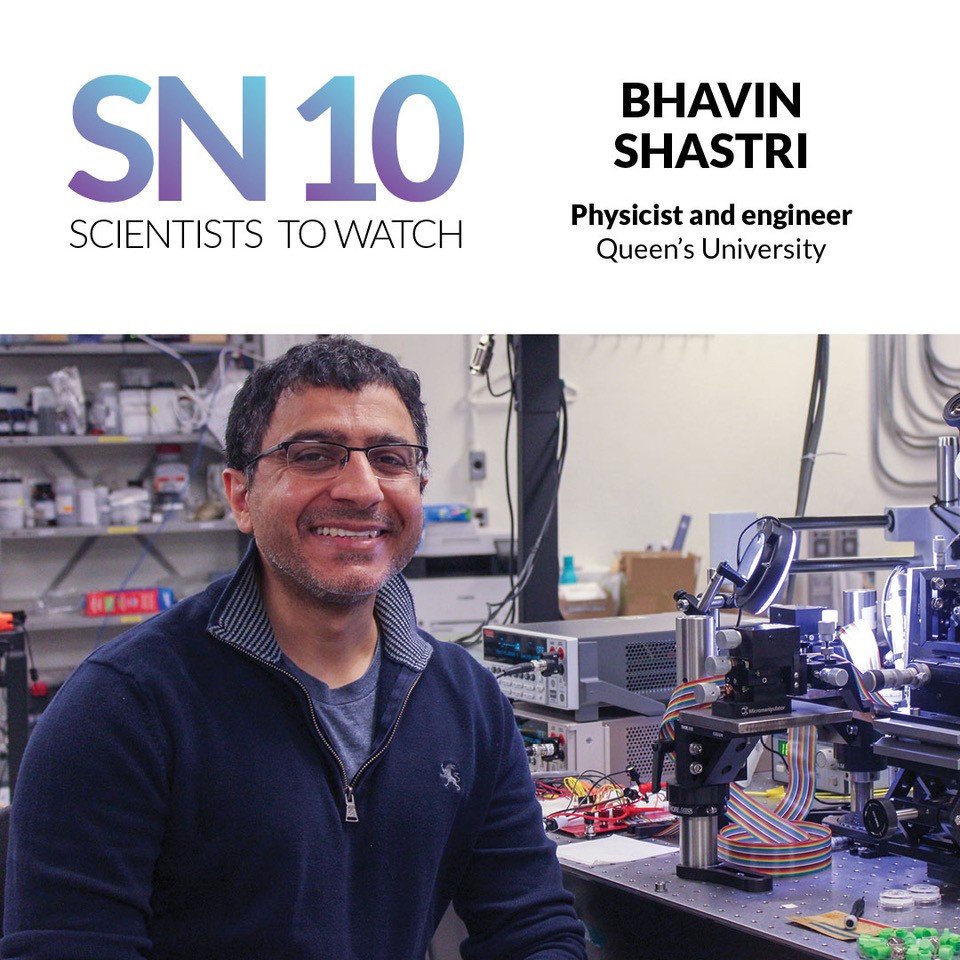
Bhavin Shastri is Canada Research Chair in Neuromorphic Photonic Computing and Assistant Professor of Engineering Physics at Queen's University. He directs research developing light-based computing systems that mimic neural processing for AI applications. His lab designs photonic integrated circuits that implement neural network architectures on chip-scale platforms. Research focuses on overcoming limitations of conventional computing through nanophotonic physics and novel materials. Publications demonstrate advances in photonic tensor cores, quantum photonic neural networks, and microwave photonic processors. Recent work achieves orders-of-magnitude improvements in processing speed and energy efficiency over electronic systems. Awards include: Alfred P. Sloan Research Fellowship (2025) Royal Society of Canada College Member (2024) Science News SN10 Scientist to Watch (2024) SPIE Early Career Award (2022) As Scientific Co-Director of NSERC's NUCLEUS program, he leads national efforts in photonic computing. Guides 12+ graduate students researching silicon photonics, neuromorphic architectures, and quantum photonics.
Jingxian Wang is an NUS Presidential Young Professor and Assistant Professor in the Department of Computer Science at the National University of Singapore's Faculty of Computing. His research builds next-generation wireless systems and satellite networks, with primary focus on integrating AI with wirelessly networked devices from WiFi to satellites. He earned his PhD from Carnegie Mellon University and previously served as a research scientist at Microsoft Research in Redmond, where he led the Smart Surface for 6G and Space initiative. His educational journey includes: PhD, Carnegie Mellon University Wang's research spans Wireless Systems , Satellite Networks , Artificial Intelligence , and Internet of Things , emphasizing AI-augmented wireless systems. His interdisciplinary work bridges robotics , materials science , and AI to develop sustainable sensing methods, robust communication networks, and multimodal AI techniques. Key projects include Multimodal AI for IoT (funded by Microsoft's Accelerate Foundation Models Program) and Satellite IoT Networks. His publication trends reveal accelerating integration of AI into wireless systems, with recent focus on satellite networking, soft robotics actuation, and generative models for IoT. The research consistently targets real-world deployment challenges in battery-free systems and space networks. His scientific contributions have earned prestigious recognition: ACM SIGMOBILE Doctoral Dissertation Award 2023 Communications of the ACM Research Highlights (2021, 2022) ACM SIGMOBILE Research Highlights 2021 Best Paper Awards at IPSN 2021 and UbiComp 2020 Microsoft Research Fellowship 2020 Emerging Rockstar in IEEE Pervasive Computing 2024 Wang actively mentors doctoral students and postdoctoral researchers through his AIoT Group. His grant portfolio includes Microsoft's Accelerate Foundation Models Research Program funding for multimodal AI projects, with ongoing work targeting satellite IoT infrastructure and wireless-powered soft robotics. Future directions emphasize foundation models for space networks and battery-free IoT systems. He leads the AIoT Group, fostering cross-disciplinary collaboration between computer scientists, roboticists, and materials engineers to pioneer wireless sensing and actuation technologies.
Baris Kasikci is an Associate Professor in the Paul G. Allen School of Computer Science & Engineering at the University of Washington. Previously (2017-2023), he was a Morris Wellman Assistant Professor in the Electrical Engineering and Computer Science Department at the University of Michigan. His research focuses on building efficient and trustworthy computer systems through innovative combinations of approaches from systems, computer architecture, and programming languages. Dr. Kasikci received his PhD in Computer Science at EPFL and has held research positions at Microsoft Research Cambridge, Google, Intel, and VMware. His work addresses critical challenges in system reliability, security, and performance in increasingly complex software ecosystems. His research interests center on improving the efficiency of datacenter applications and machine learning systems, analyzing and fixing failures, and enhancing hardware security. His lab develops techniques for automated bug detection, formal verification of distributed systems, and building systems support for heterogeneous hardware architectures. Recent projects include Whisper (profile-guided branch misprediction elimination), Huron (taming false sharing), and Agamotto (automatic detection and repair of bugs in persistent memory applications). Analysis of his recent publications shows a strong trend toward optimizing large language model serving, hardware security, and performance optimization for modern heterogeneous architectures. His work bridges traditional systems research with emerging AI infrastructure needs, particularly in efficient LLM serving, security vulnerabilities in modern hardware, and performance optimization for heterogeneous computing environments. NSF CAREER award Microsoft Research Faculty Fellowship Intel Rising Star Award VMware Early Career Faculty Grant Google Faculty Award Roger Needham PhD Award (best PhD thesis in computer systems in Europe) Patrick Denantes Memorial Prize (best PhD thesis at EPFL) Best Paper Award at OSDI'18 Best Paper Award at MICRO'22 Dr. Kasikci has advised numerous PhD students who have gone on to prestigious positions in academia and industry, including Tanvir Ahmed Khan (Assistant Professor at Columbia University), Akshitha Sriraman (Assistant Professor at CMU), and Jiacheng Ma (AMD). His research has been supported by significant grants from NSF, DARPA, Intel, Google, Microsoft, VMware, and Amazon. His lab, the EfesLab, focuses on building tools and techniques that make computer systems more reliable, secure, and efficient. The EfesLab, led by Dr. Kasikci, brings together postdocs, PhD students, and undergraduate researchers to tackle fundamental challenges in systems reliability and performance. The lab has developed numerous influential tools including Whisper, Huron, and Agamotto that address critical performance and reliability issues in modern computing systems. Current research directions include efficient LLM serving, security of emerging hardware technologies, and automated debugging techniques.