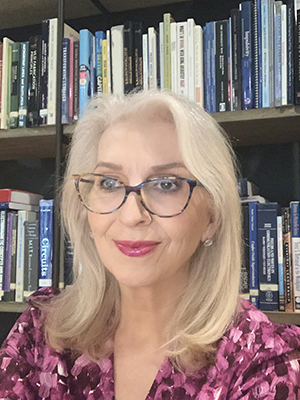
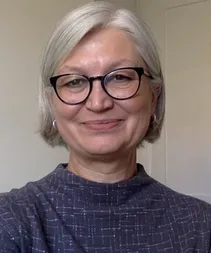
Gregory Flaxman is an Associate Professor of English and Comparative Literature at the University of North Carolina, Chapel Hill, and Director of Global Cinema Studies (GCS). He holds adjunct roles in Communication Studies and affiliate positions in American Studies, Jewish Studies, and Cultural Studies. His research explores intersections between aesthetics, philosophy, and film, with notable works including Gilles Deleuze and the Fabulation of Philosophy (2011) and edited volumes like The Brain is the Screen (2000). Flaxman earned his Ph.D. in Comparative Literature from the University of Pennsylvania (2003), and earlier degrees in Film Studies (University of Iowa, 1997) and English (University of Minnesota, 1995, and University of Michigan, 1991). His teaching awards span 20 years, including the UNC Distinguished Teaching Award (2011) and multiple grants from the Mellon Foundation and Australian Research Council. Research interests span film theory, critical theory, posthumanism, and literature-philosophy dialogues. Recent work focuses on Robert Bresson’s cinema and American biopolitics. He frequently lectures on Deleuze, cinematic ethics, and postcolonial visual culture. Flaxman teaches graduate and undergraduate courses on topics like liberalism, film theory, and comparative literature. His website hosts syllabi and writings, while his office is located at 508 Greenlaw Hall.
Matthew Halm is a Visiting Lecturer at the Georgia Institute of Technology, affiliated with the School of Literature, Media, and Communication. He also holds a lecturer position in MIT’s Writing, Rhetoric, and Professional Communication program. His research focuses on planetary-scale persuasion, new materialist approaches to rhetoric, and infrastructural communication. Halm earned a PhD in Communication, Rhetoric, and Digital Media from North Carolina State University, an MA in Rhetoric and Composition from Washington State University, and a BA in English/Mathematics from Case Western Reserve University. Research interests include environmental rhetoric, digital media studies, and the intersections of technology with persuasive discourse. His work explores how planetary challenges like climate change require rethinking rhetoric’s material and infrastructural dimensions. Notable projects include the 'DevLab' initiative at Georgia Tech, supporting tech integration in teaching/research, and experimental work with Microsoft Kinect sensors to study embodied inscription practices. Key publications analyze ecological rhetoric, materialist circulation theories, and touch-interactive technologies. Recent articles include Molten Circulation and Rhetoric's Materiality (2023) and Some Challenges of Thinking Ecologically About Rhetoric (2024). His work bridges media studies with environmental concerns, emphasizing rhetoric’s role in addressing global-scale issues.
Alissa N. Antle is Professor at Simon Fraser University's School of Interactive Arts and Technology, where she directs the Tangible, Embodied, Child Interaction (TECI) Research Lab. A Fellow of the Royal Society of Canada's College of New Scholars, her research develops interactive technologies to support children's cognitive and emotional development. Antle's current projects include VR systems for emotion regulation, AI literacy tools, and ethical design frameworks for biowearables. Her work employs research-through-design approaches and mixed-methods evaluations, often involving vulnerable populations. She collaborates with educators, clinicians, and international partners to create technologies for literacy development, mental health support, and critical digital literacy. Antle has received the FCAT Distinguished Researcher award and funding from SSHRC, NSERC, and CFI to support her research program in child-centered technology design.
Linda Katehi is a Professor of Electrical & Computer Engineering and Materials Science & Engineering at Texas A&M University, holding the O'Donnell Foundation Chair II. She is a Member of the National Academy of Engineering and American Academy of Arts and Sciences. Her research focuses on advanced electromagnetic systems, MEMS devices, and embedded intelligent sensors. Katehi earned her Ph.D. in Electrical Engineering from UCLA (1984), with prior degrees from UCLA and the National Technical University of Athens. Education: Ph.D., Electrical Engineering, UCLA (1984) M.S., Electrical Engineering, UCLA (1981) B.S., Electrical and Mechanical Engineering, National Technical University of Athens (1977) Research Interests: Katehi pioneers innovations in microwave circuits, MEMS-based reconfigurable systems, terahertz technology, and neuromorphic sensors. Her work emphasizes integrating artificial intelligence into hardware for adaptive sensing platforms. Recent projects include flexible electronics, time-domain system analysis, and sustainability in urban infrastructure. Awards & Recognition: Ramo Simon Founder’s Award (2015) Charter Fellow, National Academy of Inventors (2013) Leading Women in STEM Award (2012) Rudy E. Henning Mentoring Award (IEEE, 2011) Lab & Teams: Directs the Intelligent Electromagnetic Sensors Lab (IEMSL), advancing embodied intelligence in electronics. Her team develops AI-embedded sensors and reconfigurable systems for applications in healthcare, communications, and environmental monitoring. Collaborates across disciplines to address global sustainability and equity challenges.
Rebecca Lester is a Professor of Sociocultural Anthropology and Assistant Vice Provost of Faculty Affairs and Diversity at Washington University in St. Louis. She holds a PhD from the University of California, San Diego. Her research focuses on embodiment, existential distress, and cultural practices of self-cultivation, with key projects addressing eating disorders, Latina teen suicide, and polyamory in late capitalism. Her clinical work as a licensed social worker (LCSW) integrates anthropological insights with mental health care, specializing in eating disorders, mood disorders, and alternative relationship dynamics. She has authored influential books like Famished: Eating Disorders and Failed Care in America (2019) and Jesus in Our Wombs (2005), earning awards such as the Victor Turner Prize and Ellen Basker Prize. Lester’s academic contributions span peer-reviewed articles, special journal issues, and public-facing publications. Her work critiques healthcare systems and explores how cultural meanings shape individual experiences. Notable grants include an NIMH R01 grant for studying Latina teen suicide. She also advocates for mental health in academia and offers teletherapy services as a 501(c)(3) nonprofit. Her current research examines polyamory as a response to economic precarity, linking intimate practices to broader societal shifts. She balances academic leadership with clinical practice, emphasizing collaboration over pathologization in therapeutic approaches.
Sandra Dudley is a Professor of Museum Anthropology and Head of the School of Museum Studies at the University of Leicester. She joined Leicester in 2003 and became Head of School in 2017. Previously, she held postdoctoral positions at the University of Oxford, including roles at the Pitt Rivers Museum and the Department for International Development, and taught at Oxford’s School of Anthropology and Museum Ethnography and the University of East Anglia. Her research focuses on material culture, displacement, and refugee experiences, particularly among the Karenni people in Thailand. She has curated major textile collections from Southeast Asia and advised on refugee and museum projects. Dudley is a Senior Fellow of the Higher Education Academy and co-founded the journal Museum Worlds: Advances in Research (2013–2021). Her work examines the intersection of museums, colonial histories, and postcolonial narratives, with a focus on Myanmar. Key themes include the agency of objects, displacement studies, and the sensory dimensions of museum experiences. Her publications analyze how material culture mediates identity, memory, and displacement, particularly among marginalized communities. She has contributed to global debates on museum ethics, curation practices, and the role of museums in public spheres. Her research bridges anthropology and museology, emphasizing interdisciplinary approaches to understanding materiality and human experience.
Stephen H. Lane is a Teaching Professor at the University of Pennsylvania's School of Engineering and Applied Science, Department of Computer and Information Science. He serves as Director of the Computer Graphics and Game Technology (CGGT) Master's Program and teaches courses such as Computer Animation (CIS462/562), Advanced Topics in Computer Graphics and Animation (CIS660), and Game Design and Development (CIS564). He also supervises the Game Design Practicum (CIS568) capstone course. Education: B.S. in Mechanical and Aerospace Engineering from Cornell University (1980) M.S. in Systems Engineering from UCLA (1982) Ph.D. in Mechanical and Aerospace Engineering from Princeton University (1988) Dr. Lane's research focuses on the intersection of robotics, physically-based character animation, embodied intelligent agents, and virtual reality user interfaces. His work integrates control theory, artificial intelligence, and computer animation techniques to develop advanced simulation and training systems. His publications since 1987 cover topics such as inverse kinematics, neural networks for motion control, B-spline receptive fields, robotic skill acquisition, and gesture recognition systems. His recent work (2010-2011) emphasizes sensor fusion for gesture recognition and immersive training interfaces. Scientific Awards: Co-inventor of four US patents related to robotic animation and motion control systems Contributions to hybrid controller hierarchies and neural network training methods As founder of soVoz, Inc., Dr. Lane commercializes behavioral animation technology for virtual environments. His academic-industry collaboration includes contracts with Microsoft, Disney, and the US Army. He has developed tools like ProScena™ to integrate interactive 3D simulation capabilities into gaming and training applications.
Alanna Skuse is an Associate Professor in the Department of English Literature at the University of Reading, part of the School of Humanities. Her research examines medicine, identity, and embodiment in early modern England, with a focus on surgical practices, self-wounding, and the intersections of literature and medical history. She holds a Wellcome Trust Award for her project on self-inflicted wounds in early modern texts and actively engages in public humanities initiatives through writing and radio appearances. Skuse's work bridges literary studies and medical humanities, exploring how bodily alterations (e.g., amputations, mastectomies) influenced cultural identity debates. Her books include Surgery and Selfhood in Early Modern England (Cambridge, 2021) and Constructions of Cancer in Early Modern England (Palgrave, 2015). She co-directs the interdisciplinary Centre for Health Humanities and leads research groups on identities and diversity/inclusion within her department. Her publications analyze topics like castration narratives, prosthetic limbs in theater, and early modern medical ethics. Skuse advocates for open-access research and collaborates with artist-practitioners to foster public engagement. She supervises postgraduate students in early modern studies and health humanities.
Alice Baldock is the Okinaga Junior Research Fellow in Japanese Studies at Wadham College, University of Oxford, a position she holds from 2023 to 2026. Her academic work is situated within the Faculty of Asian and Middle Eastern Studies, specializing in the Department of Japanese Studies. Her research bridges historical scholarship with performance practice, focusing on the cultural and intellectual history of the body in 20th-century Japan. Her research interests center on 20th-century Japanese history, gender in postwar Japan, and the transnational circulation of ideas about the body. She explores how dancers and intellectuals redefined concepts like nikutai (flesh body) to challenge social hierarchies of gender, class, and ability. Her work emphasizes how embodied practices such as butoh offered alternative modes of existence in a rapidly codified and consumerist society. She is particularly interested in how these ideas gained popularity in Japan and spread globally. The themes in her recent publications reflect a strong interdisciplinary focus, combining history, gender studies, performance theory, and cultural analysis. Her work traces the intellectual legacy of dancers and bodily practices, examining how embodiment becomes a site of resistance and knowledge production. The articles show a consistent engagement with postwar Japanese identity, feminist reinterpretations of the body, and the globalization of aesthetic philosophies. Alice is actively involved in integrating the humanities with the performing arts. She co-organized the international conference Missing Bodies, Missing Voices: Ordinary Lives and the Reframing of Postwar Japan at St Antony’s College, Oxford, and has collaborated with butoh companies such as Café Reason and Mutekisha. Her creative practice includes performances in Yume no yume, oku no oku, nokori no hi and Kokkyounaki Karada , as well as participation in UK-based artist residencies. These initiatives reflect her commitment to interdisciplinary dialogue and scholar-practitioner collaboration.
Stephanie Jean Alexander is an Assistant Professor in the Department of English at Indiana State University's College of Arts & Sciences. She holds a Ph.D. in English from Louisiana State University (2014) with emphasis in Women's and Gender Studies and has been teaching at ISU since 2014. She also serves as the Faculty Fellow for Instructional Tools and Program Coordinator for the Master Teacher program. Ph.D., English, Louisiana State University, 2014 M.A., English, Indiana State University, 2008 B.S., English, Indiana State University, 2006 Her research centers on contemporary Irish literature, particularly the works of Seamus Heaney and Paul Muldoon, and intersects with feminist, queer, and trauma theories. She explores themes of maternity, abjection, surveillance, and pastoral poetics in literary texts. Her scholarship also extends into composition, literacy pedagogy, and popular culture studies , where she investigates how media representations shape gender and identity. Her recent publications reveal a strong focus on Irish literary modernism and postmodernism , with increasing attention to gendered narratives during the Troubles and feminist re-imaginings of motherhood . She frequently employs interdisciplinary lenses from psychoanalysis, cultural studies, and feminist theory. Scientific Awards and Honors: Charlotte Zietlow Women Faculty Research Award (2023) Honors College Faculty of the Year (2023) Outstanding Supervisor Award (2018) Professing Excellence and Inspiring Instruction (2019) Nominated for Foundational Studies Excellence in Instruction Award (2025) Nominated for College of Arts and Sciences Outstanding Professor Award (2025) Multiple nominations for Foundational Studies Teaching Award Stephanie Alexander actively contributes to academic service and faculty development. She has chaired technology and curriculum committees, served on the Graduate Council and Foundational Studies Council, and led initiatives in instructional design and academic integrity. As Faculty Fellow for Instructional Tools and Master Teacher Coordinator, she mentors colleagues in pedagogical innovation. She has not received external grant funding as principal investigator, but has contributed to collaborative projects such as the sensory garden initiative. She regularly presents at national conferences including the American Conference for Irish Studies, Popular Culture Association, and National Women's Studies Association. She is involved in developing academic programs and faculty support systems, particularly through her leadership in the Faculty Center for Teaching Excellence and the Learning Management System committees. Her work emphasizes inclusive, empathetic, and technology-enhanced teaching practices.
Bärbel A. Knäuper is the James McGill Professor in the Department of Psychology at McGill University. Her research focuses on applied social cognition and health behavior change, with particular emphasis on interventions targeting eating behavior, physical activity, medication adherence, and mindfulness. She directs the McGill CHIP Healthy Weight Program, a prominent initiative evaluating behavioral strategies for weight management. Her research interests include health belief systems, psychometric scale development, and the validity of self-reported data. She has supervised numerous clinical and experimental psychology graduate students in both theoretical and applied research contexts. Key research trends in her publications emphasize evidence-based interventions using if-then planning strategies, mindfulness practices, and multi-component behavioral therapies. Her work bridges clinical and experimental psychology, with practical applications in public health and chronic disease management. Labs & Teams: Director of the Health Psychology Lab and leader of the McGill CHIP Healthy Weight Program team.
Bissera Pentcheva is the Victoria and Roger Sant Professor of Art and Professor of Classics (by courtesy) at Stanford University. She holds a Ph.D. from Harvard University and a B.A. from Dartmouth College. Her research bridges art history, acoustics, and music, focusing on Byzantine and medieval art's multisensory dimensions. She co-directs the Icons of Sound project, exploring the acoustic environment of Hagia Sophia, and leads the Enchanted Images project on the medieval art and liturgy of Sainte-Foy at Conques. Dr. Pentcheva’s work emphasizes the interplay between architecture, sound, and ritual. Her books include Hagia Sophia: Sound, Space and Spirit in Byzantium (2017) and The Sensual Icon (2010), which investigate how materiality and sensory experience shaped medieval spirituality. Recent projects include aural reconstructions of Byzantine chant and interdisciplinary exhibitions linking music, dance, and art. Her research has been supported by prestigious fellowships from the Guggenheim Foundation, American Academy in Rome, and others. She has published extensively on topics like the animation of icons, multisensory aesthetics, and virtual reconstructions of medieval spaces. Current initiatives include studies on Sainte-Foy’s liturgical design and the cultural legacy of Hagia Sophia. Awards and recognitions include the Nicholas Brown Prize (2010) and the American Academy of Religion Award (2018). Her work appears in venues like Speculum and Journal of the International Society for Orthodox Christian Music . She advises on digital humanities projects and collaborates with CCRMA (Stanford’s Center for Computer Research in Music and Acoustics).
Nicole Brown is an Associate Professor in Education and Academic Head of Learning and Teaching at UCL's IOE - Culture, Communication & Media. Her work focuses on accessibility, creative research methods, and challenges faced by disabled academics. She holds a PhD and multiple certifications, including Senior Fellowship of the Higher Education Academy and RSA Fellowship. University: University College London (UCL) School: IOE - Faculty of Education and Society Department: Culture, Communication and Media Research Interests: Nicole explores embodied inquiry, creative data analysis, and ableism in academia. Her books include Photovoice Reimagined and Ableism in Academia . She advocates for inclusive pedagogies and participatory research methods, often using art-based approaches to highlight marginalized voices. Key Achievements: Nicole has developed frameworks like Systematic Visuo-Textual Analysis and led projects on doctoral education disclosure challenges. She is a sought-after mentor for HEA fellowships and contributes to academic ethics discussions.
Marta Ajmar is an Associate Professor in the Department of History of Art at the University of Warwick, specializing in Renaissance and Early Modern global material culture, design, and experiential learning. Prior to her current role, she held leadership positions at the Victoria and Albert Museum (V&A), including Deputy Director of the V&A Research Institute and Head of the V&A/RCA Masters in History of Design. Her work bridges academia, museums, and practical making, focusing on interdisciplinary research and learning-through-making pedagogies. PhD in Cultural and Intellectual History, Warburg Institute, University of London MA in Combined Historical Studies (The Renaissance), Warburg Institute BA in Art History, Literary Studies, and Classics, University of Pavia Diploma in Chinese Language and Culture, ISMEO and Beijing Language and Culture University A leading scholar in material culture and design history, Ajmar’s research explores the interconnectedness of Europe and Asia during the Global Renaissance, histories of the domestic interior, and experiential pedagogies in higher education. Her publications and projects emphasize embodied knowing, artisanal knowledge, and cross-cultural artifact analysis. Ajmar’s recent articles focus on material mimesis, transcultural objects, and globalization in the Renaissance and Early Modern periods. These works highlight her interdisciplinary approach to art history, design history, and cultural exchange. Leverhulme Research Fellowship (2016–17) Ajmar supervises PhD/M.Phil students researching topics such as Renaissance domestic interiors, craft identity, and cross-cultural objects. She is involved in shaping arts-meet-science modules at Imperial College London and collaborates internationally on projects like the Making and Knowing initiative. She is affiliated with the Global History and Culture Centre and the Centre for the Study of the Renaissance at Warwick.
Dr. Katharina Graf is a Research Fellow at the Institute of Cultural Anthropology and European Ethnology, Faculty of Linguistics, Cultures and Arts, Goethe University Frankfurt. She leads the DFG-funded ethnographic research project Cyborg Cook – Domestic Cooking in the Digital Age , investigating how digital technologies transform domestic cooking practices, knowledge reproduction, and socio-political negotiations around gender, class, and race in German households. Previously, she was a Postdoctoral Research Fellow at the SOAS Food Studies Centre, University of London, where she conducted research on bread as a measure of urban stability in Morocco, funded by the AXA Research Fund. Her educational background includes a PhD in Social Anthropology from SOAS, University of London (2016), with fieldwork in Marrakech, and a Diplom in Geography from the universities of Tübingen, Bonn, and Cologne, focusing on water supply in rural Morocco. Katharina Graf’s research lies at the intersection of cultural anthropology, food studies, gender, urban life, and science and technology studies. She explores how everyday practices—especially cooking—reflect and shape broader social, political, and technological transformations. Her work emphasizes the entanglement of material culture, digitalization, and human agency, particularly in domestic spaces. She investigates how food serves as a lens for understanding political legitimacy, social change, and human-machine relations. Her recent publications and blog posts from the Cyborg Cook project reveal a strong trend toward understanding digital domesticity through ethnographic, sensory, and feminist lenses. Themes include the role of mothers as technological pioneers, the disruption of routines by smart devices, and the multisensory experience of digital cooking practices. Her earlier work on bread in Morocco highlights how food security and culinary practices are deeply tied to political stability and state-society relations. Postdoctoral Fellowship, AXA Research Fund Principal Investigator, DFG-funded 'Cyborg Cook' project Dr. Graf has supervised undergraduate and postgraduate students at SOAS and Goethe University. While no specific grants beyond DFG and AXA are named, her role as principal investigator indicates leadership in competitive research funding. She is actively involved in academic service, including as associate book reviews editor for the FoodAnthropology Blog (Society for the Anthropology of Food and Nutrition) and former co-convenor of the Anthropology of Food Network at EASA. She disseminates research through innovative public formats such as photo exhibitions, cookery classes, and comedy clubs, reflecting a commitment to engaged scholarship. She is affiliated with the Cyborg Cook research team at Goethe University, an interdisciplinary group using ethnographic methods to study digital kitchen technologies. The project emphasizes collaborative, sensory, and participatory research approaches, often involving co-creation with participants through shared meals and observational cooking sessions.