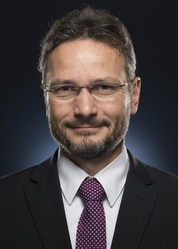
Prof. Dr.-Ing. Hakan Kayal serves as University Professor for Aerospace Engineering at the University of Würzburg, holding the Chair of Computer Science VIII (Space Technology) and chairing the Interdisciplinary Research Center for Extraterrestrial Studies (IFEX). His leadership bridges computer science and space systems engineering within the university's Institute of Computer Science. Research focuses on three synergistic domains: nanosatellite development for extraterrestrial missions (including the SONATE-2 6U platform demonstrating AI-driven onboard processing), scientific investigation of Unidentified Anomalous Phenomena (UAP) through the university's collaboration with the Federal Aviation Office, and spacecraft autonomy systems enabling higher mission independence. Current projects include the NEAlight mission (extended to develop the Apophis Interceptor concept for the 2029 asteroid flyby), VaMEx3-MarsSymphony for Mars exploration, and JMU Space Observatory initiatives. Publication trends reveal strong emphasis on asteroid defense strategies (particularly for Apophis), CubeSat-based UAP detection methodologies, and real-time AI processing in constrained space environments. His team actively engages students through ADS-B tracking, Meteosat App development, and Moon Base 2030 projects, while recent recognition includes co-authoring a landmark UAP review in Progress in Aerospace Sciences with 33 international scientists.
Bernhard J. Berger is a Lecturer in the Department of Computer Engineering at the Institute of Embedded Systems, Hamburg University of Technology (TUHH). His research focuses on software security, static code analysis, machine learning, optimization, and research data management. He has held significant roles such as Program Committee member for ICPC 2025 and MSR 2025, and has received awards including the Best Reviewer Award (ICPC 2023) and Best Engineering Paper Award (SCAM 2019). His work spans interdisciplinary applications including maritime systems security, GPU-accelerated AI, and evolutionary algorithms. Recent studies emphasize AI-driven security tools (e.g., ML-SAST) and domain-specific language approaches to optimization (EvoAl). He has contributed to over 30 peer-reviewed publications, with notable work in IEEE Transactions on Software Engineering and Science of Computer Programming. Berger collaborates closely with industry through DAAD review committees and serves on artifact evaluation boards for ISSTA and ARES conferences. Education: Doctoral Thesis (2022), Diploma in Computer Science (2007) Key Projects: ArchSec tool suite, Threat Modeling Frameworks, Bauhaus static analysis methodology Lab Affiliation: Embedded Systems Design Group His advisory roles include Deputy of TUHH's Election Verification Committee and Session Chair at IEEE Congress on Evolutionary Computation 2023. Current research trends integrate machine learning with static analysis for automated vulnerability detection, while also exploring explainable AI techniques for neural network optimization.
Stefanie Mueller is the TIBCO Career Development Associate Professor at MIT's Electrical Engineering and Computer Science Department, with joint affiliation in Mechanical Engineering. She leads the HCI Engineering Group at the Computer Science and Artificial Intelligence Laboratory (CSAIL), focusing on advancing fabrication techniques through hardware/software innovations that enable novel object interactions. Develops computational fabrication methods combining photochromic dyes, lenticular lenses, birefringent materials, and optical illusions Co-chaired ACM CHI 2023 and ACM UIST 2020 program committees Recipients of 9 MIT EECS Best Undergraduate Researcher Awards among mentees Her research spans four key directions: Appearance-changing Objects: Photo-Chromeleon (ACM UIST 2019), Lenticular Objects (ACM UIST 2021), and Polagons (ACM CHI 2023) demonstrate reprogrammable surfaces through advanced materials and optical engineering. Tracking Systems: InfraredTags (ACM CHI 2022) and G-ID (ACM CHI 2020) enable passive object tracking via infrared markers and slicing artifacts. Embedded Sensing: MechSense (ACM CHI 2023) and Sprayable User Interfaces (ACM CHI 2020) integrate sensing capabilities into complex geometries. Curved Surface Prototyping: FlexBoard (ACM CHI 2023) and CurveBoard (ACM CHI 2020) develop specialized tools for non-planar electronics. Her recent publications focus on functionality segmentation (UIST 2023), fluorescent markers (UIST 2023), and machine-knitted haptics (UIST 2023). These works combine machine learning, material science, and interactive design principles to push fabrication boundaries. Scientific recognition includes: 2022 MIT Technology Review Innovators Under 35 2020 Microsoft Research Faculty Fellowship 2020 Alfred P. Sloan Research Fellowship 2019 ACM UIST Best Paper Award 2019 NSF CAREER Award 2018 MIT EECS Outstanding Educator Award 2017 Forbes 30 Under 30 in Science Mentoring 9 PhD students and over 20 master's students, her lab has produced 20+ publications at top HCI conferences. She redesigned MIT's 6.810 Engineering Interactive Technologies course during the pandemic, maintaining hands-on learning through home electronics kits and Slack-based collaboration.
Christof Paar is a Professor of Embedded Security at Ruhr University Bochum's Faculty of Computer Science. His work focuses on hardware security, cryptography, and embedded systems security. He leads the Embedded Security Group within the CASE Cluster of Excellence (Cyber Security in the Age of Large-Scale Attacks), addressing cutting-edge challenges in hardware Trojans, side-channel attacks, and cryptographic engineering. His research spans FPGA and IoT security, with contributions to physical-layer security, wireless jamming defenses, and tamper-resistant systems. Research Interests: Paar's expertise lies in hardware-software co-design for security, with a focus on embedded systems. His work includes analyzing vulnerabilities in FPGAs, developing countermeasures against side-channel attacks, and exploring physical-layer security mechanisms. He also investigates the human factors in hardware reverse engineering and the implications of adversarial machine learning on security systems. Notable Work: Recent publications highlight breakthroughs in detecting hardware Trojans across CMOS generations, breaking industry-standard IP protection mechanisms (IEEE 1735), and proposing novel defenses like IRShield against adversarial wireless sensing. His group actively contributes to standards for secure embedded systems and IoT devices, emphasizing practical implementations.
Matthias Feurer is a Thomas Bayes Fellow and interim professor at the Chair of Statistical Learning and Data Science, funded by the Munich Center for Machine Learning (MCML) at Ludwig Maximilian University of Munich. He is a member of the Department of Statistics at LMU Munich, working under Prof. Dr. Bernd Bischl. His academic background includes: PhD in Computer Science from Albert-Ludwigs-Universität Freiburg, supervised by Prof. Dr. Frank Hutter M.Sc. in Computer Science from the University of Freiburg B.Sc. in Computer Science and Media from the Media University Stuttgart Feurer's research focuses on simplifying machine learning usage through Automated Machine Learning (AutoML). His work encompasses hyperparameter optimization, meta-learning, and model selection, with increasing emphasis on multi-objective AutoML that considers factors beyond predictive performance such as interpretability, deployability, and fairness. He actively develops open-source tools to advance the field. His recent publications demonstrate a strong trajectory in practical AutoML systems, with growing attention to tabular machine learning, foundation models integration, and addressing real-world constraints in optimization. His work consistently bridges theoretical advances with practical implementations through several widely-used open-source projects. Notable achievements include: 1st place in the warmstarting-friendly leaderboard of the BBO NeurIPS challenge Winner of the 2nd AutoML challenge Winner of the kdnuggets blog contest on AutoML Feurer is actively mentoring and teaching, having advertised PhD positions focused on AutoML, optimization, and benchmarking. He co-founded the Open Machine Learning Foundation supporting OpenML.org. His upcoming move to TU Dortmund as an assistant professor in AutoML and Optimization signals continued growth in his academic career while maintaining his research focus on making machine learning more accessible and rigorous.
Vijay Laxmi is a Professor in the Department of Computer Science and Engineering at Malaviya National Institute of Technology (MNIT) Jaipur, India. With over a decade of active research publication from 2014-2024, Dr. Laxmi has established themselves as a prominent researcher in network security, Android security systems, and Network-on-Chip architectures. Their work demonstrates consistent collaboration with Manoj Singh Gaur and numerous doctoral students at MNIT Jaipur. Dr. Laxmi's research interests span Network Security, Android Security, Malware Analysis, Network-on-Chip Architectures, Routing Protocols, Side-Channel Attacks, Wireless Networks, and Mobile Security. Their work bridges theoretical security frameworks with practical implementations, particularly in mobile and embedded systems. Recent publications indicate a growing focus on AI-based security approaches including GAN applications for fuzzing and deep learning for image dehazing. The research trajectory shows increasing sophistication in security analysis techniques, evolving from basic malware detection to advanced side-channel attack analysis and sophisticated network security protocols. Recent publications demonstrate expertise in both theoretical frameworks and practical implementations with applications in real-world security challenges. Dr. Laxmi has mentored numerous graduate students including Vineeta Jain, Anugrah Jain, Sonal Yadav, Mohit Singh, and Gaurav Singal, who appear as co-authors across multiple publications. Their collaborative network extends to researchers at international institutions, indicating strong academic connections beyond their home institution.
Elena Simperl is a Professor of Computer Science and Deputy Head of Department for Enterprise and Engagement at King's College London's Department of Informatics. She co-directs the King's Institute for Artificial Intelligence and serves as Director of Research for the Open Data Institute. As a Hans Fischer Senior Fellow at the Technical University of Munich's Institute for Advanced Study, she leads the Trustworthy Knowledge Graphs focus group and contributes to advancing human-centric AI research across European institutions. Professor Simperl obtained her doctoral degree in Computer Science from the Free University of Berlin and her diploma from the Technical University of Munich. Prior to joining King's, she held academic positions in Germany, Austria, and at the University of Southampton, and was a Turing Fellow. Her career trajectory demonstrates consistent leadership in bridging academic research with practical applications in data ecosystems. Her research sits at the critical intersection of AI and social computing, focusing on human-centric approaches to building sociotechnical systems that integrate data, algorithms, and human capabilities. She investigates how to make knowledge engineering more accessible, how to leverage collective intelligence for data quality improvement, and how to design participatory AI systems that address societal challenges like misinformation. Her work spans knowledge graphs, semantic technologies, crowdsourcing, and open data, with particular emphasis on the social dimensions of data-intensive systems and the governance frameworks needed for trustworthy AI deployment. Analysis of her recent publications reveals a strong evolution toward integrating large language models with traditional knowledge engineering practices while maintaining human oversight. There's a clear trajectory from foundational work on knowledge representation toward increasingly applied research addressing real-world challenges in media ecosystems, citizen science, and data governance, with growing attention to policy implications of AI technologies. Fellow of the British Computer Society Fellow of the Royal Society of Arts Hans Fischer Senior Fellow at TUM-IAS (2023) Ranked among top 100 most influential scholars in knowledge engineering of the last decade Included in Women in AI 2000 ranking Professor Simperl has led 14 major European and national research projects totaling millions in funding, including MediaFutures (a Horizon 2020 program tackling online misinformation), QROWD, ODINE, Data Pitch, and ACTION. She currently co-chairs the Croissant working group in ML Commons developing data standards for AI, and serves as president of the Semantic Web Science Association. Her research has directly influenced the development of data ecosystems supporting startups and citizen science initiatives across Europe, demonstrating exceptional ability to translate theoretical advances into practical impact. As Director of Research at the Open Data Institute, she oversees initiatives connecting data entrepreneurs with artists and civic organizations. Her leadership in the MediaFutures project established a data-driven innovation hub that supported 51 startups/SMEs and 43 artists through three open calls, creating a sustainable model for arts-technology collaborations addressing media challenges. Her work with the ODINE project helped create a European ecosystem for data-driven startups, demonstrating her commitment to building practical applications of open data principles.
Prof. Alexander Pretschner is a Professor of Software & Systems Engineering at the Technical University of Munich (TUM) and Founding Director of the Bavarian Research Institute for Digital Transformation (bidt). He also serves as Scientific Director of fortiss, a Bavarian research institute for software-intensive systems. His research focuses on software engineering, testing, information security, and ethical software development. Pretschner holds a PhD from TUM and has held academic positions at Karlsruhe Institute of Technology (KIT) and TU Kaiserslautern. He is a co-editor of several prestigious journals, including IEEE Transactions on Reliability and the Journal of Software Testing, Verification and Reliability. Education: PhD in Computer Science, Technical University of Munich MSc in Computer Science, University of Kansas (on Fulbright Scholarship) Diplom in Computer Science, RWTH Aachen University Research Interests: His work spans testing methodologies, secure software design, and ethical considerations in agile development. Notable contributions include frameworks for metamorphic testing, distributed data usage control, and accountability mechanisms for cyber-physical systems. Awards: IBM Faculty Award (2012, 2013) Google Focused Research Award (2011, 2012) EARTO Innovation Prize (2014) 2nd Platz Supervisory Award (2020) Advising & Grants: Pretschner has supervised numerous PhD and Master’s students, contributing to over 200 publications. He leads projects like EDAP (Ethical Deliberation in Agile Processes) and collaborates with industry partners on cybersecurity and AI ethics initiatives. Labs & Teams: His work is anchored in bidt, fortiss, and TUM’s Chair of Software & Systems Engineering, focusing on societal impacts of digitalization and trustworthy AI systems.
Prof. Dr. Ingo Scholtes is Chair of Machine Learning for Complex Networks at Julius-Maximilians-Universität Würzburg's Center for Artificial Intelligence and Data Science (CAIDAS). His research spans network science, graph machine learning, and computational social science, with applications in software engineering, ecology, biology, and physics. He received a Juniorfellowship from the German Informatics Society (2014) and an SNSF Professorship (CHF 1.5Mio, 2018). Current affiliations: JMU Würzburg (since 2021), University of Zurich (2018-2024), Bergische Universität Wuppertal (2019-2021) Research focus: Higher-order network modeling, temporal graph analysis, AI for collaborative systems, causality-aware machine learning His recent publications demonstrate strong trends in temporal network analysis , graph neural networks for time-series, and higher-order models across software engineering and social science domains. He co-chairs multiple international workshops on complex networks and serves as associate editor for EPJ Data Science and Advances in Complex Systems. Key scientific contributions: Foundational work on higher-order network models published in Nature Physics Methodological innovations in temporal network visualization (HOTVis) and path-based analysis (pathpy) As both educator and organizer, he leads the Computational Social Science Section at GI e.V., mentors across disciplines, and develops tools like git2net for collaboration analysis. His work bridges theoretical foundations with practical applications in network science.
Dongwoo Kim is a researcher affiliated with Hanyang University, ERICA Campus (Department of Electronics and Communication Engineering) and has previously collaborated with institutions like POSTECH , Chungnam National University , and Microsoft . His work spans interdisciplinary domains in Computer Science and Engineering . Hanyang University, ERICA Campus - Department of Electronics and Communication Engineering POSTECH - Power Analog Electronics & Semiconductor Devices Lab Microsoft Chungnam National University Kim's research focuses on formal verification of automotive control software, deep learning applications in environmental monitoring, 3D modeling for indoor positioning, and machine learning for signal processing. His recent publications highlight advancements in graph neural networks (GNNs), including analyzing oversmoothing and gradient dynamics, as well as developing geometric vision-language models with domain-agnostic encoders. His 15 most recent articles (2023-2025) address topics like: Optimizing hybrid electric vehicle engine performance 3D modeling for indoor localization GNN training stability UAV-based environmental monitoring Algorithm difficulty prediction for programming problems Millimeter-wave antenna design Kim collaborates with researchers in software engineering , signal processing , and environmental science domains. His work intersects formal methods , applied machine learning , and embedded systems research.
Nils Ole Tippenhauer is a faculty member at the CISPA Helmholtz Center for Information Security , leading the SCy-Phy research group . His academic journey includes an Assistant Professorship at the Singapore University of Technology and Design (SUTD) (2014–2018), a PhD in Computer Science from ETH Zurich (2012), and a Diploma in Computer Engineering from Hamburg University of Technology (2007). He also holds an exchange study year at the University of Waterloo (2004–2005) supported by a DAAD scholarship. Research Interests focus on practical systems security , particularly Security of Cyber-Physical Systems Industrial Control Systems (ICS) and Industrial IoT (IIoT) Physical-Layer Security and Wireless Security Privacy-Preserving Technologies (e.g., DP3T project) Embedded Systems Security Threat Detection & Defenses His work integrates both theoretical and applied approaches, addressing vulnerabilities in critical infrastructures like water systems and power grids. Recent Publications highlight trends in Anomaly detection evasion in industrial networks Microarchitectural side-channel defenses Localization techniques in cellular networks Security analysis of ICS protocols Data-driven vulnerability assessments for robotics Cyber-physical simulation for infrastructure security Scientific Awards include Best paper at DIMVA'23 Distinguished Paper at ACSAC 2022 Best paper at CPSIOTSEC 2022 Best paper at CPSS 2017 K-H Ditze Award for diploma thesis (2007) SG Mark Institution award (2016) Runner-Up at smart energy hackathon (2013) Advising and Grants feature PhD defenses of Daniele Antonioli and Hamid Reza Ghaeini (2022), co-organizing conferences like WiSec and CPSS , and leading projects such as the National Science Experiment (NSE) with 50,000 mobile sensors in Singapore. He also contributed to the DP3T project for privacy-preserving contact tracing. Labs and Teams include the SCy-Phy research group at CISPA and the development of testbeds like SWaT (Secure Water Treatment), WADI (Water Distribution), and EPIC (Electric Power and Industrial Control) at SUTD. These platforms enable hands-on security research in realistic industrial environments.
Prof. Dr.-Ing. Eric Sax is a Professor of Electronic Systems Engineering and Management at the Karlsruhe Institute of Technology (KIT), serving as Dean of the Department of Electrical Engineering and Information Technology (ETIT). He leads the Institut für Technik der Informationsverarbeitung (ITIV) and directs the Forschungszentrum Informatik ESS division . As Program Director of the Electronic Systems Engineering & Management (ESEM) master's program at the HECTOR School, he focuses on integrating academic and professional education. His research spans automotive systems engineering , self-learning functions , cybersecurity , and data-driven validation . Key themes include over-the-air updates, scenario-based testing, and the synergy between machine learning and automotive systems. His work addresses challenges in autonomous driving validation, software-defined mobility, and cyber-physical system security. Prof. Sax's contributions include frameworks for automotive software partitioning, cloud-enabled vehicle architectures, and methodologies for quantifying data quality impacts on perception systems. He actively collaborates with industry partners to bridge academic research with industrial application. His recent projects include OptiCAM (cloud/edge function offloading), Drive4C (autonomous driving benchmarking), and UNCOVER (data-driven security monitoring). He holds leadership roles in both KIT and the HECTOR School's technology business programs.
Marco Caccamo is a Professor at the Technical University of Munich (TUM) , holding the Chair of Cyber-Physical Systems in Production Engineering within the Faculty of Mechanical Engineering. He is also a Principal Investigator and Professor at the Department of Computer Science, with courtesy appointments in Electrical and Computer Engineering, Coordinated Science Lab (CSL), and Aerospace Engineering at the University of Illinois at Urbana-Champaign (UIUC). His research spans Embedded Systems , Real-Time Systems , and Cyber-Physical Systems (CPS) , focusing on resource management, reinforcement learning architectures, and 6D pose recognition for robotics. University of Pisa (B.Sc., 1997) Scuola Superiore Sant'Anna (Ph.D., 2002) Research highlights include predictable resource management on heterogeneous platforms, security frameworks for AI-based controllers , and UAV testbed development . His work integrates deep learning and real-time constraints in industrial applications like avionics, farming, and automotive systems. His 15 most recent publications emphasize cache optimization , memory bandwidth regulation , and reinforcement learning for CPS , with a focus on multi-core processors and DNN inference . Awards include the IEEE Fellow (2018), Alexander von Humboldt Professorship (2018), and multiple Best Paper Awards at RTSS, RTNS, and RTAS. NSF CAREER Award (2003) IEEE Fellow (2018) Alexander von Humboldt Professorship (2018) Best Paper Awards (RTSS 2024, RTNS 2023, ECRTS 2019) He has advised numerous Ph.D. students and postdocs, with a track record in UAV development and industrial collaborations . His lab, the Real-Time and Embedded System Laboratory , focuses on real-time OS and predictable computing .
Andrew Pavlo is a Professor in the Computer Science Department at Carnegie Mellon University's School of Computer Science. His research focuses on database management systems, particularly in the areas of transaction processing, in-memory databases, and self-driving database systems. He leads a productive research group that has published extensively in top database venues including VLDB, SIGMOD, and CIDR. Pavlo's research interests span database management systems, transaction processing, in-memory databases, non-volatile memory databases, and self-driving database systems. His work often bridges theoretical database concepts with practical system implementation, focusing on performance optimization, query processing, and system architecture. Recent work has explored machine learning applications for database tuning, novel storage techniques, and innovative approaches to transaction processing. An analysis of his recent publications reveals a strong focus on self-driving database systems, with significant work on the Database Gym framework for training machine learning models to optimize database performance. His research also examines columnar storage formats, transaction scheduling, and novel approaches to user-defined function optimization. The work demonstrates a consistent trajectory toward making database systems more autonomous and efficient through a combination of systems techniques and machine learning. Pavlo has been instrumental in mentoring numerous PhD students who have become active contributors to the database research community. His research has been supported by significant grants that have enabled the development of innovative database technologies and frameworks. His research group operates within CMU's vibrant database ecosystem, collaborating with other researchers on projects related to database systems, storage engines, and query processing frameworks. The group maintains close connections with industry partners to ensure practical relevance of their research contributions.
Zachary Kincaid is an Associate Professor in the Department of Computer Science at Princeton University's School of Engineering and Applied Science. His research focuses on program analysis, logic, and programming languages, with an emphasis on making program analysis compositional and robust. He received his PhD from the University of Toronto under the supervision of Azadeh Farzan. His work has been implemented in the Duet program analyzer, and he has an Erdős number of 3. Dr. Kincaid's research interests include: Compositional program analysis techniques Algebraic approaches to program analysis Termination analysis and ranking function synthesis Verification of concurrent and parallel programs Automated reasoning and decision procedures Analysis of numerical programs and loops His recent publications show a strong focus on developing novel techniques for program analysis that bridge theoretical computer science with practical verification tools, particularly in nonlinear analysis, quantified reasoning, and compositional verification. Dr. Kincaid has received research support from ONR grant N00014-19-1-2318 for his work on robust program analysis. He has advised graduate students including: Current: Jake Silverman, Nicolas Koh, Nikhil Pimpalkhare Graduated: Shaowei Zhu (PhD 2024, Researcher at Amazon), Charlie Murphy (PhD 2023, Postdoc at University of Wisconsin–Madison) Dr. Kincaid teaches courses including: COS 320 – Compiling Techniques (Spring 2024, 2022, 2020, 2019) COS 516 / ELE 516 – Automated Reasoning about Software (Fall 2025, 2022, 2018) COS 217 – Introduction to Programming Systems (Fall 2024) COS IW – Practical Solutions to Intractable Problems (Fall 2023, Spring 2023, 2018, 2017) COS IW – Little Languages (Spring 2018) COS 597D – Reasoning about concurrent systems (Fall 2016)