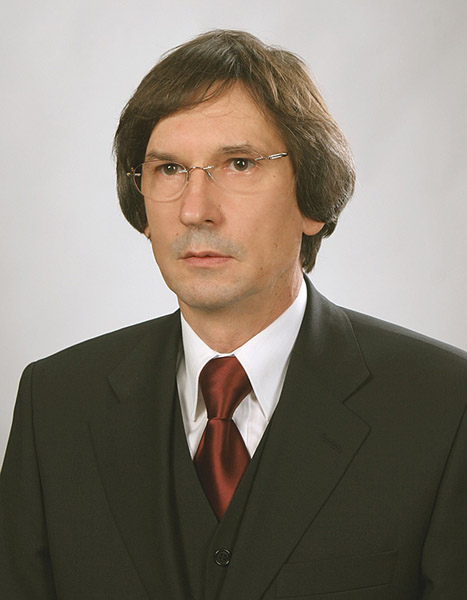
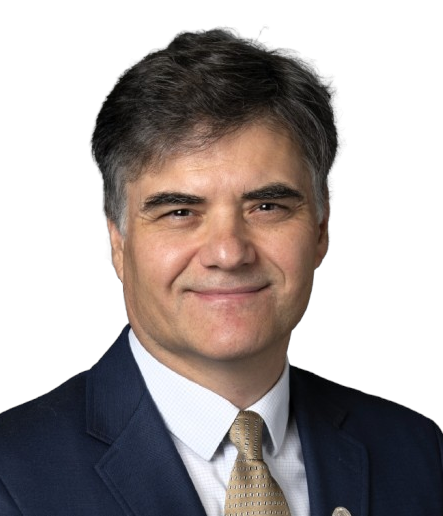
Krzysztof Redlich is a Professor of Theoretical Physics at the University of Wrocław, Poland, with a permanent faculty position since 1995. His career includes significant roles at CERN, GSI Darmstadt, and the University of Bielefeld. He holds a Ph.D. in Field Theory and Elementary Particle Physics (1981) and a habilitation in Theoretical Physics (1990). His research focuses on heavy-ion collisions, lattice gauge theory, and thermal field theory. Redlich has received multiple honors, including the Polish Academy of Science Award (1992), the Alexander von Humboldt Research Award (2001 and 2009), and membership in the Polish Academy of Sciences (2008). He actively contributes to collaborations like the ALICE Collaboration at CERN and serves on committees such as the Scientific Council of FAIR and EMMI. His work bridges particle and nuclear physics, exploring QCD phase transitions, quark-gluon plasma dynamics, and statistical hadronization. Key research themes include chiral symmetry restoration, quarkyonic matter, and fluctuation analysis in high-energy collisions. Redlich’s publications (208 total, h-index 40) are highly cited in the fields of theoretical and high-energy physics.
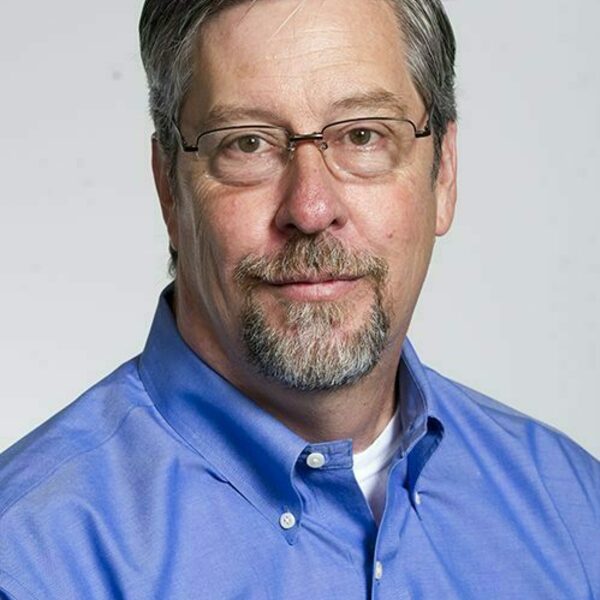
David Robertson is a Teaching Professor in the Department of Physics & Astronomy at the University of Notre Dame. Previously, he served as a faculty member at Otterbein University from 2002 to 2024, where he chaired the Physics Department for twelve years and led initiatives in undergraduate research. He also served as Otterbein’s Director of Undergraduate Research and Creative Work from 2015 to 2019. His research focuses on theoretical physics, including elementary particle physics, computational tools for quantum field theories, and Hamiltonian approaches to strongly interacting systems. Education: B.S. (with Honors), University of California, Los Angeles, 1984 Ph.D., University of California, Santa Barbara, 1990 Research Interests: Dr. Robertson specializes in high-performance computing for precision calculations in quantum field theories, light cone formalism, and particle physics phenomenology. He emphasizes bridging theoretical advancements with practical computational methods. Awards: 2017 Otterbein University Teacher of the Year Advising & Grants: While his current role at Notre Dame is not detailed, his prior leadership in undergraduate research and teaching highlights a commitment to mentorship and institutional development. Grants and specific advising roles are not explicitly listed here.
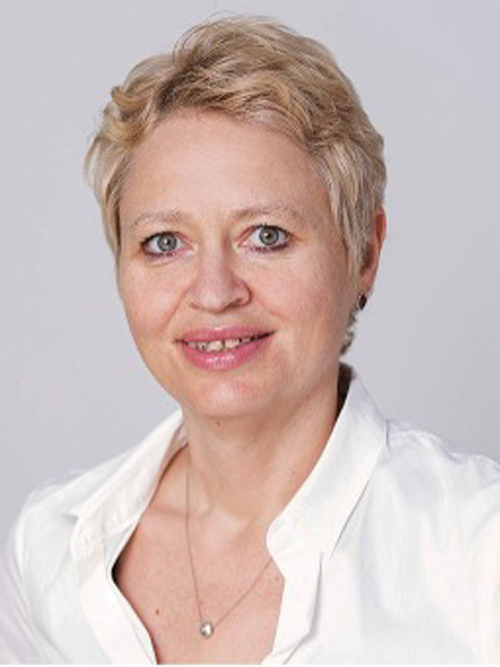
Prof. Dr. Beate Heinemann is a world-leading scientist in experimental particle physics affiliated with the University of Hamburg and Deutsches Elektronen-Synchrotron (DESY). She has held prominent roles at institutions including UC Berkeley and the University of Freiburg, and since 2022, she has served as Director of Particle Physics at DESY. Her work focuses on discovering new particles, precision measurements, and pioneering experiments in quantum theory. Doctorate from University of Hamburg (1999) Postdoctoral research at University of Liverpool Professor at UC Berkeley (2008) and University of Freiburg (2016) Her research spans experimental particle physics, including contributions to the ATLAS and CDF experiments, and planning for future particle accelerators. Currently, she leads a groundbreaking experiment at DESY to test quantum theory predictions about vacuum polarizability. Scientific Awards: Honorary Doctorate (2024), University of Zurich Prof. Heinemann has led major collaborations like ATLAS and contributes to the European Strategy Process for Particle Physics. Despite competition with UZH's CMS group, she fosters constructive collaboration in high-energy physics planning.
Dr. Matteo Pedrotti is a Senior Lecturer in Civil and Environmental Engineering within the Faculty of Engineering at the University of Strathclyde. His academic career focuses on geomechanics and advanced geomaterials research, with a particular emphasis on understanding material behavior from nano-to-micro scales to field applications. He leads multiple research projects and serves as a peer reviewer for prominent journals in his field. Dr. Pedrotti's research interests span the design and characterization of advanced composite systems of geomaterials and synthesized hydrogels. His work investigates how atmospheric interactions, stress history, and groundwater chemistry influence hydro-mechanical characteristics at the nano and micro scales. This research enables the engineering of advanced porous networks with unprecedented macroscopic bulk performance. His vision includes establishing a research group to develop "super soils" with enhanced water retention for agriculture, increased mechanical strength for construction, self-healing capabilities against desiccation cracking, and zero water permeability for environmental barriers. Analysis of Dr. Pedrotti's publication record reveals a strong focus on clay mechanics and soil characterization techniques. His research employs advanced methods like X-ray Computed Tomography to study particle kinematics and microstructural behavior. The work spans fundamental micromechanics of clay particles to practical applications in soil stabilization and environmental protection. Key themes include drying-induced volumetric behavior, pore-scale modeling, and the utilization of materials like mica for soil improvement. Dr. Pedrotti actively supervises postgraduate research and leads multiple funded projects. His current research portfolio includes: Exploring natural fibers to improve resilience of unreinforced masonry structures in Malawi (£24,986 funding) Experimental characterization of Bentonite hydromechanical behavior in high salinity environments (multiple projects totaling approximately £122,000) Mechanisms of stress transfer in clayey materials using X-ray Computed Tomography at Diamond Light Source (£60,000) An energy-free pump using nanoporous gels for passive subsurface water lifting Dr. Pedrotti maintains active professional engagement through peer review activities for journals like ACS Sustainable Chemistry and Engineering and Scientific Reports. He organizes the Geotechnical Engineering Course (CL-314) and participates in international symposia including IS-Grenoble2024 and the EPSRC Multi-Disciplinary IM3AGES Facility Workshop.
Jeffrey D. Richman is a Professor of Physics at the University of California, Santa Barbara , specializing in experimental elementary particle physics. His research focuses on the CMS experiment at CERN's Large Hadron Collider (LHC), where he investigates the Higgs boson, searches for supersymmetry (SUSY), and develops advanced electronics for the muon system. He has also contributed extensively to heavy-quark physics via the BaBar experiment at SLAC. Research Interests Supersymmetry (SUSY) and Dark Matter detection Electroweak symmetry breaking mechanisms Rare Higgs decay modes and Higgsino searches Heavy-quark physics and B meson decays Detector electronics for muon systems Academic Contributions Co-convener of CMS Supersymmetry Physics Analysis Group Co-chair of CMS Exotica and SUSY Publications Boards Former Physics Analysis Coordinator for BaBar Developed analog/digital electronics courses at UCSB Teaching spans graduate and undergraduate courses in particle physics, quantum mechanics, and electronics. He emphasizes hands-on lab work and has received consistently high teaching evaluations (averaging 1.0-1.8 on a 1-5 scale, 1 being best).
Felipe Siqueira de Souza da Rosa is an Associate Professor at the Federal University of Rio de Janeiro (UFRJ), affiliated with the Physics department. He holds a PhD in Physics from UFRJ and maintains an office in Room A-318/12. His research is supported by the CNPq Research Productivity Scholarship – Level 2, recognizing his contributions to theoretical physics. Research Focus: His work centers on low-energy quantum electrodynamics phenomena, including dispersive forces (e.g., Casimir effect), nanoscale thermal dynamics, and quantum energy transfer mechanisms. Key investigations involve the Purcell effect, resonant energy transfer, and the Fermi problem, bridging particle physics with nanoscale applications.
Keith Ulmer is an Associate Professor in the Department of Physics at the University of Colorado Boulder. His research focuses on experimental particle physics, particularly using the CMS experiment at CERN's LHC. He leads projects for the CMS Global Track Trigger and US-CMS Trigger/DAQ upgrades. His work includes searches for physics beyond the Standard Model, such as supersymmetry and dark matter, and detector R&D leveraging FPGA-based machine learning. Education: Ph.D. in Physics (2007, University of Colorado Boulder), B.A. from Amherst College. Awards include the 2024 LPC Distinguished Researcher, CU Teaching Excellence, and CERN Scientific Associate roles. Research interests span high-energy collider physics, detector innovation, and advanced computing. He advises graduate students and collaborates internationally on SUSY searches, trigger system upgrades, and Higgs physics. Notable contributions include the first observation of B_s→μμ decay and leadership in CMS Phase-2 upgrades.
Elise Novitski is an Assistant Professor in the Department of Physics at the University of Washington, part of the College of Arts & Sciences. Her research focuses on elementary particle properties and fundamental symmetries through precision low-energy experiments, including collaborations like Project 8 and He6-CRES. She employs Cyclotron Radiation Emission Spectroscopy to study beta decay processes, enabling neutrino mass measurements and symmetry tests in the weak interaction. Dr. Novitski earned her PhD from Harvard University, where she worked on antihydrogen experiments and magnetic dipole moment measurements. She joined the University of Washington in 2018 as a Robertson Postdoctoral Scholar, became a research assistant professor in 2022, and assumed her current role in 2023. She is a Member-At-Large for the American Physical Society's Topical Group on Precision Measurements and Fundamental Constants. Her awards include the 2023 Stuart Jay Freedman Award and a 2024 DOE Early Career Award. Her research bridges theoretical physics with experimental precision, contributing to CPT invariance tests and quantum electrodynamics validation.
Maria Concepcion Gonzalez-Garcia is a Professor at Stony Brook University's Department of Physics and Astronomy. She is affiliated with the YITP (Yukawa Institute for Theoretical Physics) at the university, where her research focuses on neutrino physics, particle phenomenology, and solar astrophysics. Her work often involves global analyses of neutrino oscillations and exploring beyond the Standard Model (BSM) scenarios through collider and astrophysical data. She earned her Ph.D. in 1991 from the Universidad de Valencia. Her recent teaching includes Elementary Particle Physics (PHY557) in Spring 2025. Gonzalez-Garcia is a leading contributor to the NuFIT collaboration, which performs comprehensive neutrino oscillation analyses. Her research interests span non-standard neutrino interactions (NSI), electroweak precision tests, and leveraging solar and stellar astrophysics to constrain BSM models. Her publications reflect collaborations with institutions like CERN, INFN, and the COHERENT experiment. Recent work includes studies on sterile neutrinos, quartic gauge couplings in the HEFT framework, and implications of Borexino solar neutrino data. She has also explored the effects of dimension-eight operators in the Standard Model Effective Field Theory (SMEFT) and unitarity constraints in gauge boson interactions. Gonzalez-Garcia's advising and grants include contributions to the LHC Effective Field Theory Working Group and the European Neutrino Town Meeting. She is involved in projects like the Muon Collider and High Field Magnet R&D. Her lab affiliations are tied to the YITP and collaborations such as COHERENT, Dresden-II, and NuFIT.
Professor James Wells is a theoretical physicist at the University of Michigan, Department of Physics. His research focuses on solving 'origins' problems in fundamental physics, including gauge symmetries, dark matter, flavor violations, CP violation, and mass. He holds academic appointments as Professor at the University of Michigan (since 2008), Staff Scientist at CERN (2007-2013), and previous roles at UC Davis and SLAC. He received his Ph.D. from the University of Michigan, alongside M.S. and B.S. degrees from Brigham Young University. His academic awards include the American Physical Society Fellowship (2014), Sloan Research Fellowship (2000-2004), and the Humboldt Research Award (2016). His work spans high-energy physics, science and national security, and collider physics. Key contributions include studies on the International Linear Collider, Higgs boson phenomenology, and supersymmetry. He participates in the Physics Shops and Homer A. Neal Lab at U-M’s Randall Laboratory. His research interests bridge theoretical particle physics with experimental frontiers, emphasizing precision measurements and new physics discovery strategies. Collaborative efforts include the PICO Collaboration and studies on neutrino detection for nuclear safeguarding.
James Pinfold, PhD, FRSC is a Professor of Physics at the University of Alberta's Faculty of Science. He holds dual roles as a Distinguished University Professor and a Visiting Professor at King's College London. His research focuses on fundamental particle physics, particularly the Standard Model and beyond, with leadership roles in major experiments like ATLAS, OPAL, and MoEDAL at CERN. He has discovered neutral currents, contributed to the Higgs boson discovery, and pioneered cosmic ray research through initiatives like the ALTA project. Education: PhD (1977) and BSc (1972) from University College London, with a Royal College of Science Associate degree. Academic leadership includes directorships of the Centre for Subatomic Research and spokesperson roles for MoEDAL-MAPP, ATLAS-Canada, and others. Research interests span collider physics, cosmic rays, and new physics searches. Awards include the Breakthrough Prize in Fundamental Physics (2025), Killam Prize (2018), and Fellow of the Royal Society of Canada (2013). Teaching emphasizes hands-on research engagement, highlighted by the ASTECH award for educational cosmic ray projects. Current leadership includes coordinating ATLAS detector upgrades and planning the Cosmic-MoEDAL experiment. His work bridges high-energy physics with global collaborations, fostering student involvement through initiatives like the FUTURA project.
Daniel Levin is a Research Scientist in the Department of Physics at the University of Michigan . His work spans experimental physics and advanced instrumentation. High Energy Physics Calorimeter R&D for future colliders ATLAS experiment at CERN Ion Beams Beam monitoring for FRIB and other laboratories Radiation Therapy (collaboration with University of Michigan Hospital Radiation Oncology) Instrumentation for high dose rate radiation beam dosimetry Levin is affiliated with the Randall Lab and Homer A. Neal Lab at the University of Michigan, focusing on experimental elementary particle physics and radiation beam monitoring applications.
Pavel Nadolsky is a Professor in the Department of Physics & Astronomy at Michigan State University . His research focuses on theoretical particle physics , particularly elementary particle phenomenology within and beyond the Standard Model, perturbative quantum chromodynamics , and statistical applications for high-energy physics (HEP) data analysis. As a member of the CTEQ collaboration , he contributes to the development of parton distribution function (PDF) parametrizations such as the CT10 and PDF4LHC sets. His work bridges theoretical predictions for colliders like the Large Hadron Collider (LHC) and the Electron-Ion Collider (EIC) with statistical techniques including uncertainty quantification, Monte Carlo methods, and reproducibility studies in HEP. Keywords: Quantum Chromodynamics , Electroweak Interactions , Parton Distribution Functions , AI/ML in Data Analysis , Higgs Boson Physics , Collider Physics
Dr. Sinisa Ignjatovic is a Full Professor at the Faculty of Natural Sciences and Mathematics (PMF), University of Banja Luka, Bosnia and Herzegovina. He serves as Head of the Department of Theoretical Physics, focusing on Elementary Particle Physics and Theoretical Physics. His teaching roles include Mathematical Physics, Theoretical Mechanics, and advanced topics in theoretical physics. Education: BSc in Physics (University of Sarajevo, 1988), MSc (University of Cincinnati, 1993), PhD (University of Cincinnati, 1997). Emails: sinisha@teol.net, sinisa.ignjatovic@pmf.unibl.org. His research spans Theoretical Physics , Elementary Particle Physics , and Quantum Mechanics , with notable work on hyperfine interactions, quark mass determination, and exotic hadron states. He also explored astrophysical modeling in planetary formation via gaseous vortices. Scientific contributions include the Analytic Continuation by Duality (ACD) method for S-parameter estimation in Technicolor models and precise solutions to the Dirac equation in Coulomb potentials.
Volodymyr Aushev is Professor in the Department of Nuclear Physics, Faculty of Physics, Taras Shevchenko National University of Kyiv, Ukraine. He simultaneously maintains a senior-researcher affiliation with the Institute for Nuclear Research of the National Academy of Sciences of Ukraine. His career spans four decades, beginning in 1978 at the Institute for Nuclear Research (Kyiv) and expanding through long-term visiting-scientist engagements at DESY (Germany), the Max-Planck Institutes, and Fermilab (USA). Education & Training: PhD studies focused on polarised recoil β-active nuclei and nuclear spin physics at low energies. Extensive specialised training in Quantum Chromodynamics, heavy-flavour physics, top-quark physics and neutrino physics through participation in HERA-B, ZEUS, D0, LHCb, Belle II, DUNE, WA105 and FCAL collaborations. Research Interests: Professor Aushev leads the Kyiv high-energy physics group whose principal goal is understanding the fundamental constituents of matter and their interactions at the highest energies. His work centres on experimental particle physics , with major themes including: Quantum Chromodynamics and parton distribution functions; Production and decay of charm, beauty and top quarks; Neutrino oscillations and astrophysical neutrinos; Development of radiation-hard detectors and advanced instrumentation for collider and neutrino experiments. Recent Publications Overview (2010-2016): The twelve highlighted papers reflect an intensive focus on HERA ep/γp data (ZEUS), Tevatron pp̅ data (D0) and early DUNE/Belle-II planning . Analyses span precision measurements of structure functions, heavy-quark cross-sections, top-quark properties and searches for exotic hadrons, underlining a commitment to multi-TeV energy-frontier physics and long-baseline neutrino science. Scientific Awards & Recognition: Author of ≈120 peer-reviewed papers in high-energy physics and ≈30 in nuclear physics, averaging 33.4 citations each. Group leader for Ukrainian participation in ZEUS, D0, Belle II, DUNE, WA105 and FCAL collaborations. Advising & Outreach: Professor Aushev mentors a vibrant team of post-doctoral researchers, PhD and master’s students within the Kyiv high-energy physics group. He teaches lecture courses on High-Energy Physics , Nuclear Astrophysics , Dark Matter , Neutrino Physics and Modern Experiments in High-Energy Physics , and leads outreach programmes to inspire school pupils and undergraduates. Laboratories & Teams: He heads the Kyiv High-Energy Elementary Particle Physics Group , comprising three faculty members, post-docs, PhD students and undergraduates. The group is responsible for detector R&D (radiation-hard calorimeters, micro-strip monitors), software development and physics analyses for international experiments in Europe, the United States and Japan.