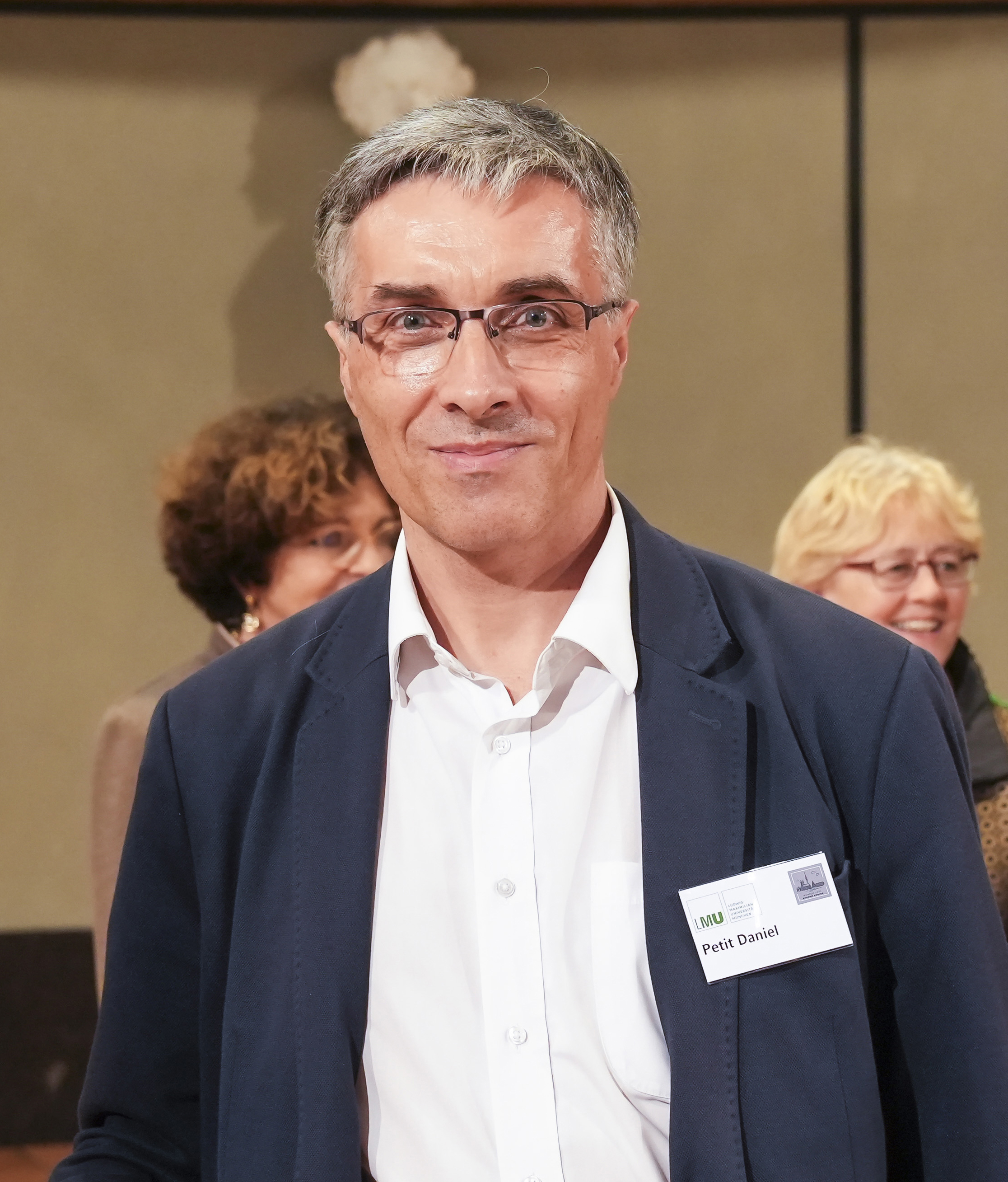
**Daniel Petit** is a **Full Professor of Indo-European Linguistics** at the **École normale supérieure (ENS)** since 2003 and **Director of Studies in Baltic and Indo-European Linguistics** at the **École pratique des hautes études (EPHE)** since 2011. He holds a PhD in Greek Linguistics (1996) and a Habilitation in Baltic Linguistics (2002), both from Paris-Sorbonne Université. His research focuses on historical syntax, comparative grammar of Indo-European languages, Baltic linguistics, and the history of comparative linguistics. **Education**: PhD in Greek Linguistics, Paris-Sorbonne Université (1996) Habilitation in Baltic Linguistics, Paris-Sorbonne Université (2002) Agrégation de Grammaire (1st rank, 1990) Multidisciplinary background including classics, Lithuanian, and Greek linguistics. **Research Interests**: Explores syntactic evolution in Indo-European languages, Baltic language structures, and the historical development of comparative linguistics. Specializes in Latvian, Old Prussian, Ancient Greek, and Lithuanian linguistics and philology. **Awards**: Correspondent member of the Académie des Inscriptions et Belles-Lettres (2021) Vice-chair of the Indogermanische Gesellschaft (2016-2021) Chevalier des Palmes Académiques (2011) **Advising & Leadership**: Supervised 9 PhD students (4 defended, 5 ongoing) and served on 28 doctoral committees. Organized 15 international conferences. Currently serves as Secretary (Chief Editor) of the *Bulletin de la Société de Linguistique de Paris* since 2017.
Francesc Miralles Torner is an Associate Professor affiliated with the Department of Enterprise and Technology, specializing in digital innovation, artificial intelligence, and entrepreneurial ecosystems. He leads the BOCETO: Boosting Comfort in Educational Environments project and participates in initiatives like Digital Innovation and AI as an agent for Digital Transformation . His work focuses on sustainability frameworks, innovation intermediaries, and technology's role in addressing global challenges. Academic Rank: Associate Professor Department: Enterprise and Technology Key Research Areas: Digital Innovation, Entrepreneurial Ecosystems, Sustainability, AI Recent research explores configurational approaches to startup innovativeness, orchestration of innovation networks, and digital transformation through global and sustainable lenses. His collaborations span institutions like AGAUR and international researchers.
Sarah Bankins is an Associate Professor at Macquarie University's Department of Management. Her research focuses on AI's impact on work, organizational ethics, and human resource management. She holds editorial roles at The Australian Journal of Management and Group and Organization Management . Before academia, she worked in public sector HR and management consulting. Education: PhD from Queensland University of Technology, B. Business/B. Economics from University of Queensland, and a Graduate Certificate in Tertiary Teaching from University of Newcastle. Research Interests: AI ethics, future of work, workplace technology, and interdisciplinary collaboration with fields like computer science and philosophy. Recent articles explore AI's role in decision-making, workplace trust, and educational ethics. Key projects include studies on mining sector mental health and ethical AI applications. Awards include teaching excellence (2013) and research supervision (2017).
Professor Sylvia Urban is a distinguished academic at RMIT University, serving as a Professor of Chemistry in the School of Science. She leads the Marine and Terrestrial Natural Product (MATNAP) research group and is the Program Manager for the Bachelor of Science degree, the largest and flagship program in the School of Science. Professor Urban also holds significant leadership roles including Reconciliation and Responsible Practice Facilitator in the School of Science (STEM College) and member of the Nugulu Committee at RMIT University. Her expertise spans natural products chemistry and separation science, with particular focus on chromatography for purification and instrumental analysis for structural characterisation and elucidation. Professor Urban's research interests encompass natural product chemistry isolation and structural elucidation, NMR spectroscopy and mass spectrometry for characterisation of natural products, High Performance/Pressure Liquid Chromatography (HPLC) and other chromatographic techniques for natural product purification, hyphenated spectroscopic techniques such as HPLC-NMR and HPLC-MS for natural product profiling, and biological evaluation of natural products for drug discovery applications. Her work primarily focuses on exploring the biodiversity of Australian marine and terrestrial organisms including plants, fungi, sponges, and algae to discover new compounds with therapeutic potential. She has developed various dereplication and chemical profiling strategies to expedite the discovery process. Professor Urban's publication record demonstrates a strong focus on natural products derived from Australian flora and marine organisms, with particular emphasis on their chemical characterisation and biological evaluation. Her research spans ethnobotanical studies of Indigenous Australian medicinal plants, phytochemical profiling of Australian species, anthelmintic and antimicrobial assessments of natural compounds, and development of analytical methodologies for natural product research. The interdisciplinary nature of her work connects chemistry with pharmacology, ethnobotany, and sustainable development goals related to health, education, and gender equality. STEM College Learning & Teaching Award (Award for Values in Action) 2024 STEM College Athena Swan Award 2023 Top STEM College Media Star 2022 School of Science Reconciliation Champion Award for 2021 School of Science Associate Dean's Impact Award (Applied Chemistry) for 2021 STEM Female Educator of the Year Award in the STEM College in 2021 Fellow of the Royal Australian Chemical Institute (RACI) in 2020 2019 Australian Award for University Teaching (AAUT) Citation for Outstanding Contributions to Student Learning Professor Urban actively supervises Masters and PhD students, with recent projects focusing on nanoparticle synthesis, natural product evaluation from Australian plants and marine organisms, food science applications, and biomedical imaging agents. She has received numerous teaching grants including the SteLR Grant 2017 for Pen-enabled, Real-time Student Engagement for Teaching in STEM Subjects, SteLR Plus Learning and Teaching Grant 2016 for Contextualizing Learning Chemistry, and Global Learning by Design (GLbD) Learning and Teaching Grant 2014. As the leader of the MATNAP research group, Professor Urban oversees a team focused on exploring Australian biodiversity for drug discovery. She has been instrumental in establishing the VICS Molecular Resolution Facility (chromatography node at RMIT University) as part of "The Pipeline – An Integrated Approach to Drug Design and Development." Her research involves collaborations both within and external to RMIT University, including Australian and international university and industry partners.
Nicholas Feltovich is a Professor of Economics at Monash University, specializing in experimental economics, game theory, and behavioral economics. His research focuses on understanding strategic behavior in markets, bargaining institutions, and decision-making under uncertainty, with notable contributions to schizophrenia-related loss aversion studies and experimental political science. He holds a PhD in Economics from the University of Pittsburgh (1997) and a BS in Mathematics from Virginia Tech (1991). Education PhD in Economics, University of Pittsburgh, 1997 BS in Mathematics, Virginia Polytechnic Institute and State University, 1991 Research Interests His work explores experimental investigations of market institutions, bargaining power dynamics, and social norms. Key topics include the effects of communication in strategic interactions, the role of fairness perceptions in pricing, and the application of neuroeconomic methods to study decision-making impairments in schizophrenia. He has conducted influential studies on corporate social responsibility, leadership in public goods provision, and the impact of leniency programs on collusion. Grant Activities Posted prices, bargaining and auctions : ARC-funded project (2014–2019) examining experimental economics of market mechanisms. Effect of bargaining power : ARC project (2013–2018) analyzing institutional and normative influences on bargaining outcomes. Collaborations He collaborates internationally on projects spanning behavioral ethics, experimental game theory, and schizophrenia-related economic behavior. His work contributes to the UN Sustainable Development Goal on Quality Education through applied research in decision-making frameworks.
Matthew Lassiter is the Louis Evans Professor of History and Arthur F. Thurnau Professor at the University of Michigan. Affiliated with Urban Planning and American Culture, he specializes in twentieth-century U.S. political history, urban/suburban studies, racial inequality, and policing/carcereral state history. His recent works include The Suburban Crisis (2023) and Detroit Under Fire (2021). He co-directs the Carceral State Project and leads the Policing and Social Justice HistoryLab, engaging student researchers in public history initiatives. Lassiter holds a Ph.D. from the University of Virginia (1999) and edits the “Politics and Culture in Modern America” series for University of Pennsylvania Press. Education: Ph.D., University of Virginia, 1999 Research Focus: Explores suburban political dynamics, drug policy, racial justice, and carceral systems through interdisciplinary projects. Recent publications analyze postwar urban development, police violence, and the War on Drugs’s sociopolitical impacts. Awards & Grants: Not explicitly listed, but his endowed chairs and project leadership indicate significant recognition. Collaborative initiatives like the HistoryLab highlight his commitment to public engagement and student mentorship. Labs/Teams: Leads the Policing and Social Justice HistoryLab, fostering collaborations between academic research and public-facing projects on social justice issues.
John Shaw is the Harry C. Dudley Professor of Structural and Economic Geology and a Professor of Environmental Science and Engineering at Harvard University's School of Engineering and Applied Sciences. He also serves as Vice Provost for Research at Harvard, overseeing institutional research strategy and initiatives. His primary research focuses on structural geology, geophysics, and earthquake hazards, particularly in active fault systems, mountain belt tectonics, and subsurface energy development. Prof. Shaw leads the Structural Geology & Earth Resources Program, an industry-academic consortium that integrates geophysical data (3D seismic surveys, remote sensing) with advanced numerical modeling to address geological and environmental challenges. Education and professional experience: Joined Harvard Faculty in 1997. His research portfolio includes collaborations with the Southern California Earthquake Center (SCEC) and the development of critical infrastructure like the SCEC Unified Community Velocity Model (UCVM). His work emphasizes practical applications such as fault stability assessments and carbon sequestration impact studies. Research interests span: 1) active fault characterization for seismic hazard mitigation, 2) tectonic evolution of mountain belts, 3) numerical modeling of fault dynamics, and 4) geomechanical impacts of subsurface energy projects. His structural modeling innovations have advanced understanding of thrust fault systems and fault-bend folding mechanisms. Professional contributions include leadership roles in interdisciplinary consortia and development of open-source geophysical software frameworks. Administrative duties at Harvard's Office of the Vice Provost for Research (VPR) focus on advancing institutional research capacity and fostering cross-disciplinary collaborations.
Professor Eva Inés Obergfell serves as Rector of the University of Leipzig since April 1, 2022, and holds a professorship in Civil Law, Intellectual Property and Copyright Law, Private International Law and Comparative Law. She also assumed the position of Chair of the Saxony Rectors' Conference on July 1, 2025, leading the collective body of university leaders in the Saxony region. Her academic career spans multiple prestigious institutions with significant administrative leadership roles. She previously served as Vice President for Teaching and Studies at Humboldt University of Berlin (2016-2021), and held various leadership positions at Humboldt University including Director of the Humboldt Research Institute Property and Copyright in Democracy, and Managing Director of the Josef Kohler Research Institute for Intellectual Property Law. Professor Obergfell's research focuses on the intersection of civil law with intellectual property frameworks across international contexts. Her work bridges legal theory with practical applications in copyright and media law, reflecting her professional experience as an attorney specializing in these areas prior to her academic career. She has been actively involved in academic governance at national levels, serving on the Standing Committee for Teaching and Studies of the German Rectors' Conference since 2019, and participating in the Berlin University Alliance as Spokesperson for Cross Cutting Theme 7 'Teaching & Learning' from 2019-2021. Her international perspective is evident through her role in the German-French Legal Studies Program at Humboldt University and her lecturing position in the Master's program CAS International Business Transactions and Technology Transfer at the University of Zurich since 2020. Professor Obergfell's leadership extends to educational program development, having served as Program Officer and Academic Director of the German-French Legal Studies Program (BerMüPa) at Humboldt University of Berlin in cooperation with Université Panthéon-Assas (Paris II) since 2016.
Jennifer Widom is the Frederick Emmons Terman Dean of Stanford University's School of Engineering and holds the Fletcher Jones Professorship in Computer Science and Electrical Engineering. She previously served as Chair of the Computer Science Department (2009–2014) and Senior Associate Dean (2014–2016). Widom earned her Ph.D. in Computer Science from Cornell University (1987) and completed her undergraduate degree in Music at Indiana University (1982). She joined Stanford in 1993 after research at IBM Almaden. Education: Ph.D., Computer Science, Cornell University, 1987 MS, Computer Science, Cornell University, 1985 MS, Computer Science, Indiana University, 1983 BS, Music, Indiana University Jacobs School of Music, 1982 Research Interests: Widom's work focuses on nontraditional data management, including data streams, uncertain databases, crowdsourcing, and query processing systems like STREAM and Deco . She has pioneered methods for managing and querying uncertain data, optimizing graph algorithms, and integrating human computation into data systems. Key Contributions: Developed the STREAM system for real-time data stream management Advanced techniques for crowdsourcing quality management Contributed to foundational work in uncertain databases and provenance tracking Awards & Recognition: ACM Fellow (2005) Member, National Academy of Engineering (2005) Edgar F. Codd Innovations Award (2007) ACM-W Athena Lecturer (2015) EPFL-WISH Erna Hamburger Prize (2018) Teaching & Leadership: Widom teaches courses on data analytics and database systems, advising students like Arnav Joshi. She has led major initiatives in computational education and institutional leadership at Stanford.
Dr. Robert French is a Senior Research Fellow at Cardiff University's School of Social Sciences. His work focuses on the intersection of health, education, and social policy, with a particular emphasis on data linkage methodologies to address disparities in healthcare and educational outcomes. He leads projects such as the ADR UK-funded initiative to establish frameworks for linking child health and education datasets in England and Wales. Key research interests include educational attainment dynamics, health inequalities among LGBTQ+ populations, and the impact of chronic conditions like diabetes on academic performance. His recent work explores factors influencing Special Educational Needs identification in Wales and the long-term outcomes of Graves' disease therapies. French's publications span epidemiology, public health, and social sciences, with methodological expertise in multilevel modeling and data integration. He collaborates with institutions like NHS Digital, the Royal College of Paediatrics and Child Health, and universities across Europe to advance evidence-based policymaking. His current projects include analyzing prescribing costs for diabetes treatments in Wales and examining cardiovascular risks linked to Graves' disease. French is also involved in public engagement, including workshops with Diabetes UK to inform ethical data usage frameworks. He holds leadership roles in multidisciplinary research teams and has secured grants from ADR UK and Wellcome Trust. His office is located at the University Hospital of Wales, Cardiff, reflecting his clinical and academic collaborations.
Elliott Green is a Professor of Development Studies at the London School of Economics (LSE), where he holds a joint appointment in the Department of International Development. He earned a BA from Princeton University and an MSc and PhD from LSE, focusing on nationalism, ethnicity, and African development. His research integrates political science, economics, and sociology, with a focus on ethnic politics, African development trajectories, and national identity formation. Key areas include the political demography of modern Africa, patronage systems, and the impact of industrialization on ethnic assimilation. Green is the author of Industrialization and Assimilation: Understanding Ethnic Change in the Modern World (Cambridge University Press, 2022), which explores how industrialization reshapes ethnic identities. His work has appeared in top journals like the British Journal of Political Science , World Development , and Journal of Development Studies . He currently co-directs the MSc Development Management program and teaches the course 'Democracy and Development' at LSE. His research spans Sub-Saharan Africa, with fieldwork in Uganda, Tanzania, and Botswana. Notable contributions include analyzing ethno-regional favoritism in public goods provision and the role of urbanization in identity transformation. Green serves on editorial boards of prestigious journals and is active in professional organizations like the American Political Science Association. His recent work emphasizes the intersection of demographic trends, political systems, and long-term development outcomes. In addition to academia, Green contributes to public discourse through op-eds and media commentary on issues like immigration, nationalism, and global development challenges. His interdisciplinary approach bridges theoretical scholarship with real-world policy implications, making him a leading voice in African studies and development research.
Heather Ferguson is an Associate Professor of History at Claremont McKenna College, specializing in Ottoman and Middle Eastern History. Her research focuses on early modern empires, archival practices, and legal/urban transformations in the Mediterranean. She holds a Ph.D. from UC Berkeley and an M.A. from UT Austin. Notable works include *The Proper Order of Things* (2018) and her current project on Ottoman-Habsburg archival dynamics. Education: Ph.D. in History, University of California, Berkeley M.A. in Middle Eastern Studies, University of Texas at Austin Awards: American Council of Learned Societies Fellow (2014–2015) National Endowment for the Humanities Grant (2019) ACLS Burkhardt Fellowship (2020) Her research integrates comparative imperial studies, exploring how archives and legal frameworks shaped governance in Ottoman and Habsburg contexts. She emphasizes interdisciplinary approaches, linking ethics, power dynamics, and urban development. Ferguson serves as Editor for the *Review of Middle East Studies* and Associate Editor for the *International Journal of Islamic Architecture*. Her publications trace themes of archival mobility, legal discourses, and Mediterranean identities. Current projects investigate 'last acts' in imperial courts and the interplay between statecraft and documentary practices. Grants and Fellowships: Extensive support from ACLS, NEH, Ford Foundation, and FLAS programs. Service: Claremont Faculty Leadership Program member and academic editor roles. Ferguson’s work bridges historical analysis with contemporary scholarly debates, advocating for multi-perspectival research in Middle Eastern and Islamic studies.
Dr. Natalie Simpson is Professor and Associate Dean for Graduate Programs at the University at Buffalo's School of Management, Department of Operations Management and Strategy. She holds a PhD and MBA from the University of Florida, and a BFA from North Carolina School of the Arts. Her research explores emergency response systems , supply chain logistics , and educational technology , with particular focus on operational challenges in crisis management. She investigates hyper-project coordination in emergency contexts and resource allocation frameworks for incident commanders. Simpson's scholarly contributions show strong emphasis on: Modeling emergency response operations and supply chain vulnerabilities Developing pedagogical innovations for operations management education Analyzing healthcare workflow efficiency and disaster management systems Her extensive recognition includes: Decision Sciences Institute's Best Case Studies Award (2005) National Instructional Innovation Award (2004) SUNY Chancellor's Award for Excellence in Teaching (2002) Grinter Fellowship and Matherly Scholarship As Academic Director of Digital Access Education, she leads technology-enhanced learning initiatives and advises graduate programs. Administrative responsibilities include heading the Digital Access Working Group and serving on editorial boards for Decision Sciences.
Sean McGinnis serves as a Professor of Practice and Director of the Green Engineering Program within the Department of Materials Science and Engineering at Virginia Tech's College of Engineering. His academic and professional endeavors focus on advancing sustainable engineering practices through education, research, and industry collaboration. Dr. McGinnis earned his educational qualifications from prestigious institutions: a B.S. in Chemical Engineering and Materials Science from the University of Minnesota, followed by a Ph.D. in Materials Science and Engineering from Stanford University. His research program is centered on Green Engineering principles, with specific expertise in Life Cycle Assessment, Sustainable Manufacturing Processes, Design for Environment, Carbon Footprint Analysis, Renewable Energy systems, and Interdisciplinary Education methodologies. He has pioneered courses such as Introduction to Green Engineering (ENGR 3124) and Environmental Life Cycle Analysis (ENGR 4134) that equip students with tools to evaluate environmental impacts across product lifecycles. His Earth Sustainability course (UCCS 2984) further extends this interdisciplinary approach to broader societal challenges. Analysis of his publication record reveals a consistent trajectory toward sustainable technology innovation, particularly in the life cycle assessment of nanomaterials and waste streams. Recent work examines circular economy models for nanowaste recycling, environmental implications of nanoparticle synthesis, and the development of optical systems that mitigate harmful blue light exposure while maintaining visual performance. This research bridges materials science, environmental engineering, and human health considerations. Professional recognition for Dr. McGinnis includes: LEED AP BD&C certification Life Cycle Assessment Certified Professional designation Johnson & Johnson Standards of Leadership Award (2003) In his leadership capacity as Director of the Green Engineering Program, Dr. McGinnis oversees curriculum development that integrates sustainability across engineering disciplines. He has published on educational methodologies for assessing interdisciplinary integration of green engineering knowledge and has organized introductory green engineering courses for undergraduates. His work extends to operational phase life cycle assessment of facilities and sustainable provision of food and water systems.
Miguel Ferreira is a Professor and the BPI | Fundação “la Caixa” Chair in Responsible Finance at Nova School of Business and Economics (Nova SBE), where he also serves as Vice-Dean for Faculty and Research. He holds a PhD in Finance from the University of Wisconsin-Madison, a Master in Economics from Nova SBE, and a Bachelor in Business from ISCTE-IUL. His research focuses on corporate finance, governance, sustainable finance, and household finance. Education: PhD in Finance, University of Wisconsin-Madison (2000) Master in Economics, Universidade Nova de Lisboa (1995) Bachelor in Business Administration, ISCTE (1992) Research Interests: Corporate finance, governance, and sustainable finance Household finance and financial literacy Asset management and international markets Recent Work Trends: His publications explore topics like entrepreneurship dynamics, monetary policy transmission, financial distress effects, and the impact of credit ratings on corporate and public financing. His work bridges theoretical finance with real-world policy applications. Awards: European Research Council (ERC) Starting and Advanced Grants Most Cited Portuguese Economist since 2000 Top 100 Author in Top Finance Journals Advising & Grants: Editor for the Journal of Banking and Finance ; recipient of multiple research grants, including from the ERC and La Caixa Foundation. He advises on policy and is a board member at BPI Asset Management. Labs/Teams: Directs the Nova Finance Knowledge Center and leads the Finanças para Todos financial literacy program, recognized nationally and internationally.