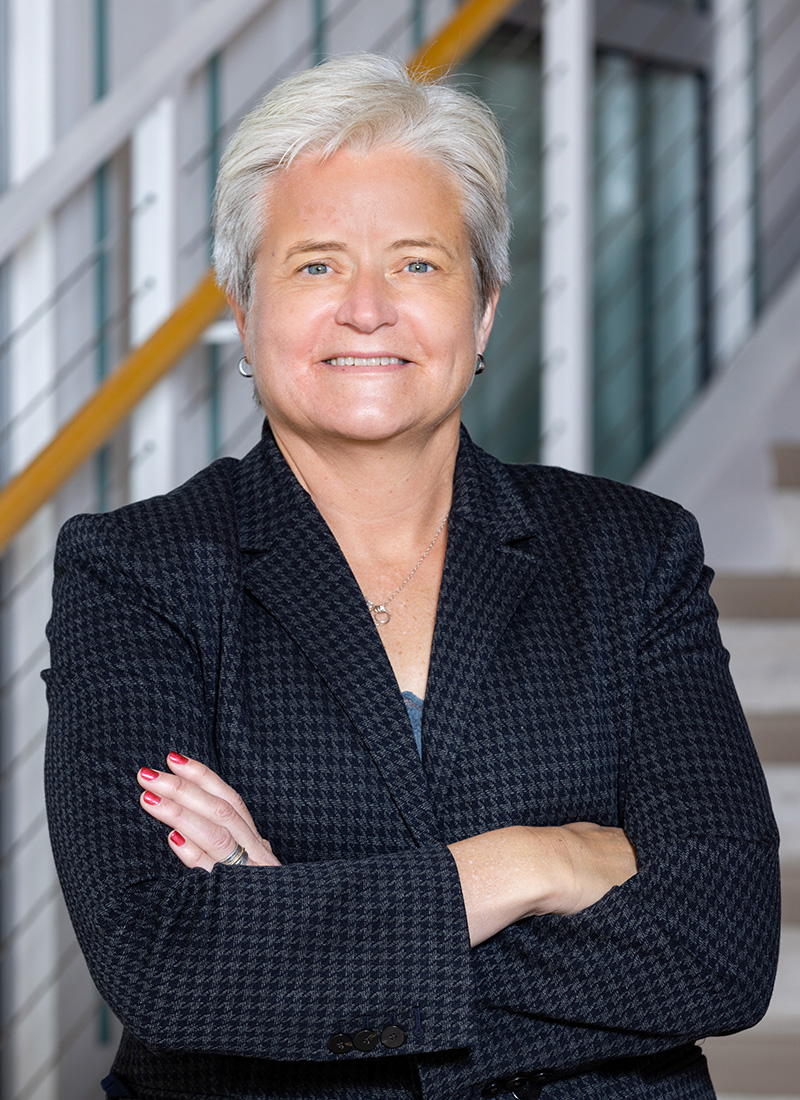
Susan Powers is a Professor of Civil & Environmental Engineering at Clarkson University, where she also serves as the Spence Professor of Sustainable Environmental Systems, Director of the Institute for a Sustainable Environment, and Associate Director of Sustainability. She earned her Ph.D. in Environmental Engineering from the University of Michigan in 1992. Research Interests: Dr. Powers specializes in lifecycle assessment and environmental impact metrics for energy systems, with recent interdisciplinary work on anaerobic digestion for food waste management and smart housing to encourage energy conservation. Her educational research integrates project-based learning to enhance energy and climate change literacy across K-12 and college levels. Scientific Awards: AEESP Distinguished Service Award (2019) AEESP Fellow (2019) Spirit of Entrepreneurship Award (2012) Premier Curriculum Award for K-12 Engineering (2009) NSF Directors Award – Distinguished Teaching Scholar (2004) Grants & Educational Leadership: Dr. Powers has led multiple education-oriented grants, including the NSF Distinguished Teaching Scholars award, to develop project-based modules for sustainability education. She actively incorporates campus sustainability initiatives into student projects to teach real-world environmental problem-solving.
Nancy E. Glass, PhD, MPH, MS, RN, FAAN, is a Professor and Associate Director of the Johns Hopkins Center for Global Health, while holding the Independence Chair in Nursing Education at the Johns Hopkins School of Nursing. She specializes in clinical and community-based intervention research targeting gender-based violence (GBV) and health equity globally. Global Health Expertise: Focuses on improving safety and economic security for women in humanitarian settings, particularly addressing GBV in Somalia, South Sudan, and Kenya. Technological Innovation: Develops mHealth tools like the MyPlan app for abuse intervention and collaborates on ASIST-GBV screening methods. Research Focus: Dr. Glass leads federally funded projects (NICHD, NIMHD, CDC, etc.) to challenge social norms sustaining violence against women and enhance healthcare systems' responses to GBV through partnerships and mHealth technologies. Scientific Awards: 2017 Independence Chair in Nursing Education 2015 Edith Moore Copeland Award 2014 PathPaver Award 2009 Fellow, American Academy of Nursing 2007 Linda Saltzman New Investigator Award Dr. Glass mentors colleagues and students globally, partnering with community organizations and experts to address health, safety, and economic disparities for women and families.
Nicolò Cesa-Bianchi is a Professor of Computer Science at the University of Milan, where he serves as head of the Computer Science programs. He is also associated with the Department of Electronics, Information and Bioengineering (DEIB) at Politecnico di Milano. Cesa-Bianchi holds significant leadership roles including Board member, Fellow and co-director of the Milan unit of the European Laboratory for Learning and Intelligent Systems (ELLIS), and membership in the prestigious Accademia Nazionale dei Lincei. He is also involved with The European Lighthouse on Secure and Safe AI (ELSA), The European Lighthouse of AI for Sustainability (ELIAS), and The FAIR foundation. Professor Cesa-Bianchi's research focuses on the theoretical foundations of machine learning, with special emphasis on sequential decision making and online learning algorithms. His work spans multiple areas including multi-armed bandit problems, regret analysis, prediction with expert advice, and learning on graphs. He has made significant contributions to understanding the theoretical limits of learning algorithms and developing efficient methods for various learning scenarios. His research has important applications in online markets, social networks, and bioinformatics. His monographs 'Prediction, Learning, and Games' and 'Regret Analysis of Stochastic and Nonstochastic Multi-armed Bandit Problems' are considered seminal works in the field. His recent publications demonstrate continued leadership in advancing the theoretical understanding of machine learning, with 2024-2025 papers covering cooperative online learning, multitask learning, fair trade mechanisms, and refined analyses of bandit algorithms. The research shows increasing focus on practical economic applications while maintaining strong theoretical foundations. Google Research Award Xerox Foundation UAC Award Member of the Accademia Nazionale dei Lincei ELLIS Fellow Cesa-Bianchi has been deeply involved in academic service, having served as action editor for the Machine Learning Journal, IEEE Transactions on Information Theory, and the Journal of Machine Learning Research. He currently serves as associate editor for the Journal of Information and Inference and TheoretiCS. He has held leadership positions including President of the Association for Computational Learning and member of the steering committee for the EC-funded Network of Excellence PASCAL2. He was program chair of the 13th Annual Conference on Computational Learning Theory and the 13th International Conference on Algorithmic Learning Theory. He leads the Laboratory for AI and Learning Algorithms (ALGA) at the University of Milan, which focuses on theoretical and applied research in machine learning. His international collaborations are extensive, with visiting positions at UC Santa Cruz, Graz Technical University, Ecole Normale Supérieure in Paris, Google, and Microsoft Research. As an educator, he teaches advanced courses including Reinforcement Learning and Statistical Methods for Machine Learning, and has supervised numerous students through the years.
Andrew Green serves as Professor and Metcalf Chair in Environmental Law at the University of Toronto Faculty of Law, where he teaches environmental law, climate change law, administrative law, natural resources law, judicial decision-making, and international trade. His scholarly contributions span multiple legal domains with particular emphasis on the intersection of environmental regulation and administrative governance. Green's research interests encompass Environmental Law , Administrative Law , Climate Change Policy , Judicial Decision-Making , and International Trade Law . His empirical approach to legal scholarship has produced significant insights into how judges make decisions, particularly in administrative contexts, and how trade rules interact with domestic environmental regulations. His work often bridges theoretical legal analysis with practical policy implications. His recent publications reveal a strong focus on Canadian climate policy implementation, judicial behavior in high courts, and the evolving standards of review in administrative law. The research demonstrates increasing interdisciplinary integration, incorporating machine learning approaches to analyze judicial decisions and examining the systemic challenges in environmental governance. His scholarship consistently addresses the tension between regulatory effectiveness and legal accountability. Metcalf Chair in Environmental Law Past co-President of the Society for Empirical Legal Studies Past President of the Canadian Law and Economics Association Former Associate Dean at the Faculty of Law Chair of the University of Toronto Academic Appeals Committee (2009-2018) Before joining the Faculty of Law, Green practiced environmental law in Toronto for six years, handling both litigation (including prosecutions, administrative appeals, and civil actions) and transactional work. His practical experience informs his scholarly work on regulatory design and implementation. His research has influenced policy discussions on climate change, securities regulation, and administrative law reform in Canada.
Anthony Niblett is a Professor and Canada Research Chair in Law, Economics, & Innovation at the University of Toronto Faculty of Law. He is an Affiliate Researcher with the Vector Institute for Artificial Intelligence and co-founder of Blue J, a startup leveraging AI for tax and legal professionals. Education: Ph.D. in Economics, Harvard University (2009) M.A. in Economics, Harvard University (2006) LL.B. (Honours), University of Melbourne (2003) B.Com. (Honours in Economics), University of Melbourne (2003) Bigelow Fellow, University of Chicago His research bridges artificial intelligence , innovation , and legal theory , with a focus on contract law , competition policy , and judicial behavior . He explores how machine learning transforms legal practice, regulatory frameworks, and judicial decisions. His work includes self-driving contracts , computational antitrust , and the personalization of law . Recent publications analyze AI’s role in legal disagreement , gender gaps in employment law , and computational merger reviews . His articles emphasize the intersection of technology , economics , and legal reform . Scientific Awards: Canada Research Chair in Law, Economics, & Innovation Bigelow Fellow, University of Chicago He serves as an Academic Advisor at the Future of Law Lab and contributes to Blue J , advancing AI applications in legal domains. His teaching includes Contract Law , Torts , and Economic Analysis of Law .
Dr. Zhifu Mi is a Professor of Climate Change Economics at the Bartlett School of Sustainable Construction , University College London. His research focuses on carbon footprint analysis, climate change economics, air pollution and health, sharing economy sustainability, and input-output modeling. He has published extensively in top journals like Nature Sustainability , Lancet , and Science Advances . Co-Editor-in-Chief, Structural Change and Economic Dynamics (2020–present) Executive Editor, Journal of Cleaner Production (2019–present) President, Chinese Economic Association (UK/Europe) Council Member, International Input-Output Association Fellow of the Royal Geographical Society His research explores: Carbon Footprints: Economic development and emission convergence in Chinese households Climate-Health Linkages: Air pollution impacts, ultra-low emission policies Sharing Economy: Sustainable societies through shared micro-mobility Policy Analysis: Synergies between environmental regulations Recent publications analyze decarbonization employment gaps, polycentric urban structures, and health-environment policy intersections. Awards include the World Sustainability Award (2018), multiple Clarivate Highly Cited Researcher honors, and UCL's Outstanding Research Supervision Award (2022). He teaches modules on construction economics and input-output analysis.
Stephan Schmidt is an Associate Professor at Cornell University's College of Architecture, Art and Planning, affiliated with the Department of City and Regional Planning. His research bridges urban spatial patterns, planning institutions, and sustainability outcomes across Europe, sub-Saharan Africa, and China. Education: PhD in Urban Planning from Rutgers University MS in Landscape Architecture from the University of Washington His work examines: land-use policy evolution in Europe; urbanization dynamics in African cities; and polycentricity trends in Chinese metropolises. Recent studies focus on climate risk mitigation through urban form, including urban heat island effects and air pollution in German regions. Key trends in his 2024-2022 publications: comparative analysis of polycentric urban systems; GIS-based spatial pattern evaluation; and institutional impacts on sustainable development. Awards include Cornell's Global Strategic Collaboration Award and German Academic Exchange Service grants. Scientific Awards: Cornell Global Strategic Collaboration Award (2024) Cornell Center for Social Sciences Accelerated Research Grant (2024) German Academic Exchange Service (2019) Advising includes mentoring graduate students like Juan Fernandez, Justin Peng, and Hassan Yakubu on projects analyzing urban morphology. His lab investigates intersections between spatial patterns and environmental outcomes, including climate change adaptation in Tanzanian cities and park fragmentation in German metropolises.
Max Planck Institute for Innovation and CompetitionGermany
Lisa Soder serves as Senior Policy Researcher and Acting Head of Technical AI Governance at Interface, a leading European tech policy think tank, and is an incoming Visiting Research Fellow at Stanford University's Intelligent Systems Laboratory within the School of Engineering. She holds a Master's degree from the London School of Economics focusing on comparative transatlantic approaches to technology regulation and competition law, and brings prior experience from the Centre for the Governance of AI, Boston Consulting Group, and global health NGO work in Ethiopia. Her research centers on establishing AI accountability infrastructures with particular emphasis on developing third-party auditing ecosystems and bridging technical and regulatory aspects of AI governance. She has developed a taxonomy for Technical AI Governance organized along technical targets (Data, Compute, Algorithms and Models, Deployment) and governance capacities (Assessment, Access, Verification, Security, Operationalization, Ecosystem Monitoring). Her work examines open problems across these dimensions, highlighting the critical need for technical tools to support effective AI governance. Analysis of her publications reveals a strong focus on practical implementation challenges in AI regulation, particularly regarding the EU AI Act's provisions for general-purpose AI systems. Her research consistently addresses the gap between policy aspirations and technical capabilities, with particular attention to verification mechanisms, risk assessment frameworks, and the development of technical infrastructure necessary for oversight. She advocates for closer collaboration between technical experts and policymakers to ensure governance mechanisms are both feasible and effective. Lisa has been actively engaged in high-level policy discussions, participating in events such as the AI Action Summit in Paris, Sino-German Track 2 Dialogues on AI governance, and expert briefings on frontier AI systems. Her upcoming visiting research fellowship at Stanford University represents a formal academic affiliation that complements her policy-focused work at Interface.
Rey Ramirez, MD is an Assistant Professor of Orthopaedics & Rehabilitation at Yale School of Medicine, specializing in Hand & Upper Extremity Surgery with a focus on pediatric hand conditions. He joined Yale in 2022 after completing his pediatric hand surgery fellowship at Shriners Hospital of Philadelphia. Dr. Ramirez is affiliated with the Hand & Upper Extremity Surgery division and Pediatric Orthopaedics within the Department of Orthopaedics & Rehabilitation. Dr. Ramirez's educational background includes: BS in Biology from California Institute of Technology (2003) MD from David Geffen School of Medicine at UCLA (2007) Internship at Keck School of Medicine - Los Angeles County Medical Center (2008) Residency at Keck School of Medicine - Los Angeles County Medical Center (2012) Hand Surgery Fellowship at University of Texas Southwestern (2013) Pediatric Hand Surgery Fellowship at Shriners Hospital of Philadelphia (2014) Dr. Ramirez's primary research interests focus on pediatric hand surgery, including congenital hand conditions, brachial plexus birth injuries, and arthrogryposis. His clinical expertise spans pediatric hand reconstruction, microsurgery, and treatment of conditions such as amniotic band syndrome, carpal tunnel syndrome in children, and peripheral nerve injuries. Additionally, he has a strong interest in diversity and inclusion within orthopedic surgery, examining gender and racial disparities in the field and factors influencing specialty choice among medical students and residents. His recent publications demonstrate a dual focus on clinical pediatric hand surgery techniques and diversity in medicine. The surgical publications often address innovative approaches to complex pediatric hand conditions, while his diversity-focused work examines gender disparities in orthopedic surgery and physical medicine, contributing to important conversations about inclusion in medical specialties. His work spans both original research articles and textbook chapters on hand surgery topics. Dr. Ramirez has received several professional recognitions: "Top Research Study" award for his work on women's experiences in orthopedics versus physical medicine (2024) Top Doc for Kids recognition (2020) Best "Surgical Pearl" Paper award from the Pediatric Hand Study Group (2014) Dr. Ramirez is actively involved in mentoring medical students and residents, currently advising Tamanna Patel, Claire Donnelley, Louise Atadja, and Peter Laub. His educational contributions include developing virtual curricula for medical student orthopedic education and examining methods to improve resident performance on standardized examinations. While specific grant funding isn't detailed in the provided information, his research activities suggest involvement in both clinical outcomes studies and healthcare disparities research. Within the Yale Orthopaedics & Rehabilitation department, Dr. Ramirez contributes to the Hand & Upper Extremity Surgery and Pediatric Orthopaedics divisions. His work intersects with the department's broader research initiatives including the Liu Lab for Translational Orthopaedic Research and the 3D Collaborative for Medical Innovation (3DC), though specific lab leadership isn't mentioned in the provided information.
Pardis Emami-Naeini is an Assistant Professor of Computer Science at Duke University, with joint appointments in the Sanford School of Public Policy and the Department of Electrical and Computer Engineering. She serves as the Director of the Duke Interdisciplinary Security, Privacy, and Interaction Research (InSPIre) lab and is a Duke Science and Technology Scholar. Her interdisciplinary work bridges computer science, public policy, and electrical engineering, with a focus on developing usable privacy and security solutions that empower individuals from diverse sociodemographic backgrounds. Dr. Emami-Naeini earned her Ph.D. in Computer Science from Carnegie Mellon University in 2020, followed by postdoctoral research at the University of Washington (2020-2022). Her research sits at the intersection of security, privacy, and human-computer interaction, with particular expertise in IoT security, technology-enabled abuse, reproductive health privacy, and smart city security. She has published extensively at flagship venues including IEEE S&P, CHI, CSCW, and SOUPS, with her work covered by major media outlets such as Wired and The Wall Street Journal. Her recent publications reveal a clear trajectory toward examining the human dimensions of security and privacy in emerging technologies, from LLM chatbots for mental health to social robots and period-tracking apps in the post-Roe v. Wade landscape. Her work consistently emphasizes the need for privacy-aware design that accounts for diverse user needs and contexts, particularly for vulnerable populations. Google Systems and ML Research Gift Award (2025) Google AI Research Scholar Program Award (2024) Top 5% Instructor in Duke Trinity College (2024) ORAU Ralph E. Powe Junior Faculty Enhancement Award (2023) Duke Science and Technology Scholar (2022) IEEE S&P paper highlighted in IEEE Security and Privacy Magazine (2021) CyLab Presidential Fellowship (2019) Dr. Emami-Naeini actively mentors several Ph.D. students including Jabari Kwesi, Jessie Cao, and Hiba Laabadli, as well as undergraduate and master's students. Her research has influenced key organizations including the National Institute of Standards and Technology (NIST), Consumer Reports, and the World Economic Forum in creating usable security and privacy labels for smart devices. She serves on numerous program committees including USENIX Security and CHI, and has participated in NSF grant review panels, demonstrating her growing leadership in the security and privacy community. Her InSPIre lab conducts user-centered research to uncover security and privacy needs of diverse stakeholders, with a particular focus on marginalized communities. The lab's work spans multiple domains including intimate partner violence, reproductive health, virtual reality, and smart cities, always with a strong emphasis on translating research findings into practical tools and policy recommendations.
Kathryn M. Dominguez is a Professor of Public Policy and Economics at the University of Michigan's Gerald R. Ford School of Public Policy, where she also serves as Associate Dean for Academic Affairs. She maintains a dual affiliation with the Department of Economics as director of the honors program. Her educational background includes: PhD in Economics from Yale University (1987) AB from Vassar College (1982) Dominguez's research focuses on international financial markets and macroeconomics, with particular expertise in foreign exchange rate behavior. Her work examines global financial systems, exchange rate interventions, and monetary policy across borders. She has authored influential works including 'Exchange Rate Efficiency and the Behavior of International Asset Markets' and 'Does Foreign Exchange Intervention Work?' (co-authored with Jeff Frankel). Her recent publications reveal a strong emphasis on understanding financial crises, particularly the Great Recession and pandemic-era challenges, with attention to policy responses and international ramifications. Her research demonstrates consistent engagement with central banking policies, exchange rate dynamics, and international financial stability. Professional affiliations: Research Associate, National Bureau of Economic Research Member, Panel of Economic Advisers at the Congressional Budget Office Member, Advisory Scientific Committee of the European Systemic Risk Board Dominguez has advised major institutions including USAID, the Federal Reserve, IMF, World Bank, and Bank for International Settlements. She previously taught at the Kennedy School, Woodrow Wilson School, London School of Economics, and UC Berkeley's Goldman School. At Michigan, she teaches macroeconomics, finance, and international economics courses including Global Financial Markets, Crises, and Policy, and Macroeconomics.
Mohammad Fazlhashemi is a Professor of Islamic Theology and Philosophy at Uppsala University's Department of Theology (Systematic Theology). His work bridges Islamic intellectual traditions with contemporary issues like democracy, environmental ethics, and interreligious dialogue. Current affiliations: Uppsala University, Faculty of Theology Key research areas: Islamic political philosophy, ecotheology, gender in Islam, and theological responses to modernity Email: mohammad.fazlhashemi@teol.uu.se Recent publications highlight trends in Islamic ecoethics (e.g., Islamic Ecotheology , 2025), critical analysis of classical texts (e.g., Critical-constructive interpretation of Islamic documents , 2024), and political theology (e.g., Justifying political decisions through theological arguments , 2016). His scholarship often engages comparative frameworks, as seen in works like Occidentalism (2005) and Shiʿite Salafism? (2022). Mohammad Fazlhashemi's impact spans both academic and public discourse, with contributions to debates on Islam and modernity in outlets like Expressen and Svenska Dagbladet . His co-authored book Visdomens hus: Muslimska idévärldar 600 - 2000 (2017) demonstrates his interest in Islamic intellectual history across eras.
Emie Yiannaka is a Professor in the Department of Agricultural Economics at the University of Nebraska-Lincoln, affiliated with the College of Agricultural Sciences and Natural Resources. Her research focuses on the economic impacts of new technologies and policies in the agri-food sector, including genetically modified products, food fraud, and consumer behavior. Ph.D. in Agricultural Economics, University of Saskatchewan (2002) M.Sc. in Agricultural and Resource Economics, Mediterranean Agronomic Institute at Chania, Greece (1996) M.A. in Agricultural Policy, Mediterranean Agronomic Institute at Chania, Greece (1995) B.Sc. in Agricultural Economics, Aristotle University of Thessaloniki, Greece (1994) Her research spans topics such as innovation economics, intellectual property strategies, consumer acceptance of food technologies, and the economic effects of corporate social responsibility. Recent work examines food fraud deterrence, information avoidance behavior, and ecosystem services valuation. She has published extensively in journals like Journal of Agricultural and Resource Economics , PLOS ONE , and American Journal of Agricultural Economics . Yiannaka has taught courses including Agricultural Marketing in Multinational Environments, Applied Welfare Economics, and Innovation Strategies. She has mentored numerous advisees, including Mavroutsikos C., Deka A., Britwum K., and Meerza S.I.A., who co-authored key publications on food fraud and consumer behavior.
Bonnie Honig, Nancy Duke Lewis Professor at Brown University, holds joint appointments in Modern Culture and Media and Political Science , with courtesy roles in Religious Studies and Theater and Performance Studies . Her scholarly work intersects democratic theory , feminist critique , and cultural analysis , examining how inherited political narratives shape collective action. Education: PhD (Johns Hopkins, 1989), MSc (London School of Economics, 11981), BA (Concordia University, 1980) Central to her research is a reexamination of classical texts like Sophocles' Antigone and Euripides' Bacchae to develop agonistic democratic models . Her Antigone, Interrupted (2013) challenges heroic readings of Antigone, proposing instead a collective feminist politics rooted in textual counter-interpretations. Public Things: Democracy in Disrepair (2017) argues for shared objects as democratic orientation devices , while Emergency Politics (2009) analyzes crisis responses beyond Schmittian frameworks. The 2021 dual publications A Feminist Theory of Refusal and Shell Shocked: Feminist Criticism After Trump extend these themes through Trump-era analysis and queer theoretical lenses . Scientific Awards: 2023-24 Guggenheim Fellowship 2012 David Easton Prize 2012 Okin-Young Award 2007-08 American Philosophical Society Fellowship 1994 Scripps Prize Affiliated with the American Bar Foundation and Digital Democracy Group at Simon Fraser University, Honig's teaching spans feminist theory , Politics and Film , and advanced seminars on Arendt . Her Shell Shocked analysis of Trump-era disaster patriarchy connects classical feminist frameworks to contemporary political crises.
Ahmed Hammad is an Associate Professor in the Department of Civil and Environmental Engineering at the University of Alberta's Faculty of Engineering, where he also serves as Director of Academic Integrity, ENG WIL, Co-op and Career Connections. With 25 years of industry experience as a Project Planning & Control Manager on global mega-projects (including Oil Sands, LNG, and Infrastructure across Canada, UAE, Australia, and Egypt), he brings extensive practical expertise to academia. Education: Doctorate of Philosophy, Construction Engineering & Management, University of Alberta (2009) Master of Science, Construction Engineering & Management, University of Alberta (1999) Master of Engineering, Construction Engineering and Management, Cairo University (1996) Bachelor of Science, Civil Engineering, Mansoura University (1989) Research Focus: Dr. Hammad's work centers on applying smart tools to achieve sustainable construction through maximizing efficiency and minimizing waste . His research employs Machine Learning , Multi-Criteria Decision Making , Knowledge-Based Decision Support Systems , and digital twin technologies to optimize project planning, resource allocation, and sustainable material selection. He investigates the integration of BIM and Augmented Reality to enhance construction processes while reducing environmental impact. Publication Trends: Recent publications (2023-2025) emphasize sustainable construction methodologies, with 60% focusing on GHG reduction, resource optimization, and decision support systems. Key themes include machine learning for labor estimation, TOPSIS/MCDM for sustainable material selection, and digital twins for production planning, reflecting his NSERC-funded projects on KBDSS and construction-oriented digital twins. Scientific Recognition: Best Paper Award at 8th International Conference on Industrial Engineering and Operations Management (2018) Best Paper Award at HBRC Green Smart Sustainable Buildings Conference (2024) Research Leadership: Dr. Hammad secures major industry-academic partnerships, including NSERC Mission Alliance Grants ($1.2M+) with 16 industry partners for GHG reduction projects and NSERC Alliance Grants with 9 partners for digital twin development. His completed projects include collaborations with the City of Edmonton and Alberta Ministry of Infrastructure on resource allocation models. Research Ecosystem: As leader of the Sustainable Construction Research Group (SCRG), he fosters industry-academia collaboration through regular workshops with construction firms and government agencies, focusing on translating research into practical tools for sustainable project delivery.