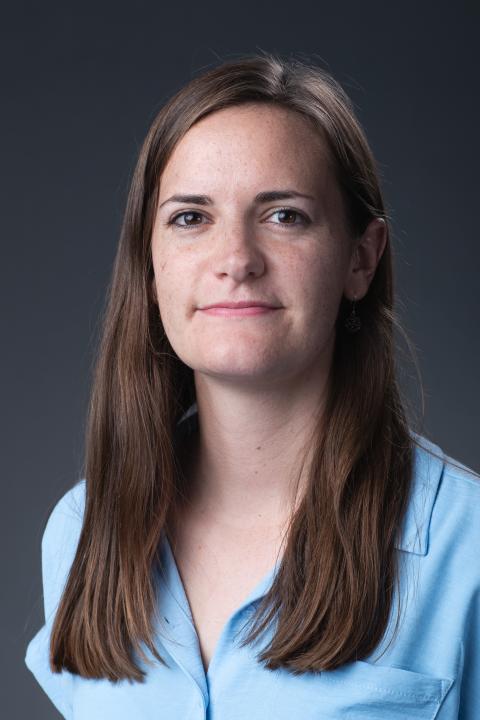
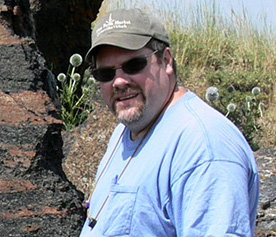
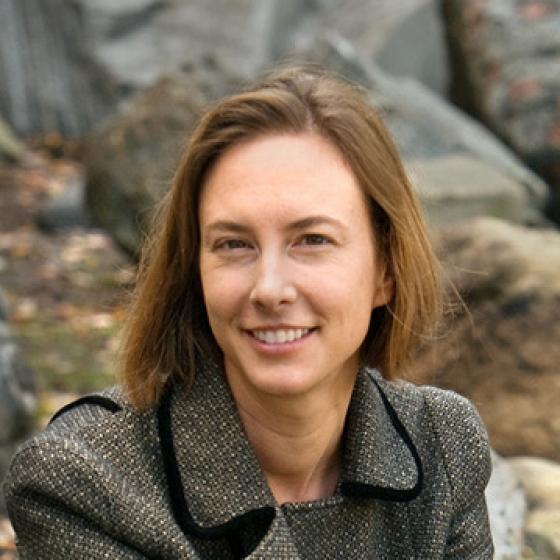
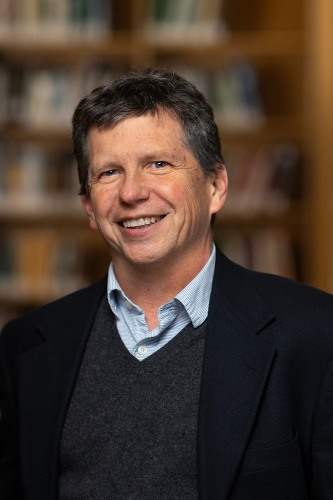
Adriano Gualandi is a researcher at the University of Cambridge , affiliated with the Department of Earth Sciences and associated with the Cambridge NERC Doctoral Landscape Awards program as a DLA supervisor. His work focuses on nonlinear dynamical systems in geophysics, extreme events, and their hazards. Research Areas : Seismology, Geodesy, Fluid-Solid Earth interactions, and machine learning applications to tectonic data. Techniques : Combines classical statistical methods with modern machine learning to extract tectonic insights, using deterministic and stochastic models. Collaborations : Linked to institutions like INGV (Italy), EPOS, and British Antarctic Survey via the C-CLEAR DTP. His publications highlight a focus on slow earthquakes, seismic cycles, and causal analysis in complex systems. Current projects explore machine learning for geophysical data and fluid-solid-earth interplay.
Luc L. Lavier is a Professor in the Department of Earth and Planetary Sciences at the Jackson School of Geosciences, The University of Texas at Austin. He holds the Morgan J. Davis Centennial Chair in Geosciences. His research focuses on large-scale tectonic processes, particularly the dynamic evolution of continental and oceanic rift systems, subduction zones, and the rheological behavior of Earth materials. He uses numerical modeling, geophysical data analysis, and laboratory experiments to understand deformation mechanisms at plate boundaries. Education: Ph.D. in Earth Sciences (2000s), Columbia University M.S. equivalent in Geophysics (2000s), Université Montpellier, France Maîtrise & License in Theoretical Physics (1990s), Université Besançon, France Research Interests: Luc's work spans computational geomechanics, lithospheric deformation, and the interplay between tectonic processes and surface geology. Key themes include: Parameterization of Earth material rheology Initiation and evolution of subduction zones Numerical modeling of mantle dynamics and rifting Integration of geophysical data (e.g., InSAR, seismic imaging) with field observations Recent Research Trends: Recent publications emphasize fault dynamics in subduction zones, Venusian tectonics, and the mechanical controls on continental rifting. His work bridges laboratory-scale experiments with large-scale geodynamic models to address questions about earthquake mechanics, mantle flow during continental breakup, and the role of fluids in deformation processes. Awards: Morgan J. Davis Centennial Chair in Geosciences (Fellow) Advising & Grants: Luc advises postdoctoral researchers and graduate students, though no named advisees are listed. His grants include collaborative projects on tectonic inheritance and rifting dynamics, supported by NSF and other agencies. Research tools include DynEarthSol3D and hybrid finite difference models. Labs & Collaborations: Affiliated with the UT Institute for Geophysics (UTIG), he collaborates internationally on projects such as the Deep Ivory Coast Basin seismic experiments and the Hikurangi subduction zone observatory.
David C Bolton is a Research Assistant Professor at the University of Texas at Austin's Jackson School of Geosciences, specifically within the Institute for Geophysics. He holds an NSF Postdoctoral Fellowship and focuses on experimental rock mechanics and observational seismology. His research integrates laboratory experiments with seismic data to study fault zone processes and foreshock properties, aiming to scale these findings to tectonic scales. PhD and academic background: Not explicitly stated in the provided text. Research interests include fault mechanics, rock deformation, ultrasonic monitoring, foreshock properties, and earthquake scaling laws. His work bridges laboratory observations with field data, such as the Apennine fault system in Italy, to address questions about seismic cycle dynamics and foreshock-main-shock relationships. Recent articles highlight his focus on machine learning applications for earthquake forecasting, laboratory earthquake mechanics, and induced seismicity. Key themes include nucleation processes, rupture propagation, and the use of elastic waves and acoustic emissions as predictive tools. Scientific Awards: NSF Postdoctoral Fellowship. He advises no listed students but has contributed to grants via his NSF postdoctoral role. His lab affiliations include the Institute for Geophysics at the University of Texas, where he collaborates on projects involving fault zone dynamics and seismic hazard analysis. Labs/Teams: Active member of the Institute for Geophysics research groups focusing on experimental seismology and tectonic processes.
Zhe Jia is a Research Assistant Professor at the Institute for Geophysics, Jackson School of Geosciences, The University of Texas at Austin. He holds a PhD from the California Institute of Technology (2016-2022) and prior degrees from the University of Science and Technology of China (BS 2009-2013, MS 2013-2016). His research focuses on earthquake mechanisms and hazards, using multi-geophysical data and modeling to study rupture dynamics across diverse tectonic settings, from shallow continental faults to subduction zones. Key interests include fault geometry effects, stress interactions, and fluid dynamics in controlling earthquake behavior. He employs advanced techniques such as moment tensor inversions, numerical modeling, and machine learning to analyze seismic and geodetic data. Notable contributions include discoveries of multi-fault rupture complexity in events like the 2019 Ridgecrest sequence and the 2023 Kahramanmaraş doublet. His work emphasizes integrating observations with structural models to improve seismic hazard assessments and tsunami prediction. Zhe’s research has been featured in high-impact journals like Science and Geophysical Research Letters. He actively mentors students and collaborates internationally. His professional service includes roles as a NSF proposal reviewer and session convener at AGU meetings. Teaching roles include lecturing in seismology and earthquake geodesy at Scripps Institution of Oceanography and the California Institute of Technology. Field experiments include nodal seismometer deployments in the Los Angeles Basin and active-source studies on the San Andreas Fault. His lab focuses on developing novel inversion tools (e.g., gCAPjoint software) and applying machine learning to seismic tomography.
Katie M Smye is a Research Associate Professor at the Bureau of Economic Geology within the Jackson School of Geosciences at The University of Texas at Austin. Her work focuses on geomechanical and hydrogeological processes related to oil and gas operations, particularly induced seismicity, wastewater disposal, and reservoir dynamics. She combines satellite InSAR data with subsurface modeling to assess anthropogenic land deformation and fault stability. Research Interests: Induced seismicity mechanisms and mitigation Wastewater disposal reservoir characterization Pore pressure evolution in unconventional plays Geomechanical modeling of fault systems Hydrogeological impacts of energy operations Her recent work emphasizes regional studies in the Permian and Delaware Basins, linking injection practices to surface deformation and fault reactivation. Over 50 peer-reviewed articles demonstrate her contributions to understanding subsurface-fluid interactions and geohazard assessment. Lab/Affiliations: Active member of the Bureau of Economic Geology's Energy and Geoscience group, collaborating with industry and government agencies on applied geoscience solutions for sustainable resource development.
Sophie Coulson is an Assistant Professor of Geophysics in the Department of Earth Sciences at the University of New Hampshire. She received her Ph.D. in Earth and Planetary Sciences from Harvard University and previously worked at Los Alamos National Laboratory as part of the Ice Sheet Group. Her research focuses on flow and deformation in the Earth's interior and the effect these processes have on changing sea level and ice sheet stability over diverse timescales. Dr. Coulson's research interests include: Sea Level Change Ice Sheet Dynamics Mantle Flow and Dynamic Topography Glacial Isostatic Adjustment (GIA) Paleoclimate Reconstruction Gravitational Effects on Sea Level Her recent publications demonstrate expertise across multiple domains of Earth sciences, with particular focus on detecting the 'sea level fingerprint' of ice sheet melt, 3-D crustal deformation from ice mass loss, and historical sea level changes during events like the Messinian Salinity Crisis and Viking settlements in Greenland. Her work has been published in top journals including Science, Science Advances, and PNAS. Dr. Coulson has received significant media attention for her research, with coverage in Nature, The Washington Post, CNN, and NBC News. She actively participates in major scientific conferences including PALSEA meetings and AGU Fall Meetings, where she has convened sessions on ice sheet-solid Earth interactions. As an educator, she teaches courses including ESCI 402: Earth History, ESCI 734/834: Global Geophysics, and ESCI 795/895: Topics in Sea Level Change & Geodynamics. She mentors graduate students including Grace Ertel (PhD student) working on ocean dynamics and solid-Earth deformation interactions. Dr. Coulson is committed to outreach, having led numerous workshops for girls in STEM programs across New Mexico.
Paul Wetmore is an Associate Professor in the Department of Geology at the University of South Florida (USF), affiliated with the School of Geosciences within the College of Arts and Sciences. His research focuses on structural geology, tectonics, and magmatic systems, with global fieldwork extending to regions like Mexico, Armenia, Canada, and the U.S. Cordillera. He teaches courses such as Structural/Tectonics and Geological Field Studies. Education: B.S. in Geology, SUNY College at Brockport (1994) M.S. in Geology, Idaho State University (1998)—specializing in volcanism, geochemistry, and tectonics Ph.D. in Geology, University of Southern California (2003)—specializing in structure-tectonics and petrochemistry Research Interests: Wetmore’s work examines the structural and magmatic evolution of continental margins, including the Peninsular Ranges Batholith and the Snake River Plain. He investigates processes like pluton emplacement, mass transfer, and the tectonic integration of accreted terranes. Recent projects include geophysical studies of volcanic fields (e.g., Idaho’s Lost River Valley) and fault slip rates in California and Baja California. Publications & Trends: His 15 most recent articles (2025–2014) emphasize geophysical methods (e.g., gravity inversion, LiDAR), fault dynamics, and magmatic systems. Key themes include 3D subsurface imaging of volcanic domes, seismic analysis of the Stanley earthquake, and tectonic evolution of the Peninsular Ranges. Awards: Best Professional Paper (Peninsular Geological Society, 2002) USC Dissertation Fellowship (2002–2003) Multiple teaching awards at USC (2000–2001) Advising & Grants: Wetmore advises graduate students on projects ranging from fault slip rates to pluton emplacement. He collaborates with institutions like the University of Arizona (BATHOLITHS project) and contributes to field camps in Idaho and Mexico. His research is supported by NSF grants and international partnerships. Labs & Teams: Active in USF’s Crustal Dynamics Group and the Petrology, Geochemistry, and Planetary Science Group. Collaborators include Helge Alsleben, Scott S. Hughes, and Mihai Ducea.
Dr. Andrea D. Hawkes is an Assistant Professor in the Department of Earth and Ocean Sciences at the University of North Carolina Wilmington (UNCW) , affiliated with the Center for Marine Science . She supervises the Sea Level Research Laboratory , focusing on coastal evolution through geological evidence of megathrust earthquakes tsunami deposits hurricane/storm impacts long-term glacial isostatic adjustment patterns. Her research integrates microfossil analysis (foraminifera, ostracods), stable isotope geochemistry , and sediment dynamics to reconstruct relative sea level changes and extreme environmental events. Key methodologies include laser total station mapping YSI/HOBO sensor networks CHIRP coring systems microscope imaging multi-proxy calibration in coastal wetlands and marine environments. Recent publications highlight her expertise in Cascadia subduction zone earthquakes (2013-2018), Atlantic/Gulf Coast hurricane chronologies (2011, 2014), and international collaborations on tsunami deposits in Indonesia (2007, 2008) and Argentina (2015). The Sea Level Research Lab maintains extensive field equipment (520 sq. ft. lab space + storage facilities) for sediment analysis and paleoenvironmental reconstruction.
Donsub Rim is an Assistant Professor in the Department of Mathematics at Washington University in St. Louis. He holds a PhD from the University of Washington, advised by Randall J. LeVeque and Gunther Uhlmann. His research focuses on numerical analysis of PDEs, inverse problems, and low-rank neural network representations (LRNRs) for real-time solutions in geophysics, medical imaging, and plasma physics. Key areas include stability analysis of neural networks for tsunami early warning, fast inversion of the approximate discrete Radon transform (ADRT), and computational applications in geophysical hazard assessment. Rim is on leave during 2024-2025 as a Visiting Scholar at the University of Washington. Previously, he was a visiting scholar at Tohoku University's IRIDeS (2023) and affiliated with the Courant Institute and Columbia University. His work bridges mathematical theory with practical tools like the 'adrt' Python library for signal processing. Research Interests: Numerical methods for PDEs, model reduction techniques, neural network applications in high-consequence domains (e.g., tsunami forecasting), and ADRT-based algorithms for dimensional splitting and sparse approximations. Collaborations include projects on probabilistic tsunami hazard assessment (PTHA), earthquake kinematic effects on tsunami propagation, and meta-learning approaches for physics-informed networks. Publications highlight contributions to real-time prediction systems, stability analysis of neural networks, and manifold approximations for transport-dominated problems. His software developments, such as the ADRT Python package, emphasize open-source tools for scientific computing. Rim has advised or collaborated with researchers at institutions including Columbia University, Tohoku University, and the University of Washington. Grants and future work involve advancing LRNR frameworks for nonlinear hyperbolic problems, improving tsunami early warning systems via GNSS data, and exploring applications of sparse physics-informed backpropagation in geophysics and plasma physics.
Rowena B. Lohman is a Professor in the Department of Geological Sciences at Cornell University's College of Engineering. She holds a B.S. in Geology (1998) and Ph.D. in Geophysics (2004) from Caltech, followed by postdoctoral roles at WHOI and JPL before joining Cornell in 2007. Her research focuses on earthquake physics, satellite remote sensing (InSAR), tectonic deformation, and human-induced ground displacements. She is actively involved in advancing geodetic modeling techniques and improving access to satellite data. Education: B.S. in Geology, California Institute of Technology (1998) Ph.D. in Geophysics, California Institute of Technology (2004) Research Interests: Lohman’s work integrates InSAR data with finite element modeling to study earthquake nucleation, fault interactions, and anthropogenic impacts on ground deformation. She examines tectonic regions like Southern California, Cascadia, Iran, and Louisiana, with recent emphasis on land use effects (e.g., mining, subsidence in New Orleans). Key methods include geodetic analysis and remote sensing innovations. Awards & Grants: 2019: Daniel M. Lazar Teaching Award, Cornell Engineering 2019: Benjamin Meaker Visiting Professorship, University of Bristol 2013: AGU Geodesy Section Award 2011: NASA New Investigator Program Grant ($318k) Service & Collaboration: Lohman serves on the Southern California Earthquake Center (SCEC) planning committee and advocates for open access to remote sensing tools. Her work bridges geoscience with societal needs through hazard mitigation and interdisciplinary collaborations.
James Dolan is a Professor of Earth Sciences at the University of Southern California (USC), affiliated with the USC Dornsife College of Letters, Arts and Sciences. His research focuses on tectonics, geophysics, and fault dynamics, with particular emphasis on understanding slip rate variability, fault system interactions, and earthquake mechanics. He holds a Ph.D. in Geology from UC Santa Cruz (1988) and a B.S. in Geology from UC Davis (1981). His work integrates geodetic imaging, luminescence dating, and field-based studies to investigate fault behavior across diverse regions, including the Garlock Fault (California), Marlborough Fault System (New Zealand), and the East Anatolian Fault (Turkey). Key contributions include refining Holocene slip rates, analyzing coseismic slip distributions, and exploring the implications of non-constant earthquake behavior for seismic hazard assessment. Expertise: Structural geology, paleoseismology, and geochronology. Techniques: LiDAR, remote sensing, and advanced luminescence dating methods. Fieldwork: Alaska, New Zealand, and California, emphasizing fault zone evolution and geomorphic markers. His publications highlight innovative approaches to quantifying fault slip variability and strain localization, with applications to improving earthquake rupture models and hazard mitigation strategies.
David T. Sandwell is a Professor of Geophysics at the Institute of Geophysics and Planetary Physics within Scripps Institution of Oceanography, University of California, San Diego. His research integrates satellite remote sensing, geodesy, and marine geophysics to study Earth's dynamic processes. Research Interests: Sandwell specializes in marine gravity anomaly mapping from satellite altimetry, predicted and measured seafloor topography, synthetic aperture radar interferometry (InSAR), thermal and mechanical structure of the oceanic lithosphere, geodynamic applications of satellite altimetry, and tectonics on Venus. His work bridges planetary science with terrestrial geophysics, focusing on crustal deformation, earthquake mechanics, and ocean basin evolution. He teaches courses including Introduction to Geodynamics, Satellite Remote Sensing, and Physics of Surfing. His recent publications demonstrate a strong trend toward high-resolution seafloor mapping, interseismic deformation analysis, and advanced InSAR techniques for earthquake cycle studies. Key themes include satellite-derived bathymetry, fault creep monitoring along major plate boundaries like the San Andreas Fault, and tectonic applications of gravity field recovery. His research increasingly incorporates multi-satellite data fusion and computational geophysics for modeling lithospheric behavior. Scientific Awards: While specific awards aren't detailed in the source material, Sandwell's extensive publication record (over 200 papers) and leadership in major projects like the SRTM15+ global bathymetry model reflect significant recognition in geophysics. Advising and Grants: Sandwell has advised 17 Ph.D. students since 1988, with recent graduates (2016-2023) focusing on seafloor geodesy, InSAR applications, and lithospheric mechanics. His research is supported by NASA, NSF, and USGS grants targeting satellite geodesy, earthquake cycle modeling, and marine gravity field recovery. Current projects include meter-scale seafloor deformation monitoring and absolute phase recovery in InSAR processing. Labs and Teams: He leads research within Scripps' Institute of Geophysics and Planetary Physics, collaborating with the GPlates development team for 3D tectonic visualization and contributing to NASA's Earth Surface and Interior focus area. His group develops open-source radar interferometry software (GMTSAR) and maintains global gravity and bathymetry databases used worldwide.
Greg Hirth is the Vice President for Research and Professor of Earth, Environmental, and Planetary Sciences at Brown University. He holds affiliations within the Department of Earth, Environmental & Planetary Sciences and has served as a researcher at institutions like Woods Hole Oceanographic Institution and MIT. His research focuses on experimental rock mechanics, deformation mechanisms in crustal and mantle lithologies, and structural geology. Recent awards include the 2024 Harry Hess Medal from the American Geophysical Union. Education: PhD (1991), ScM (1987), and BS (1985) from Brown University and Indiana University, respectively. Honors include Fellowships from the Mineralogical Society of America (2006) and AGU (2008). Key research areas include tectonics, volcanic processes, and the application of experimental flow laws to geophysical observations. He advises graduate students such as Nicholas Dygert and Brooks Proctor. His grants include studies on mantle dynamics, lower crustal viscosity, and plume-trench interactions. Labs/Teams: Not explicitly listed, but his work involves collaborations with institutions like WHOI and MIT, focusing on mantle rheology and deformation mechanisms.
Henrik Andersen Sveinsson is a Researcher and Postdoctoral Fellow at the University of Oslo's Department of Physics, affiliated with the Center for Computing in Science Education. His research focuses on molecular simulations of fractures in geologically relevant materials like silica, ice, and gas hydrates, alongside fundamental studies of friction dynamics. He teaches courses including HON1000 (Cross-Disciplinary Thematic Focus for Honours Students) and HON2200 (Data-driven Projects), alongside prior instruction in electromagnetism and wave physics. His work bridges computational physics and geoscience, with recent papers exploring machine learning applications in atomic force modeling, methane hydrate mechanics under varying conditions, and diffusion-driven frictional aging. Key contributions include studies on nanoscale damage production in quartz and the role of water ice in nanocrystalline materials. Publications highlight interdisciplinary approaches, combining molecular dynamics with AI tools for material property prediction and environmental impact assessments. Sveinsson’s research has implications for understanding earthquake mechanics, climate-related material stability, and energy storage systems. His academic background includes a PhD in computational physics (2019) and master’s/bachelor’s degrees from UiO (2015/2013). Current projects include the ChemFrac initiative on reaction-induced fracturing and CO2Basalt studies. No awards are explicitly listed, though his work is broadly collaborative with institutions like the Norwegian Broadcasting Corporation and international journals.
Professor Γαντές Χαράλαμπος serves as Director of the Steel Structures Laboratory at the School of Civil Engineering, National Technical University of Athens (NTUA). He holds a Diploma in Civil Engineering from NTUA (1985), and M.S. (1988)/Ph.D. (1991) from MIT. Since 1994, he has been a faculty member at NTUA, teaching courses on steel structures, nonlinear behavior, and marine structures. His research focuses on steel structures under extreme loads (earthquake, wind, explosion), energy sector infrastructure (wind turbines, pipelines), and deployable systems. Education: Ph.D. in Civil Engineering, MIT, 1991 M.S. in Civil Engineering, MIT, 1988 Diploma in Civil Engineering, NTUA, 1985 Research interests emphasize steel structures' nonlinear behavior, seismic resilience, and innovative designs for energy systems. He leads Eurocode 3 standardization efforts as ELOT TE67/OE3 coordinator and serves on CEN committees. His work spans 100+ journal articles, 175 conference papers, and 3 books including Deployable Structures – Analysis and Design . He advises on major projects like Attiki Odos highway, Attiko Metro tunnels, and Olympic Games infrastructure. Grants and collaborations include international conferences (e.g., EUROSTEEL 2021), journal editorships (IASS Journal), and consulting for structural projects globally. His lab explores cutting-edge topics like composite materials, fire-resistant systems, and fault-crossing pipeline design.