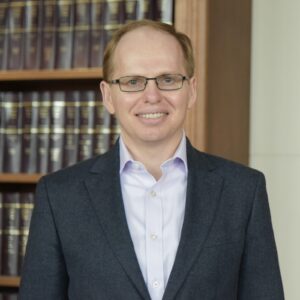
James P. Naughton is an Associate Professor at the Darden School of Business , University of Virginia. His research focuses on how financial, legal, and regulatory institutions influence disclosure practices and economic decision-making, particularly in the context of pension plans, ESG reporting, and litigation risk. Key research areas: Pension accounting, ESG disclosure, Social media strategy, Regulatory enforcement Teaches core financial accounting in Darden's MBA program Research Trends : His recent work examines investor integration of ESG and earnings news, algorithmic litigation risk prediction, and the role of credit ratings in voluntary disclosure. Co-authored studies on social media's impact on corporate communication and public pension accounting rules' economic effects. Collaborators : Frequently works with Clare Wang, Ira Yeung, Austin Moss, and Rafael Rogo. Affiliated with institutions like University of Colorado Boulder, London Business School, and Simon Fraser University.
Dr. Madhushi Bandara is a Lecturer at the School of Computer Science, University of Technology Sydney (UTS), specializing in knowledge representation, complex system modeling, and data analytics. She leads the data management research stream at the UTS DigiSAS lab and is a core member of the Biomedical Data Science Laboratory within the UTS Australian Artificial Intelligence Institute. Her industry collaborations include Telstra, Cancer Australia, and Capsifi, focusing on AI integration in healthcare and finance. She coordinates the Business Information Systems major in UTS's Master of Information Technology program and convenes the Future Generation Enterprise Architecture Community of Practice. Education PhD in AI Systems Engineering, University of New South Wales (2020) BSc (Hons) in Engineering, University of Moratuwa, Sri Lanka (2015) Research Interests Madhushi's work bridges machine learning, knowledge graphs, and enterprise architecture to address challenges in data governance for SMEs, ESG metric management, and healthcare pathway analysis. Her research emphasizes translating cutting-edge AI into industry solutions through contextual domain knowledge integration. Scientific Awards UNSW-UTS Trustworthy Digital Society Scholarship Teaching & Leadership She teaches enterprise information systems, digital strategy, and AI for enterprises in UTS's online postgraduate programs. Her service roles include co-chairing tracks at the Australasian Conference on Information Systems and reviewing for Expert Systems with Applications.
Professor Craig Deegan is a leading academic in the field of accounting at the University of Tasmania, where he serves as Professor of Accounting and Acting Head of the Tasmanian School of Business and Economics. He has previously held professorial roles at RMIT University and the University of Southern Queensland, and his work is internationally recognized for its impact and influence. His research focuses on social and environmental accountability , financial accounting , and accounting theory . He is one of the most highly cited accounting researchers globally, with over 38,000 citations on Google Scholar, and has been recognized as Australia’s Research Field Leader in Accounting and Taxation by The Australian . His work has appeared in top-tier journals such as Accounting, Organizations and Society , Critical Perspectives on Accounting , and Journal of Business Ethics . His recent publications reflect a strong trend toward accountability in sustainability , climate change reporting , supply chain ethics , and critical analysis of corporate disclosures . His work often applies legitimacy theory and institutional perspectives to examine how organizations respond to societal expectations. Educational Publishing Awards Australia – Most Outstanding Tertiary Resource Award (2020) Peter Brownell Manuscript Award University of Southern Queensland Award for Excellence in Research Best Paper Awards at nine international conferences Australia’s Research Field Leader in Accounting and Taxation (2018) Craig Deegan has supervised over 25 PhD students and numerous master’s and honours students. He has secured multiple research grants from bodies including the Accounting and Finance Association of Australia and New Zealand and the Blue Economy CRC. His current projects include accountability frameworks for seasonal work, carbon offset methodologies, and stakeholder accountability in biodiversity reporting. He is also involved in consultancy work, including a major report on Tasmania’s hydrogen economy. He leads research teams focused on sustainability accounting, stakeholder engagement, and social auditing, and is deeply involved in advancing both academic knowledge and practical applications in corporate accountability and ethical financial reporting.
Li Zhongfei is a Chair Professor and Vice Dean of the School of Business at Southern University of Science and Technology (SUSTech). He is a member of the State Council's Discipline Review Group, National Outstanding Young Scientist, National Model Teacher, and recipient of the State Council's Special Government Allowance. His career spans roles as Distinguished Professor at Lingnan College, Executive Dean at Sun Yat-sen University, and leadership positions in academic societies such as the Chinese Society for Systems Engineering. Education : PhD in Management (1997-2000) and Master's in Operations Management (1988-1990) from the Chinese Academy of Sciences, and a Bachelor of Science in Mathematics from Lanzhou University. Research Interests : His work focuses on Technological Finance Green Finance Pension Finance Financial Engineering and Risk Management Insurance and Actuarial Science with applications to financial markets, digital finance, and sustainability. Scientific Trends from his publications include: ESG rating impacts on capital markets Green innovation under carbon pricing Machine learning in cryptocurrency forecasting Robust portfolio optimization under uncertainty Climate risk and policy analysis Post-pandemic economic recovery and systemic risk Scientific Awards : Recipient of the National Teaching Achievement Award, Guangdong Province Philosophy and Social Sciences prizes, Zhong Jiaqing Operations Research Award, and recognition as a Top 2% Scientist (Stanford, 2023). He was honored as a National Model Teacher and 'Top Ten Most Respected Business School Deans in China.' Grants & Projects : Principal investigator in NSFC key projects, including 'Intelligent Investment and Risk Management under Dual Carbon Strategy' and 'Financial Innovation and Risk Management.' His projects address fintech, pension funds, and climate risk. Labs & Teams : Leads advanced research teams in SUSTech's School of Business and collaborates with international institutions like the University of Waterloo and Hong Kong Polytechnic University.
David Ardia is a Full Professor in the Department of Decision Sciences at HEC Montréal, promoted to this position on June 1, 2025. Previously, he served as an Associate Professor from June 2020 to May 2025. He holds the Research Professorship in Sentometry and is a member of the Study and Research Group on Decision Analysis (GERAD) and the International Statistical Institute. Ardia is also an elected member of the ISI Louis Bachelier Fellow and serves as Associate Editor for both the International Journal of Forecasting and the Journal of Statistical Software. His educational background includes a Ph.D. in Financial Econometrics from the University of Fribourg, a Master of Applied Sciences in Quantitative Finance from the Swiss Federal Institute of Technology Zurich and University of Zurich, and a Master of Science in Financial Engineering from the University of Neuchâtel. Ardia's research focuses on the intersection of quantitative finance, machine learning, and natural language processing, with particular emphasis on sentometrics (textual sentiment analysis in finance), risk management, and climate finance. His work spans financial econometrics, volatility modeling, and the application of advanced statistical methods to asset allocation and economic forecasting. He has pioneered methods for analyzing climate change concerns in financial markets and has made significant contributions to understanding green versus brown stock performance. His publication record shows a strong trajectory in high-impact finance and statistics journals, with recent work examining Robinhood trading patterns, cryptocurrency markets, climate finance, and innovative methodological approaches to financial time series analysis. His research demonstrates increasing focus on sustainability applications within quantitative finance. Prix de la qualité des données ouvertes 2024 (Canadian Open Data Community) Prix de recherche pour les professeures et professeurs agrégés (HEC Montréal, 2024) Prix pour l'excellence en pédagogie (HEC Montréal, 2022) Best Paper Award at the 38th International Conference of the French Finance Association Best Paper Award 2018-2019 from International Journal of Forecasting eRum 2020 COVID19 contest winner for the COVID-19 Data Hub Ardia actively supervises numerous graduate students, with over 70 mentorship activities documented in the past five years, spanning both thesis supervision and supervised projects. His research is supported by collaborations with institutions including IVADO, the R Consortium, and the University of Lugano. He co-created the influential COVID-19 Data Hub platform, which integrates epidemiological data with policy measures and spatial databases to analyze pandemic impacts. His research group focuses on developing computational tools for financial analysis, particularly through R packages like MSGARCH for Markov-switching GARCH models and sentometrics for textual sentiment analysis. This work bridges academic research with practical applications in financial institutions and policy analysis.
Paul Shrivastava is a Professor of Management and Organizations at the Smeal College of Business, Pennsylvania State University. He served as Penn State's Chief Sustainability Officer and Director of the Sustainability Institute until July 2022. Previously, he led Future Earth as Executive Director and co-founded the David O'Brien Centre for Sustainable Enterprise at Concordia University. His expertise spans sustainability, transdisciplinary research, crisis management, and organizational strategy. Education: PhD in Strategic Planning and Policy from the University of Pittsburgh (1981), Post Graduate Diploma in Management from IIM Calcutta, and Mechanical Engineering from NIT Bhopal. Research focuses on sustainable development, corporate sustainability strategies, and integrating arts with science for environmental stewardship. Key contributions include foundational work on crisis management (e.g., Bhopal disaster analysis) and pioneering 'embodied learning' methods. He co-founded the Organizations and Natural Environment Division of the Academy of Management and chairs the UNESCO Art and Sustainable Enterprise initiative. Awards include the Academy of Management ONE Division Distinguished Scholar Award (2023) and IIM Calcutta Distinguished Alumni Award (2016). His advisory roles span global institutions like the Club of Rome and Hiroshima University's NERPS. Notable projects include Balance unBalance 2011 and Montreal Degrowth 2012 conferences, emphasizing artistic and transdisciplinary approaches to sustainability. He advocates for systemic integration of SDGs and resilience in urban systems, as highlighted in his work on 'sustainable cities' and climate governance.
Yuki Tanaka is a Professor at the Department of Contemporary Business, Faculty of Economics, Hosei University . Her research focuses on financial accounting and ESG disclosures , examining how corporate sustainability reporting impacts decision-making and organizational value. PhD in Commerce from Hitotsubashi University (2012) Specializes in empirical research using econometrics, text mining, and field studies Active in Japan Bankers Association and Trust Companies Association of Japan Research Themes include corporate ESG disclosures, climate change risk management, and AI applications in sustainability evaluation. She leads projects like "AI-based ESG Information Analysis" (JSPS Grant-in-Aid (B), 2022-2025) and "Climate Change Disclosure Content Analysis" (JSPS Grant-in-Aid (C), 2020-2023). Professional Memberships : Japan Accounting Association Social Accounting Society of Japan Japan Investor Relations Association
Andrew Tuch is a Professor at Washington University School of Law, where he teaches Corporations Law, Investment Banking and Private Equity, and Securities Regulation. His scholarly work focuses on securities and financial regulation, corporate law and governance, and comparative law, with publications appearing in top law reviews and peer-reviewed journals. LLM and SJD degrees from Harvard Law School LL.B. and B.Com. from the University of Queensland His research examines fiduciary principles, regulatory frameworks for financial markets, and comparative analyses of corporate governance systems. His 2024 article "Green Gatekeepers" explores ESG investing, while earlier works analyze SPAC reforms, proxy advisor influence, and conflicts in M&A advisory roles. Notable awards include the 2024 Berkeley-ECGI Best Paper Award and multiple Victor Brudney Prizes. He has served on the FINRA National Adjudicatory Council and chaired AALS executive committees for Business Associations and Financial Institutions.
Mercedes Herrero de la Fuente is a Professor at Antonio de Nebrija University's School of Communication and Arts in Madrid, specializing in Journalism and Media Innovation. Holding a PhD in Information Sciences from Complutense University of Madrid, she coordinates the doctoral program in Innovation in Digital Communication and Media while leading research through the INNOMEDIA Research Group. Her academic affiliations include active participation in multiple national research projects funded by Spain's Ministry of Science and Innovation. Her research focuses on the intersection of digital technologies and communication, with particular emphasis on data journalism, transmedia narratives, disinformation combat strategies, and gender representation in media. Recent work explores augmented reality applications in journalism, accessibility for people with disabilities in the audiovisual sector, and women's leadership in media production. She has conducted research fellowships at Cornell University, Radboud Universiteit, Salford University, and Charles University. Herrero de la Fuente has published extensively in high-impact journals, with her most recent work examining AI applications against electoral misinformation, women creators in streaming platforms, and immersive journalism technologies. Her research demonstrates consistent focus on emerging media technologies and their societal implications, particularly regarding inclusion and verification practices. As an educator, she previously directed Nebrija University's Master's in Digital and Data Journalism (2016-2021) and Master's in Television Journalism (2015-2020), while currently teaching in both undergraduate and graduate programs. Her professional background includes eight years as a producer for TELEMADRID News, providing practical industry experience that informs her academic work.
Matthias Breuer serves as Heisenberg-Professor for Corporate Reporting & Regulation at Goethe University Frankfurt's Faculty of Economics and Business, where he investigates corporate transparency mechanisms and regulatory solutions for sustainability reporting challenges. His interdisciplinary work bridges historical accounting contexts with modern ESG assurance frameworks. His academic foundation includes: PhD from the University of Chicago Master’s degree from the London School of Economics and Political Science Bachelor’s degree from WHU Breuer's research program centers on information verification dynamics in corporate reporting, with particular emphasis on how financial regulation shapes resource allocation, innovation incentives, and disclosure practices. He examines historical precedents (e.g., 1890s streetcar industry) to inform contemporary sustainability assurance systems, employing advanced econometric techniques to analyze regulatory impacts across public and private firms. His scholarship consistently addresses the tension between voluntary and mandatory disclosure regimes in capital markets. Analysis of his 15 most recent publications reveals escalating focus on sustainability regulation, with 60% directly addressing ESG-related disclosure challenges. Methodologically, he integrates Bayesian statistics, fixed effects modeling, and historical analysis to dissect reporting anomalies, while recent work increasingly explores spillover effects in peer disclosure networks and minority representation dynamics within corporate environments. Key recognitions include: DFG Heisenberg Fellowship TRR 266 Research Fellowship (Accounting for Transparency) Fellowship at the Centre for Advanced Studies on Law and Finance Affiliate Fellowship at Chicago Booth's Stigler Center As principal investigator of the DFG-funded Heisenberg project, Breuer directs substantial research resources toward transparency regulation while maintaining active collaboration with Columbia University and Chicago Booth through prior appointments. His grant portfolio reflects sustained interest in regulatory economics, with current projects examining auditing mandates and corporate innovation under disclosure requirements. Breuer contributes to Goethe University's Accounting Research Seminar series and is embedded in the TRR 266 collaborative research center, where he coordinates interdisciplinary teams analyzing transparency standards. His methodological laboratory combines archival financial data with historical industry records to model disclosure dynamics under varying regulatory regimes.
Joel Hartter is a Professor in the Department of Environmental Studies at the University of Colorado, where he also served as the founding director of the Masters of the Environment and Outdoor Recreation Economy programs. With dual BS degrees in Mechanical Engineering and German from the University of Michigan, an MS in Forest Engineering from Oregon State University, and a PhD in Geography from the University of Florida, his expertise bridges sustainability science, policy, and practice. His research focuses on private sector engagement in sustainability, ESG frameworks, climate action, and the Sustainable Development Goals (SDGs), with particular attention to net-zero strategies, bioeconomy implementation, and nature-based solutions. Dr. Hartter’s work emphasizes stakeholder engagement, inclusive decision-making, and bridging science with practical applications in conservation, climate resilience, and economic development. He has led projects globally in Africa, South America, and the US, addressing challenges such as wildlife conservation, sustainable supply chains, and community-based natural resource management. As a National Geographic Explorer and advisor to Fortune 500 companies, NGOs, and governments, he integrates sustainability into organizational strategies to drive innovation and competitive advantage. His teaching reaches over 20,000 students annually through courses on sustainability leadership and workforce development. Dr. Hartter’s interdisciplinary approach combines geospatial analysis, participatory methods, and behavioral science to address complex socio-ecological issues. His research spans topics like climate migration, household vulnerability, and the impact of conservation policies on communities. Notable projects include studying land-use changes in Uganda’s Albertine Rift and evaluating the effects of oil exploration on protected areas in Murchison Falls Conservation Area. Dr. Hartter collaborates closely with communities, governments, and international organizations to create equitable, actionable sustainability solutions.
Associate Professor Jacquelyn Humphrey is the Discipline Convenor (Finance) at the University of Queensland's School of Business. She specializes in sustainable finance, ESG factors, and responsible investment, with interdisciplinary work in broader sustainability and funds management. Her research has influenced international entities like the UN Environment Programme and Norway's Government Pension Fund. She holds a PhD in Finance from UQ (2008) and an Honours degree in Business (2004). Her research focuses on how environmental, social, and governance considerations impact investment decisions, corporate behavior, and climate goals. Key areas include green bonds, fossil fuel extraction benchmarks, and the financial implications of corporate sustainability commitments. Her work appears in top journals like Nature Climate Change and Journal of Banking and Finance . Her 2022 study on climate skepticism's link to temperature trends and political shifts highlights her interdisciplinary impact. Recent articles analyze plastic pollution reduction strategies in the food sector and reproducibility in management science. She co-authored the open textbook Sustainable Finance (2024), addressing industry needs. Awards: Senior Fellow of Advance HE, BEL Faculty Teaching & Leadership Awards Industry Impact: Advised Queensland Treasury Corporation on social benefit bonds and DNR Capital on board performance Research Groups: Leads sustainability-focused projects with global industry partners
Tarun Ramadorai is Professor of Financial Economics at Imperial College London, with a distinguished career spanning household finance, financial economics, behavioral economics, real estate, and international finance. He serves as Executive Editor of the Review of Financial Studies and holds prestigious fellowships including Research Fellow of the Centre for Economic Policy Research (CEPR), Senior Academic Fellow of the Asian Bureau of Finance and Economics Research (ABFER), and Nonresident Senior Fellow at the National Council of Applied Economic Research (NCAER). Education BA in Mathematics and Economics from Williams College MPhil in Economics from the University of Cambridge PhD in Business Economics from Harvard University Research Interests Professor Ramadorai's research spans household finance, financial economics, behavioral economics, real estate, and international finance. His work examines how households make financial decisions across different markets and countries, with particular focus on housing markets, investment behavior, and financial inclusion. He has established himself as a leading expert in international comparative household finance, having previously served as Principal Investigator on a transformational initiative financed by the Sloan Foundation to establish this sub-field of finance and economics. His recent research explores the intersection of technology and personal finance, housing market dynamics, and optimal tax policy. He has demonstrated how housing costs impact fertility decisions, how machine learning affects credit markets, and how privacy policies influence consumer data extraction. His work combines rigorous theoretical frameworks with innovative empirical approaches using large-scale datasets from diverse markets. Publication Trends Professor Ramadorai's recent publications reveal a strong focus on household decision-making in financial markets, with increasing attention to the digital transformation of finance. His work bridges theoretical insights with practical policy implications, particularly in emerging economies. There is a clear trend toward interdisciplinary research that combines finance, economics, and data science to address pressing questions about financial inclusion, housing affordability, and the impact of technology on traditional financial services. Scientific Awards Brattle prize for best paper in the Journal of Finance Jensen prize for the best paper in the Journal of Financial Economics Wharton School-WRDS Best Paper Award in Empirical Finance James A Lebenthal Excellence in Municipal Finance Research Prize FMA Napa Conference Best Paper Prize INQUIRE Europe third prize Viz Risk Management Best paper prize Policy Engagement and Advisory Roles Professor Ramadorai has made significant contributions to policy discussions worldwide. He served as Chairman of the Inter-Regulatory Committee on Household Finance constituted by the Reserve Bank of India, which produced the influential "Indian Household Finance" report. He has advised numerous institutions including the Economic Advisory Council to the Prime Minister of India, the European Securities and Markets Authority, and the Norwegian Sovereign Wealth Fund. Currently, he co-chairs the Fintech workstream of the India-UK Financial Partnership, helping to shape the future of financial technology across borders. Research Initiatives Professor Ramadorai previously led the Initiative on International Comparative Household Finance, funded by the Sloan Foundation, which established household finance as a distinct sub-field of research. He is in the process of setting up a new initiative at Imperial College Business School to further advance this area of study. His work has influenced both academic research and practical policy interventions in financial markets around the world.
Andrea Appolloni is an Associate Professor at the Department of Management and Law, University of Rome Tor Vergata. His academic career focuses on Management with emphasis on Sustainable Supply Chain Management , Digital Transformation , and Circular Economy . His research explores the intersection of technological innovation and sustainability, particularly through topics like AI in Logistics , Green Procurement , and Policy Optimization . Publications span both theoretical frameworks and empirical studies in China, Italy, and Malaysia, with a strong focus on environmental impact and organizational performance. Recent work includes digital twin applications for human-AI collaboration, blockchain integration in sustainable supply chains, and analyzing barriers to circular economy adoption. His 15 most recent articles (2025-2022) demonstrate a trend toward combining Artificial Intelligence , Operations Management , and Environmental Governance .
Antonella Basso serves as a Full Professor in the Department of Economics at Ca' Foscari University of Venice, specializing in mathematical methods of economics and actuarial and financial sciences (STAT-04/A). She is affiliated with the Research Institute for Complexity and maintains her office in the San Giobbe building where she holds regular office hours on Tuesdays from 2:00 pm to 5:00 pm CET. Professor Basso's research expertise spans multiple domains of quantitative finance and economics, with particular emphasis on Financial Mathematics , Quantitative and Computational Finance , and Ethical Finance including ESG investments and green finance. She has pioneered the application of Data Envelopment Analysis (DEA) across diverse contexts from mutual funds and pension funds to museum evaluation. Her work increasingly explores the integration of Artificial Intelligence and Machine Learning techniques for economic applications, alongside traditional risk assessment methodologies. She also maintains significant research interests in art as a financial asset and alternative investment class. Her recent publications (2019-2025) reveal a consistent research trajectory with growing emphasis on sustainable finance, alternative investments including art, and performance measurement in cultural institutions. Her work demonstrates sophisticated methodological approaches to portfolio optimization with volume-based liquidity constraints, ethical fund evaluation using metafrontier approaches, and innovative integration of DEA with Balanced Scorecard and AHP methodologies for comprehensive performance assessment. As an educator, Professor Basso actively supervises undergraduate and master's theses on topics spanning financial mathematics, computational finance, insurance, and ethical finance applications. She requires preliminary discussions with students to ensure appropriate thesis topic alignment with research objectives and methodological capabilities. Through her affiliation with the Research Institute for Complexity, she contributes to interdisciplinary research examining complex economic and financial systems through quantitative lenses, bridging theoretical mathematical approaches with practical financial applications across multiple sectors.