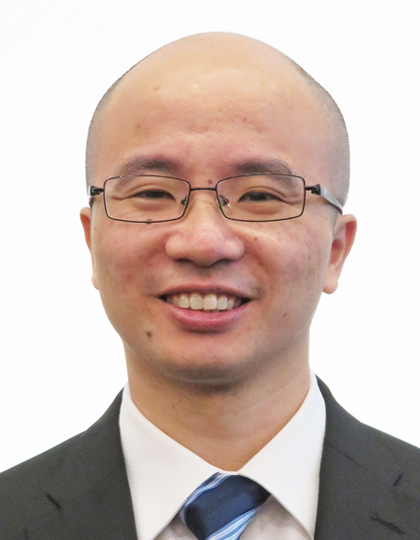
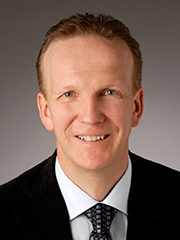
Scott Rettberg is a Professor of Digital Culture at the University of Bergen's Department of Linguistic, Literary and Aesthetic Studies. He leads the Center for Digital Narrative and has directed major projects like ELMCIP, funded by the Ford and Rockefeller Foundations. Contact: scott.rettberg@uib.no. Research Focus: Electronic literature, AI-generated narratives, digital humanities infrastructure. Recent Work: Explores AI writing practices, pandemic-themed digital art, and cyborg authorship models. His publications analyze intersections between generative algorithms and literary form, with a strong emphasis on digital ethics and pedagogy. Awards include the Robert Coover Award (2016) and N. Katherine Hayles Award (2019). Key Contributions: Co-founder, Electronic Literature Organization Director, ELMCIP Electronic Literature Knowledge Base Author, Electronic Literature (Polity, 2018)
David Go is the Vice President and Associate Provost for Academic Strategy at the University of Notre Dame, where he also holds the Viola D. Hank Professorship in Aerospace and Mechanical Engineering. He oversees implementation of the University Strategic Framework and manages faculty appointment processes, with administrative oversight of institutes including the Lucy Institute for Data and Society and the Fitzgerald Institute for Real Estate. His research focuses on plasma science, heat transfer, fluid dynamics, and chemical analysis, with significant contributions to plasma-electrochemistry and sustainable chemical synthesis. Education: B.S. (2001) and M.S. (2004) from University of Notre Dame, Ph.D. (2008) from Purdue University His work explores plasma-liquid interfaces, solvated electron dynamics, and plasma-assisted catalysis, particularly for light hydrocarbon conversion. Recent publications highlight advancements in non-aqueous plasma electrolysis, machine learning-enhanced plasma sintering, and interfacial transport phenomena. Awards include the Air Force Young Investigator Award, NSF CAREER award, and multiple honors for teaching and innovation. Current research trends integrate plasma physics with chemical engineering and materials science, focusing on sustainable energy solutions and microscale manufacturing. Scientific recognitions include: Fellow of the American Society of Mechanical Engineers Senior Member of IEEE IEEE Early Achievement Award First-Source Bank Commercialization Award Go has supervised graduate studies and received patents for technologies in plasma-assisted synthesis and microfluidic diagnostics. His leadership roles involve committees addressing academic governance, risk management, and foreign influence in research.
Yacine Atif is a Professor of Information Technology at the University of Skövde, affiliated with the School of Informatics and Department of Information Technology. He maintains an active research profile with numerous publications spanning from 2002 to the present, demonstrating sustained academic contribution in his field. His research interests focus on Internet of Things (IoT), Cybersecurity, Cyber-Physical Systems, Digital Transformation, Cloud Computing, and Educational Technologies. Professor Atif's work bridges theoretical research with practical applications, particularly in smart city technologies, critical infrastructure protection, and educational innovations. His research has evolved from early work in e-commerce trust (2002) to contemporary work on metaverse learning experiences (2023) and vehicle collision prediction (2025). Analysis of his recent publications (2018-2025) reveals a strong focus on cybersecurity applications for cyber-physical systems, particularly in critical infrastructure protection. His work demonstrates a progression from foundational IoT concepts toward sophisticated integration of machine learning and cognitive approaches in security analysis. The research portfolio shows consistent collaboration with both academic and industry partners across multiple countries. Professor Atif leads or contributes to significant research projects including the ongoing 'Intelligent Driver Support Systems and Safety Enhancement' (I2Connect) project (2023-2026) focused on developing next-generation Advanced Driver Assistance Systems for trucks, and previously led the 'Infrastructure Resilience – ELVIRA' project (2017-2020) which developed time-based infrastructure dependency analysis for power-grid risk assessment. His teaching responsibilities include multiple courses at both bachelor's and master's levels, with course credits ranging from 3 to 7.5 credits across various technology domains. His office is located in room PA420K at the University of Skövde, and he can be contacted at yacine.atif@his.se or by phone at 0500-448312.
Bert de Vries is a Professor at the Signal Processing Systems Group at Eindhoven University of Technology (TU/e), where he has been employed since January 2012. He maintains a dual career, also working at GN Hearing in the hearing aids industry since April 1999, where he holds both research and managerial roles. His academic journey began at TU/e, where he earned his MSc in Electrical Engineering in 1986, followed by a PhD from the University of Florida in 1991. Between 1992 and 1999, he worked at Sarnoff Research Center in Princeton, NJ, contributing to diverse signal and image processing projects. Professor de Vries's research centers on Bayesian Machine Learning, with particular focus on the Free Energy Principle and its applications to engineering problems. His work bridges theoretical neuroscience with practical signal processing systems, especially in biomedical applications. He directs the BIASlab research team at TU/e, which develops probabilistic programming tools including RxInfer.jl, ForneyLab.jl, GraphPPL.jl, ReactiveMP.jl, and Rocket.jl. His research spans active inference, variational message passing, probabilistic programming, and Bayesian neural networks, with applications ranging from hearing aids to multi-agent systems. Analysis of his recent publications reveals a strong trend toward practical implementations of Bayesian inference frameworks, particularly through Julia-based probabilistic programming tools. His work shows increasing focus on active inference applications, message passing algorithms, and the intersection of Riemannian geometry with probabilistic modeling. The research demonstrates consistent progression from theoretical foundations toward real-world engineering applications, particularly in biomedical signal processing and autonomous systems. Professor de Vries teaches a graduate-level course on Bayesian Machine Learning at TU/e and actively contributes to open-source software development through his GitHub profile (bertdv), with recent activity as recent as August 2025. His research team has developed several influential probabilistic programming libraries that have gained significant attention in the machine learning community. The BIASlab research group continues to advance the state of the art in Bayesian inference methods with applications in hearing technology, robotics, and signal processing.
Lisa Hansson is a Professor of Community Planning at Molde University College, specializing in urban governance and transport policy. She is affiliated with the Logistics Department and actively contributes to sustainable mobility, socio-technical change, and multi-level governance research. PhD in Science and Technology Studies (2011), Linköping University MSc in Political Science/Public Administration (2005), Gothenburg University BA in Human Geography/Urban Planning (2003), Karlstad and Gothenburg Universities Her research focuses on sustainable transport systems, visual representation in planning, and policy adaptation. She leads externally funded projects like LEAD (Digital Twins for logistics) and SNAPSHOT (e-commerce transport), with partners including SINTEF and K2 Sweden. Her work bridges political science and transport governance, challenging economic-technical discourses. Recent articles analyze equity in 15-minute city planning, social justice in transport protests, and regulatory governance for autonomous vehicles. She chairs the WCTRS SIG G1 Transport Governance group and serves on the Thredbo Conference Committee. 2023: Co-authored Public Participation in Transport in Times of Change (Emerald) 2021: Chapter on Transport Policy and Governance (Elsevier) 2020: Editorial in Transportation Research Part A Lisa teaches MA/BA courses like Smart Mobility, European Transport Policy, and Future Cities. She supports Master’s and PhD research in sustainable urban development and transport policy.
Dr. Umar Ruhi is a Full Professor and Ian Telfer Teaching Fellow at the Telfer School of Management, University of Ottawa, where he also serves as Vice-Dean of Undergraduate Programs. He holds a B.Sc. in Computer Science from the University of Toronto, an MBA from McMaster University, and a Ph.D. in Information Systems and Management Science from McMaster's DeGroote School of Business. His teaching spans undergraduate and graduate programs, covering information systems, cybersecurity management, and interdisciplinary courses in digital transformation. Research Focus: Professor Ruhi's work intersects information systems and knowledge management, with current emphasis on: Consumer health informatics and personal health records Digital misinformation countermeasures and tool usability Human-AI collaboration frameworks and governance Learning analytics and adaptive gamification in education Social computing and enterprise applications His research has resulted in commercial patents and practical implementations across industries. Research Recognition & Funding: Professor Ruhi has secured significant research funding, including: Canadian Heritage grant ($68,160) for disinformation research Multiple MITACS grants ($30,000 each) for AI, blockchain, and health tech projects Telfer Education Excellence Fellowship ($45,000) for learning analytics Noteworthy recognitions include the 2012 Best Dissertation Award from the German Society for Online Research and conference best paper awards. Academic Leadership: Beyond research, Professor Ruhi leads pedagogical innovation through his Ian Telfer Teaching Fellowship, exploring generative AI applications in education. His extensive consulting portfolio includes e-government portals, UX design, and knowledge management systems. As Vice-Dean, he oversees undergraduate program development and strategic initiatives.
Federico Becca is an Associate Professor in the Department of Physics at the University of Trieste . He is a theoretical condensed matter physicist specializing in strongly correlated electronic systems , with a focus on spin liquids , superconductivity , and topological phases . His research employs quantum Monte Carlo and exact diagonalizations to study lattice models like the Hubbard and Heisenberg models . Education: Laurea in Physics, Università La Sapienza, Roma (1996) PhD in Condensed Matter, ISAS-SISSA, Trieste (2000) Research Interests: Prof. Becca’s work centers on Mott insulators , spin-liquid phases , and superconductivity in systems with magnetic frustration and strong electron correlations. He investigates unconventional electronic states in reduced dimensions and explores the interplay between spin-phonon interactions and quantum phase transitions . Scientific Collaborations: Alberto Parola (Insubria University) Michele Fabrizio (SISSA) Roser Valenti (University of Frankfurt) Didier Poilblanc (University of Toulouse) Yasir Iqbal (Indian Institute of Technology Madras) Current Projects: Unravelling the intertwined correlated states of matter in moiré superlattices (funded by MINISTERO DELL'UNIVERSITA' E DELLA RICERCA). He also leads the "Studio computazionale del modelli di Kane and Mele" project as a Scholar at risk.
Dr. Katarzyna Grunt-Mejer is an academic at SWPS University of Social Sciences and Humanities, based at the Poznań campus. She is affiliated with the Faculty of Psychology and Law and works within the Department of Clinical and Health Psychology at the Institute of Psychology. Holding a Doctor of Humanities in Psychology degree with additional training in sexology, philosophy, and bioethics, she serves as an Assistant Professor teaching sexology, basic psychology, and research methods in clinical psychology. She also directs the postgraduate studies in practical sexology. Dr. Grunt-Mejer's research focuses on sexual ethics, psychological support, the functioning of close relationships, and sexology. She has made significant contributions to understanding consensual non-monogamy, having led an international project from 2013 to 2015 examining attitudes toward non-mononormative relationships. Her work spans multiple disciplines including psychology, bioethics, and social sciences, with particular emphasis on the ethical implications of sexual health practices and the social construction of sexual norms. Her publication record shows consistent output across multiple domains, with her most recent work addressing contemporary issues in sexology, relationship structures, and sexual health. The articles demonstrate a clear progression from foundational research on relationship types to more nuanced examinations of ethical considerations in sexual health and the medicalization of sexual desire. Member of the scientific committee for the "Conference on the Future of Monogamy and Non-monogamy" Recipient of National Science Centre funding (SONATA competition) for her project "The concept of norm in sexology" (2017-2020) Contributor to significant research on road aggression and transportation psychology Dr. Grunt-Mejer actively engages in both academic and public discourse, participating in conferences like the Impact 2024 congress and contributing to public understanding of human sexuality. She leads the Sexology Scientific Club at the university and has been involved in numerous research projects examining the intersection of psychology, ethics, and sexual health. Her work demonstrates a commitment to bridging academic research with practical applications in clinical settings and public education.
Professor George Ghinea is a distinguished academic in the Department of Computer Science at Brunel University London's College of Engineering, Design and Physical Sciences. With over 350 publications and 33 successfully supervised PhD students, he leads cutting-edge research at the intersection of computer science, media studies, and psychology. His educational background includes a PhD from the University of Reading (1999) where he pioneered the Quality of Perception (QoP) metric - a precursor to today's widely adopted Quality of Experience (QoE) concept. He holds multiple degrees with distinction from the University of the Witwatersrand in South Africa, including BSc, BSc (Hons), and MSc in Computer Science. Professor Ghinea's research focuses on perceptual multimedia quality and human-centered e-systems, with particular emphasis on mulsemedia (multiple sensorial media) - his own conceptual framework extending multimedia to engage non-traditional senses. His work spans eye-tracking applications, telemedicine, multi-modal interaction, and ubiquitous computing. Current research explores mulsemedia integration in autonomous vehicles, security-enhanced systems, and accessibility solutions. His publications reveal strong trends in multisensory computing (42% of recent works), telemedicine applications (28%), accessibility research (18%), and network optimization (12%). The work consistently bridges theoretical frameworks with practical implementations, often incorporating physiological data and user perception metrics. Distinguished Visiting Fellow of the Royal Academy of Engineering (2018) SPARC DUO-India 2020 Fellowship Programme recipient Principal Investigator for multiple EU Horizon 2020 projects Research featured in major media including BBC, Forbes, and Daily Telegraph Professor Ghinea has secured substantial research funding through projects like the EU H2020 NEWTON initiative, Royal Academy of Engineering partnerships, and multiple Newton Fund collaborations. His supervision portfolio includes 33 PhD completions with diverse research spanning security behavior in Ghana, physiological QoE in VR, smart city adoption in Oman, and sustainable digital transformation in Qatar. He leads the IMUSY research group focusing on mulsemedia systems and human perception. His laboratory work centers on the IMUSY research group where they develop mulsemedia applications integrating thermal, wind, and olfactory devices for enhanced user experiences. Current team projects include mulsemedia in autonomous vehicles (MulsEAV), physiological data for QoE assessment, and smart city adoption studies.
Gerald C. Kane is a Professor and the C. Herman and Mary Virginia Terry Distinguished Chair in Business Administration at the Terry College of Business, University of Georgia. He is a leading scholar in digital transformation, artificial intelligence ethics, and social media for knowledge management, with over 100 publications in top-tier journals including MIS Quarterly and Management Science. His educational background includes: PhD in Information Systems, Emory University, Goizueta Business School (2006) MBA in Computer Information Systems, Georgia State University, Robinson College of Business (2002) M. Div. in Theology, Emory University (1998) BA in Humanities, Furman University (1994) Professor Kane's research focuses on the social and ethical implications of artificial intelligence and machine learning, the success factors in digital transformation of legacy companies, and how organizations use digital tools to innovate through disruption (e.g., during the COVID-19 pandemic). He also explores social media for knowledge management across organizational boundaries and information systems in healthcare. His work provides critical insights for businesses navigating the digital era. His recent publications (2020-2025) demonstrate intense focus on AI ethics—particularly fairness and bias in machine learning algorithms—and the transformative impact of digital tools on organizational strategy and workplace design. Kane's research addresses digital strategy formulation challenges and post-pandemic workplace reinvention, reflecting his commitment to solving real-world organizational problems through technology-driven solutions. Professor Kane's contributions have been recognized with numerous prestigious awards: Davis-Dixon Impact Award, MIS Quarterly (2024) Axiom Business Book Awards Gold Medal (2021) Carroll School Coughlin Distinguished Teaching Award (2018) National Science Foundation CAREER Award ($500,000) (2009-2016) McKiernan Distinguished Fellow ($30,000), Boston College (2014-2016) Runner-up, Best Published Paper, Academy of Management (2015) U.S. Department of Defense Small Business Technology Transfer Award ($100,000) (2012) Professor Kane has secured significant research funding including a National Science Foundation CAREER Award and U.S. Department of Defense grant supporting his work on social media and knowledge management. His influential books 'The Technology Fallacy' and 'The Transformation Myth' have been translated into multiple languages and provide practical frameworks for digital transformation. While specific advisees are not documented, his role as former Senior Editor at MIS Quarterly and extensive publication record highlight his leadership in shaping information systems research.
Line Kolås is a researcher at Nord University , specializing in E-learning , ICT in Education , and Digital Pedagogy . Her work focuses on integrating infographics , gamification , and collaborative tools into teaching. Key research areas: E-learning, Educational Technology, ICT, Gamification, Infographics 2024: Contributed to Innovation in Teaching of Research Methodology Excellence Awards Publications highlight trends in student-driven research , interactive learning , and digital tools for education. Her 2023 work explores artificial intelligence and conflict management games in teaching. Scientific awards include the Innovation in Teaching of Research Methodology Excellence Award 2024
Professor David Xu is a distinguished faculty member in the Department of Information Systems at City University of Hong Kong, where he has served as Professor since 2023 after progressing from Associate Professor (2017-2023). Prior to joining CityU, he held academic positions at Wichita State University from 2011-2017, culminating in the Bomhoff Endowed Professor of Business title in 2017. His educational background includes a PhD in Management Information Systems from the University of British Columbia (2011), an MPhil in Information Systems from City University of Hong Kong, and a First-class honors BBA in Business Administration from Lingnan University. As Programme Leader for both BBA Information Management and Bachelor's Degree in Information Systems programs since 2018, he plays a significant administrative role in curriculum development. Professor Xu's research spans human-computer interaction, artificial intelligence applications, and technology adoption across diverse domains. With over 90 publications including 40+ journal papers in top-tier venues like MIS Quarterly and Information Systems Research, his work demonstrates exceptional scholarly impact. His Google Scholar metrics (3,300+ citations, h-index of 22) reflect substantial influence in the field. His recent publications reveal a strategic focus on AI ethics, information cocoon mitigation in social media, healthcare applications of AI, and digital transformation effects on business. The work spans theoretical contributions and practical implementations, with increasing emphasis on societal impacts of technology. AIS Early Career Award (2018) AIS Distinguished Member – Cum Laude (2020) Multiple teaching excellence awards (2021, 2024, 2025) ICIS and ISR Best Associate Editor Awards (2020-2021) Numerous paper award nominations across major conferences Professor Xu has secured significant research funding including NSFC, RGC GRF, and CityU Strategic Research Grants totaling millions in funding. His current projects address critical issues like AI beauty filters, depression treatment systems, and information cocoon mitigation. As Senior Editor for Information Systems Journal and Associate Editor for Information Systems Research, he shapes the field's scholarly discourse while supervising DBA and PhD students across multiple programs.
Professor Jitesh H. Panchal is a Professor of Mechanical Engineering and Associate Head of Undergraduate Programs at Purdue University's School of Mechanical Engineering. His research focuses on computational design of socio-technical systems, secure manufacturing, and collaborative engineering processes. He holds a PhD from Georgia Tech and has received numerous awards including the NSF CAREER Award (2010) and ASME's Guest Associate Editor Award (2019). Education: Ph.D. (Mechanical Engineering), Georgia Tech, 2005 M.S. (Mechanical Engineering), Georgia Tech, 2003 B.Tech. (Mechanical Engineering), IIT Guwahati, 2000 Research Interests: His work integrates computational methods with human factors, addressing challenges in secure design, additive manufacturing, and decision-making frameworks. Recent trends show focus on AI-driven design optimization, cybersecurity in manufacturing, and policy frameworks for defense acquisitions. Awards: ASME Journal of Mechanical Design Guest Associate Editor Award (2019) NSF CAREER Award (2010) Robert E. Fulton SEIKM Best Paper Award (2013) Ruth and Joel Spira Award (2018) Advising & Grants: His research is supported by grants from NSF and industry partnerships. He advises graduate students in design engineering and manufacturing systems, though no specific student names are listed. Labs: Directs the Design Engineering Lab at Purdue (DELP) , focusing on computational design methodologies and secure manufacturing technologies.
Carla Bevins is an Associate Teaching Professor of Business Communication at the Tepper School of Business, Carnegie Mellon University. She specializes in written, oral, and digital business communication, with a focus on leadership, crisis communication, and social media engagement. PhD in Communication, University of Kentucky (2011) BA in Communication Studies, Butler University (2001) Her research interests include business communication , crisis management , and CEO/C-Suite communication . She actively contributes to teaching areas like interpersonal communication , leadership development , and digital media strategies . Her recent publications highlight crisis communication frameworks , social media integration in education , and persuasive strategies for public health initiatives . Teaching activities include courses on Business Communication for Analytical Decision Making , Executive Communication Skills , and Professional Communication for Economists . Actively mentors students in business communication and leadership Featured faculty in Carnegie Mellon’s Women's Executive Leadership Academy
Prof. Ingenuin Gasser is a Professor of Modelling and PDEs at the University of Hamburg's Department of Mathematics. He holds roles including UHH Coordinator for the Joint Master's Programme 'MathMods' and former Vice Dean for Internationalization and Young Researcher Support (2012-2022). His research focuses on mathematical modelling with PDEs, renewable energy systems, traffic flow dynamics, and semiconductor equations. He leads interdisciplinary projects on urban systems and energy technologies. Education & Career: Born 1965 in Brixen, Italy Diplom in Technical Physics (1989, TU Wien) Diplom in Technical Mathematics (1992, TU Wien) PhD in Mathematics (1996, TU Berlin) Habilitation in Mathematics (2000, UHH) Junior Professor (2002–2003, UHH) Full Professor (W3) since 2010 at UHH Research Interests: Modelling with PDEs, kinetic/fluid dynamics, renewable energy systems (solar updraft towers, osmosis power), traffic flow models, semiconductor equations, and interdisciplinary urban system modelling. Publications: Over 67 publications, recent works focus on PRO power stations, solar energy systems, and urban modelling. Key themes include energy efficiency optimization, nanofluid applications, and mathematical models for sustainable infrastructure. Grants & Projects: Participated in EU-funded networks (e.g., TMR), DFG projects on quantum transport, and international collaborations in applied mathematics and renewable energy.


.jpg)