Evelina Fedorenko is an Associate Professor in the Department of Brain and Cognitive Sciences at the Massachusetts Institute of Technology (MIT) , with affiliations at Massachusetts General Hospital (MGH), Boston Campus . Her research focuses on the cognitive and neural mechanisms underlying language processing, including interactions with artificial systems like language models. Lab: Language Lab at MIT , exploring minds and brains creating language Key Research Areas: Cognitive Neuroscience of Language and Music, Neural Representations, Computational Models Her recent work examines how artificial language models map to human brain regions , investigates the universality of language networks across languages and individuals, and explores non-classical aspects like cerebellar involvement. She develops advanced methodologies for neuroimaging, including individualized brain mapping and standardized stimuli creation. Scientific contributions include debates on language localization, studies of language evolution, and frameworks for semantic analysis. Her team employs fMRI , MEG , and precision imaging to dissect the language-selective network and its interactions with other cognitive systems.
Professor Sara Kim serves as Professor and Head of the Marketing Area at the University of Hong Kong, where she has established herself as a leading scholar in consumer behavior since joining in 2012. Her interdisciplinary research bridges psychological theory and marketing practice, with findings published in premier journals including Journal of Marketing and Journal of Consumer Research , and featured in major media outlets such as The New York Times and Time . Her academic credentials include: Ph.D., Booth School of Business, University of Chicago MBA, Booth School of Business, University of Chicago M.S., KAIST Business School, Korea B.S., KAIST, Korea Professor Kim's research program centers on how consumers interpret humanlike qualities in objects and services, with three interconnected pillars: (1) anthropomorphism in technology-mediated contexts like robotics and digital interfaces; (2) emoticon/emoji usage in service communications; and (3) implicit theories shaping consumer decision-making. Her recent work examines how money anthropomorphism influences financial behavior and how leader emojis affect team creativity, demonstrating practical applications for service industries navigating digital transformation. Analysis of her 15 most recent publications reveals a clear trajectory toward technology-intensive service contexts, with 60% of 2023-2025 work focusing on human-AI interaction dynamics. Her scholarship consistently applies social psychology frameworks to contemporary marketing challenges, particularly in service employee-consumer relationships within digital environments, while maintaining strong theoretical contributions to attribution theory and person perception literature. Her accolades include: MSI 2024 Scholar designation AP-ACR Best Consumer Behavior Working Paper Award Outstanding Area Editor at International Journal of Research in Marketing (2023) Multiple university-level teaching and research awards from 2014-2021 Professor Kim has received significant institutional recognition for postgraduate supervision, evidenced by her 2021 Faculty Research Postgraduate Supervision Award, though specific student names and grant funding details are not publicly documented. Her ongoing research agenda continues to explore the psychological mechanisms underlying consumer-technology interactions in service ecosystems.
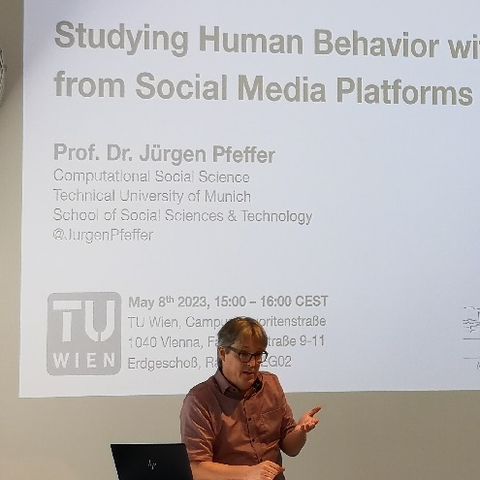
Jürgen Pfeffer is a Professor of Computational Social Science & Big Data at the Technical University of Munich's School of Social Sciences and Technology, with an additional appointment as Adjunct Professor at Carnegie Mellon University's Institute for Software Research. His interdisciplinary work bridges computer science and social science with a focus on analyzing large-scale socio-technical systems. His research expertise spans computational social science, network analysis, and big data methodologies. Pfeffer's work examines methodological, algorithmic, and theoretical challenges in analyzing dynamic social systems, with current projects focusing on modeling and detecting negative dynamics from social media, particularly online firestorms and hate speech against politically active women. His research combines network science approaches with computational methods to understand complex social phenomena. Pfeffer's publication record demonstrates significant contributions to the field since his 2010 doctorate, with high-impact papers in journals like Science and EPJ Data Science. His work on social media analysis, particularly the influential 2014 Science paper 'Social Media for Large Studies of Behavior' co-authored with Derek Ruths, has shaped methodological approaches in the field. His research shows consistent evolution from foundational network analysis to contemporary applications in political discourse, hate speech detection, and multi-layer network analysis. Hennig, M., Brandes, U., Pfeffer, J., & Mergel, I. (2012). Studying Social Networks. A Guide to Empirical Research Ruths, D., & Pfeffer, J. (2014). Social Media for Large Studies of Behavior Pfeffer, J., Morstatter, F., & Mayer, K. (2018). Tampering with Twitter's Sample API As an advisor and collaborator, Pfeffer has worked extensively with researchers including Raji Ghawi, Mirco Schönfeld, Momin Malik, and Kathleen Carley. His work demonstrates strong connections between theoretical network science and practical applications in social media analysis. His current research continues to address pressing issues in online discourse, with recent work focusing on hate speech classification, lexical change in negative word-of-mouth, and polarization dynamics in social media environments. Pfeffer leads the Pfeffer Lab, which focuses on developing methodological approaches for analyzing complex social systems through computational methods. His work has implications for understanding political legitimacy, social influence, and community dynamics in both online and offline contexts.
Yuhong Nan is an Associate Professor in the School of Software Engineering at Sun Yat-sen University, China, specializing in software security and privacy leakage analysis for emerging platforms including IoT, mobile systems, and blockchain. Previously a Post-doctoral Research Associate at Purdue University under Prof. Dongyan Xu, she builds practical security tools to detect and mitigate vulnerabilities in real-world systems. Dr. Nan earned her PhD from Fudan University in 2018 supervised by Prof. Min Yang. Her academic journey spans rigorous research in security engineering with emphasis on empirical validation and tool development for complex platform ecosystems. Her research program focuses on uncovering systemic security flaws through innovative analysis techniques. Key contributions include vulnerability detection in smart contracts (e.g., state dependencies, reentrancy), privacy leakage analysis in mobile/IoT ecosystems, and countermeasures against deceptive UI patterns. She employs hybrid approaches combining static/dynamic analysis, machine learning, and large-scale empirical studies to develop deployable security solutions. Analysis of her 15 most recent publications (2023-2025) reveals dominant themes in blockchain security (60%), particularly smart contract/DApp vulnerabilities, with significant work in mobile privacy (30%) and cross-platform threats (10%). Her methodology consistently leverages fine-grained static analysis, semantic enrichment, and feedback-driven fuzzing, yielding tools like SmartAxe and Midas that have influenced industry practices. Dr. Nan actively mentors graduate researchers with 17 advisees including Tencent-employed graduates, and serves as a trusted reviewer for premier journals (IEEE TDSC, TMC, TOPS) and conference committees (ASIACCS, ICICS). Her leadership in security communities bridges academic research with practical defense mechanisms. At Sun Yat-sen University, she directs a high-output research group that collaborates with industry partners to address evolving threats in decentralized systems, maintaining her position among top publishing authors in USENIX Security, CCS, and NDSS venues through rigorous technical innovation.
Baishakhi Ray is an Associate Professor of Computer Science at Columbia University, working at the intersection of AI, Software Engineering, and Security. She received her Ph.D. from the University of Texas, Austin, and has established herself as a leading researcher in applying artificial intelligence to software engineering challenges. Her educational background includes a Ph.D. from the University of Texas, Austin, which provided the foundation for her research career at the forefront of AI and software engineering. Dr. Ray's research focuses on leveraging artificial intelligence to solve fundamental challenges in software engineering and security. Her work spans multiple areas including code generation with large language models, vulnerability detection, software testing, and program analysis. She has pioneered approaches that combine deep learning with traditional software engineering techniques to create more robust, secure, and efficient software development processes. Her research has practical implications for improving code quality, enhancing software security, and accelerating development cycles through AI assistance. Her recent work demonstrates a strong emphasis on semantic-aware code generation, execution reasoning, and addressing hallucinations in code language models. She has also made significant contributions to evaluating the functionality and security of AI-generated code, identifying critical challenges in the practical adoption of AI for software development. Dr. Ray has received numerous prestigious awards recognizing her contributions to the field: IEEE TCSE Rising Star NSF CAREER award IBM faculty award VMware Faculty award Distinguished Paper awards at FSE'17, ASE'22, and ISSTA'23 ICSME Most Influential Paper award Publications featured in CACM Research Highlights As an Amazon Visiting Academic and active participant in major software engineering conferences, Dr. Ray has established herself as a thought leader in AI for software engineering. Her research has been widely covered in trade media, indicating its relevance and impact on industry practices. She has mentored numerous students through their research and has been instrumental in shaping the next generation of researchers in this interdisciplinary field. Her work demonstrates a consistent focus on bridging theoretical advances with practical applications, ensuring that her research has tangible benefits for the software development community. The trajectory of her publications shows an evolving research agenda that has successfully adapted to the rapidly changing landscape of AI and its applications to software engineering.
Jingling Xue is a Scientia Professor at the School of Computer Science and Engineering at the University of New South Wales (UNSW) in Sydney, Australia. As an IEEE Fellow of the Computer Society, he leads the Programming Languages and Compilers research group, focusing on practical applications of compiler optimization and program analysis techniques. His work bridges theoretical foundations with real-world software systems, particularly in developing open-source tools for large-scale program analysis. Professor Xue received his B.Eng and M.Eng degrees from Tsinghua University in 1984 and 1987, respectively, followed by a PhD from the University of Edinburgh in 1992. His academic journey has established him as a leading figure in programming languages and compiler technology. Xue's research spans programming languages, compiler technology, and program analysis with emphasis on practical relevance. His current projects include compiler techniques for improving parallelism and locality, pointer/alias analysis for million-line-scale programs, and static/dynamic analysis for detecting bugs and security vulnerabilities in real-world applications like web browsers and Android apps. His group actively develops open-source tools to support scientific replicability and reproducibility in these areas. His recent publications demonstrate a strong focus on applying program analysis techniques to modern challenges including AI compilers, homomorphic encryption, security vulnerability detection, and graph processing systems. The work shows evolution from traditional compiler optimization to addressing emerging domains like privacy-preserving computation and deep learning systems while maintaining rigorous theoretical foundations. Scientific Awards: Best Paper Award at CGO'13 Best Paper Award at CGO'16 Distinguished Paper Award at ECOOP'16 Distinguished Paper Award at ICSE'18 Distinguished Paper Award at ISSTA'19 Distinguished Paper Award at ASE'19 Distinguished Artifact Award at ISSTA'23 Best Artifact Award at FSE'23 Distinguished Paper Award at ASE'23 Test-of-Time Award at CGO'21 Professor Xue has successfully supervised 30 PhD students to completion, many of whom now work as professors or researchers in academia and industry. He has served as Program Chair for major conferences including LCTES'13, CC'18, CGO'20, and General Chair for LCTES'20. His group currently focuses on memory safety in Rust, smart contract analysis, AI compilers, compilation for privacy-preserving computation, and adversarial attacks in deep learning. The Programming Languages and Compilers group maintains strong connections with industry partners, translating theoretical advances into practical tools for real-world software development challenges. Their work on pointer analysis, memory safety, and compiler optimizations continues to influence both academic research and industrial practice.
Chia-Jung Tsay is an Associate Professor in the Management and Human Resources Department at the Wisconsin School of Business, University of Wisconsin-Madison, and a Faculty Affiliate at the Institute for Diversity Science. Her research bridges psychological science and business, examining nonconscious biases in professional decision-making processes across music, entrepreneurship, and organizational contexts. Her distinguished educational background includes: Ph.D. in Organizational Behavior and Psychology (secondary field in Music) from Harvard University A.B. in Psychology and A.M. in History of Science from Harvard University (Phi Beta Kappa) Advanced music training at The Juilliard School and Peabody Conservatory of Johns Hopkins University Professor Tsay's research centers on decision-making biases , particularly the naturalness bias where 'naturals' are favored over 'strivers', and the dominance of visual information in evaluations. Her work demonstrates how sight overrides sound in music competitions, how visuals dominate investor decisions in pitches, and how semantic ambiguities around 'talent' affect workplace judgments. This research critically informs diversity, equity, and inclusion initiatives by exposing hidden cognitive mechanisms that undermine meritocratic systems. Her publication trajectory reveals consistent focus on bias mechanisms, evolving from foundational music perception studies (2013) to entrepreneurial funding decisions (2021) and contemporary investigations of gratitude, goal orientation, and talent semantics. The work consistently identifies systematic deviations from rational evaluation across domains, with practical implications for reducing bias in hiring, promotion, and investment decisions. Her major recognitions include: Association for Psychological Science (APS) Rising Star World’s Best 40 Under 40 Business School Professors by Poets&Quants (2021) Best Paper Award from Diversity in Management and Organizations (2023) Professor Tsay mentors graduate students in organizational behavior while leading cutting-edge research. She recently secured competitive seed funding from UW-Madison's Institute for Diversity Science (2024) for projects at the business-diversity science intersection. Her work generates significant real-world impact through frequent media engagement and advisory roles. She actively collaborates within the Management and Human Resources department and Institute for Diversity Science, contributing to interdisciplinary initiatives that translate bias research into organizational practices. Her unique background in both music performance and psychology enables distinctive approaches to understanding human judgment in professional settings.
Ulrich Schmid is a Full Professor and Head of the Research Unit for Embedded Computing Systems at TU Wien. He holds a position in the Faculty of Informatics and leads the department of Embedded Computing Systems (E191-02). His roles include Curriculum Coordinator for the Bachelor and Master programs in Computer Engineering, as well as the Excellence Program Bachelor with Honors. He is also the Chair of the Curriculum Commission for Computer Engineering and a Substitute Member of the Informatics Commission. His research focuses on fault-tolerant distributed algorithms, digital integrated circuits, and topology-based approaches to distributed systems. He coordinates major projects such as the FWF-funded DMAC (2019–2024) and ByzDEL (2020–2025), which integrate topological semantics and hybrid delay models for robust hardware design and distributed system analysis. Schmid has contributed to groundbreaking work in Byzantine fault tolerance, epistemic logic for system recovery, and real-time scheduling through collaborations with researchers like Chatterjee, Függer, and Rajsbaum. Notable awards include the 2018 Edsger W. Dijkstra Prize and the 2021 Principles of Distributed Computing Doctoral Dissertation Award. His research also bridges formal verification techniques with physical hardware implementations, exemplified by projects like HEX (a Byzantine-tolerant clock distribution system) and the Involution tool for timing analysis. Schmid actively contributes to academic governance, advancing rigorous education and research standards in computer engineering. His advising and grant work involve mentoring on fault-tolerant architectures and securing funding from agencies like FWF and the European Commission. Labs and teams under his leadership include the Embedded Computing Systems group, specializing in hardware-software co-design for dependable systems-on-chip, and collaborations with institutions like GSI Helmholtzzentrum and the University of Amsterdam.
Freja Stær Hincheli serves as a Lecturer at the Department of Computer Science , University of Copenhagen. Her work intersects multiple domains within machine learning, with a particular emphasis on quantum-inspired algorithms, medical imaging, and sustainable AI development. Keywords : Machine Learning, Quantum Computing, Medical Imaging, Natural Language Processing, Computational Biology Key Collaborations : SCIENCE AI Centre Her research spans quantum-enhanced neural networks, explainable AI for medical diagnostics, and energy-aware model design. Recent publications highlight applications in cross-cultural recipe adaptation, emotion-aware dialogue systems, and climate-conscious AI strategies. The Machine Learning Section at DIKU focuses on theoretical foundations and applications including medical image analysis , biological data modeling , and quantum computing , aligning with her contributions.
Arjun Mukherjee is a Lecturer at the Department of Computer Science , University of Houston , where he teaches courses in Machine Learning , Data Mining , Natural Language Processing , and Data Structures . His research focuses on Bayesian Inference , Data Mining , Natural Language Processing , Sentiment Analysis , Opinion Spam , and Web Mining , with a strong emphasis on deception detection and social media analysis. His recent publications explore advanced techniques in LLM-generated content detection synthetic data applications cross-domain deception modeling temporal user behavior analysis , reflecting his commitment to addressing modern challenges in digital content authenticity and machine learning robustness. Dr. Mukherjee has developed educational materials for graduate-level courses, including a well-structured Machine Learning course (COSC 6342) covering probabilistic inference, supervised/unsupervised learning, and neural networks. He earned his Ph.D. from the University of Illinois at Chicago in 2014, with a thesis titled Probabilistic Models for Fine-Grained Opinion Mining: Algorithms and Applications .
Attila Keresztes is an Assistant Professor in the Department of Cognitive Psychology at Eötvös Loránd University (ELTE), Budapest, Hungary. He serves as Principal Investigator of the Lifespan Memory Development Lab and Head of the Hippocampal Circuit and Code for Cognition Lab (HCCCL), a Max Planck Partner Group. His research focuses on hippocampal structure-function relationships across the lifespan, employing high-resolution MRI and experimental methods to study memory development, stress impacts, and cognitive aging. Keresztes holds a PhD in Cognitive Science from Budapest University of Technology and Economics (2014) and completed postdoctoral training at the Max Planck Institute for Human Development in Berlin. Key interests include hippocampal maturation’s role in memory specificity, longitudinal brain development, and the interplay between stress hormones (e.g., cortisol) and hippocampal morphology. His work has been funded by grants such as FK128648 from Hungary’s National Research, Development, and Innovation Office. In 2022, he received the prestigious Bolyai János Research Scholarship from the Hungarian Academy of Sciences. Current lab activities involve collaborations with the Max Planck Institute and the ELTE Babylab, including the NeMO study on early childhood memory development. The HCCCL team includes PhD students (Alex Ilyés, Zsuzsanna Nemecz, Hunor Kis) and student researchers focusing on neuroimaging, semantic memory, and pattern separation mechanisms. Public engagement initiatives include participation in events like the European Researchers' Night and science outreach for children.
Professor Marios Polycarpou is a leading academic in intelligent systems and control engineering at the University of Cyprus, serving as Director of the KIOS Research and Innovation Center. He holds concurrent roles as Visiting Professor at Imperial College London and Founding Member of the Cyprus Academy of Sciences. His expertise spans neural networks, cyber-physical security, and critical infrastructure systems. Education: B.A. Computer Science & B.Sc. Electrical Engineering, Rice University, 1987 M.S. & Ph.D. Electrical Engineering, University of Southern California, 1989-1992 Research Interests: Intelligent systems and networks Adaptive learning control systems Fault diagnosis methodologies Machine learning applications Critical infrastructure resilience Awards: IEEE Neural Networks Pioneer Award (2016) ERC Advanced and Synergy Grants IEEE/IFAC Fellowships Cyprus Distinguished Researcher Award (2015) Grants & Leadership: Directed over 40 research projects Presidency roles in IEEE Computational Intelligence Society and European Control Association Edited prestigious journals including IEEE Transactions on Neural Networks Led major conferences: 2020 IEEE World Congress on Computational Intelligence and 2018 European Control Conference. Labs & Teams: Founder of KIOS Center (EU-funded excellence center) Developed SEMIoTICS semantic control framework
Michalis Mountantonakis is a Postdoctoral Researcher at FORTH and Laboratory Teaching Staff in the Department of Computer Science at the University of Crete, Greece. He holds a PhD (2020), MSc (2016), and BSc (2014) in Computer Science from the University of Crete, all with top grades. His research focuses on Large-Scale Semantic Data Integration, Linked Open Data, and Semantic Web technologies, with over 45 publications in top venues like ACM VLDB, ISWC, and ECML. He has been awarded the prestigious SWSA Distinguished Dissertation Award (2020) and the Maria Michael Manasaki Fellowship (2020). His work includes tools like LODsyndesis and LODChain, addressing challenges in knowledge graph connectivity and validation of AI-generated content. Education: PhD in Computer Science (2016-2020), University of Crete (Excellent GPA 9.74/10) MSc in Computer Science (2014-2016), University of Crete (Excellent GPA 9.87/10) BSc in Computer Science (2010-2014), University of Crete (2nd in class with GPA 8.42/10) Research Interests: His work bridges semantic web technologies with modern AI challenges, emphasizing large-scale data integration, knowledge graph applications, and validation frameworks. He has contributed to cultural heritage informatics, machine learning-augmented semantic systems, and cross-lingual NLP solutions. Recent trends include leveraging LLMs for query generation and semantic enrichment while ensuring factual accuracy through knowledge graph-driven validation. Key Achievements: Developed LODsyndesis, a global-scale semantic integration service Pioneered real-time validation of ChatGPT responses using RDF knowledge graphs Won Best Paper Award (ISWC 2022) for entity enrichment techniques Recipient of Stelios Orphanoudakis Undergraduate Fellowship (2013-2014) Participated in Roche Continents 2019 (top 100 European science students) Grants & Labs: His research has been supported by GSRT/HFRI. He collaborates with FORTH-ICS and leads projects in EU-funded initiatives like iMarine and BlueBridge. Current work focuses on governance models for ontologies, interoperable thesaurus creation (e.g., FoodEx2), and semantic analytics for cultural heritage datasets.
Johann Eder is a full professor for Information and Communication Systems at the Department of Informatics Systems, University of Klagenfurt, Austria, and currently serves as Deputy Head of Department. He previously held positions at the Universities of Linz, Hamburg, Vienna, and Klagenfurt, and was Vice President of the Austrian Science Funds (FWF) from 2005-2013. He was also a visiting scholar at AT&T Shannon Labs, NJ. Educational Background: Diplom-Ingenieur, University of Linz Doctor of Technical Sciences, University of Linz Johann Eder's research focuses on databases, information systems, and data management for medical research, including temporal information modeling, process evolution, and workflow systems. His work spans temporal data warehousing, exception handling in workflows, and application interoperability, with a particular emphasis on privacy and quality in medical data lakes and federated biobanks. Recent publications highlight trends in temporal reasoning for business processes, medical data quality, and service composition optimization. His editorial roles include positions at ACM Transactions on Database Systems and IEEE Transactions on Knowledge and Data Engineering . He leads the Information and Communication Systems Research Group at AAU, contributing to projects like federated biobank integration and blockchain-based smart contracts.
Dr. Vladimir Vlassov is a full Professor in Computer Systems at the Division of Software and Computer Systems (SCS) , Department of Computer Science (CS) , School of Electrical Engineering and Computer Science (EECS) , KTH Royal Institute of Technology , Stockholm, Sweden. He leads the AVA project in ALEC2, an AI-powered system for mental health care. He is a member of the Distributed Computing research group (DC@KTH) . Education & Roles: Holds a PhD and is a member of ACM and IEEE. Previously visited MIT (1998) and UMass Amherst (2004). Teaches courses on Data Mining , Distributed Systems , and Concurrent Programming . Research Interests: Focus on scalable AI, Cloud computing, distributed systems, and NLP for mental health. Projects include ExtremeEarth (Copernicus data analytics) and EMJD-DC (distributed computing PhD program). Grants & Projects: Principal Investigator in ALEC2 (adaptive mental health care) and ExtremeEarth (EU H2020). Led EU projects like ENCORE (manycore systems) and PaPP (embedded systems). Labs & Teams: Directs the Distributed Computing group, contributing to Hopsworks (machine learning feature store) and Maggy (hyperparameter optimization).