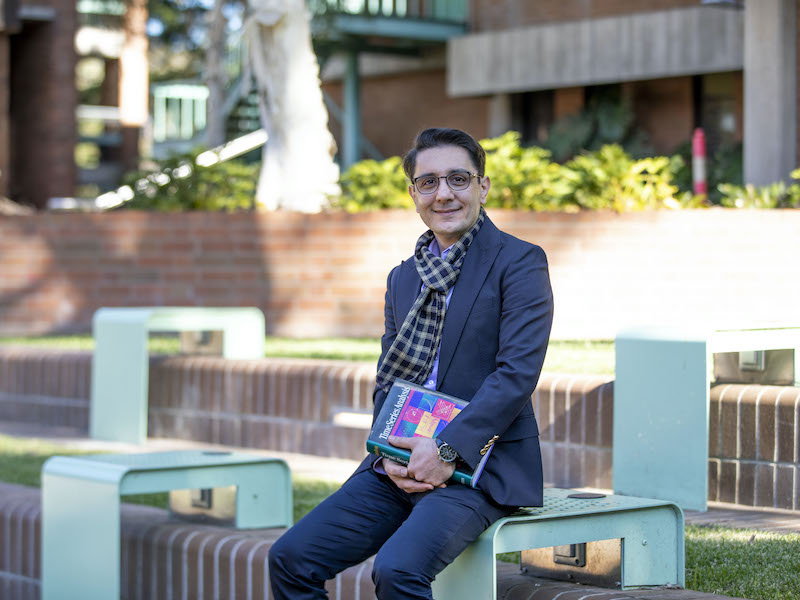
Gwion Evans is a Lecturer and Head of the Department of Mathematics at Aberystwyth University. He holds a PhD in Mathematics from Cardiff University (1998) and has conducted postdoctoral research at the University of Copenhagen and the University of Rome, Tor Vergata. His research focuses on Operator Algebras, particularly C*-algebras and their interplay with topological dynamics and quantum information. He is affiliated with the Aberystwyth Quantum Structures, Information and Control (AQStIC) group and the Welsh Society for Operator Algebras and Noncommutative Geometry (Welsh SONG). After administrative roles in Aberystwyth’s Planning Office, he transitioned to academia as a part-time lecturer, later becoming full-time in 2011. He leads the university’s Welsh medium provision in Mathematics. His grants include LMS-funded projects on operator algebras and dynamical systems (2013) and international collaboration support (2009). He advises two students: Zac Bufton (PhD) and Shubh Joshi (MPhil). Key research themes include topological invariants of C*-algebras, multi-dimensional symbolic dynamics, and inverse semigroups. His work bridges pure mathematics and quantum systems, with publications in journals like Annals of Functional Analysis and Journal of Functional Analysis .
Prof. Philipp Kanske is Chair of Clinical Psychology and Behavioral Neuroscience at TU Dresden, leading the Institute of Clinical Psychology and Psychotherapy since 2020. He holds a PhD (summa cum laude) from Leipzig University and completed postdoctoral research at the Central Institute of Mental Health and Max Planck Institute for Human Cognitive and Brain Sciences. His work focuses on social cognition, emotion regulation, and neuroimaging in psychiatric disorders like bipolar disorder. He has held prestigious roles including Young Academy member at the Leopoldina and BMBF Health Research Forum. Education: M.Sc. Psychology (University of Oregon, 2004), Diploma in Psychology (TU Dresden, 2005), Dr. rer. nat. (Leipzig, 2008), and psychotherapist license (2011). Research emphasizes neural mechanisms of empathy, theory of mind, and stress responses using fMRI/EEG. Editor roles include Cognition and Emotion and Scientific Reports . Key awards include the Otto Hahn Medal (2008) and Heinz Maier-Leibnitz Award (2017). His 78+ peer-reviewed papers explore social brain networks, with a SCOPUS h-index of 25. Collaborations span clinical, neuroimaging, and interdisciplinary projects addressing mental health vulnerability and neuroplasticity in interventions.
Lech Duraj is a researcher at the Department of Algorithmics, part of the Faculty of Mathematics and Computer Science at Jagiellonian University in Kraków, Poland. His research focuses on computational complexity, combinatorics, and algorithm design, with notable contributions to graph theory and transportation systems optimization. He holds a doctoral degree from Jagiellonian University, with his thesis titled Optimal graph orientation problems , completed in 2010. His work spans theoretical computer science, including subquadratic algorithms, hypergraph properties, and geometric intersection graphs. He has collaborated with prominent researchers such as Grzegorz Gutowski, Jakub Kozik, and Adam Polak, contributing to projects like Colorings, cliques, and independent sets in graph classes and Development of innovative mathematical and IT models for intelligent transport systems . Dr. Duraj’s publications address topics ranging from dynamic pricing in ride-sharing to algorithmic lower bounds for sequence analysis. His grants include a 2020–2025 National Science Center project and a 2017–2020 initiative on transport systems. He is affiliated with the Algorithmics Research Group and actively participates in academic service and student mentorship.
Marcos Solera Diana is an Assistant Professor in the Department of Mathematical Analysis at the Faculty of Mathematics, Universitat de València. His research lies at the intersection of partial differential equations, functional analysis, and applied mathematics, with a focus on nonlocal and nonlinear phenomena. His primary research interests include: Nonlinear and nonlocal partial differential equations Gradient flows in discrete and metric spaces Applications to image processing and clustering Geometric flows and inequalities Instability and non-uniqueness in fluid mechanics His recent publications, spanning from 2020 to 2023, demonstrate a consistent focus on PDEs in the context of metric random walk spaces and graphs. These works explore the heat flow, total variation flow, and doubly nonlinear diffusion, contributing to the theoretical understanding of evolution equations in discrete settings. The research trends indicate a strong foundation in analysis and a growing interest in connections with geometry and fluid dynamics. Marcos earned his PhD in 2021 from the Universitat de València with a thesis on Gradient flows in random walk spaces , supervised by Dr. José Manuel Mazón Ruiz and Dr. José Julián Toledo Melero. He is an active member of the EDPNOL (Nonlinear Partial Differential Equations) research group. He has collaborated extensively with researchers such as J. Julián Toledo and José M. Mazón Ruiz, resulting in publications in high-quality journals including Journal of Functional Analysis , Calculus of Variations and Partial Differential Equations , and Advances in Calculus of Variations .
Jose Julian Toledo Melero is a Professor in the Department of Mathematical Analysis at the Faculty of Mathematics, Universitat de València. He is a leading researcher in nonlinear partial differential equations, with a focus on nonlocal diffusion, evolution equations, and optimal transport in metric random walk spaces. His work bridges pure and applied analysis, with strong collaborations with mathematicians such as José M. Mazón and Julio D. Rossi. His research interests include: Nonlinear Partial Differential Equations Nonlocal Diffusion and Operators Calculus of Variations and Optimal Transport Evolution Problems in Metric Spaces Geometric Analysis and Minimal Surfaces Doubly Nonlinear and Degenerate Equations The recent articles show a consistent focus on analytical and geometric properties of nonlocal models, particularly in discrete and metric random walk settings. His work frequently appears in top journals such as Calculus of Variations , SIAM Journal on Mathematical Analysis , and Journal of Evolution Equations , often in collaboration with leading experts. The publications reveal a deep engagement with both theoretical foundations and structural analysis of solutions. He has co-authored influential books such as Nonlocal Diffusion Problems (AMS, 2010) and Variational and Diffusion Problems in Random Walk Spaces (Birkhäuser, 2023), which are key references in the field. His research is highly cited, indicating significant impact in the mathematical community. He advises no publicly listed students in the provided data. There is no mention of specific grants or teaching roles, but his extensive publication record and book authorship reflect a sustained and high-level research career. He maintains an active research profile with upcoming events such as the 2025 CIMPA-UCA School on optimal transport and PDEs, suggesting ongoing leadership and contribution to the international mathematical community.
Michael Kapralov is an Associate Professor in the School of Computer and Communication Sciences at École Polytechnique Fédérale de Lausanne (EPFL), where he is part of the Theory Group. His research focuses on theoretical computer science with emphasis on the theoretical foundations of big data analysis. Dr. Kapralov completed his PhD at Stanford iCME under the supervision of Ashish Goel. Following his doctoral studies, he spent two years as a postdoc at the Theory of Computation Group at MIT CSAIL working with Piotr Indyk, and then a year at the IBM T. J. Watson Research Center as a Herman Goldstine Postdoctoral Fellow. His research primarily centers on sublinear algorithms, with specific directions including streaming algorithms, sketching techniques, sparse recovery, and Fourier sampling. Kapralov's work addresses fundamental questions in the theoretical computer science of big data, developing algorithms that can process massive datasets efficiently with limited computational resources. His approach often combines deep theoretical insights with practical considerations for real-world applications of theoretical computer science principles. Analysis of Kapralov's recent publications reveals a strong focus on advancing the state of the art in sublinear-time algorithms, particularly for graph problems and kernel methods. His work demonstrates a consistent trajectory toward developing more efficient algorithms for fundamental computational problems while establishing tight theoretical bounds on what's possible in streaming and sublinear settings. There's a notable emphasis on bridging theoretical computer science with practical machine learning applications, particularly through kernel methods and Fourier analysis techniques. ERC Starting Grant SUBLINEAR (2018-2023) Gene H. Golub Dissertation Award Best paper award in CT at Fully3D 2007 Institute of Physics (IoP) Select article Professor Kapralov has advised numerous PhD students and postdocs who have gone on to successful careers in both academia and industry, including several who now hold faculty positions at prestigious institutions worldwide. He has also received significant research funding, most notably the European Research Council Starting Grant that supported his SUBLINEAR project from 2018 to 2023. Within the EPFL academic community, Kapralov is actively involved in several initiatives including organizing the Turing Course for high school students, leading a reading group on the Foundations of Deep Learning, and participating in the EPFL Theory Seminar series. He also contributes to the broader theoretical computer science community through program committee service for major conferences including SOSA 2023 and STOC 2022.
H. Vincent Poor is the Michael Henry Strater University Professor in the Department of Electrical Engineering at Princeton University’s School of Engineering and Applied Science. He holds a Ph.D. in Electrical Engineering and Computer Science from Princeton (1977), and has maintained a long-standing and influential career in academia and research. His work spans multiple domains including wireless networks, information theory, machine learning, and smart grid systems. Ph.D., Electrical Engineering & Computer Science, Princeton University, 1977 M.A., Electrical Engineering, Princeton University, 1976 M.S., Electrical Engineering, Auburn University, 1974 B.E.E., with Highest Honor, Auburn University, 1972 His research interests are centered on the theoretical and practical challenges in modern communication and energy systems. He investigates information-theoretic foundations of wireless networks, including spectrum sharing, semantic communications, and AI-driven network design. His work explores low-latency, high-reliability communications , physical-layer security, and joint communication-sensing systems. In energy, he focuses on smart grid resilience , integration of renewable energy, privacy in energy data, and game-theoretic models for peer-to-peer energy trading. He also collaborates on epidemic modeling and control using network science and machine learning. The recent publications reflect a strong trend toward integrating machine learning with networked systems —whether in wireless communications, power grids, or public health. His work increasingly leverages graph neural networks , diffusion models , and data-driven optimization to solve complex, real-world problems involving uncertainty, delay, and security. The interdisciplinary nature of his research is evident in the breadth of journals, from IEEE Transactions to PNAS. His numerous scientific awards highlight his global impact: Elected Member of the U.S. National Academy of Sciences and National Academy of Engineering Foreign Member of the Royal Society (UK), Chinese Academy of Sciences, and Royal Society of Canada IEEE Alexander Graham Bell Medal, IEEE Marconi Prize Paper Award (twice), IEEE James H. Mulligan Education Medal Multiple honorary doctorates from institutions including Imperial College, University of Waterloo, and Tsinghua University John Fritz Medal, considered the highest honor in engineering Prof. Poor has advised numerous Ph.D. students who have gone on to prominent academic and industrial positions. His research is supported by extensive collaborations and likely major grants from NSF, DOE, and other agencies, though specific grants are not listed. He has held visiting positions at UC Berkeley, Caltech, and Imperial College, reflecting his international stature. He leads a dynamic research group working on the intersection of information theory, AI, and critical infrastructure. His research group is actively engaged in projects involving AI-enabled wireless networks , secure and resilient smart grids , and data-driven epidemic control . The team combines theoretical rigor with practical implementation, often publishing in top IEEE and interdisciplinary journals. They maintain a strong presence on arXiv, indicating ongoing, high-volume research output.
Guillaume Rabusseau is an Associate Professor at Mila and the Department of Computer Science and Operations Research (DIRO) at Université de Montréal , holding a Canada CIFAR AI Chair since 2019. His research spans machine learning, theoretical computer science, and multilinear algebra. Education : PhD in Computer Science (2016) from Aix-Marseille Université , MSc in Fundamental Computer Science from AMU, BSc in Computer Science (distance learning) from AMU. Research Interests : Tensor methods for machine learning, spectral learning algorithms, connections between weighted automata, tensor networks, and RNNs, low-rank regression, and nonlinear computational models on structured data. Publication Trends : Recent work focuses on tensor train decomposition, temporal graph benchmarks, quantum-inspired ML, spectral regularization, and formal methods for sequence modeling. Collaborative papers address dynamic graphs, foundational models for molecular learning, and high-order pooling in GNNs. Scientific Awards : Canada CIFAR AI Chair (2019–present, renewed) Advising : Supervises PhD students like Maude Lizaire and Pascal Tikeng Notsawo, and MSc students such as Soroush Omranpour. Past advisees include Andy Huang (now at Oxford) and Tianyu Li (Samsung).
Adam Landsberg is a Professor of Physics at the W.M. Keck Science Department, affiliated with Claremont McKenna College, Pitzer College, and Scripps College. His research focuses on mathematical and computational modeling of complex systems, spanning interdisciplinary domains such as opinion dynamics, network theory, nonlinear dynamics, and combinatorial games. Educated at Princeton University (A.B. in Physics) and U.C. Berkeley (Ph.D. in Physics) Former Visiting Assistant Professor at Haverford College Research collaborations with institutions including Cornell University and U.C. Berkeley His recent publications highlight trends in modeling cultural dissemination, synchronization in superconducting systems, and nonlinear dynamics in combinatorial games. He frequently collaborates with students, as indicated by student co-authors in multiple papers. While no explicit scientific awards are listed, his contributions to research are evident through extensive publications in journals like CHAOS, Physical Review Letters, and PLoS One. His work bridges physics, mathematics, and computational science, with applications in social systems, neuroscience, and economic models.
Krzysztof Onak is the Shibulal Family Career Development Assistant Professor in the Faculty of Computing & Data Sciences at Boston University. He is actively engaged in research and teaching, with a focus on theoretical foundations of algorithms for big data and their applications in AI and machine learning. PhD, Massachusetts Institute of Technology (2010) Researcher, IBM T.J. Watson Research Center Simons Postdoctoral Fellow, Carnegie Mellon University His research interests include theoretical computer science , streaming algorithms , sublinear-time algorithms , and parallel and distributed computing models . He works on algorithmic techniques for taming big data, such as sampling, sketching, and dimensionality reduction, with applications in machine learning and artificial intelligence. His work bridges theory and practice, addressing challenges in modern data processing frameworks like MapReduce. The most recent publications highlight a strong focus on efficient graph algorithms in distributed and streaming settings, dynamic data structures , and fairness in machine learning . His work frequently appears in top-tier venues such as STOC, FOCS, SODA, and ICML, demonstrating both theoretical depth and practical relevance. Scientific awards and recognitions include: ACM ICPC World Champion Gold Medalist, International Olympiad in Informatics Krzysztof Onak advises several PhD students and postdoctoral researchers, including Esty Kelman, Dragos Ristache, Themistoklis Haris, and Zi Song Yeoh. He has secured research funding through academic appointments and fellowships, and he is actively involved in the theoretical computer science community as a program committee member and workshop organizer. He has taught courses such as Algorithmic Techniques for Taming Big Data and Algorithms for Data Science . He is involved in organizing key academic events, including the Workshop on Emerging Models of Colossal Computation (E=mc²), the Workshop on Local Algorithms (WOLA 2022), and the Simons Semesters on Algorithms for the Massive Parallel Computation Model. He also contributes to the community through SUBLINEAR.INFO, a curated list of open problems in sublinear algorithms.
Soheil Behnezhad is an Assistant Professor in the Department of Computer Science at Khoury College of Computer Sciences, Northeastern University. He previously served as a Motwani Postdoctoral Fellow at Stanford University and received his PhD from the University of Maryland (UMD) and BSc from Sharif University. Research Interests: His work centers on theoretical computer science, particularly the design and analysis of algorithms for large-scale data. Key areas include sublinear-time algorithms, dynamic algorithms, streaming algorithms, parallel computation (MPC), and graph sparsification, with a strong emphasis on matching, coloring, and clustering problems. Recent Trends in Publications: His recent publications (2023–2025) highlight groundbreaking work in dynamic and sublinear algorithms. He has made significant advances in maximum matching, edge coloring, and correlation clustering, often providing tight bounds or breaking longstanding approximation barriers. His work connects theoretical models with combinatorial structures such as Ruzsa-Szemerédi graphs and explores practical implications in massive data settings. Scientific Awards: NSF CAREER Award Google Research Award Best Paper Award at STOC'25 Best Paper Award at SODA'23 Charles A. Caramello Distinguished Dissertation Award Larry S. Davis Doctoral Dissertation Award Multiple invitations to TALG and HALG Advising and Grants: He advises multiple PhD students including Amir Azarmehr, Mohammad Saneian, and Alma Ghafari. His research is supported by an NSF CAREER Award and a Google Research Award, reflecting both federal and industry recognition of his impactful work. Labs and Teams: He co-organizes the Graph Simplification reading group with Ronitt Rubinfeld and Madhu Sudan and is a key member of the Theory Group at Northeastern University, fostering a collaborative environment for theoretical research.
Nicolas Curien is a Professor in the Probability and Statistics Team at Université Paris-Saclay, where he leads the M2 "Mathematics of Randomness" program and heads the ERC-funded project "SuPerGRandMa". His office is located in Building 307, Orsay. Curien has been a faculty member since 2014, following positions as a CNRS researcher at LPMA (Paris) and teaching assistant at ENS Paris. He completed his PhD under Jean-François Le Gall in 2011. Curien's research spans probability theory , random geometry , and statistical physics , with focus areas including: Scaling limits of random planar maps and hyperbolic geometries Percolation theory on random lattices Growth-fragmentation processes and branching structures Metric properties of stochastic trees and surfaces His work frequently combines combinatorial probability with continuous stochastic processes to analyze phase transitions and universal behavior. Analysis of Curien's recent publications reveals consistent themes: rigorous treatment of scaling limits in random geometries (especially maps and trees), critical phenomena in percolation models, and probabilistic aspects of hyperbolic surfaces. Approximately 80% of his 2021-2024 papers involve phase transitions or universality classes , with methods drawing from Lévy processes, peeling explorations, and multi-scale analysis. Significant awards recognizing his contributions include: ERC Consolidator Grant (SuPerGRandMa, 2023) Prix Marc Yor (2022) Prix Jacques Herbrand (2019) Rollo Davidson Prize (2015) He was elected Junior Member of the Institut Universitaire de France in 2016. Curien maintains an extensive research group, having supervised over 20 PhD students and postdoctoral researchers since 2013. Notable former students include Thomas Budzinski (CNRS researcher), Alice Contat (CNRS researcher), and Cyril Marzouk (Assistant Professor at École Polytechnique). His ERC project currently supports 4 early-career researchers. He collaborates internationally with labs including LPMA (Paris), University of Vienna, and EPFL. Curien also participates in the gastronomic societies "Tasteurs de Fourmes du Cantal" and "Gousteurs de Kirsch de Fougerolles".
Dr. Ali Eshragh is an Honorary Senior Lecturer at the University of Newcastle's School of Information and Physical Sciences, specializing in statistical modeling and machine learning for big data analysis. His research focuses on developing automated forecasting systems to analyze big time series data and generate accurate future predictions, with applications spanning energy demand forecasting, supply chain optimization, and pandemic modeling. Dr. Eshragh holds a PhD from the University of South Australia and a BSc from Sharif University of Technology in Iran. His research expertise spans Time Series Forecasting (30%), Operations Research (30%), and Stochastic Analysis and Modeling (40%), as reflected in his Fields of Research codes. He has established the ForBiD (Forecasting and Big Data) research group, which has rapidly grown to include members from the University of Newcastle, University of Queensland, Monash University, UC Berkeley, and Yale University. His publication record demonstrates a strong trajectory in applying advanced statistical methods to real-world problems, with recent work focusing on reinforcement learning for combinatorial optimization, efficient algorithms for big time series data analysis, and probabilistic modeling of complex systems like pandemics. His research bridges theoretical advances in randomized numerical linear algebra with practical applications in forecasting. Dr. Eshragh has received the Australian Society for Operations Research 2017 Rising Star Award and has secured over $3.6 million in research funding from various sources including the Australian Research Council, Department of Education, and industry partners like Coca Cola Amatil and Sanitarium. He actively supervises PhD and honors students in areas including reinforcement learning algorithms, big time series data analysis, and Markov decision processes. His industry collaborations with Australian food and beverage supply chains have directly motivated his academic research, reflecting his commitment to translating theoretical advances into practical solutions.
Omri Weinstein is an Assistant Professor in the Department of Computer Science at Columbia University. His research bridges Information Theory, Data Structures, and Optimization, focusing on dynamic data structures and dimensionality-reduction techniques to accelerate optimization and search. He received his PhD from Princeton University and was a Simons Society Junior Fellow at the Courant Institute (NYU). Education: PhD in Computer Science, Princeton University Simons Society Junior Fellowship, Courant Institute (NYU) His work explores the theoretical foundations of data structure lower bounds, communication complexity, and secure computation. Recent research includes advancements in dynamic matrix inversion for linear programming, oblivious near-neighbor search, and the interplay between matrix rigidity and data structure efficiency. Key trends in his publications include: Proving polynomial and super-logarithmic lower bounds for static and dynamic data structures Developing novel techniques in information complexity and protocol compression Applications in parallel algorithms, compressed data structures, and algorithmic game theory Scientific Awards: NSF CAREER Award Simons Society Junior Fellow Best Paper Award at CSR '13 Advising and Grants: Advised PhD students Hengjie Zhang and Shunhua Jiang MsC student Victor Lecomte and postdoc Alexander Golovnev Research funded by NSF CAREER Award on data structure lower bounds Labs and Teams: Omri is affiliated with the Theoretical Computer Science Group at Columbia and leads the Data-Structure Lower Bounds Reading Group.
Professor Adam Niesłony is a Full Professor at Opole University of Technology, working in the Department of Mechanics and Fundamentals of Machine Design within the Faculty of Mechanical Engineering. With extensive experience in materials science and fatigue analysis, he has established himself as a leading researcher in the field of structural durability under various loading conditions. His educational background includes Mechanical Engineering studies at Opole University of Technology (1998-2003). Prior to his current position, he served as Head of Department at the Science and Technology Park in Opole (2017-2018) and completed a PostDoc position at the Fraunhofer Institute for Structural Durability and System Reliability in Germany (2006-2007) through a Humboldt Research Fellowship. Professor Niesłony's research focuses on strength of materials and structures, numerical calculations in fatigue strength and FEM analysis, fatigue tests under random loading, and determination of fatigue strength in both time and frequency domains. His work bridges theoretical models with practical industrial applications, particularly in solving real-world engineering problems related to material durability. His extensive publication record shows a consistent focus on spectral methods for fatigue life assessment, multiaxial fatigue criteria, and the effects of non-Gaussian loading on material fatigue. Recent work emphasizes additive manufacturing materials, composite materials, and advanced methods for fatigue life prediction under complex loading conditions. Scientific Award of the Division IV of the Polish Academy of Sciences for research on fatigue damage evaluation using spectral methods (2010) Humboldt Research Fellowship for Postdoctoral Researchers at Fraunhofer Institute (2006) Professor Niesłony maintains an active research laboratory focused on fatigue testing and analysis, collaborating with numerous researchers across Europe. He has supervised numerous students and participates in international research projects, particularly those addressing industrial applications of fatigue analysis. His work with electromagnetic shakers for durability testing has contributed significantly to acceleration methods for vibration tests, benefiting multiple industries including automotive and aerospace sectors.