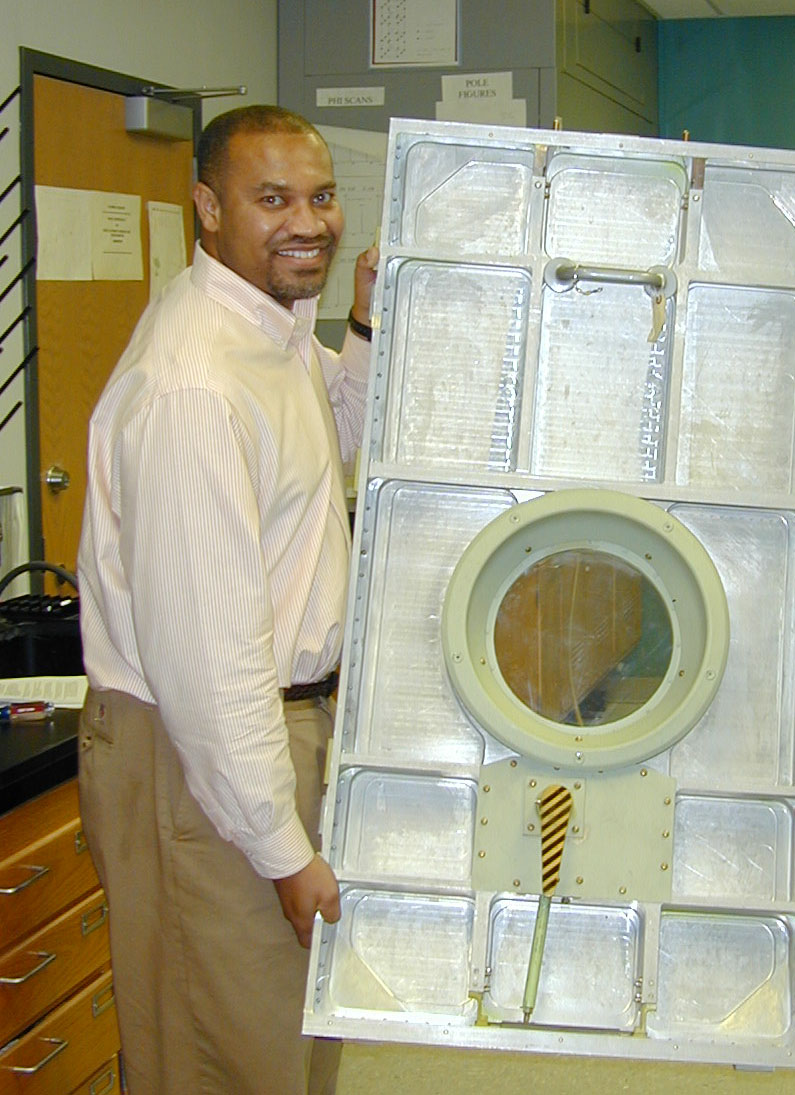
David Veazie is a Professor at Kennesaw State University's Southern Polytechnic College of Engineering and Engineering Technology, leading the Center for Advanced Materials Research and Education (CAMRE). He holds a Ph.D. in Mechanical Engineering from Georgia Tech (1993) and has extensive industry experience with roles at AT&T Bell Laboratories, Georgia Tech Research Institute, and NASA Langley. His research focuses on advanced composites, polymer materials, and structural analysis for aerospace and naval applications. He has secured over $25 million in research funding from agencies like the DoD, NASA, and industry partners, including Lockheed Martin and Boeing. Education: Ph.D., Mechanical Engineering, Georgia Tech, 1993 M.S., Mechanical Engineering, Georgia Tech, 1987 B.S., Mechanical Engineering, Southern University, 1986 Research interests emphasize fabrication, characterization, and durability of polymeric composites, including rheology, thermochemical analysis, and fatigue life assessment. His work spans MEMS, aerospace structures, and lightweight materials. He has authored over 60 peer-reviewed publications and serves on editorial boards for journals like AIAA Journal and Experimental Mechanics . Recent projects include developing bio-sustainable nanocomposites for food packaging and investigating adhesive joint durability under thermal aging. His research has direct applications in defense, space exploration, and biomedical engineering. Grants and collaborations include $1.6M from the Army Research Lab for MEMS structural design and $18M from NASA for advanced polymer composites. He also oversees industry partnerships for materials testing and certification. Led the CAMRE since joining SPSU in 2008, fostering interdisciplinary research in materials science and engineering innovation.
Kenneth Matthews serves as the Dr. Charles Smith Distinguished Professor of Medical Physics in the Department of Physics & Astronomy at Louisiana State University's College of Science. He concurrently holds adjunct appointments at LSU's Department of Comparative Biomedical Sciences (as Faculty Manager of the Small Animal Imaging Facility), LSU Health Sciences Center's Department of Radiology, Pennington Biomedical Research Center, and the University of North Texas Health Science Center. His academic background includes: B.A. in Chemistry and Physics from Austin College (1990) Ph.D. in Medical Physics from The University of Chicago (1997) Diplomate certification from the American Board of Radiology (2001) Matthews' research centers on medical imaging physics with emphasis on nuclear medicine applications. His laboratory develops novel imaging systems including X-ray interferometry for lung disease diagnosis (COPD/COVID-19), endorectal digital prostate tomosynthesis (endoDPT), and synchrotron-based techniques. He maintains active interests in radiation protection, shielding design, and radiobiology, particularly regarding Auger electron therapy and radioiodine monitoring. Translational research bridging engineering solutions to clinical applications defines his approach. Analysis of his 2015-2025 publications reveals three dominant research trajectories: (1) Advanced imaging system development (prostate tomosynthesis, X-ray interferometry), (2) Radiation safety protocols (shielding for radiopharmaceuticals, uranium series decay analysis), and (3) Cancer therapy innovations (electromagnetically induced osmotic lysis, VMAT radiotherapy). These works consistently integrate physics principles with clinical oncology and nuclear medicine applications. His scientific recognition includes: Fellow of the American Association of Physicists in Medicine (2017) LSU College of Science Teaching Excellence Award (2018) Southwest AAPM Robert J. Shalek Award (2020) As an educator, Matthews has supervised 19 MS and 3 PhD theses while serving on 57 graduate committees across multiple disciplines. He founded LSU's Physics & Astronomy REU program (2010-2018), mentoring 110 undergraduates. His $10M+ grant portfolio features NIH, NSF, American Cancer Society, and DoD funding for projects including breast cancer interferometry imaging, VMAT radiotherapy optimization, and lung disease diagnostics. Current grants focus on clinical translation of imaging technologies through industry partnerships. He directs the Small Animal Imaging Facility and collaborates with the LIGO-Virgo-KAGRA Collaboration and Hearne Institute of Theoretical Physics, maintaining active roles in the AAPM Southwest Chapter (serving as Treasurer 2020-2024) and RSNA educational initiatives.
Joseph Lopreiato is a Professor of Pediatrics, Medicine, and Nursing at the Uniformed Services University of the Health Sciences in Bethesda, MD. As the Associate Dean for Simulation Education and Medical Director of the Val G. Hemming Simulation Center , he leads multidisciplinary simulation programs for medical students and military healthcare providers. His 31-year U.S. Navy Medical Corps career included roles as pediatric clerkship director, residency director, and national education leadership positions. Education : B.S. in Biology (Seton Hall University), MD (Georgetown University), MPH (University of Texas), Fellowships at Michigan State University and University of Texas, and a Certificate in Healthcare Modeling and Simulation (Naval Postgraduate School). Research Interests span healthcare simulation , medical education , patient safety , and military medicine , with a focus on simulation-based mastery learning, handoff protocols, and team dynamics in crisis scenarios. His work includes developing standardized assessment tools and AI-driven feedback systems. Scientific Awards include the Ray Helfer Award, American Academy of Pediatrics National Education Award, Walter Tunneson Award, and the John Eisenberg Award. He was honored with the DoD Superior Service Medal and Alpha Omega Alpha induction. Notable Projects include co-developing the I-PASS handoff curriculum, leading simulation research collaborations (e.g., EXPRESS), and innovating in moulage and surgical training for military contexts. He is certified as a Healthcare Simulation Educator by the Society for Simulation in Healthcare.
Dr. Houssam A. Toutanji serves as Dean of the Andrew J. Anagnost College of Engineering and Computer Science and Professor of Civil Engineering and Construction Management at California State University, Northridge. Previously, he held leadership positions including Dean of the College of Engineering and Applied Sciences at Western Michigan University, Chair of Civil and Environmental Engineering Department, and Associate Dean for Research and Graduate Education at the University of Alabama in Huntsville. Dr. Toutanji's educational background includes: Certificate in Communication for Impact, Harvard University, Graduate School of Education (2022) Certificate in Management and Leadership Education (MLE), Harvard University, Graduate School of Education (2018) Ph.D. in Civil Engineering, Worcester Polytechnic Institute, Worcester, MA (1992) M.S. in Civil Engineering, Northeastern University, Boston, MA (1987) B.S. in Civil Engineering, Northeastern University, Boston, MA (1985) Dr. Toutanji's research focuses on advanced construction materials and structural engineering. His work spans processing and mechanics of composites, smart materials and structures, high-performance concrete, sustainable construction materials, and fiber-reinforced polymer (FRP) composites. He has made significant contributions to bridge design, infrastructure renewal, multi-threat mitigation (including blast), impact/damage mechanics, fracture fatigue, and nondestructive assessment of materials and structures. His research addresses critical challenges in civil infrastructure durability and performance under various loading conditions. Dr. Toutanji's scholarly output demonstrates consistent focus on strengthening techniques for concrete structures, particularly using FRP composites. His work shows progression from fundamental material characterization to practical applications in structural rehabilitation. Recent publications emphasize fatigue analysis, prediction models, and innovative coating systems for enhanced structural performance and durability. His research bridges theoretical modeling with experimental validation across multiple structural systems, with particular attention to long-term performance under cyclic loading. Dr. Toutanji has received numerous prestigious awards: National Science Foundation CAREER Award (1996) NSF-EPSCoR Scholarly Productivity Award (1995, 1996) Fellow, American Society of Civil Engineers (2006) John J. Guarrera Engineering Educator of the Year Award (2020) UAH Research and Creative Achievement Award (2005) UAH Distinguished Teaching Award (2004) As a dedicated educator and researcher, Dr. Toutanji has secured over $7 million in research funding from agencies including NSF, DOD, NOAA, NASA, Army Corps of Engineers, ALDOT, and UTCA. He has advised 18 doctoral students to completion and served as principal or co-principal investigator on numerous research projects. His leadership extends to editorial roles for academic journals and service as an ABET evaluator. Dr. Toutanji also holds visiting positions at Cergy-Pontoise University as a Research Visiting Scholar and University of Gent as a Visiting Professor. Dr. Toutanji's research activities center around advanced materials testing and structural analysis laboratories focused on composite materials, concrete technology, and structural rehabilitation techniques. He has established collaborative research networks with international institutions including universities in France and Belgium, contributing to the global advancement of civil engineering knowledge and practice in structural engineering and construction materials science.