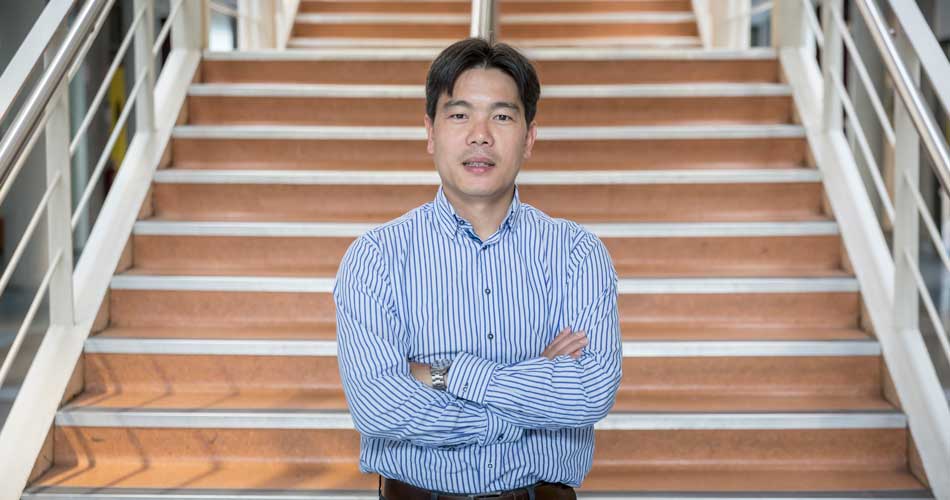
Dr. Le-Nam Tran is a researcher at the UCD School of Electrical & Electronic Engineering , University College Dublin. His work focuses on optimizing the last hop of 5G/6G wireless networks through mathematical programming, with emphasis on energy efficiency, interference management, and security against eavesdropping. Develops low-cost, low-complexity transmission techniques Projects supported by Science Foundation Ireland Career Development Award Author of over 80 peer-reviewed publications Research Keywords: Wireless Communications Network Security Signal Processing Energy-Efficient Systems Beamforming Optimization Interference Mitigation
Dr. Mathieu Mercadier is an Assistant Professor of Business Analytics at Dublin City University Business School, Ireland. He serves as Programme Chair for the MSc and Graduate Diploma in Business Analytics. His research focuses on Business Analytics, Machine Learning, Financial Risk Management, and Sustainable Finance. Education: PhD in Economics from Université de Limoges, France, specializing in Machine Learning applied to Banking and Finance. He has ten years of industry experience as a Market Finance Consultant. Research interests include applying Machine Learning to banking risk, sustainable finance, and quantitative finance. His work spans statistical modeling for financial stability, algorithmic risk assessment, and ESG fund evaluation. Key trends in his articles involve quantum-enhanced machine learning for stock forecasting, systemic risk measurement, and pandemic impact analysis. No scientific awards listed. Advising and grants: No formal grants or student advisees mentioned. Active in curriculum development for business analytics programs. Engaged in international conferences and seminars. Labs/Teams: Not explicitly stated in provided data.
Dr. Barry Hayes is a Senior Lecturer (Associate Professor) in Power Systems Engineering at University College Cork (UCC), Ireland. He leads a research team focusing on grid integration of sustainable energy technologies and future power system operation/planning. Previously held roles include Lecturer at University of Galway (2016-2018) and Marie Sklodowska-Curie Research Fellow at IMDEA Energy (2013-2016). Holds a PhD in Electrical Power Systems Engineering from University of Edinburgh (2013). Research interests include smart grids, distribution network management, demand-side flexibility, non-intrusive load monitoring, and energy communities. Active in IEEE standards development (P2030 smart grid interoperability) and serves as Associate Editor for IEEE Transactions on Energy Markets, Policy and Regulation. Has secured €1.03M SFI grant (2024-2029) for disruptive energy tech research, plus other grants including €506K from Disruptive Technologies Innovation Fund. Supervised PhD students in power systems and energy markets. Collaborates with Irish energy industry and international partners through MaREI Centre. Publications emphasize grid integration challenges, P2P energy trading, and smart meter applications. Notable recognition includes Elsevier's Most-Cited Article award (2022). Engages in public science communication via RTÉ and advises community-owned renewable energy projects.
Professor Paul Fanning is a Full Professor at University College Dublin (UCD), holding dual roles as UCD International Dean for China and Provost of UCD’s three joint international colleges in China: Beijing-Dublin International College (BDIC), Chang’an Dublin International College of Transportation (CDIC), and Guangzhou-Dublin International College of Life Sciences & Technology (GDIC). He previously served as UCD Deputy Vice President for Global Engagement (2017–2019), overseeing global academic strategies and governance. As a Chartered Engineer and Fellow of the Institution of Engineers of Ireland, Fanning’s expertise spans structural engineering, with a focus on masonry arch bridges, structural health monitoring, and vibration serviceability. His research integrates advanced numerical modeling, field testing, and material science to address challenges in infrastructure sustainability and safety. Education: B.E. in Civil Engineering from UCD, PhD in Structural Engineering from the University of Surrey (UK). Post-PhD, he worked as a consultant engineer before returning to UCD in 1996. His academic leadership roles include Research Group Director, Head of Teaching & Learning, and Deputy Vice-Principal for Internationalization in the College of Engineering and Architecture. Research interests center on structural assessment techniques, including nonlinear finite element modeling of masonry arches, vibration response analysis of buildings and bridges, and the impact of non-structural elements on dynamic performance. He has led projects funded by the Irish government, including the 2017–2018 International Mobility Programme. Key achievements include pioneering methodologies for masonry arch bridge assessment and advancing understanding of pedestrian-induced vibrations in footbridges. His work on composite timber beams with welded-through dowels has redefined sustainable construction practices. Awards include Chartered Engineer status and Fellowship from the Institution of Engineers of Ireland. UCD’s joint colleges under his provostship exemplify international academic collaboration, blending Irish and Chinese educational frameworks. His grants and professional activities reflect a commitment to globalizing engineering education and infrastructure research.
Ravi Reddy Manumachu is an Assistant Professor in the School of Computer Science at University College Dublin (UCD), Ireland. He holds a B.Tech from IIT Madras (1997) and a PhD in Computer Science from UCD (2005), specializing in high-performance heterogeneous computing and energy-efficient systems. His research focuses on optimizing performance and energy efficiency in modern heterogeneous platforms like clouds, grids, and supercomputers through novel models and algorithms. Key contributions include functional performance/energy models, energy-prediction frameworks, and extensions like Heterogeneous MPI and ScaLAPACK for heterogeneous clusters. He has published over 69 articles in top journals/conferences, with recent works addressing data transfer energy measurement, scalable allreduce algorithms (SUARA), and portable programming models (OpenH). Professional roles include Assistant Professor at UCD (2023–present), SEAI Research Fellow (2022–2023), and prior industrial experience at Ansys, Siemens, and IONA Technologies. He has certifications in university teaching, GDPR, and research integrity. Languages include English (fluent), Telugu, and Hindi. Research trends emphasize bi-objective optimization (performance-energy), hardware heterogeneity challenges, and scalable communication algorithms for deep learning. His work addresses energy non-proportionality in CPUs and GPU-CPU interactions, with practical solutions for real-world applications like matrix operations and gene sequencing.
Ehsan Namjoo serves as a Research Fellow in the Department of Electronics & Computer Engineering at the University of Limerick, with a primary affiliation at Lero – the Irish Software Research Centre. His multidisciplinary work bridges theoretical signal processing, machine learning applications, and hardware implementation for real-world systems. His research spans signal processing (DOA estimation under non-ideal noise conditions, EEG source imaging), machine learning (explainable AI for medical diagnostics, feature selection in cancer detection), and computer engineering (polar code decoders, visible light communication systems). Notable biomedical applications include breast cancer diagnosis and epileptic source analysis, while cybersecurity work focuses on intrusion detection in cloud environments. Recent publications (2021-2025) reveal a consistent trajectory toward developing lightweight, interpretable models for tabular medical data alongside robust signal processing frameworks for communication systems. His work increasingly integrates hardware-aware algorithms, particularly in polar coding implementations, and emphasizes practical validation through experimental demonstrations in visible light networks. As an active Lero researcher, Namjoo participates in Ireland's national software research ecosystem, contributing to interdisciplinary projects that connect theoretical innovations with healthcare, communications, and security applications through collaborative frameworks.
Dr. David Ayala Cabrera is an Ad Astra Fellow and Lecturer/Assistant Professor in the School of Civil Engineering at University College Dublin. He holds a PhD in Water and Environmental Engineering from the Universitat Politècnica de València (UPV, Spain), awarded Cum Laude with the Extraordinary Thesis Award 2017. His research focuses on cybersecurity, resilience engineering, and non-destructive testing (e.g., GPR) for critical infrastructure, particularly water distribution systems. He has contributed to projects like STOP-IT (H2020) and ResiWater, addressing cyber-physical threats and network vulnerability. His teaching includes modules like Civil Engineering Systems and Computer Applications in Civil Engineering. Education: B.Eng. (Sanitary Engineering, Universidad del Valle, Colombia), MSc (Hydraulic & Environmental Engineering, UPV), PhD (Water & Environmental Engineering, UPV). He also holds postgraduate certifications in university teaching and leadership. Research interests include smart city technologies, machine learning applications, and infrastructure resilience. His work spans over 49 publications, with recent focus on GPR-based leak detection, cybersecurity, and data-driven state estimation in water networks. Grants: Led projects like the EU-funded WatQual (2018–2019) and contributed to innovative tools for cyber-physical security. Awards: PhD Cum Laude, International Doctor honor, and multiple research fellowships (e.g., KIOS Research Center, Cyprus). Advising: Co-supervised PhD and Master’s theses at UPV on GPR applications and WDS analysis. His lab collaborations include ICCS (Greece), Irstea (France), and the University of Cyprus’s KIOS Center, advancing tools for infrastructure resilience and smart water management.
Kirk Soodhalter is the Ussher Assistant Professor in Numerical Analysis at the School of Mathematics, Trinity College Dublin. His research focuses on numerical linear algebra, ill-posed problems, Krylov subspace methods, and high-performance computing applications. He can be reached at ksoodha@maths.tcd.ie and is based in Office 244 of the Llyod Building. His work integrates advanced computational techniques with applications in astrophysics, fluid dynamics, and quantum computing. Research Interests: His primary areas include developing efficient iterative methods for large-scale linear systems, particularly those arising in PDEs and quantum algorithms. He explores Krylov subspace recycling, preconditioning strategies, and sparse grid sampling to address challenges in numerical stability and computational efficiency. Publications: Recent work demonstrates contributions to quantum super-Krylov methods for ground state estimation, fast solutions for Sylvester-structured systems in astrophysics, and hybrid iterative techniques for ill-posed problems. His articles often emphasize high-performance computing frameworks and their practical implementations. Awards: No scientific awards explicitly mentioned in the provided text. Advising & Grants: No student advisees or grant details listed. His research is primarily conducted through Trinity College Dublin's School of Mathematics infrastructure.
Micheál L. Collins serves as Assistant Professor of Social Policy and Head of Social Policy at University College Dublin's School of Social Policy, Social Work and Social Justice. His academic leadership extends to roles including Member of School Executive, Programme Director for B.SocSc (Social Policy & Sociology), and Deputy Assistant Dean. As Fellow of the UCD Geary Institute for Public Policy and coordinator of the European Social Survey Round 11 in Ireland, he maintains significant institutional affiliations. BA from NUI Galway MA from University College Cork PhD from Trinity College Dublin Dr. Collins' research centers on the critical intersection of taxation and social policy, with particular expertise in income distribution, poverty measurement, fiscal welfare systems, and pension economics. His interdisciplinary approach bridges economics and social policy to examine how taxation structures influence social outcomes, especially regarding gender disparities in pension systems and the public cost burden of poverty. Recent work analyzes the cost-of-living crisis through comparative UK-Ireland policy responses, revealing administrative challenges in targeted support systems. His publication trends demonstrate consistent focus on taxation's role in social policy, with 2023-2025 works establishing frameworks for understanding tax expenditure impacts on poverty costs and gender pension gaps. Key contributions include estimating Ireland's annual public service cost of poverty at €3bn-€7bn and documenting how tax supports for pensions disproportionately favor males. Professional engagement includes membership on Ireland's Commission on Taxation (2008-2009), Advisory Group on Tax and Social Welfare (2011-2014), and current roles with the EU-wide Cost Action PROFEEDBACK and European Social Policy Analysis Network. He serves on editorial boards for Journal of Social Policy and Social Policy and Society . As an advisor, Dr. Collins has provided expert evidence to Oireachtas Select Committees and chaired roundtables on tax expenditure research agendas. His grant portfolio includes major projects like the European Social Survey Round 11 and research on low-paid workers across age groups. Teaching responsibilities span modules including Inequality in Irish Society and Applied Public Policy, reflecting his commitment to experiential learning approaches.
Krishna Chaitanya Vadlamannati is an Associate Professor in International Development Studies at the University College Dublin School of Politics and International Relations (SPIRe) . He serves as Director of the PhD program in Global Human Development and chairs the Athena Swan Application Committee. Previously, he held academic roles at the Norwegian University of Science & Technology (NTNU) and the University of Göttingen. Education: PhD in Economics (University of Heidelberg), BA (Osmania University), PG DIP (Dhruva College of Management) His research bridges Development Politics in India , Political Economy of Natural Resources , and International Political Economy . Recent publications analyze FDI-conflict linkages , China's vaccine diplomacy , and IMF program effectiveness with cultural diversity. He examines how economic freedom affects health equity and income inequality . Scientific awards include the 2024 Research Ally Award and the 2021-22 UCD Teaching and Learning Award . As Editor of The Journal of International Development and former editorial board member of Journal of Peace Research , he shapes academic discourse. His work connects subnational Indian development with global health and geopolitical strategies .