Maurice Herlihy serves as the An Wang Professor of Computer Science at Brown University, where he leads research in distributed systems and blockchain technology. His academic career spans decades with continuous contributions to concurrency theory and practical distributed system design. Education: PhD in Computer Science from Massachusetts Institute of Technology (1984) MS in Computer Science from Massachusetts Institute of Technology (1980) BA from Harvard University (1975) His research focuses on fundamental problems in distributed computing, particularly transactional memory systems and blockchain scalability. Recent work centers on overcoming concurrency limitations in blockchain execution through sharding techniques, optimized transaction scheduling, and cross-chain protocols. He investigates how hardware features like trusted monotonic counters can enhance Byzantine fault tolerance in asynchronous networks. Analysis of his 2020-2025 publications reveals a dominant focus on blockchain systems, with 85% of recent work addressing scalability, concurrency, and security challenges. Key trends include sharded permissioned ledgers for enterprise applications, concurrent execution models for Ethereum, and formal verification of cross-chain protocols. His work bridges theoretical distributed computing with practical cryptocurrency system design. He has secured significant research funding including NSF SHF grants for run-time support in concurrent programming. While specific advisees aren't listed in source materials, his teaching of advanced courses like CSCI 1760 (Multiprocessor Synchronization) indicates active graduate mentorship in distributed systems.
Professor Hyung Seok Kim is a distinguished academic at Sejong University, currently serving as Professor in the Department of AI and Robotics. He also holds significant administrative positions including Dean of the College of Software Convergence at Sejong University. Professor Kim leads the MINES LAB (Mobile Intelligent Embedded Systems Lab), located in Room 211, Chungmu Hall at Sejong University, where he directs research in cutting-edge AI and embedded systems technologies. Professor Kim's educational background includes: Bachelor of Engineering: Department of Electrical Engineering, Seoul National University Master of Engineering: Department of Electrical and Computer Engineering, Seoul National University Doctor of Engineering (Ph.D.): Department of Electrical and Computer Engineering, Seoul National University Professor Kim's research spans multiple domains at the intersection of artificial intelligence and embedded systems. His work focuses on AI robots, wearable AI devices, Large Language Models (LLMs), and on-device AI technologies . His research group develops innovative solutions for emotion recognition, medical imaging analysis, and IoT applications. The MINES LAB specifically targets the integration of AI with embedded systems to create efficient, low-latency solutions for real-world problems ranging from healthcare monitoring to industrial applications. Analysis of Professor Kim's recent publications reveals a strong focus on medical AI applications, federated learning for IoT networks, and multimodal emotion recognition . His work demonstrates consistent innovation in applying deep learning techniques to medical imaging (particularly ophthalmology and cardiology), developing efficient edge-AI solutions for wearable devices, and creating novel network optimization approaches for industrial IoT. The publications show a clear trajectory toward more integrated, privacy-preserving AI systems that can operate effectively on resource-constrained devices. While specific awards to Professor Kim aren't detailed in the provided information, his research group has achieved notable recognition: Dr. Song Seung-hwan, a Ph.D. candidate at the lab, received the Presidential Industrial Service Medal Professor Kim has mentored an extensive number of students throughout his career, with alumni pursuing diverse career paths at leading organizations worldwide. His former students have secured positions at major technology companies including Samsung Electronics, LG Electronics, Kakao, and Amazon, as well as academic positions at universities globally. The MINES LAB currently supports multiple graduate students, post-doctoral researchers, and research assistants working on various AI and embedded systems projects. Professor Kim's research appears to be well-funded, with connections to industry partners including Hyundai Motor Company and Samsung Electronics, though specific grant details aren't provided in the text. The MINES LAB serves as the central hub for Professor Kim's research activities, focusing on AI robots, wearable AI devices, and LLM applications. The lab maintains active collaborations with industry partners and has produced numerous commercial applications through its alumni network. Current research directions include developing low-latency emotion recognition systems, medical imaging analysis tools, and efficient network protocols for IoT applications. The lab environment appears highly collaborative, with both full-time and part-time researchers contributing to various projects across the AI and embedded systems spectrum.
Sarah Dumnich serves as an Assistant Professor in the Department of Mathematics at Saint Vincent College within The Herbert W. Boyer School of Natural Sciences, Mathematics and Computing, teaching courses including Calculus, Complex Variables, Data Science, and Statistics. Her educational background includes: PhD in Mathematics from Lehigh University MS in Mathematics from Lehigh University BA in Mathematics from Washington and Jefferson College Dr. Dumnich's research specializes in Statistics and Reinforcement Learning, with particular focus on asynchronous Markov Decision Processes in multi-agent systems. Her work bridges theoretical statistics with practical reinforcement learning applications, while her teaching actively integrates data science methodologies across the curriculum. Her recent publication analyzes asynchronous challenges in multi-agent reinforcement learning, advancing understanding of temporal misalignment in distributed decision-making systems within artificial intelligence and machine learning domains. Dr. Dumnich has not listed any scientific awards in the available information. No advising roles or research grants are specified in the provided materials.
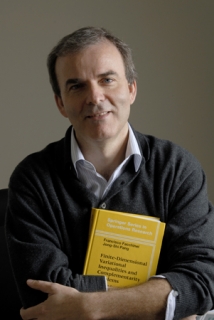
Francisco Facchinei is a Professor at Sapienza University of Rome, affiliated with the Department of Computer, Automatic and Management Engineering Antonio Ruberti within the College of Engineering. His research spans nonlinear and non-differentiable optimization, complementarity problems, variational inequalities, and game theory applications in telecommunications. His work focuses on developing algorithms for nonconvex optimization with ghost penalties, asynchronous distributed methods, and applications in healthcare and communications systems. Key Contributions: Foundational work in variational inequality theory, generalized Nash equilibrium problems, and optimization over dynamic networks. Recent Trends: Emphasis on asynchronous parallel algorithms, stochastic optimization, and non-invasive medical diagnostics via machine learning. He has held academic positions at Sapienza University since 1990, progressing from Ricercatore to Professore Ordinario. No scientific awards are explicitly mentioned in the provided texts.
Rachid Guerraoui is a Moroccan-Swiss computer scientist and Full Professor in the School of Computer and Communication Sciences at EPFL. He is renowned for his significant contributions to distributed and concurrent computing, holding the prestigious Chair in Distributed Computing at the Collège de France (2018-19). As an ACM Fellow (2012) and recipient of the Dahl-Nygaard Senior Prize (2024), his work has shaped both theoretical foundations and practical implementations in distributed systems. Guerraoui earned simultaneous Master's degrees in Computer Engineering from École supérieure d'informatique électronique automatique (ESIEA) and in Computer Science from Pierre and Marie Curie University in 1989. He completed his PhD at Université d'Orsay in 1992 under the supervision of Christian Fluhr, with a dissertation titled "Programmation Répartie par Objets: Études et Propositions." Following postdoctoral research at EPFL, he joined the computer science faculty in 1999 after working at HP Labs and MIT. Guerraoui's research spans distributed computing, concurrent systems, transactional memory, and asynchronous algorithms. His work on establishing theoretical foundations of Transactional Memory, including the concept of opacity, has been highly influential. He has also made significant contributions to scalable information dissemination methods, asynchronous distributed computations, and the mathematical abstraction of indulgence. His research bridges theoretical rigor with practical implementations, as evidenced by systems like SwissTM and STMBench7. His publication record shows a clear evolution from theoretical foundations to practical implementations and broader applications. Early work focused on fundamental problems like consensus and renaming, while more recent publications address machine learning applications and public understanding of AI. The consistent thread throughout his career is a focus on making distributed systems more reliable, efficient, and accessible. Guerraoui has received numerous prestigious awards including: ACM Fellow (2012) ERC Advanced Grant Award (2013) Google Focused Award (2014) Middleware Best Paper Award (2014) Middleware 10-Years Best Paper Award Chair in Distributed Computing, Collège de France (2018-19) Dahl-Nygaard Senior Prize (2024) As an academic advisor, Guerraoui has mentored students including El Mahdi El Mahmdi, with whom he co-created the Wandida project - a collection of educational videos on computer science. His research has been supported by significant grants from the European Research Council and Google. Beyond research, Guerraoui actively participates in public discourse, particularly regarding computer science education and technology policy. Guerraoui leads the Distributed Computing Laboratory (DCL) at EPFL, which focuses on advancing the state of the art in distributed systems. The lab's work spans theoretical foundations, practical implementations, and educational outreach, reflecting Guerraoui's holistic approach to computer science research and education.
Sophia Knight serves as Associate Professor in the Department of Computer Science at the Swenson College of Science and Engineering, University of Minnesota Duluth. Her academic credentials include: PhD (2013) from École Polytechnique (LIX) under Frank Valencia and Catuscia Palamidessi in the COMETE team, dissertation analyzing information flow between agents using game semantics, modal logic, and process calculus Master's degree (2009) from McGill University's School of Computer Science supervised by Prakash Panangaden in the Reasoning and Learning Laboratory, thesis on game semantics for process algebra modeling anonymity protocols Dr. Knight's research examines knowledge dynamics and communication in multi-agent systems through epistemic logic and concurrency theory frameworks. Her work addresses security challenges in social networks and personal data systems using: Asynchronous communication effects on knowledge modeling Epistemic strategy logic for agent uncertainty Constraint programming for distributed knowledge reasoning Topological semantics for dynamic epistemic logics (with Aybüke Özgün) Prior appointments include: Postdoctoral researcher (2016-2018) at Uppsala University's Concurrency group Postdoctoral researcher (2013-2016) at LORIA, Université de Lorraine in Hans van Ditmarsch's CELLO team
Prof. Dr.-Ing. Sebastian Esser serves as Group Lead for Information Management at the Chair of Computing in Civil and Building Engineering at Technical University of Munich. His research focuses on advancing Building Information Modeling (BIM) methodologies, particularly in infrastructure and railway applications. He contributes significantly to international standardization efforts including IFC-Road and IFC-Rail projects, and leads research initiatives such as RIMcomb and BauPuls360. Dr. Esser's research spans several critical areas in digital construction: Graph-based version control systems for BIM collaboration Digital twin development for infrastructure management Semantic modeling of built environments BIM-based regulation checking for railway infrastructure Interdisciplinary model coordination techniques Knowledge representation in civil engineering His work bridges theoretical computer science with practical civil engineering applications, focusing on improving data interoperability and workflow efficiency in construction projects. Analysis of his recent publications reveals a strong emphasis on graph-based approaches to BIM challenges. His research has evolved from foundational work on BIM programming interfaces to sophisticated implementations involving knowledge graphs, semantic reasoning, and digital twin architectures. Key trends include increasing integration of semantic web technologies with BIM standards, development of specialized query interfaces like GraphQL for construction data, and application of formal methods to infrastructure modeling problems. Dr. Esser actively supervises numerous bachelor's and master's theses annually, with recent topics covering graph-based entity alignment, BIM-GIS integration for flood assessment, incremental model updates, and digital twin implementations. His teaching portfolio includes courses such as Bau- und Umweltinformatik, BIM.fundamentals, BIM.infra, and Semantic Modeling of the Built World, demonstrating his commitment to educating the next generation of digital construction professionals. He is involved in multiple research initiatives including DFG FOR 5672 (The information backbone of robotized construction), SPP 2187 (Adaptive modularized constructions), and AM2PM (Additive to Predictive Manufacturing). His laboratory work spans the BIM-Lab and related computational infrastructure supporting his research in digital construction technologies.
Jérôme Leroux is a Directeur de Recherche (DR CNRS) at the Laboratoire Bordelais de Recherche en Informatique (LaBRI) , affiliated with the University of Bordeaux , France. His research focuses on formal verification of infinite-state systems, vector addition systems, Presburger arithmetic, and acceleration techniques for symbolic computation. Key research themes include: Vector Addition Systems (VASS) and Petri Nets Automata-based representations for Presburger arithmetic Abstract interpretation and CEGAR frameworks Verification of asynchronous distributed systems His recent publications highlight work on acceleration techniques for convex binary relations, serialized digit automata, and regular acceleration methods for number decision diagrams. These contributions are implemented in tools like the Talence Presburger Arithmetic Suite (TAPAS) and the FAST tool for symbolic verification. Scientific awards include a Best Paper Award at TURING'100 . He has advised several Ph.D. students and postdoctoral researchers, including Alexander Heußner and Thibault Hilaire (current Ph.D. candidate). Leroux is actively involved in organizing conferences like MFCS'23 and serving on program committees for venues such as VMCAI'26 .
Dr. Kim Völlinger is a Researcher at the Technical University of Berlin in the Models and Theory of Distributed Systems group. Her academic career spans formal methods, trustworthy machine learning, and distributed systems, with a focus on integrating interactive proof assistants like Coq for neural network verification. Education: Computer Science with a minor in Cognitive Psychology at Humboldt University of Berlin and ENSEEIHT in Toulouse, France PhD Supervisors: Wolfgang Reisig (HU Berlin), Kurt Mehlhorn (MPI-INF Saarbrücken), Holger Schlingloff (Fraunhofer FOKUS) Her research bridges theoretical computer science and practical verification, exploring witness-based runtime verification for asynchronous systems, hybrid system formalization, and LLM-supported proof synthesis. She also contributes to interdisciplinary collaborations, particularly evident in her microbiology-related publications. Recent publications on Google Scholar highlight her work in environmental microbiology, including microbial community dynamics in petroleum reservoirs, DNA extraction from crude oil, and bacterial stress responses in extreme saline environments. These studies reflect cross-disciplinary applications of computational modeling to environmental systems. Teaching activities include formal languages, automata theory, and interactive theorem provers. She actively mentors doctoral students, leads research-oriented master's projects, and supervises student theses. The Models and Theory of Distributed Systems group at TU Berlin serves as her primary research environment, where she continues to develop tools for computational verification and machine-reviewed proofs.
Gabriel Luque is an Assistant Professor in the Department of Languages and Computer Science at the E.T.S.I. Informática (School of Computer Engineering) of the University of Málaga, Spain. His academic career focuses on parallel metaheuristics and evolutionary algorithms, with applications spanning bioinformatics, natural language processing, traffic optimization, and workforce planning. Dr. Luque's research interests center on the design and analysis of parallel and distributed metaheuristics for solving complex combinatorial optimization problems. His work has significantly contributed to understanding the performance characteristics of distributed evolutionary algorithms, including studies on takeover time dynamics, energy consumption analysis, and communication overhead in parallel implementations. He has made notable contributions to DNA fragment assembly problems using parallel genetic algorithms and has extended his research to emerging areas like quantum computing applications. Research grant from Spanish Government: 'Ayuda a la Movilidad José Castillejo' (2008) Research grant from Andalusian Government: 'Beca de Formación de Personal Docente e Investigador' (2002-2006) Award: 'Proyecto Fin de Carrera - Diario el País' (2001) Dr. Luque actively supervises student research projects and has directed several final degree projects on topics including particle swarm algorithms for complex problem solving and extending optimization libraries. His research is supported by multiple national and international projects focused on smart mobility, intelligent cities, and fundamental metaheuristic research. Dr. Luque has established a productive research trajectory with numerous high-impact publications in journals and conferences, demonstrating consistent contributions to the field of parallel metaheuristics and their real-world applications.
Dr. Kooktae Lee is an Assistant Professor in the Department of Mechanical Engineering at New Mexico Institute of Mining and Technology. He leads the ICON Lab (Innovative Control Of Networked multi-agent systems Laboratory), focusing on distributed control systems for multi-agent robotics. His research bridges theoretical frameworks and practical applications in areas like UAV optimization and environmental monitoring. Education: Ph.D., Aerospace Engineering, Texas A&M University (2015) M.S., Mechanical Engineering, Korea University (2008) B.S., Mechanical Engineering, Korea University (2006) Research Focus: Dr. Lee's work centers on uncertainty quantification in networked systems, asynchronous algorithms, and multi-objective optimization for robotics. Key applications include autonomous exploration, infrastructure inspection, and adaptive resource allocation using heterogeneous robot teams. The ICON Lab develops novel approaches to handle communication delays and packet drops in distributed systems. Lab Resources: The ICON Lab employs advanced computational tools to model multi-agent interactions and optimize exploration strategies. Current projects emphasize real-world deployment of intelligent systems for time-critical missions.
Thomas Wies is a Professor of Computer Science at the Courant Institute of Mathematical Sciences, New York University, and Chair of the Computer Science Department. He is a member of the Analysis of Computer Systems Group and has a personal website. Affiliation: New York University Research Focus: Program Analysis, Verification, Automated Deduction, Concurrency Teaching: Principles of Programming Languages (undergraduate), Programming Languages (graduate), Rigorous Software Development Research Interests: His work centers on program analysis, verification of concurrent systems, automated deduction, and applications of separation logic. He develops tools like Raven, GRASShopper, and Sprout for verifying concurrent programs and search structures. Recent Articles (2025-2023): Focus on SMT-based verification, concurrent data structures, temporal safety effects, multiparty protocols, and separation logic extensions. These span conferences like OOPSLA, CAV, IEEE S&P, and TACAS. Scientific Awards: Best Paper at ISSRE 2019 Best Paper at ICFP 2014 Professional Activities: Organizer/Co-organizer of VerifyThis 2025, Program Chair roles in NETYS 2023, VMCAI 2022, and others. Active in PC roles for POPL, PLDI, CAV, and VMCAI. Students & Group: Advises PhD students including Elaine Li, Devora Chait-Roth, and Ekanshdeep Gupta. Group alumni include Kshitij Bansal, Siddharth Krishna, and Wei Wang.
Andrew Myers is a Professor in the Department of Computer Science at Cornell University , focusing on Programming Languages , Computer Security , and Distributed Systems . He is an ACM Fellow and currently serves as Editor-in-Chief for ACM Transactions on Programming Languages and Systems (TOPLAS). His professional roles include program chair or co-chair for conferences such as ACM POPL 2018 , ACM CCS 2016 , and POST 2014 . His research bridges formal methods with practical language design , as evidenced by projects like the Condorcet Internet Voting System and the Viaduct compiler . Contributions span security protocols , concurrent programming , and hardware design languages . 2023 : Universally Composable Security for Program Partitioning 2022 : A Flexible Type System for Fearless Concurrency, PDL: A High-Level Hardware Design Language 2021 : Viaduct compiler for secure distributed programs 2020 : Handling Bidirectional Control Flow 2018 : MixT consistency language, Covert Channel-Free Hardware Scientific recognition includes Best Paper Awards at POPL 1999 , SOSP 2001 , SOSP 2007 , CIDR 2013 , PLDI 2013 , and PLDI 2015 . Professional service includes conference organization (e.g., ACM POPL 2018 Program Chair , Steering Committee roles in PriSC and PLDI). Myers maintains active open-source projects like civs (Condorcet Internet Voting System) and Viaduct , reflecting his commitment to secure, verifiable systems and language-driven solutions .
MARÍA ISABEL GARCÍA ARENAS is a researcher affiliated with the University of Granada 's Department of Computer Science , specializing in Computer Architecture and Technology and Distributed Computing . Education: Doctorate (2003) from University of Granada with thesis on Distributed Asynchronous Evolutionary Computation in Heterogeneous Networks Using a Java Virtual Machine Research Interests: Focus on Java-based virtual machines for distributed systems Applications in asynchronous processing and network heterogeneity
Rajiv Gupta is a Distinguished Professor and the Amrik Singh Poonian Professor of Computer Science at the University of California, Riverside (UCR), where he serves as Associate Dean for Academic Personnel in the Bourns College of Engineering (BCOE). He is a member of the RIPLE research group and has co-authored 327 papers with an h-index of 69 and over 16,600 citations. His extensive service includes chairing major conferences such as FCRC 2015, PPoPP 2020, ASPLOS 2011, and PLDI 2008. Professor Gupta's research focuses on Programming, Compiler, Runtime & Architectural Support for Parallel & Distributed Heterogeneous Systems and Software Tools for Monitoring and Managing Runtime Behavior . His work spans graph analytics with scalability and performance, understanding and managing the dynamic behavior of parallel programs, software speculation for irregular parallelism, dynamic program analysis for secure and reliable computing, and compiler optimizations with architectural support. His research has significant applications in high-performance computing, GPU programming, and distributed systems. Analysis of his recent publications reveals a strong focus on graph processing systems, with particular emphasis on evolving and streaming graph analytics. His work addresses critical challenges in memory management for large-scale graph processing, hardware acceleration for graph algorithms, and optimization techniques for concurrent and distributed graph computations. The research demonstrates a progression from foundational compiler and architecture work to increasingly sophisticated systems for handling modern data-intensive computing challenges. Fellow of the ACM (2009) Fellow of the IEEE (2008) Fellow of the AAAS (2011) NSF Presidential Young Investigator Award (1991) UCR Doctoral Dissertation Advisor/Mentor Award (2012) Multiple best paper awards across major conferences Two students won ACM SIGPLAN Outstanding Doctoral Dissertation Award Five advisees received NSF CAREER Award Professor Gupta has supervised 42 PhD students to completion and currently advises several doctoral candidates. His advising success is reflected in his students' achievements, including multiple award-winning dissertations and significant career accomplishments in academia and industry. His research has been supported by numerous grants from NSF, DARPA, and industry partners, enabling sustained investigation into parallel computing systems. The RIPLE research group under his leadership has produced influential work that bridges theoretical foundations with practical system implementations. As the leader of the RIPLE research group at UC Riverside, Professor Gupta oversees a vibrant team focused on innovative approaches to parallel and distributed computing. The group maintains strong collaborations with industry partners and other academic institutions, contributing to the development of next-generation computing systems. Current projects include GRASP (Graph Analytics with Scalability & Performance) and research on understanding and managing the dynamic behavior of parallel programs, reflecting the group's continued focus on cutting-edge computing challenges.