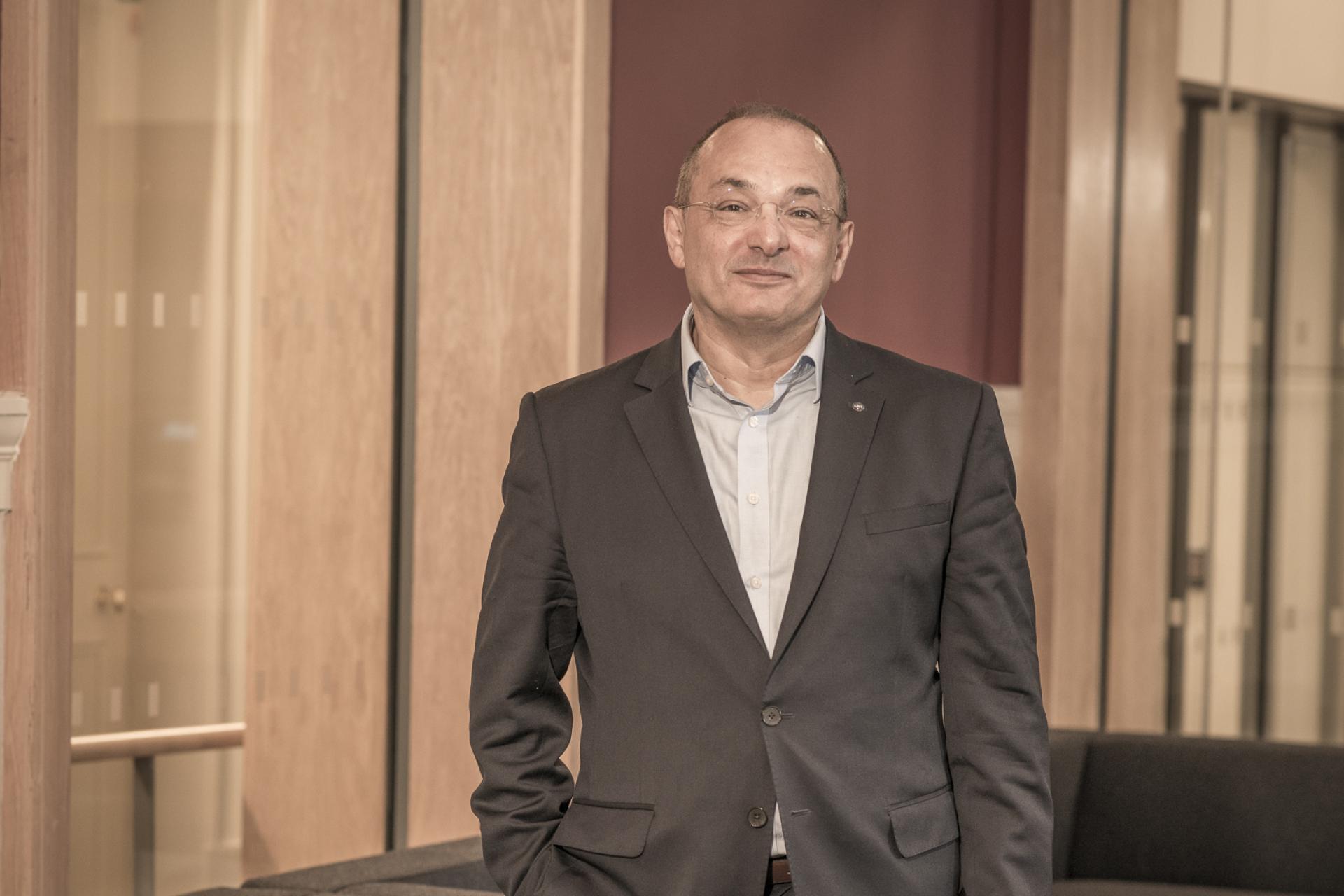
Professor Emilios Avgouleas holds the Chair of International Banking Law and Finance at the University of Edinburgh's School of Law. He is a leading expert in financial regulation, fintech policy, and systemic risk governance. His research focuses on blockchain technology, sustainable finance, and digital finance frameworks. He serves on the European Securities and Markets Group, advises the World Economic Forum, and collaborates with institutions like the European Banking Institute and the Monetary Committee of the International Law Association (MOCOMILA). Education: PhD (LSE), LLM (LSE), LLB (Athens University). Research grants include Leverhulme Trust funding and collaborations with the Asian Development Bank and Hong Kong University. He has been a visiting professor at Harvard, Yale, Tsinghua, and other global institutions. Research interests span financial stability, bank resolution mechanisms, and the intersection of technology with legal frameworks. His recent work addresses CBDCs, crypto regulation, and post-pandemic banking challenges. Over 80 peer-reviewed articles and books include *Governance of Global Financial Markets* (CUP, 2012) and co-edited volumes on systemic risk and capital markets union. Grants and awards: AHRC (2008-2009), Australian Research Council (2013-2016), Leverhulme Trust. He advises the European Parliament on financial stability and NPLs. Engages in high-level policy dialogues with regulators like the Bank of England, FCA, and ECB.
Jonathan McCarthy is a Professor and Director of the LLM Business Law Programme at University College Cork (UCC), serving as Deputy Director for Graduate Research in the School of Law. He holds a BCL and LLM from UCC and earned his PhD there in 2018. His research focuses on financial law and corporate governance, particularly regulatory frameworks for FinTech and SME support. He has taught at UCC since 2015 and previously at University of Limerick. Education: BCL (University College Cork) LLM (University College Cork) PhD (University College Cork, 2018) Research interests emphasize EU financial regulation, digital finance innovation, and corporate rescue mechanisms for SMEs. His work explores the efficacy of legal processes for start-ups and the adaptation of traditional frameworks to emerging technologies like blockchain and distributed ledger systems. He frequently reviews submissions for journals and publishers in his field. Teaching spans courses such as Company Law, Digital Finance Regulation, and Corporate Law at both undergraduate and postgraduate levels. He also serves as an external examiner for the Dublin Business School's LLB program. Professional development includes certifications in research integrity, universal design for learning, and connected curriculum strategies. Grants and funding include an Irish Research Council Government of Ireland Postgraduate Scholarship and the Ronan Daly Jermyn Scholarship during his doctoral research on SME rescue procedures in Ireland. His work combines qualitative analysis with policy advocacy for improved legal frameworks. Labs/Teams: Active in cross-disciplinary research within UCC's School of Law, collaborating on projects related to FinTech regulation and EU policy implementation.
Associate Professor Anton Didenko is a leading academic at UNSW Sydney's School of Private & Commercial Law, specializing in FinTech regulation, banking law, and central bank digital currencies (CBDC). He holds law degrees from Russia and the UK, including an MJur and DPhil from the University of Oxford. His research focuses on CBDC design, regulatory sandboxes, open banking frameworks, and cybersecurity in finance. University Affiliation: UNSW Sydney Key Academic Roles: Author of Banking Law in Australia (11th ed, 2024) and lead author of Customer Data Sharing Frameworks (2024) Global Engagement: Adviser to G20, Asian Development Bank, and UN agencies Research Interests: - CBDC policy and design implications - Regulatory frameworks for FinTech innovation - Cybersecurity in financial systems - Transnational commercial law and secured transactions - Open data and customer consent mechanisms Recent Articles: Focus on CBDC adoption in Pacific economies, weaponization of digital currencies in geopolitical conflicts, and comparative analysis of blockchain liabilities. His work bridges legal, technological, and policy dimensions of financial innovation. Awards : Australian Academic of the Year in Digital Finance (2023) Advising & Grants: - No listed advisees - Collaborations include Asian Development Bank-funded Pacific CBDC studies - Co-authored policy reports for UN Capital Development Fund and CPA Australia Labs/Teams: - Editor-in-Chief of the Cape Town Convention Journal - Co-leader of UNSW's FinTech regulation research initiatives
Professor Vallipuram Muthukkumarasamy is an Associate Professor at the School of Information and Communication Technology at Griffith University, where he has pioneered Network Security teaching and research since joining in 2001. He leads the Networking & Security and Blockchain Research Group at the Institute for Integrated and Intelligent Systems. Muthu holds a Ph.D. from Cambridge University and a B.Sc. Eng. with 1st Class Honors from the University of Peradeniya, Sri Lanka. His extensive academic appointments include Group Leader of Network Security and Blockchain Research (2008-present), Program Director for the Graduate Certificate in Blockchain Technology (2022-present), HDR Convenor (2022-present), Member of the University Council (2020-2021), and Deputy Head of School for Learning and Teaching (2013-2016). Muthu's research expertise spans Cyber Security, Blockchain Technology (DLT), and Wireless Sensor Networking. He has secured national and international funding for interdisciplinary research, published over 150 articles in international journals and conferences, and supervised more than 30 research Masters and PhD students to completion. He pioneered the Network Security teaching at Griffith and successfully proposed and led the development of Queensland's first Master of Cyber Security Program, creating a truly interdisciplinary curriculum with Law, Business, and Criminology Schools. His recent publications reveal a strong research trajectory in blockchain applications, security visualization techniques, and wireless sensor networks. His work explores DeFi user behavior analysis, NFT privacy risks in the metaverse, blockchain transaction visualization, and the integration of blockchain with AI for credit scoring systems. His wireless sensor network research focuses on energy-efficient routing protocols and network lifetime modeling. Muthu has received multiple best teacher awards from students and peers, and during his tenure as Deputy Head of School, the Griffith IT program was ranked #1 in Australia for overall student satisfaction. He successfully proposed and developed Cisco-related courses at undergraduate and postgraduate levels and instrumental in creating industry-sought-after networking and security courses across all academic levels. His funded research includes significant projects such as Increasing the South East Queensland Cyber Security Workforce, Linking Digital Payments to Crime Using Big Data Machine Learning Tools, Improving Water Markets through Digital Technologies, and developing Indo-Australian partnerships for digital transformation through blockchain. He is actively involved in community and charity activities and has been instrumental in internationalization efforts for Griffith University.
Jannis Angelis is an Associate Professor at the Department of Industrial Economics and Management (Indek), Royal Institute of Technology (KTH), with a focus on interdisciplinary research bridging technology and management. His educational background includes a PhD in Operations Management from the University of Cambridge, MPhil in Political Economy from Cambridge, MA in China Studies from SOAS, Certificate in Medical Innovation from Oxford, and MSc in International Relations from Stockholm University. His research explores operational flexibility, digital transformation, and sustainable competitiveness across industries. Key themes include: Blockchain 4.0 for value-added services in business ecosystems Strategies to manage EV battery material scarcity via circular economy Data-driven performance management in healthcare and pandemic scenarios Lean operations and servitization in knowledge-intensive sectors His work has been supported by a Vinnova-funded project on blockchain in automotive sectors and collaborations with organizations like Cling Systems and William Bergh. He has supervised nine PhD students and 400+ student projects. Scientific awards include: Shingo Prize for Lean and Operational Excellence Skinner Best Paper Award Voss Best Paper Award Recent publications analyze blockchain applications, circular supply chains, and AI-driven management systems, reflecting his commitment to advancing digital and sustainable operational frameworks.
Prof. Peter Hertkorn is a full professor of Computer Science at Reutlingen University's Faculty of Computer Science, specializing in programming languages and databases. He holds leadership roles including Chair of the Examination Board for Media and Communication Informatics B.Sc. and BAföG Officer for the same program. His research focuses on model-driven software development, domain-specific languages, DevOps automation, interactive learning technologies, and distributed ledger technologies. He co-leads the Software Engineering and User Experience (swuxLAB) and Distributed Ledger Technologies (DLT-LAB) research groups. Education background includes a Diplom-Informatiker (master's equivalent) and Dr.-Ing. (PhD) from University of Stuttgart. Professional experience includes 5 years at T-Systems International GmbH and prior academic roles at University of Stuttgart. His teaching focuses on Software Engineering and Database Systems courses. Publications span interactive learning environments, collaborative innovation systems, and AR-based knowledge spaces. Active in academic service roles and interdisciplinary research collaborations since 2009.
Professor Asif Gill is Head of Discipline for Software Engineering at the School of Computer Science, University of Technology Sydney (UTS), where he was promoted to Professor of Computer Science in January 2024. He also serves as Director of the DigiSAS Research and Innovation Lab and is actively involved in the Global Big Data Technologies Centre at UTS. As a founder of both the DigiSAS Lab and the Future Generation Enterprise Architecture Community of Practice (FGEA CoP), he has established integrated teaching-research-engagement frameworks that translate academic research into practical applications while enhancing graduate employment opportunities. Professor Gill's research interests span Adaptive Enterprise Architecture , Agile Software Development , and Design Science Research & Innovation , with a particular focus on architecting large-scale data-intensive enterprise software systems. His work addresses challenges across academia, industry, government, and society, with significant contributions to AI systems architecture, digital identity management, and enterprise knowledge graphs. His applied research has resulted in numerous collaborations with organizations including the Reserve Bank of Australia, Revenue NSW, Capsifi, Data Zoo, and the NSW Department of Planning, Industry and Environment. His publication record includes 3 books and over 190 articles in major academic journals such as IEEE Transactions on Professional Communication, Information and Management, and Information Systems. His recent work demonstrates a consistent focus on cutting-edge topics in enterprise architecture, AI systems, and digital identity, with multiple publications appearing in 2024-2025. His research trajectory shows a clear evolution from foundational work in agile software development toward more sophisticated integration of AI, enterprise architecture, and data governance. Fellow of the Australian Computer Society (ACS) Fellow of DSE (ESCP Center for Design Science in Entrepreneurship) Senior Member IEEE Associate Editor, IEEE Transactions on Technology & Society Associate Editor, Springer Nature Discover Data journals Member, Data Sharing Committee, IFIP Technical Committee 8.1 Member, Standards Australia Software and Systems Engineering Committee IT-015 Professor Gill has successfully secured numerous research grants from 2019-2026, totaling significant funding for projects related to digital identity, enterprise architecture, and AI systems. His approach emphasizes industry-academia collaboration, with many projects involving direct partnerships with government agencies and industry organizations. He has supervised multiple PhD and Master's students through industry-sponsored scholarships and maintains active collaborations with researchers across multiple institutions. Leading the DigiSAS Research and Innovation Lab, Professor Gill has created an environment that bridges theoretical research with practical implementation. The lab focuses on developing frameworks and tools for adaptive enterprise architecture, with particular emphasis on AI-enabled systems, data governance, and digital identity solutions. His work on the Data Satellite Architecture represents a significant contribution to combating data pollution in federated digital ecosystems.
Laura Emilia Maria Ricci is a Full Professor at the University of Pisa's Department of Computer Science, leading the Pisa Distributed Ledger Laboratory (Pisa DLT Lab). Her research focuses on blockchain technology, layer-2 solutions, cryptographic techniques, and self-sovereign identity frameworks. She coordinates the National PhD program in Blockchain and Distributed Ledger Technologies and leads the PRIN research project 'AWESOME' (2023-2025). Ricci serves as an associate editor for the ACM Distributed Ledger Technologies: Research and Practice journal and the Springer Nature SN Computer Science section on blockchain innovations. Her research emphasizes blockchain scalability, transaction analysis, and social network dynamics. Recent work includes studies on NFT architectures, post-quantum cryptography in Ethereum, and query authentication protocols. She co-organized the 7th IEEE International Conference on Blockchain and Cryptocurrencies (2025) and actively participates in global blockchain initiatives. Ricci has been awarded Best Paper Awards for her contributions to decentralized cloud scheduling, hybrid architectures for online games, and distributed virtual environments. She advises numerous PhD students and oversees grants like the H2020 'HELIOS' project. Ricci's academic roles include teaching blockchain, peer-to-peer systems, and web scraping at the University of Pisa. Her lab collaborates on projects such as the AQuSDIT grant (2024-2025) and the Ethereum Foundation's 'Cross Chain Authenticated Queries.' She also chairs conferences like IEEE Blockchain and co-edits special issues on blockchain-based pervasive systems and social media analysis.
Noel Crespi is a Professor and Director of Studies at Telecom SudParis, part of Institut Polytechnique de Paris. He leads research in the NeSS group and is affiliated with SAMOVAR, a prominent research laboratory focusing on networks, systems, and services. His work spans multiple domains in telecommunications, networking, and smart systems. His primary research interests include digital twins for smart cities, blockchain technologies, Internet of Things (IoT) security and applications, 5G/6G networking, and machine learning applications in network management. He has published extensively on these topics, with over 100 publications in top-tier journals and conferences. His recent work shows a strong focus on digital twin applications for urban management, particularly in traffic and air quality monitoring. He has developed modular frameworks for smart city digital twins that integrate real-time data from multiple sources. His research also explores blockchain applications for network security, access control, and service provisioning in next-generation cellular networks. Dr. Crespi has received significant recognition for his work on digital twins, with his 2020 paper "Digital twin in the IoT context" in Proceedings of the IEEE being highly cited. His current research explores the integration of AI with digital twin technologies for sustainable urban development. He has supervised numerous PhD students and collaborates extensively with researchers across Europe and internationally. His work often involves interdisciplinary approaches, bringing together computer science, networking, urban planning, and environmental science. Dr. Crespi has been instrumental in developing frameworks for network digital twins, with applications in traffic management, air quality monitoring, and resource allocation in smart cities. His research demonstrates practical implementations in cities like Madrid, showing measurable improvements in urban management.
Benjamin Sturm is a postdoctoral researcher at the Chair of Information Infrastructures at the Technical University of Munich . His work focuses on Distributed Ledger Technology (DLT) , blockchain systems , and design science research . He has contributed to projects like COOLedger (DLT configuration analysis) and BISE Student (open access thesis platform using blockchain). Sturm’s research investigates security vulnerabilities in DLT , autonomous agent collaboration , and systematic information retrieval frameworks . His work on DLT design principles and configuration trade-offs has been published in top conferences like ICIS and HICSS . He has developed tools for transparent academic publishing using the bloxberg blockchain and IPFS for decentralized storage. Key publication trends include DLT security , blockchain configuration challenges , and methodological innovations in design science research . He collaborates with Prof. Ali Sunyaev and researchers like Niclas Kannengießer on DLT applications in cloud computing, autonomous driving, and academic infrastructure. Current projects focus on decentralized knowledge management and robustness in open multi-agent systems .
Klitos Christodoulou is an Assistant Professor in the Department of Digital Innovation at the University of Nicosia (UNIC), affiliated with the School of Business. He holds a PhD in Computer Science from the University of Manchester (2014), along with a BSc and MSc in Computer Science from the same institution. His research focuses on Distributed Ledger Technologies, Blockchain, Machine Learning, and Data Integration. He is a research faculty member at UNIC's Institute For the Future (IFF) since 2018 and actively contributes to ISO/TC 307 standards for Blockchain. Christodoulou has led projects like the Ripple grant and participated in EU initiatives such as EUNOMIA and DLT4ALL. He teaches blockchain courses in UNIC's MSc in Digital Currency program and serves on editorial boards, including Frontiers in Blockchain. His work explores blockchain governance, consensus algorithms, and ethical applications in supply chains. Education: BSc in Computer Science, University of Manchester (2006–2009) MSc in Advanced Computer Science, University of Manchester (2009–2010) PhD in Computer Science, University of Manchester (2010–2014) Research Interests: Blockchain and DLT architectures Machine Learning applications in finance and security Decentralized governance models Blockchain adoption frameworks Awards/Grants: Principal Investigator of the Ripple grant; EU-funded projects (EUNOMIA, DLT4ALL); contributor to Cyprus National Blockchain Strategy. Labs/Teams: Institute For the Future (IFF), University of Nicosia
Andrea Tosato is a Professor of Law at Southern Methodist University's Dedman School of Law . His scholarship intersects commercial law , intellectual property , and cryptocurrency regulation , with a particular focus on digital assets and secured transactions . Research Interests include: Digital asset classification under Uniform Commercial Code (UCC) Bankruptcy implications of crypto organizations Security interests in intellectual property Stablecoin regulation and tokenized debt instruments Blockchain applications in real estate finance His article trends show deep engagement with cryptocurrency legal frameworks , IP collateralization , and bankruptcy adaptation for decentralized systems. Co-authors include leading scholars like Christopher K. Odinet and Kara J. Bruce . Advising : Mentored ezinne igbokwe on pharmaceutical patent research. His work appears in top law journals including University of Pennsylvania Law Review and Arizona State Law Journal .
Omry Ross is an Associate Professor at the Department of Computer Science, University of Copenhagen. His research focuses on Programming Languages and Theory of Computation, with significant contributions to decentralized finance (DeFi), blockchain technology, and algorithmic governance. Research Interests: Decentralized Finance (DeFi) and Smart Contract Systems Blockchain Protocol Design and Cryptoeconomics Programming Language Theory and Formal Verification Token Governance in Decentralized Autonomous Organizations (DAOs) Algorithmic Game Theory and Market Mechanisms Recent publications highlight his work in AI moderation of online communities, compliance reporting in DLT systems, and MEV optimization in multi-block scenarios. His research bridges theoretical computer science with practical applications in financial cryptography. Scientific Awards: Nasdaq Nordic Foundation Grant (2021) Omry Ross collaborates extensively with researchers in blockchain and DeFi, including contributions to the Financial Cryptography and Data Security workshops.
Giulia Scaffino is a PreDoc Researcher in the Security and Privacy group at the Technical University of Vienna (TU Wien). Her research focuses on cryptocurrencies, blockchain interoperability, scalability, off-chain protocols, and decentralized finance (DeFi). She holds an MSc in Nuclear and Particle Physics from the University of Pavia, Italy, and is pursuing a PhD at TU Wien. Before her PhD, she worked as a Salesforce developer at Deloitte Digital in Milan. Giulia is involved in projects such as CDL-BOT (2020–2025), Browsec (2018–2024), CoRaF (2022–2025), and SFB SPyCoDe (2023–2026). Her work includes developing frameworks for cross-blockchain smart contracts, optimizing light clients for DeFi, and creating scalable blockchain bridges. She has contributed to publications on topics like IoT data marketplaces and distributed key generation using zk-SNARKs. Her research trends emphasize solving blockchain scalability challenges through innovative protocols and enhancing interoperability between different blockchain systems. Projects like Glimpse and Alba highlight her focus on efficient, secure, and decentralized solutions for modern blockchain ecosystems.
Prof. Jannis Angelis is a Visiting Professor at ISM and a Docent/Reader in Operations Strategy at Indek. Previously, he held roles at Cambridge Judge Business School, Warwick, and Stockholm, and served as a country champion for teaching excellence at Oxford University’s education society. His academic journey includes a PhD in operations management from Cambridge, MPhil in political economy (Cambridge), MA in China studies from SOAS, and an MSc in international relations from Stockholm. His research focuses on the intersection of technology and management, exploring areas such as blockchain applications in supply chains, circular economy strategies for EV batteries, and digital transformation in manufacturing. Notable contributions include studies on blockchain in food supply chains, DLT ecosystems, and lean operational excellence, as evidenced by his receipt of the Shingo Prize and Skinner/Voss best paper awards. Angelis has supervised 9 PhDs and 400 student projects, secured €1.4m in grants, and led major research initiatives. His professional experience spans roles at the ILO, venture capital firms, and international consultancies like ITC (WTO/UNCTAD). He currently leads research at the Gunilla Bradley Centre and IFN Research Institute, focusing on digitalization and operational excellence. Teaching Awards: Four teaching awards, including recognition for pedagogical innovation. Research Grants: Over €1.4m secured, with leadership in three major projects. Labs/Teams: Active in the Gunilla Bradley Centre (Digitalisation) and IFN Research Institute (Industrial Economics).