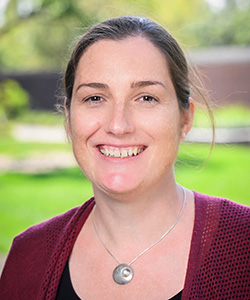
Dr. Rachel Seary is a Lecturer in Marine Conservation at the University of Kent's Durrell Institute of Conservation and Ecology (DICE). She holds an MSc from the University of St Andrews and a PhD in Geography from the University of Cambridge. Her work focuses on applied marine conservation solutions that balance ecological preservation with community needs, particularly in coastal and fishing communities. Key areas include dynamic ocean management, mangrove-fisheries interactions, and mitigating human-wildlife conflicts in fisheries. Professional Roles: Member of PICES Working Group 51, Editorial Board Member for Frontiers in Marine Science and Bulletin of Marine Science . Education: PhD in Geography, University of Cambridge (2019) MSc in Ecosystem-based Management of Marine Systems, University of St Andrews Research Interests: Social-ecological systems, sustainable fisheries, marine protected areas, and participatory conservation approaches. Her research spans global contexts including California, Indonesia, Cambodia, Greece, and the UK. Notable projects include studying whale-fishery interactions on the US West Coast and assessing mangrove-fisheries in South-East Asia. She advocates for interdisciplinary solutions to ensure biodiversity goals align with human well-being under climate and regulatory changes. Teaching includes modules on environmental sustainability, the Anthropocene, conservation policy, and climate change impacts. She supervises postgraduate research in marine conservation and resource management topics.
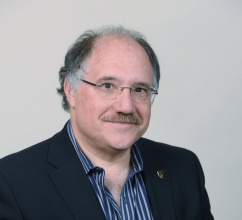
Abderrahim Benslimane is a Full Professor of Computer Science at the University of Avignon, France, where he serves as Vice Dean of International Relations at the UFR STS (Unité de Formation et de Recherche en Sciences et Technologies). He is also Head of the master degree SICOM (Systèmes Informatiques Communicants: réseaux, services et sécurité) program at the university. His extensive academic career spans several decades with significant contributions to computer science, particularly in networking and security domains. Professor Benslimane holds a HDR (Title to supervise researches) from the University of Cergy-Pontoise, a Ph.D. from the University of Franche-Comté, along with M.S. and B.S. degrees in Computer Science from the same institution and the University of Nancy respectively. His research interests primarily focus on distributed computing, networking and communication protocols, with particular emphasis on modeling, describing and implementing secure communication protocols and multimedia applications in heterogeneous network architectures. He combines engineering and theoretical approaches using graphs, distributed algorithms, transition systems, and performance evaluation models. Benslimane's scholarly work demonstrates a strong trend toward addressing security and privacy challenges in emerging technologies. His recent publications focus on cybersecurity applications for wireless sensor networks, Internet of Things, blockchain implementations, UAV communications, and vehicular networks. He has pioneered research in energy attack mitigation, trust management systems, and secure group communications, often employing game theory and novel cryptographic approaches. His work bridges theoretical foundations with practical implementations in next-generation networking technologies. IEEE VTS Distinguished Lecturer (2020-2022) Best Paper award at IEEE ICC 2019 Multiple Prime d'Encadrement et de Recherche Doctorale awards (1998-2021) Prime d'Excellence Scientifique (2011-2015) IEEE Senior Member As an academic leader, Benslimane has served as Editor in Chief of Multimedia Intelligence and Security Inderscience Journal, Area Editor of IEEE Internet of Things Journal, and Associate Editor for multiple prestigious publications including IEEE Transactions on Multimedia and IEEE Wireless Communication Magazine. He has founded and led research centers including the Informatics Research center (CRI) at the French University in Egypt and the Multimedia and networking team (RAM) at the Laboratoire d'Informatique d'Avignon (LIA). His laboratory research focuses on security, communication protocols, graphs and distributed algorithms, with applications in ad hoc networks, sensor networks, vehicular networks, and IoT.
Emma Mercier is an Associate Professor and Associate Head & Director of Graduate Programs in the Department of Curriculum & Instruction at the University of Illinois, Urbana-Champaign's College of Education. She also holds a secondary appointment in the Department of Educational Psychology, demonstrating her interdisciplinary approach to educational research. Dr. Mercier's research focuses on the relationship between social interaction and learning, with particular emphasis on collaboration and computer-supported collaborative learning (CSCL) in classroom settings. Her work examines how technology influences group interactions and learning, especially through the use of multi-touch tables in classrooms. She investigates between-group and whole-class interactions, device ecologies, teacher tools, and classroom contexts that shape learning opportunities in technology-enhanced environments. Her research spans K-12 and higher education settings, with significant contributions to engineering education and the design of collaborative learning spaces. Analysis of Dr. Mercier's recent publications reveals a strong focus on orchestration tools that support instructors in facilitating collaborative learning, the role of technology (particularly augmented and virtual reality) in collaborative problem solving, and the design of effective collaborative tasks in engineering education. Her work bridges educational theory with practical classroom applications, often employing design-based implementation research methodologies. A notable trend is her increasing focus on machine learning applications to analyze and support collaborative interactions in real-time classroom settings. Dr. Mercier has been actively involved in mentoring graduate students and teaching courses related to educational research methods, child development and technology, and advanced study of education. Her work has involved significant collaboration with researchers across institutions and disciplines, particularly in the fields of educational technology, learning sciences, and engineering education. Her research has been supported through various projects, including the CSTEPS (Collaborative Support Tools for Engineering Problem Solving) initiative, which has developed and evaluated tools to support collaborative learning in engineering classrooms. This work has involved partnerships with teaching assistants, course assistants, and faculty to implement and refine collaborative learning approaches in undergraduate engineering courses.
Andrew Rau-Chaplin is a Professor and Dean of the Faculty of Computer Science at Dalhousie University, where he leads the Risk Analytics Lab and contributes significantly to research in high performance computing, parallel algorithms, and risk analytics. He is affiliated with the Institute for Big Data Analytics and has a strong academic and administrative presence. Education: Postdoc - DIMCS (Princeton, Rutgers, Bell Labs) PhD - Carleton University (1993) MCS - Carleton University (1990) BCS - York University (1986) His research focuses on applying parallel and high performance computing to data-intensive domains such as data warehousing, OLAP, catastrophe modeling, and risk analytics. He emphasizes both algorithmic design and practical system implementation, with a strong grounding in experimental evaluation. His work spans theoretical studies and real-world applications in finance, bioinformatics, and geospatial systems. The 15 most recent publications reflect a consistent focus on parallel data processing, OLAP optimization, indexing techniques (e.g., Hilbert curves), and risk modeling. Key themes include scalable data cube computation, view selection, adaptive coding, and spatial analytics, demonstrating expertise in both algorithmic innovation and systems-level performance. He has served on numerous scientific committees and grant panels, including NSERC and Compute Canada, and has been a journal editor for JPDC and DMTCS. Dr. Rau-Chaplin has supervised a wide range of graduate students in areas including risk analytics, GPU computing, text analytics, and parallel algorithms. His lab has received funding for postdoctoral, graduate, and undergraduate research positions. He teaches courses such as Parallel Computing, Software Engineering, Data Structures, and Risk Analytics, and has developed software tools like LaHave, Clustal XP, and Digital Coliseum. His lab, the Risk Analytics Lab, focuses on integrating analytics, risk management, and HPC for challenges in catastrophe modeling and financial risk. The lab leverages technologies such as stochastic simulation, optimization, and spatial OLAP.
Oliver Gasser is a researcher at the Max Planck Institute for Informatics (MPI-INF) and the Technical University of Munich (TUM), where he has co-lectured courses such as Advanced Computer Networking and Master Course Computer Networks. His research focuses on Internet measurement, security, and privacy, with a strong emphasis on IPv6, DNS, BGP, and web tracking technologies. His research interests include Internet measurement, IPv6 deployment, BGP security, DNS infrastructure, web tracking, privacy technologies, and network resilience. He has made significant contributions to understanding IPv6 hitlists, router fingerprinting, hypergiant content delivery networks, and consent banner manipulation on the web. His work combines large-scale active measurements with data analysis to uncover systemic issues in Internet infrastructure and privacy practices. The recent publications highlight a consistent focus on measurement-driven research across networking, security, and privacy. Trends include analyzing IPv6 adoption patterns, detecting covert tracking mechanisms in web cookies, evaluating security of Internet protocols like DNS and BGP, and improving measurement methodologies for large-scale network studies. His work often involves developing open tools and datasets that advance reproducibility in networking research. PAM 2023 Best Paper Award TMA 2023 Best Paper Award TMA 2023 Fast Track Award PAM 2018 Best Paper Award IRTF Applied Networking Research Prize 2018 IMC 2017 Community Contribution Award TMA 2017 Best Dataset Award CoNEXT 2023 Community Contribution Award Oliver Gasser has advised or co-advised over 40 master’s and bachelor’s theses at MPI-INF and TUM, demonstrating strong mentorship in academic research. He has led several measurement projects that have received external funding, including development of the IPv6 Hitlist Service and tools for analyzing web tracking. His community service includes extensive participation in program committees for major networking conferences such as IMC, CoNEXT, PAM, and TMA. He leads and contributes to several open research initiatives including the IPv6 Hitlist Service, SNMPv3 Measurement Service, MPTCP Measurement Service, DNS Observatory, and the BannerClick tool for automated cookie banner interaction. These platforms provide valuable resources for the global networking research community and support reproducible science.
Lucio Baccaro is Director at the Max Planck Institute for the Study of Societies (MPIfG) and was Full Professor of Macrosociology at the University of Geneva, where he also served as Deputy Dean for Research (2016–2020). He has held academic positions at MIT, Case Western Reserve University, and visiting roles at the University of Turin and the University of Vienna. His primary affiliations are with MPIfG and the University of Geneva, both central to his research in political economy and sociology. Education: PhD in Management and Political Science, Massachusetts Institute of Technology (MIT), 1999 Doctorate in Labor Law and Industrial Relations, University of Pavia, 1997 Master of Business Administration, Stoa' (IRI-MIT joint venture), 1991 Laurea in Philosophy, summa cum laude, University "La Sapienza", Rome, 1989 Lucio Baccaro’s research focuses on comparative political economy, labor relations, global worker rights, and deliberative governance . His work integrates economic sociology and political sociology to analyze institutional change, social dialogue, and the impact of globalization on labor and welfare systems. He has led major comparative studies on employment models, pension reforms, and international labor standards. His scholarship emphasizes the interplay between institutions, ideas, and power in shaping economic governance. His recent publications reveal a consistent focus on institutional change, deliberative processes, labor market reforms, and global justice . Themes include path dependence in international organizations, the transformation of collective bargaining, and the role of expertise in democratic governance. His interdisciplinary approach bridges sociology, political science, and economics, with strong methodological rigor in comparative and qualitative analysis. Scientific Awards and Honors: Honorary Professor, University of Duisburg-Essen (2023) Professeur honoraire, University of Geneva (2020) International Geneva Award (2011) Outstanding Young Scholar Award, IRRA (2003) Founder's Prize, SASE (2001) Maurice F. Strong Career Development Chair, MIT (2006–2009) Multiple fellowships from SSRC, Harvard, MIT, and CUNY Alfiere del Lavoro, awarded by the President of Italy (1984) Advising and Grants: While specific student advisees are not listed, Baccaro has supervised research and mentored scholars through his roles at MPIfG and the University of Geneva. He has secured substantial research funding, including grants from the Swiss National Science Foundation (SNF) and the Swiss Network for International Studies (SNIS), supporting projects on post-Fordist growth models, employment policy, and deliberative governance. His leadership in co-principal investigator roles highlights his collaborative research approach and institutional influence. Labs and Research Teams: As Director at MPIfG, Baccaro leads a major research institute focused on the study of societal and economic institutions. He has been instrumental in shaping research agendas on political economy and governance, fostering interdisciplinary collaboration and international scholarly exchange.
Shoshana R. Shelton is a Professor at the RAND School of Public Policy and a Policy Researcher at the RAND Corporation. Her work centers on program evaluation, public health systems, emergency preparedness, and national health security, with significant contributions to pandemic response, violence prevention, and crisis decision-making. She has led major projects for federal agencies including the CDC, DHS, FEMA, and the U.S. Secret Service. Education: M.P.H., The Ohio State University B.A. in English, Denison University Her research focuses on strengthening public health infrastructure through performance measurement, logic modeling, and stakeholder engagement. She has developed tools such as tabletop exercises for continuity of operations in public health laboratories and led after-action reviews of the public health response to COVID-19. Her work emphasizes building resilience against biological threats, natural disasters, and targeted violence. Shelton's recent publications highlight trends in emergency alert systems, disaster resilience, criminal justice reform during pandemics, and equitable health security research investment. She advocates for evidence-based policies that balance bioterrorism preparedness with responses to natural disasters and climate-related emergencies. Scientific Awards: No awards listed in the provided text. She has advised or collaborated with numerous federal and state agencies, contributing to national health security through rigorous evaluation and policy analysis. Her grants and projects reflect sustained funding from DHS, CDC, and other federal bodies focused on improving public safety and health system readiness. She has also led initiatives on behavioral threat assessment in schools and wearable technology for law enforcement wellness. Labs and Teams: Previously led a four-year project on mass attacks and targeted violence for the U.S. Secret Service. Collaborated with the Association of Public Health Laboratories (APHL) on continuity of operations planning. Contributed to the Priority Criminal Justice Needs Initiative, fostering innovation across law enforcement, courts, and corrections.
Dr. Sam Ferguson is a Senior Lecturer at the School of Computer Science, University of Technology Sydney (UTS), with a multidisciplinary background in music performance, cognitive science, and psycho-acoustics. His research explores the intersection of sound, music, and human experience through creative coding, machine learning, and interactive systems. Key Research Areas: Sound and Music Computing, Human-Computer Interaction, Creative Coding, Cognitive Science, Installation Art, and Acoustics. Current Projects: ARC Linkage project on creative coding and multiplicitous media; industry collaborations on IoT-based audiovisual systems. Recent Publications: Focus on spatial audio complexity, gestural interaction with networked sound, music emotion recognition frameworks, and robotic performance through genre-based cultural platforms. Leadership Roles: Director of Teaching & Learning Engagement; former Deputy Head of School (Teaching and Learning); active in ACM Creativity and Cognition Steering Committee. Teaching: Courses like Digital Media Studio , Prototyping Physical Interaction , and Data Processing using R within UTS's interdisciplinary Software Development Studio.
David Henderson is the Director of the Cyclone Testing Station (CTS) in the School of Engineering and Physical Sciences at James Cook University, Australia. He has over two decades of experience as a research engineer specializing in the performance of low-rise buildings under extreme wind conditions. He previously served as the CTS Research Fellow and Manager, and was seconded as a Postdoctoral Researcher at the University of Western Ontario, Canada, working on full-scale house testing under simulated wind loads. His work bridges engineering research, disaster assessment, and policy development. David's research focuses on wind engineering, structural resilience, and disaster mitigation. His key interests include cyclonic wind loading, internal and external pressure dynamics in buildings, fatigue failure of structural connections, and the vulnerability of housing to severe wind events. He has conducted post-disaster surveys across Australia and Canada, assessing damage from cyclones, tornadoes, and earthquakes. His research has direct applications in building codes, retrofitting strategies, and community risk reduction. The recent publications highlight a strong trend in understanding and mitigating wind-induced damage to residential structures, particularly through full-scale testing, modeling of pressure dynamics, and fragility assessment of roofing systems. His work spans experimental, theoretical, and policy-oriented domains, with a growing emphasis on climate change adaptation and community resilience. Topics such as internal pressure design, load sharing in roof frames, and retrofitting for wind resistance are central to his contributions. 14 research awards (specific names not listed) Active member of Standards Australia code committees Invited speaker at national and international conferences Media contributor on storm damage and building safety David has led multiple research projects funded by councils and agencies focused on extreme wind mitigation, data systems (SWIRLnet), and community risk reduction. While formal student supervision is not explicitly listed, he collaborates extensively with researchers such as John Ginger, Korah Parackal, and Daniel Smith. He has contributed to major studies involving wind load testing, housing vulnerability modeling, and climate adaptation planning. David is a key figure in the Cyclone Testing Station, leading its full-scale testing program and contributing to the development of software for controlled load and measurement systems. His team conducts wind risk assessments for communities and large installations, incorporating terrain analysis and retrofitting evaluations. The CTS serves as a national resource for wind engineering research and disaster resilience innovation.
Gabriel Felbermayr is a Professor of Economics at Vienna University of Economics and Business (WU) and Director of the Austrian Institute of Economic Research (WIFO) since 2021. He holds a PhD in Economics and has held academic positions at the University of Munich (ifo Center for International Economics), Kiel University (Chair in Economics), and the University of Tübingen. University Professor: WU Vienna (2021–) Director: WIFO Vienna (2021–) President: Kiel Institute (2019–2021) Research Interests include international trade theory, labor markets in open economies, European integration, migration economics, and climate-trade intersections. His work combines theoretical models with empirical policy analysis, focusing on globalization challenges, supply chain disruptions, and economic sanctions. Current Projects Trump 2.0 Transatlantic Tariff Scenarios Scientific Awards include recognition for his research contributions, though specific award names are not detailed in the text. He has led major projects for institutions like the Austrian Economic Chamber and the Foundation for Family Businesses. Education includes studies at the University of Linz and University of Florence (PhD). His publications span journals like Journal of International Economics , Review of World Economics , and World Development .
Shahid Raza is a Professor of Cybersecurity at the University of Glasgow's School of Computing Science. He previously led the RISE Cybersecurity Unit in Sweden, establishing it as a leading research group. His expertise spans IoT Security, PKI, AI-driven cybersecurity solutions, and hardware/data security. Raza holds a PhD and Docentship from Uppsala University, alongside a Bachelor's with a Gold Medal for academic excellence. Education: B.Sc. (Computer Science, 3.99/4.0 CGPA, Gold Medal), Licentiate, PhD, and Docentship in Cybersecurity from Sweden. He leads EU-funded projects like H2020 CONCORDIA and Horizon Europe CUSTODES, coordinating initiatives such as the Cyber Node and Cyber Range. Active in cybersecurity policy, he serves on the EU SCCG, ECSO, and EARTO Security & Defence Research working groups. Research Interests Public Key Infrastructure (PKI) for IoT AIAgent-Driven Cybersecurity Solutions IoT Certification Standards Hardware Security for Low-Power Devices Grants & Projects Coordinator: Horizon Europe CUSTODES Technical Leader: H2020 Arcadian-IoT Founder: RISE Cyber Range (Sweden's largest cybersecurity test facility) Awards & Memberships IEEE Senior Member Gold Medal for Academic Excellence (Bachelor's)
Timothy Harris is an Affiliated Lecturer at the University of Cambridge's Department of Computer Science and Technology, where he jointly teaches courses on multicore semantics and programming. Currently, he works at OpenAI, focusing on performance optimization for GPU inference of large language models, including the Azure OpenAI Service. Previously, he held roles at Microsoft, AWS, Oracle Labs, and was a faculty member at the University of Cambridge (2000–2004). His research spans distributed systems, runtime systems, operating systems, and high-performance computing, with an emphasis on scalability and performance. He contributed to projects like the Xen hypervisor and the Barrelfish research OS. Key research interests include distributed training of PyTorch models in the ONNX runtime, large-scale storage performance with Amazon S3, and runtime systems for in-memory graph analytics. His work often bridges 'big data' and high-performance computing techniques. Notable contributions include the book Transactional Memory (2010) and the Barrelfish OS, alongside numerous publications in top-tier conferences like SOSP, ASPLOS, and EuroSys. He has served as PC chair for ISMM 2025, VEE 2017, and EuroSys 2015, reflecting his leadership in the systems research community. His awards include a Best Paper Award at PACT 2010. Beyond academia, Harris is an avid hiker, aiming to complete the UK coastline, and maintains a photography portfolio at tlhphotography.uk .
Carlos Enrique Palau is a prominent researcher in the field of Internet of Things (IoT), edge computing, and cyber-physical systems. His work focuses on interoperability, security, and scalability in distributed systems, particularly in industrial and smart city applications. He has contributed to frameworks for cloud-edge continuum integration, blockchain-based IoT solutions, and federated computing architectures. Key areas of research include: IoT interoperability and semantic frameworks Edge computing and distributed workload management Cybersecurity for IoT and critical infrastructure Smart port logistics and real-time data analytics Cognitive services in legacy port management systems His recent work explores: Data-as-a-Product frameworks for Industry 4.0/5.0 Autonomous workload scheduling in energy-efficient edge-cloud systems Deception mechanisms for IoT security Self-* capabilities in cloud-edge nodes Palau has collaborated extensively with institutions like Universitat Politècnica de València and international partners in projects funded by EU initiatives. His research addresses practical challenges in industrial IoT deployments, smart city infrastructure, and emergency management systems.
Claudio A. Cañizares is a University Professor in the Department of Electrical and Computer Engineering (ECE) at the University of Waterloo. He holds a PhD and MASc from the University of Wisconsin-Madison and an Engineering degree from Escuela Politécnica Nacional in Ecuador. He is an IEEE Fellow and a Professional Engineer (PEng). His research focuses on power and energy systems, including smart grids, microgrids, energy storage, and renewable integration. He has advised over 100 graduate students and postdoctoral fellows, contributing to groundbreaking work in microgrid control, energy management systems, and grid stability. Notable awards include the 2017 IEEE-PES Outstanding Power Engineering Educator Award and the 2022 Award for Excellence in Graduate Supervision. His software contributions include the PSAT (Power System Analysis Toolbox) and SRLS (Smart Residential Load Simulator), widely used for power system analysis and smart grid modeling. He teaches courses such as ECE 6613PD (Power System Analysis) and ECE 467 (Power System Operation and Markets). Key research areas include voltage and frequency stability, distributed energy resources, and transactive energy markets. Collaborations span international institutions and industry partners like the Canadian Renewable Energy Laboratory (CANREL).
Yan Huang is an Associate Professor of Business Technologies at the Tepper School of Business, Carnegie Mellon University. She holds a Ph.D. in Information Systems and Management from Carnegie Mellon University (2013) and a B.Sc. (with honors) in Information Systems and Management from Tsinghua University, Beijing, China (2009). Prior to joining Carnegie Mellon University, she served as an Assistant Professor of Technology and Operations at the University of Michigan–Ann Arbor, Ross School of Business (2013-2018). Her educational background includes: B.Sc. (with honors) in Information Systems and Management, Tsinghua University, Beijing, China (2009) Ph.D. in Information Systems and Management, Carnegie Mellon University, Pittsburgh, United States (2013) Dr. Huang's research examines the economic and social impacts of technologies and identifies effective designs and policies for technology-enabled markets and platforms. She employs economic theories, structural modeling, statistical modeling, machine learning methods, and an understanding of the underlying technologies in her research. Her recent work focuses on the economics of artificial intelligence (AI) and machine learning (ML), with particular attention to algorithmic fairness, transparency, and collusion. She is among the first to bring economic and social perspectives to research on fair ML. Additionally, she studies digital platforms and online markets, examining how firms can leverage data-driven strategies to optimize pricing, personalization, and user engagement. Her recent publications demonstrate a strong focus on the intersection of AI/ML with economic principles, particularly in areas like algorithmic bias, pricing strategies, and platform regulation. A significant portion of her work examines how machine learning algorithms impact financial lending decisions, housing markets, and content creation platforms. Her research methodology frequently combines structural econometric modeling with empirical analysis of real-world data, providing both theoretical insights and practical implications for platform design and policy. Dr. Huang has received several prestigious awards for her scholarly contributions: AIS Senior Scholar Best Publication of 2023 Award for "Algorithmic Transparency with Strategic Users" Runner Up, Best Paper Published in Information Systems Research for 2021 for "Crowds, Lending, Machine, and Bias" INFORMS Information Systems Society Sandy Slaughter Early Career Award Finalist, Best Student Paper Award, CIST 2021 for "Human-Algorithmic Bias: Source, Evolution, and Impact" Pounds Fellowship As an active member of the academic community, Dr. Huang serves on various committees at CMU including the MSBA Curriculum Review Committee and the Tepper School Strategic Plan Task Force. She has also held editorial positions for Management Science, Information Systems Research, and the International Conference on Information Systems. Her teaching portfolio includes courses on Human and Algorithmic Bias, Modern Data Management, and PhD-level instruction at the Tepper School.