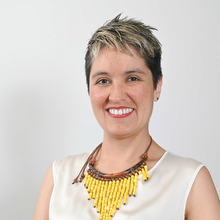
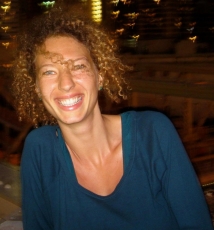
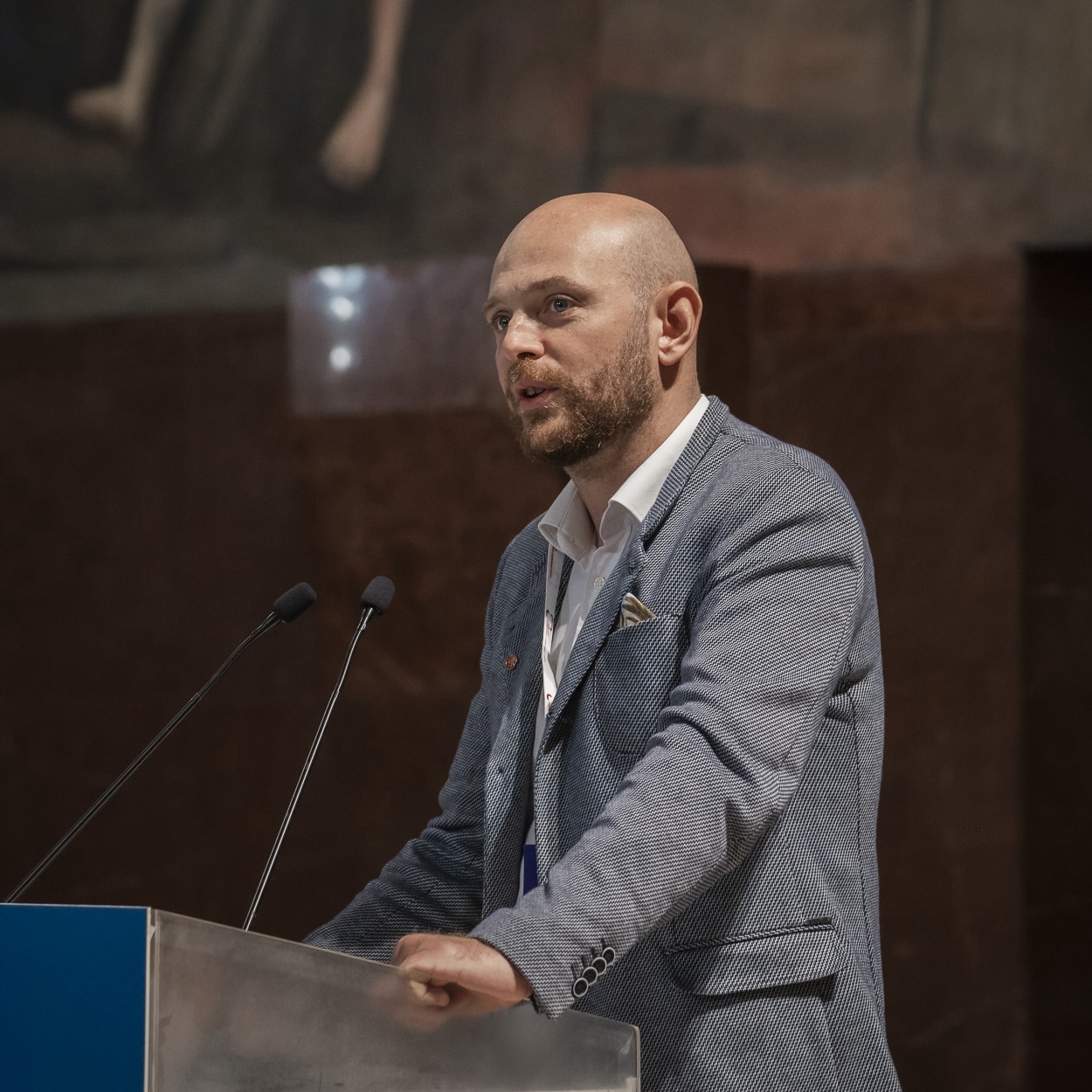
Helga Ballardini is a Research Fellow at the University of Trento's Department of Psychology and Cognitive Science. Her work focuses on educational technologies, gamification strategies, and inclusive learning environments. Primary research areas: Playful learning design Digital education platforms Teacher training methodologies Inclusive pedagogical approaches
Isadora Antoniano Villalobos is an Associate Professor at the Department of Environmental Sciences, Informatics and Statistics at Ca' Foscari University of Venice. Her research focuses on statistical models and methods for complex data structures, particularly Bayesian inference for intractable models, extreme value theory, and risk analysis. She leads projects such as RISE (Rethinking and Innovating Statistics for Extremes) and SMARTMUS-E, addressing environmental and energy challenges. Her teaching spans courses like Applied Probability and Statistics for Empirical Research in Management across various degree programs. She collaborates internationally, speaks English, Spanish, and Italian fluently, and contributes to editorial boards in statistical journals. Research Interests : Bayesian methods, extreme value analysis, statistical modeling of spatio-temporal data, risk assessment, and applications in environmental science, hydrology, and social sciences. Her work emphasizes flexible models for complex datasets and interdisciplinary collaborations. Recent Projects : RISE: PRIN-funded project on extreme value analysis (2023-2026) SMARTMUS-E: EU Horizon Europe project on museum energy management (2023-2025) Bayesian Nonparametric Mixture Models for the Dependence of Extremes (BayMEx, 2019-2021) Teaching : Courses include Applied Probability for Computer Science , Statistics for Language Sciences , and Statistics for Empirical Research in Management . She has taught at undergraduate and graduate levels since 2019.
Emiliane Elizabeth Marie Rubat Du Mérac is an Associate Professor at Sapienza University of Rome's Department of Developmental and Socialization Psychology. She teaches Research Methodology in Pedagogy and related subjects under the M-PED/04 sector. Her research focuses on transversal skills development and assessment in educational contexts, emphasizing the impact of pedagogical practices on student learning and attitudes. She leads national and international projects like Open Badge EDU Sapienza and UNI-T Academy, and coordinates an inter-university project on graduates' transition to the workforce. She serves as an academic representative for CIVIS Alliance’s 'Innovative Learning' and 'Service-Learning' initiatives and is part of the doctoral program in Social, Developmental, and Educational Psychology. Her work spans teacher development, outdoor education, well-being, and inclusive education. Key projects include certification frameworks for transversal skills and collaborations on environmental impact studies in teaching. She actively contributes to educational policy through research on teacher-student relationships during crises and pandemic-era pedagogy. Her research also explores mindfulness, youth political engagement, and the role of educational contexts in fostering leadership and democratic values. Dr. Rubat Du Mérac’s interdisciplinary approach integrates psychology, education science, and policy analysis to address contemporary challenges in schooling and teacher training. She emphasizes practical applications of research through tools like the 3SQ soft skills questionnaire and outdoor education programs. Her academic leadership includes managing research teams and fostering international partnerships to advance innovative educational practices.
Laura Farinetti is an Associate Professor in the Department of Control and Computer Science (DAUIN) at Politecnico di Torino. She is a member of both the College of Management and Production Engineering and the College of Computer, Film and Mechatronics Engineering, reflecting her interdisciplinary role in engineering education. Her work bridges computer science and pedagogy, with a focus on innovative teaching methods. Her research interests include human-computer interaction, learning analytics, semantic web, and the use of information and communication technologies (ICT) to support accessibility, inclusion, aging, and open/distance education. She is particularly interested in fostering creativity and critical thinking through technological tools in educational contexts. Her recent publications (2022–2024) demonstrate a strong trend in applying artificial intelligence and data-driven methods to enhance learning experiences. Key themes include the use of ChatGPT for automated correction of SQL exercises, development of educational chatbots using LangChain, abstractive summarization of video lectures, and serious games like 'SQL Murder Mystery' for teaching database querying. These works highlight her focus on intelligent systems, machine learning, and web-based educational platforms. Laura Farinetti has served as Scientific Responsible or Director for several research and teaching projects, including the EU-funded Virtual Campus Hub (2011–2013) and the ESWES project (2004–2007), as well as commercial teaching initiatives like Challenge@PoliTo by Firms (2021–2022). These projects reflect sustained external funding and leadership in educational innovation. She is an active member of the ELITE research group (Intelligent and Interactive Systems) at DAUIN, which focuses on developing advanced interactive technologies. Her teaching responsibilities include leading and instructing the 'Databases' course across multiple engineering programs, such as Management Engineering and Film and Media Engineering, as well as the 'Challenge@PoliTo' master's course, showcasing her commitment to both curriculum delivery and innovative pedagogical practices.
Marco Corneli is a Professor at the University of Côte d'Azur , where he focuses on developing AI models for archaeology and history. He collaborates with the CEPAM laboratory , is a member of the INRIA research team MAASAI , and part of the LJAD laboratory. His research spans network analysis, optimal transport, and 3D shape analysis. Research Interests : Static/Dynamic Network Analysis (Spectral Clustering, SBMs, HRGs) Optimal Transport for Machine Learning Image and 3D Shape Analysis Probabilistic and Deep Learning Methods Clustering in High-dimensional and Sparse Data Advising : Davide Adamo (2023 - ongoing, co-advised with E. Vila and M. Vuillien) Seydina Ousmane Niang (2023 - ongoing, co-advised with C. Bouveyron and P. Latouche) Giulia Marchello (2020-2023, co-advised with C. Bouveyron) Cédric Vincent-Cuaz (2020-2023, co-advised with R. Flamary) Dingge Liang (2019-2022, co-advised with C. Bouveyron and P. Latouche) Software Development : Co-developed CpDyna (R/C++ package for change point detection in dynamic graphs) Contributed to ordinalLBM (R package for co-clustering ordinal data) Teaching : Delivered courses in statistical learning, graph theory, and data science at University of Côte d'Azur (M2 MA IM), Université Paris 1 (Licence MIASHS), and University of Côte d'Azur (MSc Data Science).
Sergio Rapuano is a Full Professor in the Department of Engineering at the University of Sannio, Italy, specializing in Instrumentation and Measurement. With approximately 270 publications including journal papers, conference proceedings, book chapters, and IEEE standards, he coordinates nationally and internationally funded research projects focused on measurement systems and signal processing. His research spans analog-to-digital conversion characterization, biomedical measurement systems, distributed measurement networks, and telecommunications instrumentation. Recent work shows a pronounced shift toward compressed sensing applications for cable diagnostics, spectrum monitoring, and biomedical signal processing, reflecting his focus on efficient data acquisition in constrained environments. He also contributes significantly to distance learning methodologies in electrical measurement education. Prof. Rapuano actively shapes the field through IEEE Technical Committee 10 (Waveform Generation, Measurement, and Analysis), where he drives standardization efforts and conference organization for the Instrumentation and Measurement Society. His leadership in waveform measurement standards and traceability frameworks demonstrates his commitment to advancing measurement science globally.
Wael Abughres is an Assistant Professor of Communication Engineering at the University of Tripoli, Faculty of Engineering. He holds a PhD in Communication Engineering from the University of Bradford, UK (2009), and an M.Sc. in Electrical & Electronic Engineering from the University of Tripoli (2000). His academic career spans teaching and research in telecommunications, performance modeling, and wireless networks. Research interests include Communication Network Modeling, Performance and Reliability Engineering using MOSEL language, Cloud Computing, Fiber Optic Systems, and Open Education Resources. He has published 12 journal and conference papers and served as Director of the Information & Communication Technology Centre at University of Tripoli for four years.
Natalia Montinari is an Associate Professor of Economics at the Department of Economics, University of Bologna . Her academic discipline is Economics (ECON-01/A). She holds a PhD in Economics and Management from the University of Padua (2011), followed by postdoctoral research at the Max Planck Institute of Economics (2011–2013) and an Assistant Professorship at Lund University (2013–2016) before joining the University of Bologna in 2016 as an Assistant Professor and transitioning to her current rank in 2020. Her research focuses on behavioral and experimental economics , particularly exploring the emergence of gender wage gaps, the role of social norms in career choices, and the impact of affirmative actions. She also examines how monetary incentives interact with individual preferences, often employing experimental methodologies. Her work has been published in journals like European Economic Review , Journal of Risk and Uncertainty , and Experimental Economics . Key Grants and Awards: Almaidea- Linea Junior Grant (2017): Project on 'The Power of Identity in Multicultural Societies.' Modigliani Research Grant (2017) from Unicredit & Unicredit Foundation for the same project. Italian Ministry of University and Research PhD Scholarship (2007). Teaching: She has chaired courses at the PhD and master’s levels in institutions like the University of Bologna and Lund University, covering topics such as experimental economics, strategic interaction, and advanced microeconomic analysis. Research Themes: Montinari’s work bridges theoretical frameworks with empirical experiments, addressing societal challenges like gender inequality, environmental sustainability, and dishonest behavior in academic and workplace settings. Her recent studies investigate how visibility and institutional structures influence ethical decisions, contributing to policy-relevant insights in public goods management and organizational behavior.
Francesco Tommasi is an Associate Professor at the Department of Innovation Engineering, University of Salento, where he teaches Operating Systems, System and Network Programming, and System Security courses for both undergraduate and graduate Computer Engineering programs. His academic affiliation spans multiple departments within the School of Engineering, focusing on the intersection of computer science, networking, and security. His current research interests center on computer security, with specific focus on authentication systems, web security, and mobile security. His past research includes Quality of Service for computer networks, IP mobility, satellite internetworking, and satellite distance learning technologies. Tommasi has made significant contributions to the field of cybersecurity, particularly in identifying and analyzing novel attack vectors including Browser-in-the-Middle attacks and MobileApp-in-the-Middle attacks. His recent publications (2021-2025) demonstrate a strong focus on cybersecurity challenges, particularly authentication vulnerabilities, web security threats, and mobile security issues. The research shows progression from fundamental network security concepts to more sophisticated attack methodologies targeting modern authentication systems and mobile platforms. His work bridges theoretical security concepts with practical attack demonstrations, contributing significantly to the understanding of security vulnerabilities in contemporary systems. Co-author of the first Internet Proposed Standard signed by an Italian university (RFC 2961) Co-author of attack #701 included in the CAPEC database of dangerous cyber attacks Scientific director of the Laboratory for Internetworking and Interoperability between Systems (LIIS) Co-scientific director of the Cybersecurity Research Lab Responsible for the Unisalento node of the CINI Cybersecurity National Lab Tommasi has directed numerous research projects funded by MIUR, European Space Agency, and regional authorities, including satellite distance learning initiatives, cybersecurity projects, and technology transfer initiatives. He created the Salento Satellite Campus and has been instrumental in developing satellite-based educational infrastructure. His laboratory work focuses on practical security testing and developing defensive mechanisms against emerging cyber threats. He leads the Laboratory for Internetworking and Interoperability between Systems (LIIS) and co-directs the Cybersecurity Research Lab, which focuses on practical security testing, vulnerability analysis, and developing defensive security mechanisms. These labs collaborate with national and international partners on cutting-edge cybersecurity research and implementation projects.
Lorenzo Ardito is an Assistant Professor in the Department of Business and Management Engineering at Politecnico di Bari (Poliba), Italy. His research focuses on sustainable innovation, family business dynamics, digital transformation, and the commercialization of green technologies. Email: lorenzo.ardito@poliba.it Address: Via Orabona 4, 70125 Bari, Italy His work explores green energy technologies (electrolysis, hydrogen systems), family firm innovation (tradition-driven strategies, intergenerational knowledge), and digital transformation (AI, IoT, Big Data synergies). He investigates the sharing economy , smart city governance , and ESG dynamics in family businesses. Recent publications highlight trends in hydrogen-based patents , AI adoption in SMEs , and smart mobility frameworks . His research often combines knowledge management and open innovation theories.
Daniele Venturi is a Full Professor at the Department of Computer Science, Sapienza University of Rome, appointed in April 2022. His expertise lies in theoretical and applied cryptography, with a focus on secure multi-party computation, leakage resilience, and digital watermarking. Research Interests: Theoretical Cryptography Applied Cryptography Watermarking in Generative Models Predicate Encryption Financial Fairness in Cryptographic Protocols Leakage-Resilient Cryptography His recent publications span top-tier venues including ICML 2024 , EUROCRYPT 2023 , IEEE Transactions on Information Forensics and Security , IEEE Transactions on Information Theory , and IACR Transactions on Symmetric Cryptology . Contact: Email: venturi@di.uniroma1.it Office: Dipartimento di Informatica, Viale Regina Elena, 295 (Edificio G), II piano, st. G29
Emanuele Lattanzi is an Associate Professor in the Department of Pure and Applied Sciences (DiSPeA) at the University of Urbino Carlo Bo, specializing in Information Processing Systems (IINF-05/A). His research focuses on human activity recognition, wireless sensor networks, IoT systems, and artificial intelligence applications. He obtained his Laurea degree in 2001 and PhD in 2003, followed by a visiting scholar position at Pennsylvania State University's Department of Computer Science and Engineering. His educational background forms the foundation for his current research in sensor-based AI systems. Lattanzi's research interests center on developing energy-efficient solutions for human activity recognition using wearable sensors, with particular emphasis on optimizing machine learning models for resource-constrained IoT devices. His work bridges theoretical AI advancements with practical implementation challenges in real-world sensor deployments. Analysis of his 2025 publications reveals a strong thematic focus on human activity recognition, with recurring exploration of energy-accuracy tradeoffs, novel neural network architectures (including transformers and Siamese networks), and self-supervised learning techniques specifically adapted for inertial sensor data. His research demonstrates consistent collaboration with multiple co-authors across international conferences. As an educator, Lattanzi teaches core computer science courses including Operating Systems (12 credits) and IoT Programming (6 credits) across multiple Informatics degree programs. His teaching spans from 2021/2022 through the current 2025/2026 academic year, demonstrating sustained contribution to the department's curriculum in both foundational systems programming and emerging IoT technologies.
Salvatore DISTEFANO is a Full Professor of Computer Science in the Department of Mathematical and Computer Sciences, Physical Sciences and Earth Sciences at the University of Messina. With over 250 scientific publications, he maintains active research collaborations with institutions worldwide including University of Massachusetts Dartmouth, UCLA, Duke University, and Innopolis University. His academic appointments include Professor Fellow at Kazan Federal University (2015-2018) and coordinator of the CINI Working Group on System and Service Engineering. Professor DISTEFANO's research spans an exceptionally broad range of computing disciplines with emphasis on practical applications. His primary interests include non-Markov modeling, performance and reliability evaluation, distributed computing paradigms (cloud, edge, fog), Internet of Things, cyber-physical systems, and smart city technologies. His work demonstrates strong interdisciplinary connections between theoretical computer science and real-world applications in transportation, environmental management, and healthcare. Notably, he has contributed to the development of several research tools including WebSPN, ArgoPerformance, GS3, and Stack4Things. His recent publications (2021-2025) reveal a research trajectory focused on applying computing technologies to sustainability challenges. The articles demonstrate consistent emphasis on IoT applications for environmental monitoring, smart urban infrastructure, and resource management. His work shows particular strength in developing analytical models for complex distributed systems, with increasing integration of machine learning techniques in recent years. Best Paper Award IEEE International Conference on Distributed Computing Systems (2017) Professor DISTEFANO has participated in numerous significant research projects including Reservoir, Vision (EU FP7), SMSCOM (EU FP7 ERC Advanced Grant), Beacon, and IoT-Open.EU (EU H2020). He serves on editorial boards for prestigious journals including IEEE Transactions on Dependable and Secure Computing, Journal of Cloud Computing, and Journal of Big Data. As one of the co-founders of startup SmartMe.io (2017), he has successfully translated academic research into commercial applications. He currently serves as referent for both the High-performance Computing and Applications Group and the Quantum Information and Computing Systems Group at the University of Messina.
Gherardo Mazziotti serves as Associate Professor of Endocrinology at Humanitas University's School of Medicine, where he leads the Research, Diagnosis and Care Center for Osteo-Metabolic Diseases within the Endocrinology and Medical Andrology Unit. His clinical and academic work focuses on the intersection of endocrine disorders and skeletal health, with particular expertise in bone complications arising from cancer therapies and genetic conditions. His educational foundation includes: 1995: Cum laude Degree in Medicine and Surgery, University of Campania Luigi Vanvitelli 2000: Cum laude Specialization in Endocrinology and Metabolic Diseases, University of Campania Luigi Vanvitelli 2002-2003: Clinical Research Fellow, Autoimmunity Section, University of Wales College of Medicine 2004: PhD in Pathology of Cellular Signal Transduction, University of Campania Luigi Vanvitelli 2012: Master's in Osteoporosis and Bone Metabolism Diseases, University of Brescia Mazziotti's research program investigates bone health in endocrine pathologies through multiple clinical lenses. His work examines skeletal fragility in Klinefelter syndrome using advanced DXA-derived metrics, evaluates bone-active drugs in cancer patients receiving hormone therapies, and explores artificial intelligence applications for fracture risk prediction. He has pioneered studies on the relationship between body composition and bone quality in acromegaly and neuroendocrine tumors, while also developing telemedicine approaches to improve osteoporosis treatment adherence. Recent publication trends (2022-2025) reveal three dominant research streams: 1) Real-world effectiveness of bone-active agents (romosozumab, denosumab) in high-risk cancer populations, 2) DXA-based bone quality assessment beyond traditional BMD measurements, and 3) Mechanistic studies on hormone therapy-induced skeletal deterioration. His work consistently bridges clinical endocrinology with oncology, focusing on practical management strategies for bone complications. Academic leadership includes directing Humanitas' Osteo-Metabolic Diseases Research Center and previously teaching endocrinology courses at University of Brescia (2008-2017) and Catholic University of Rome (2013-2018). His multidisciplinary approach integrates endocrinology, oncology, and radiology to address skeletal complications in complex patient populations.
Claudia LANDI is a Full Professor at the University of Modena and Reggio Emilia, affiliated with the Department of Engineering Sciences and Methods. Her primary academic rank is Professor, focusing on research in computational topology, geometry, and their applications. She teaches courses such as Computational Topology, Geometry and Linear Algebra, and Additional Training Requirements for engineering programs. Her work integrates algebraic topology with data science, emphasizing topological data analysis (TDA) for biomedical and environmental applications. Research Interests: Dr. LANDI specializes in computational topology, with a focus on persistent homology, Reeb graphs, and discrete Morse theory. Her applied work spans proteomics, fibrosis treatment, and environmental safety assessments. She has contributed to developing algorithms for multi-parameter persistence and topological metrics, bridging theoretical mathematics with practical applications in imaging and machine learning. Teaching: She leads courses on computational topology for mathematics and engineering students, emphasizing practical skills in TDA libraries and visualization. Her geometry and linear algebra courses are foundational for management and mechatronic engineering programs, integrating theoretical rigor with problem-solving exercises. Education: Not explicitly detailed in provided texts. Labs/Teams: Engaged in interdisciplinary projects involving proteomic analysis and topological data science. Grants/Awards: None explicitly mentioned, though her extensive publication record suggests active research funding.