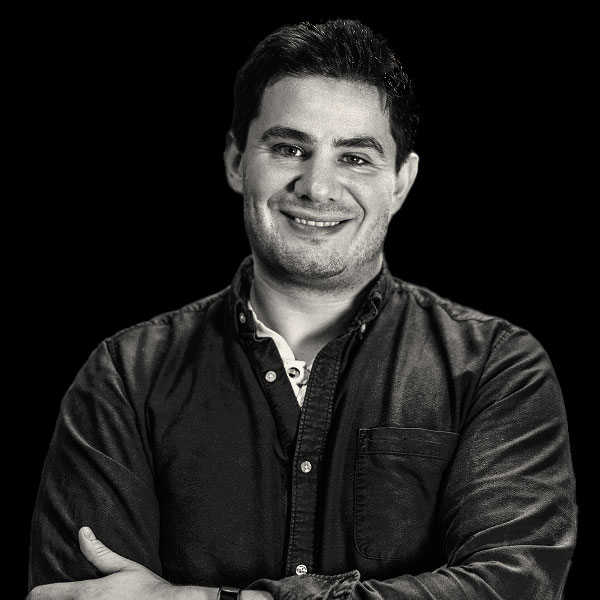
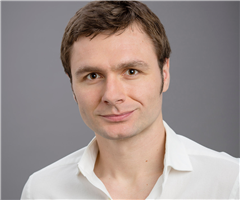
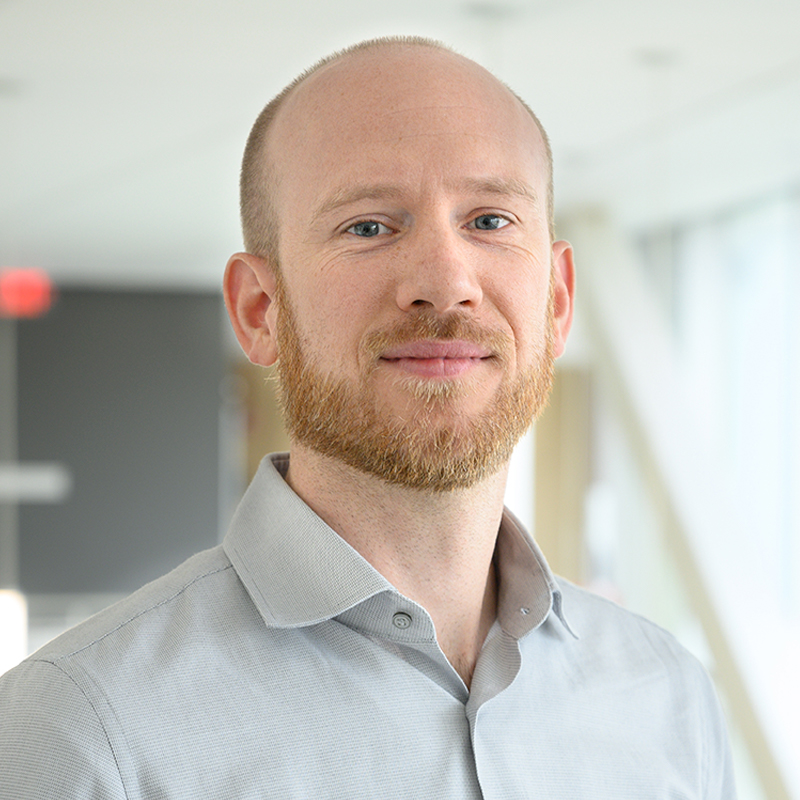
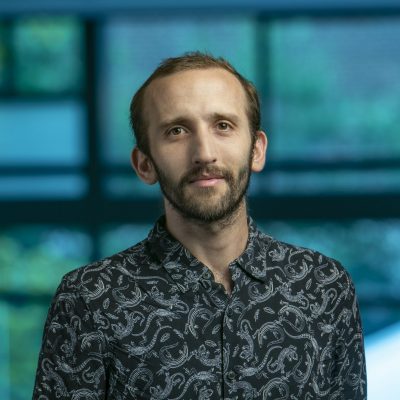
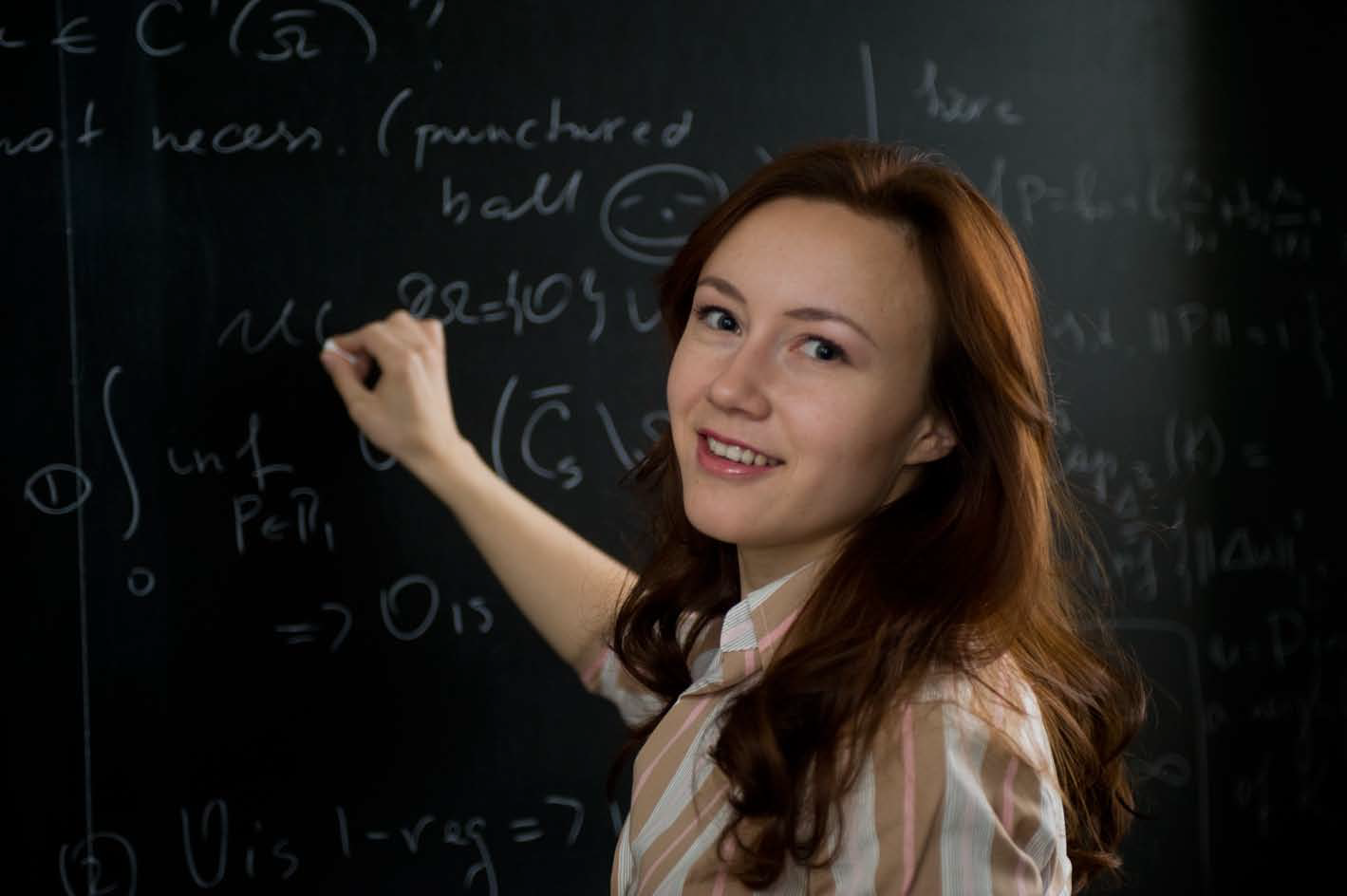
Renjie Feng is a Research Fellow in Mathematics and AI at the School of Mathematics and Statistics and the Sydney Mathematical Research Institute , University of Sydney. His work bridges probability theory, statistics, and applications in machine learning, deep learning, and artificial intelligence. His research interests focus on probability theory and its applications to machine learning , random matrix theory , and statistical physics . He investigates extreme value problems, spectral properties of random matrices, and topological features of random fields over Riemannian manifolds. Recent publications highlight trends in random matrix theory (GUE, GOE, GSE), extreme gap problems , determinantal point processes , and Wiener chaos . Collaborative works with F. Götze, D. Yao, and R. Adler emphasize U-statistics , multivariate linear statistics , and random topology inspired by Poisson point process studies.
Professor Carlo Harvey is a creative technologist at the School of Digital Arts (SODA), Manchester Metropolitan University. His interdisciplinary research merges games , machine learning , virtual production , and cultural heritage reinterpretation . He leads industry collaborations with entities like Jaguar Land Rover and Epic Games, focusing on AI-driven interactive audio, real-time visualization, and accessibility solutions. Award-winning projects : TIGA, Innovate UK, and Epic Games MegaGrant for Accession Industry partnerships : Automotive sector, cultural institutions His research spans human-computer interaction , multisensory virtual environments , and acoustic-visual cross-modal perception . Recent publications address robotic simulations, motion alignment, and haptic feedback systems. Scientific recognition : TIGA Award, Innovate UK Funding, Epic Games MegaGrant Advocacy : Digital inclusion, creative collaboration, social impact of technology
Tzu-Mao Li is an Assistant Professor in the Department of Computer Science and Engineering (CSE) at the University of California, San Diego (UCSD), affiliated with the Center for Visual Computing. His research focuses on differentiable graphics algorithms, combining classical visual computing with modern machine learning techniques. He holds a Ph.D. from MIT CSAIL under Frédo Durand and a postdoc at MIT and UC Berkeley with Jonathan Ragan-Kelley. His work spans rendering, programming languages for graphics, Monte Carlo methods, and inverse problems. Education: B.S. and M.S. from National Taiwan University (2011-2013), advised by Yung-Yu Chuang. Ph.D. from MIT CSAIL (Computer Graphics Group), advised by Frédo Durand. Postdoctoral research at MIT and UC Berkeley with Jonathan Ragan-Kelley. Research Interests: Differentiable rendering, Monte Carlo integration, programming language design for visual computing, physical simulation, adversarial machine learning, and applications in computer vision and robotics. Key areas include rendering algorithms (path tracing, bidirectional methods), optimization techniques (MCMC, gradient-based), and neural representations (SDFs, neural fields). Publications focus on advancing rendering algorithms, differentiable systems, and applications in inverse problems. Notable contributions include edge sampling for differentiable rendering, warped-area sampling, and diffusion models for BSDF sampling. Awards: ACM SIGGRAPH 2020 Outstanding Doctoral Dissertation Award, multiple Best Paper Awards at SIGGRAPH, and oral presentations at ICCV. Teaching: Courses include CSE 167 (Computer Graphics), CSE 168 (Rendering), and CSE 272 (Advanced Image Synthesis), emphasizing physically-based methods and programming.
Ronald Parr is a Professor of Computer Science in the Department of Computer Science at Duke University's Pratt School of Engineering. He has been at Duke since 2000, progressing from Assistant Professor to Associate Professor with tenure, and ultimately to Full Professor. From 2014 to 2017, he served as Department Chair and delivered graduation speeches in 2015, 2016, and 2017. Dr. Parr received his Ph.D. in Computer Science from the University of California, Berkeley in 1998, with a dissertation titled "Hierarchical Control and Learning in Markov Decision Processes" under advisor Stuart Russell. He earned his A.B. in Philosophy, cum laude, from Princeton University in 1990. His primary research focuses on methods for solving large stochastic planning problems using Markov Decision Processes and approximate dynamic programming techniques. His work spans reinforcement learning, value function approximation, game theory, sensing, and robotics. Dr. Parr's research has been consistently funded by major agencies including NSF, DARPA, and ARO, with recent projects focusing on feature encoding for reinforcement learning, neurosymbolic hierarchical reinforcement learning, and reasoning in large, structured, uncertain domains. His publication record demonstrates consistent contributions to top venues including NeurIPS, ICML, and AAAI, with work that bridges theoretical foundations and practical applications. Dr. Parr has received numerous honors including being elected as an AAAI Fellow in 2023, receiving an AAAI Outstanding Paper Honorable Mention in 2013, winning the IJCAI-JAIR Best Paper Award in 2007, receiving an NSF CAREER award in 2006, and being named an Alfred P. Sloan Fellow in 2003. He has advised ten graduate students to completion across various research areas within AI and robotics. His research has been supported by over $1.5 million in direct funding to his lab, with additional collaborative funding from multiple NSF, DARPA, and ARO grants. Dr. Parr has served extensively on program committees for major AI conferences including ICML, NeurIPS, AAAI, and UAI, and has held leadership roles such as Program Co-Chair and General Chair for UAI. Dr. Parr maintains an active research group focused on reinforcement learning and sequential decision making, with ongoing projects in neurosymbolic AI, hierarchical reinforcement learning, and interpretable machine learning models, continuing to bridge theoretical foundations with practical applications in robotics and AI systems.
Pan Xu is a tenure-track assistant professor with joint appointments in the Department of Biostatistics & Bioinformatics, Department of Computer Science, and Department of Electrical & Computer Engineering at Duke University. Previously, Xu was a Postdoctoral Scholar Research Associate at Caltech's Department of Computing and Mathematical Science and earned a Ph.D. in Computer Science from UCLA. Xu's research focuses on developing computationally- and data-efficient machine learning algorithms with strong empirical performance and theoretical guarantees. Xu's research interests center around Machine Learning with broad applications in Artificial Intelligence, Data Science, Optimization, Reinforcement Learning, and High Dimensional Statistics. The research specifically targets real-world problems in Bioinformatics and Healthcare, with recent work emphasizing distributionally robust decision making, efficient exploration strategies, and multi-agent systems. Xu has developed novel algorithms that address the challenges of exploration in sequential decision making and robustness to distributional shifts between training and deployment environments. Xu's recent publications demonstrate a strong trend toward developing theoretically grounded yet practical algorithms for reinforcement learning and bandit problems, with particular emphasis on distributionally robust methods, efficient exploration techniques, and applications to healthcare. The work spans both theoretical analysis (providing minimax optimal regret bounds) and practical implementations (validated on benchmarks like Atari games and real healthcare datasets). Whitehead Scholar award from Duke University School of Medicine (2023) Best Paper Award at ACM FAccT 2023 for Queer In AI paper PIMCO Postdoctoral Fellowship in Data Science (2022) TMLR Featured Certification (2023) NSF award on approximate sampling based exploration (2023) Xu actively mentors multiple Ph.D. students across Duke's Biostatistics & Bioinformatics, Computer Science, and Electrical & Computer Engineering programs, with several alumni now pursuing doctoral studies at top institutions. The research group has secured competitive funding including an NSF award for approximate sampling based exploration for sequential decision making. Xu serves as an action editor for TMLR and as an area chair for major conferences including ICML, NeurIPS, AAAI, ICLR, and AISTATS. Xu leads a dynamic research group focused on sequential decision making, with projects spanning theoretical algorithm development, implementation of practical systems, and applications to healthcare and bioinformatics. The group maintains active collaborations across Duke's medical and engineering schools, with recent work applying machine learning to epidemic forecasting during the pandemic.
Ivan Dokmanic is an Assistant Professor at the Coordinated Science Laboratory (CSL) within the University of Illinois . His research bridges signal processing , machine learning , and applied inverse problems , with a focus on acoustics, biomedical imaging, and distance geometry. Current Role : Assistant Professor, CSL Email : dokmanic@illinois.edu Research Interests : Dokmanic explores machine learning applications in inverse problems , particularly distance geometry for molecular imaging and acoustics . His work includes unlabeled sensing , where distances between points are known but their arrangement is not. This has implications for powder diffraction , indoor localization , and echo modeling . Article Trends : His recent publications emphasize distance geometry in machine learning , acoustic signal processing , and inverse problem theory . Key areas include molecular imaging , audio encryption , and sensor positioning . Collaborative work spans medical imaging , cyberphysical systems , and geometric invariants . 2016 Google Faculty Award NSF Grant (1 year, $157,079) Students and Grants : Dokmanic mentors PhD students like Puoya, Shuai, and Anadi. His research is funded by the National Science Foundation , Google , VISA , and nVidia .
Martin Larsson is a Professor in the Department of Mathematical Sciences at Carnegie Mellon University (CMU), affiliated with the Mellon College of Science. He holds a Ph.D. from Cornell University and completed a postdoctoral appointment at the Swiss Finance Institute at EPFL, Lausanne, Switzerland. His research focuses on Mathematical Finance, stochastic analysis, probability, and statistics, with emphasis on affine and polynomial processes, stochastic portfolio theory, and sequential statistics. Key research domains include modeling interest rate term structures, large-scale equity market dynamics, and statistical testing in online settings. He serves as the Departmental representative for the Master of Science in Computational Finance (MSCF) program at CMU. Larsson has received the Bruti-Liberati Visiting Fellowship from the University of Technology Sydney. His work bridges theoretical probability with applications in finance, including contributions to stochastic volatility modeling, optimal contracts in trading, and robust portfolio optimization under uncertainty. Publications span topics such as martingale exit times, Wasserstein distance convergence, and ergodic control in stochastic systems, reflecting his interdisciplinary approach to mathematical finance and probability theory. His research often combines analytical techniques with stochastic control and geometric flows.
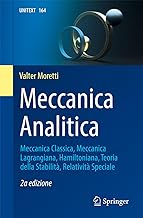
Valter Moretti is a Full Professor in the Department of Mathematics at the University of Trento. His academic career spans roles from Research Fellow to Full Professor, focusing on Mathematical Physics and Quantum Field Theory (QFT) in curved spacetime. He earned an MSc in Physics from Genova University and a PhD in Theoretical Physics from Trento University. Research Interests : Algebraic QFT, General Relativity, Quantum Mechanics, Operator Algebras, and Spectral Theory. His work bridges mathematical rigor with physical applications, particularly in quantum localization, entanglement, and curved spacetime phenomena. Publications : Authored 15+ recent papers on topics like quantum particle localization, entanglement certification, and QFT on curved backgrounds. Collaborated on a 2022 patent for generating entangled photon states. Awards : Holds a patent for a quantum-certified random number generator (2022). Supervision : Advised 8 PhD students, including N. Pinamonti, L. Franceschini, and C. van de Ven. Coordinated national and international research projects (e.g., H2020-MSCA-COFUND-2015). Labs & Collaborations : Affiliated with INFN, TIFPA-INFN, and Q@TN (Quantum@Trento). Organized conferences like Quantum Physics and Geometry (2014) and Quantum Machine Learning (2023). Teaching : Lectures on Analytical Mechanics, Quantum Relativistic Theories, and Special Relativity. Authored textbooks on Spectral Theory and Quantum Mechanics.
Erik Waingarten is an assistant professor at the University of Pennsylvania in the Computer and Information Science department. His research focuses on algorithms for massive datasets, including similarity search, streaming/sketching, property testing, and distribution testing. Former postdoctoral researcher at Stanford's CS Department under Moses Charikar PhD from Columbia University advised by Xi Chen and Rocco Servedio Key research areas: High-dimensional geometry Streaming algorithms Property testing Sketching techniques Clustering and metric optimization Recent article trends show expertise in: 2025 publications on monotonicity testing and metric property analysis 2024 work on Earth Mover's Distance and kernel evaluations 2023 papers on clustering, optimal transport, and MST algorithms 2022-2020 foundations in sublinear algorithms and entropy estimation Scientific recognition: NSF CAREER Award (2023) CCC Best Paper Award (2017) Invited to Journal of the ACM (2017) Academic advising includes PhD students: Ashwin Padaki Tian Zhang Nicolas Menand Krish Singal Junkai Song
Yuxin Chen is a Professor at the University of Pennsylvania , holding joint appointments in the Department of Statistics and Data Science and the Department of Electrical and Systems Engineering . Prior to UPenn, he was an Assistant Professor at Princeton University (2017-2021) and a Postdoctoral Researcher at Stanford University (2015-2017). His research spans statistics, optimization, reinforcement learning theory, diffusion models, and information theory , with a focus on theoretical foundations and practical algorithms for machine learning. Education : Ph.D. in Electrical Engineering (Stanford, 2015), M.S. in Statistics (Stanford, 2013), M.S. in Electrical and Computer Engineering (UT Austin, 2010), B.E. in Electrical/Microelectronics (Tsinghua, 2008). Research Interests encompass theoretical and applied aspects of machine learning, including nonconvex optimization , sample complexity analysis , low-dimensional adaptation , and generative modeling . His work bridges mathematical rigor with real-world applications, particularly in scientific imaging and high-dimensional data analysis. Scientific Awards include the SIAM Activity Group on Imaging Science Best Paper Prize (2024) Alfred P. Sloan Fellowship (2022) NSF Career Award (2022) Google Research Scholar Award (2022) IEEE Transactions on Power Electronics Prize Paper Award (2024) Advising and Grants : He has mentored numerous students who have transitioned to academic roles at institutions like UIUC and UW-Madison. His research is supported by grants from the NSF , Amazon , and Google , with recent projects focusing on controllable diffusion models and efficient reinforcement learning algorithms .
Svitlana Mayboroda is a Professor of Mathematics at ETH Zurich and the McKnight Presidential Professor at the University of Minnesota. Her research focuses on partial differential equations, harmonic analysis, and wave localization phenomena. University of Minnesota: School of Mathematics, 127 Vincent Hall, Minneapolis, MN ETH Zurich: Department of Mathematics, Ramistrasse 101, Zurich Research Interests: Analysis and partial differential equations Wave localization and Anderson localization Elliptic theory on non-smooth and lower-dimensional domains Harmonic measure and geometric measure theory Applications to quantum mechanics and semiconductor physics Recent Publications: Her 2023-2022 works investigate Anderson mobility edges, landscape functions in spectral theory, regularity problems for elliptic operators, and Green function estimates. Key themes include localization landscape theory, uniformly rectifiable domains, and spectral analysis of disordered systems. Grants & Collaborations: Simons Collaboration on Localization of Waves (Director, 2018–2025, $14M) NSF RAISE–TAQS grant ($1M) Academic Leadership: She has organized numerous conferences and workshops, including annual meetings of the Simons Collaboration on Wave Localization (2020–2024) and programs at MSRI and PCMI. Her mentorship includes postdocs and PhD students working on elliptic theory, spectral problems, and applied mathematical physics.
Eugene Tang is an Assistant Professor in the Department of Mathematics and Physics at Northeastern University. His research focuses on quantum information theory and the theoretical limitations of quantum computing, particularly quantum error correction and efficient protocols using high-rate codes. He received his PhD from the California Institute of Technology in 2021. Dr. Tang's research interests include quantum error correction, the development of efficient quantum protocols surpassing conventional schemes, and the study of quantum algorithms such as QAOA. He explores the theoretical boundaries of quantum computing, with a focus on optimizing error detection and decoding methods for quantum LDPC codes and subsystem codes. His work also intersects with quantum gravity, particularly in the context of black hole interiors and bulk geometry construction through tensor methods. His recent publications highlight advancements in quantum error correction, including optimal locality in subsystem codes and efficient decoding strategies for quantum LDPC codes. His work on variational quantum optimization addresses challenges in scalability, such as QAOA's performance at large qubit scales and symmetry-related obstacles. Earlier contributions include research on superoscillations and hybrid quantum-classical algorithms for graph coloring. No scientific awards or grants are explicitly mentioned in the provided information. No specific labs or teams are associated with his work in the given data.
Venkatesan Guruswami is a Chancellor's Professor in the Department of EECS and a Senior Scientist at the Simons Institute for the Theory of Computing at UC Berkeley . He also holds a Professor position in the Department of Mathematics . His academic journey began with a B.Tech in Computer Science from the Indian Institute of Technology, Madras (1997) , followed by a Ph.D. in Computer Science from the Massachusetts Institute of Technology (2001) . After a Miller Research Fellowship at UC Berkeley (2001–02), he held faculty roles at the University of Washington and Carnegie Mellon University before returning to UC Berkeley in January 2022. Education : B.Tech, IIT Madras (1997) Ph.D., MIT (2001) Professional Affiliations : Chancellor's Professor, UC Berkeley (EECS) Senior Scientist & Interim Director, Simons Institute Professor, UC Berkeley (Mathematics) Guruswami's research spans multiple domains within Theoretical Computer Science , focusing on Error-Correcting Codes , Approximation Algorithms , Randomness in Computing , Probabilistically Checkable Proofs , and Computational Complexity . His groundbreaking work in List Decoding has enabled codes with minimal redundancy for correcting worst-case errors, while recent advancements include Polar Codes , Deletion-Correcting Codes , and Constraint Satisfaction Problems . He has also contributed to Quantum Coding Theory , Locally Recoverable Codes , and Approximation Hardness in various computational contexts. His publications reflect a deep engagement with interdisciplinary topics. Key trends include: Quantum Information Theory : Quantum LDPC codes, transversal gates, and quantum storage. Algebraic Coding : Reed-Solomon codes, AG codes, and polynomial-based constructions. Computational Complexity : Hardness of approximation, CSPs, and parameterized intractability. Data Transmission : Polar codes, deletion channels, and feedback mechanisms. Algorithmic Techniques : Spectral methods, semirandom models, and Lasserre hierarchy applications. Guruswami has received numerous accolades, including the Simons Investigator Award , Presburger Award , Packard Fellowship , Sloan Research Fellowship , ACM Doctoral Dissertation Award , and the IEEE Information Theory Society Paper Award . He is an ACM Fellow (2017) and IEEE Fellow (2019) , with recent honors like the Guggenheim Fellowship (2023) and AMS Fellow (2023) . As an advisor, he has mentored over 25 PhD and postdoctoral researchers , including Atri Rudra , Prasad Raghavendra , and Peter Manohar , whose work has won awards like the Edmund M. Clarke Doctoral Dissertation Award and CRA Outstanding Undergraduate Researcher Award . His research is supported by grants from the National Science Foundation , Packard Foundation , and Sloan Foundation . He also serves as Editor-in-Chief of the Journal of the ACM and holds leadership roles in IEEE and arXiv moderation. Guruswami is actively involved in Simons Institute programs and co-organized workshops on Coded Computation and Information Theory . His work bridges theoretical advancements with practical applications in Cloud Storage , Quantum Computing , and Group Testing , including pandemic-era contributions like AC-DC: Amplification Curve Diagnostics for SARS-CoV-2 .
Florence d'Alché-Buc is a Professor at Télécom Paris (Institut Polytechnique de Paris), holding an Isaac Newton Institute Simons Chair (2025) and leading the Data Science and Artificial Intelligence for Digitalized Industry & Services (DSAI) Chair. She heads the Image, Data, and Signal Department and is part of the Signal, Statistics, and Learning (S2A) team at the LTCI laboratory. Her research focuses on machine learning, bioinformatics, and industrial applications, emphasizing kernel methods, structured prediction, and reliable AI. Education: Previously a professor at Université d’Evry and deputy director of the IBISC lab. Co-director of the Paris-Saclay Data Science Master and creator of specialized AI programs (e.g., Certificate of Specialized Studies in AI). Research highlights include contributions to operator-valued kernel methods, graph prediction, and frugal AI. She actively collaborates with institutions like Inria, École Polytechnique, and industry partners (Airbus, Engie, etc.). Notable roles: Scientific director of Digicosme Labex, Ellis Fellow, and board member of IVADO (Montreal). Her recent work addresses AI explainability, robustness, and sustainability, including projects on interpretable networks and energy-efficient models.
Christian Wald is a Post-doctoral researcher at Technical University Berlin working under Professor Gabriele Steidl, focusing on generative modeling, flow matching, and stochastic processes in machine learning. His research bridges theoretical probability with practical medical imaging applications, particularly in MRI reconstruction and analysis. He completed his PhD at Humboldt University of Berlin in 2017 with a thesis on p-adic quantum groups. His academic journey transitioned from pure mathematics to interdisciplinary machine learning research, reflecting his versatile expertise. Wald's primary research explores generative models through the lens of optimal transport and flow matching, with significant contributions to Wasserstein geometry and conditional distance metrics. His work frequently integrates stochastic processes to enhance medical image reconstruction, demonstrating strong cross-disciplinary impact in both theoretical machine learning and clinical applications. Recent publications highlight innovations in sliced MMD flows, Bayesian OT methods, and uncertainty-aware medical image analysis. Analysis of his 15 most recent publications (2019-2025) reveals a consistent trajectory toward unifying geometric probability with deep learning. Key themes include flow-based generative modeling for medical time-series data, optimal transport applications in image reconstruction, and novel kernel methods for distribution matching. His work spans both foundational theory (e.g., Fisher-Rao curves) and high-impact medical applications (e.g., coronary calcium scoring). No specific scientific awards are documented in the provided text, though his publications appear in prestigious venues including ICLR, IEEE TMI, and Physics in Medicine & Biology. Wald maintains extensive collaborations with the medical imaging group at Technical University Berlin, particularly with Andreas Kofler and Gabriele Steidl. His co-authored works demonstrate consistent contributions to MRI reconstruction pipelines and segmentation frameworks, though no formal advising roles or grant leadership are indicated. Current projects focus on uncertainty quantification in active learning for medical image segmentation. He operates within Gabriele Steidl's research group at Technical University Berlin, which specializes in mathematical imaging and machine learning. The team combines expertise in optimization, probability theory, and deep learning to solve medical imaging challenges, with Wald contributing core algorithmic innovations in generative modeling and stochastic reconstruction.