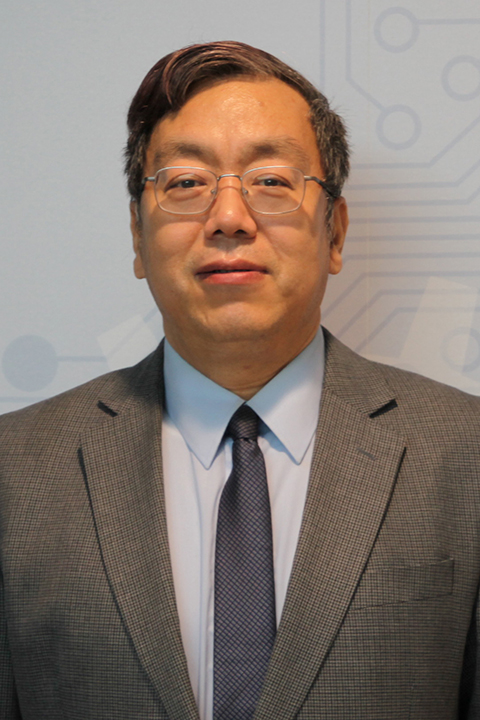
Joseph Anderson is a Visiting Assistant Professor of Physics at Carthage College. He holds a Ph.D. in Materials Engineering from Purdue University and a B.S. in Physics from Texas A&M University. His research focuses on theoretical models of metal deformation, particularly fluid-like theories of dislocation dynamics in metals. He also explores acoustic physics, statistical field theories, and the history and philosophy of science. Education Ph.D. in Materials Engineering, Purdue University B.S. in Physics, Texas A&M University Research Interests Prof. Anderson’s work centers on understanding metal deformation through fluid-like dislocation theories. He investigates how statistical properties of dislocation arrangements influence material behavior. Beyond this, he studies acoustic phenomena, complex data correlations, and the intellectual history of scientific methodologies. Advising & Grants No advising or grant information is currently available.
Scott Fung is a Professor in the Department of Accounting & Finance at California State University, East Bay. His research focuses on corporate finance, market efficiency, institutional investor behavior, and corporate governance. He has published extensively on topics including executive compensation, liquidity dynamics, and the impact of regulatory changes on financial markets. His work spans empirical studies on financial market microstructure, real estate investment trusts, and the effects of information shocks on investor decisions. Fung’s recent studies explore the role of luck in executive promotions, liquidity provision during market dislocations, and strategic regulatory arbitrage in cryptocurrency markets. Key themes in his research include analyzing how market participants (institutions vs. retail investors) process information, the efficiency of derivatives markets, and the governance mechanisms influencing firm performance. His findings have implications for corporate policy, investor strategies, and regulatory frameworks.
Dr. Chris Torockio is a Professor of English at Eastern Connecticut State University, specializing in creative writing and contemporary fiction. He holds an M.F.A. from the University of Pittsburgh and a Ph.D. in Creative Writing and Contemporary Fiction from Western Michigan University. His research focuses on fiction writing techniques and pedagogy, with a strong emphasis on narrative innovation and character development. Dr. Torockio has published four acclaimed works: the novels The Soul Hunters (2016) and Floating Holidays (2007), and short story collections The Truth at Daybreak (2008) and Presence (2000). His stories have appeared in prestigious literary journals such as Ploughshares , The Iowa Review , and The Gettysburg Review , earning four Pushcart Prize Special Mentions. His teaching philosophy prioritizes student creativity and literary immersion, often employing a 'coaching' approach to nurture emerging writers. He leads the Creative Writing Abroad program in Florence, Italy, where students explore narrative through cultural immersion. Awards include grants from the Connecticut Commission on the Arts and residencies at the Vermont Studio Center.
Dr. Mark Bernhardt is a Professor in the Department of History and Philosophy at Jackson State University (JSU), part of the College of Liberal Arts. He holds a B.A. from UC Berkeley (1999), an M.A. from California State University, Sacramento (2001), and a Ph.D. in History from UC Riverside (2006). His research explores intersections of gender, race, and media in American history, with a focus on war coverage, western expansion, and popular culture. Dr. Bernhardt has taught courses on U.S. History, Media History, and Sexuality Studies since joining JSU in 2007. He served as Graduate Program Coordinator for History (post-tenure in 2013) and received the College and University Excellence Awards for Teaching and Advising (2015) and the Mississippi Humanities Council Teaching Award (2016). He was promoted to Professor in 2017. As Phi Alpha Theta advisor, he mentors students for conference presentations and organized its state conferences in 2012, 2014, and 2018-2020. His research trends emphasize media’s role in shaping societal narratives around masculinity, race, and class. Recent scholarship analyzes depictions of the American West in films like Breaking Bad and historical media coverage of wars and scandals. His 2016-2019 articles highlight recurring themes of media’s influence on cultural identity and moral discourse. Awards: College Faculty Excellence Award (2015), University Excellence Award (2015), Mississippi Humanities Council Teaching Award (2016), Teaching Assistant of the Year (2004). Grants/Advising: Secured fellowships for research in San Francisco and New York; advised Phi Alpha Theta conference preparations. Dr. Bernhardt’s work bridges historical analysis and contemporary media, with ongoing projects exploring intersectionality in Cold War sitcoms and filmic interpretations of historical events. He is a member of the American Historical Association, Western History Association, and Popular Culture Association.
Ernesto Capello is a Professor of History and Latin American Studies at Macalester College since 2008. He holds a PhD from the University of Texas (2005) and previously taught at the University of Vermont. His research focuses on transnational imaginaries, urban history, visual culture, and cartography, with a geographic emphasis on the Andes, Amazonia, and Quito. His book City at the Center of the World (2011) explores Quito's modernization through spatial narratives. Current projects include French-Ecuadorian cartographic collaboration and analysis of Nelson Rockefeller’s 1969 Latin America mission. Education: PhD in History, University of Texas (2005) Teaching emphasizes Latin American history’s intersections with global identity, racial politics, and state-art relationships. Courses include Andean history, Amazonian studies, and urban history. Research outputs include journal articles in Latin American Research Review , City , and others, analyzing transhemispheric cultural dynamics and colonial narratives.
Stefano Almi is an Associate Professor at the University of Naples Federico II. His research focuses on calculus of variations, partial differential equations, fracture mechanics, and optimal control, with applications in material science and elasticity. He has contributed to topics such as free discontinuity problems, nonlocal approximations, and geometric rigidity in multi-well systems. Almi has organized several conferences, including the upcoming 'Variational Analysis of complex systems in Materials Science, Physics and Biology' (Oct 2025) and 'Variational models in Materials Science-III' (Feb 2025). He has spoken at events like 'Recent progress in PDEs' (Feb 2025) and 'Beyond Elasticity: Advances and Research Challenges' (May 2022). His recent work explores mean-field limits, agent-based models, and fractional approaches to plasticity. He has collaborated extensively with researchers such as R. Durastanti, M. Friedrich, and F. Solombrino, producing publications in journals like Calculus of Variations and Partial Differential Equations and Mathematische Annalen .
Nicola Fusco is a Full Professor at the Department of Mathematics of the University of Naples Federico II. His research focuses on Calculus of Variations, Geometric Measure Theory, and Partial Differential Equations, with emphasis on isoperimetric inequalities, surface diffusion flows, and energy minimization problems. He has contributed to foundational work in quantitative geometric inequalities, stability estimates for geometric flows, and variational models in materials science. Recent activities include studies on surface diffusion flat flows, capillary energy inequalities, and nanowire growth models. Fusco organizes conferences in Calculus of Variations and has participated in events such as the 'Frontiers of the Calculus of Variations' (2024) and 'Nonlinear PDEs and Applications' (2022). His work bridges geometric analysis with applied mathematics, addressing both theoretical aspects (e.g., analytic stability of flows) and practical applications (e.g., epitaxial thin film mechanics).
Filippo Cagnetti is an Associate Professor at the Università di Parma. His research focuses on advanced topics in mathematical analysis, including calculus of variations, partial differential equations, and geometric measure theory. He specializes in free-discontinuity problems, homogenization, fracture mechanics, and optimal transport, with applications to material science and continuum mechanics. His work bridges theoretical rigor and practical models in cohesive zone theory and fracture evolution. Key research interests include the analysis of BV functions, rigidity phenomena in geometric inequalities, and stochastic homogenization. He has developed methods for studying free boundary problems, symmetrization techniques, and Γ-convergence in free-discontinuity contexts. Recent contributions address the stability of Steiner symmetrization and optimal regularity in cohesive zone models. He has organized several international conferences, including the 2025 Perspectives in the Calculus of Variations and the 2023 Variational Analysis of Complex Systems. His work often involves collaborations with leading figures such as G. Dal Maso, L. Scardia, and A. Chambolle.
Rubén Hernández-León is a Professor in the Department of Sociology at the University of California, Los Angeles (UCLA), affiliated with the College of Letters and Science. His work focuses on Mexican migration patterns, transnational communities, and labor dynamics. He holds a Ph.D. from SUNY-Binghamton. Research interests include the structural dimensions of migration systems, social capital in immigrant communities, and the evolving role of migration brokers in cross-border labor markets. His scholarship emphasizes urban-origin migration, policy impacts, and the cultural dimensions of transnationalism. Prominent works include Metropolitan Migrants (2008) and co-edited volumes like New Destinations (2005). Recent research analyzes the H-2 visa program's labor brokerage systems and return migration trends involving children and families. His articles critically examine economic exploitation, policy frameworks, and cultural expressions in migration contexts. His studies often bridge micro-level community dynamics with macro-level policy analysis, offering insights into how migration systems are shaped by both institutional structures and grassroots actors. He has contributed to debates on temporary work visas, educational integration in southern US regions, and the evolving nature of US-Mexico migration since the 1990s.
Rémi Dingreville is an Adjunct Assistant Professor at the Woodruff School of Mechanical Engineering, Georgia Institute of Technology, and is based at Sandia National Laboratories. His research focuses on the mechanical behavior and aging of materials under extreme environments, including irradiation and high strain rates. He specializes in computational materials science, combining molecular dynamics, cluster dynamics, and phase-field methods to study defect mechanisms and interface engineering. Education: Ph.D. in Mechanical Engineering (Georgia Tech, 2007), M.S. in Materials Science (Université de Rennes, 2001), and B.S. in Mechanical Engineering (École Nationale Supérieure des Techniques Avancées, 2001). Research emphasizes designing materials with enhanced performance through interface engineering, particularly in nanocrystalline systems and advanced alloys. Key areas include radiation damage, hydrogen effects, and materials aging under extreme conditions. Distinctions: International visiting scholar fellowships (CNRS, 2017 and 2015) Sandia SPOT Awards (2017, 2009) ASME and TMS awards for leadership and innovation Advising/Grants: Collaborates on interdisciplinary projects at Sandia, focusing on materials for energy and defense applications. Extensive grants include DOE and DOD funding (details not explicitly listed). Active in developing computational models integrated with experimental data, such as the X-LPR fracture criterion and multiscale simulations of radiation effects. Collaborates with national labs and academic institutions globally.
Jeff Ma is an Associate Professor of Mechanical Engineering at Saint Louis University's School of Science and Engineering, Department of Aerospace and Mechanical Engineering. He teaches core Mechanical Engineering courses including Computer Aided Engineering, Machine Design, Materials Science, Manufacturing Processes, Principles of Mechatronics, Engineering Fracture Mechanics, Theories of Plasticity, Finite Element Analysis of Composite Materials with Abaqus, Advanced Manufacturing Technology, and Finite Element Method I and II. Ph.D. in Computational Solid Mechanics, Kansas State University M.Sc. in Mechanical Manufacturing and Automation, Beijing Institute of Technology B.Sc. in Mechanical Design and Manufacturing, Beijing Institute of Technology Dr. Ma's primary research focuses on computational solid mechanics (including Meshless method, Finite Element Method, and Peridynamics), multi-scale modeling of manufacturing processes, and advanced materials processing. His work spans from theoretical computational mechanics to practical applications in machining difficult-to-machine materials like titanium alloys, structural ceramics, superalloys, composites, and biomaterials. He has developed significant expertise in laser-assisted machining, laser peening, and the application of machine learning/AI in manufacturing processes. His research bridges the gap between computational modeling and experimental validation, with strong emphasis on industrial applications. Recent publications reveal a trend toward integrating computational mechanics with emerging technologies. There's a clear focus on 3D printed composites manufacturing and post-processing, vibration-assisted nano machining techniques, and the coupling of different numerical methods (particularly peridynamics with FEM). His work increasingly incorporates machine learning for quality control and process optimization, reflecting the growing trend of Industry 4.0 in manufacturing research. 2022 NAMRC Outstanding Paper Award 2019 ASME Reviewers of the Year Award Saint Louis University Parks College Outstanding Graduate Faculty Award (2014) National Science Foundation (NSF) CMMI Award (2016) President's Research Fund Award, SLU (2012) Dr. Ma serves as Faculty Advisor for the ASME SLU Student Chapter and has been actively involved in numerous research projects funded by NSF and other agencies. He has mentored students in computational mechanics, advanced manufacturing, and materials research. His service includes reviewing proposals for NSF, NASA, and the Nebraska Transportation Center, as well as manuscript reviews for top journals including Engineering Fracture Mechanics and ASME Journal of Manufacturing Science and Engineering. He also serves as an associate editor for SME Journal of Manufacturing Processes. Dr. Ma directs or is associated with several research laboratories at Saint Louis University, including the Manufacturing System Laboratory with conventional and CNC machine tools, the Mechatronics Laboratory with autonomous mobile robots and PLC systems, and the Laser Peening Laboratory which operates in collaboration with the U.S. Air Force Research Laboratory. These facilities support both educational activities and research projects focused on advanced manufacturing technologies.
Professor Soran Birosca is a faculty member at the University of Portsmouth's Faculty of Technology, leading the Materials Design & Characterisation (MD&C) Research Group within the School of Mechanical and Design Engineering. He holds a PhD from Loughborough University and has held previous roles at Swansea University, the University of Cambridge, and the University of Manchester. His research focuses on advanced manufacturing, materials characterisation, physical metallurgy, and alloy optimization, with expertise in microstructure/microtexture analysis and synchrotron/neutron diffraction techniques. Education: PhD in Materials Science and Engineering, Loughborough University MSc in Corrosion Science and Engineering, University of Manchester BSc in Mechanical Engineering, Salahaddin University Research Interests: His work emphasizes microstructure-property relationships in alloys for aerospace, automotive, and energy sectors. Key areas include deformation mechanisms, phase transformations, and material processing optimization. Techniques employed include electron microscopy, diffraction-based methods, and in-situ mechanical testing. Recent Research Trends: Recent publications highlight corrosion mechanisms in marine environments, fatigue analysis in titanium alloys, and optimizing magnetic/mechanical properties in electrical steel. His studies often integrate advanced characterization tools to understand microstructural evolution and performance under extreme conditions. Grants & Advising: As a PhD supervisor, Prof. Birosca guides students in materials science and engineering. His grants support research on alloy design, additive manufacturing, and high-temperature material behavior. Collaborations span academia and industry, focusing on practical applications of materials innovation. Labs & Teams: Leads the MD&C Group, which collaborates with global institutions to advance materials characterization and design. Projects include developing novel alloys and optimizing manufacturing processes for critical infrastructure components.
Siniša Mesarović serves as a Visiting Professor at the Faculty of Engineering, University of Kragujevac, while maintaining his primary academic position at Washington State University's School of Mechanical and Materials Engineering. His research bridges theoretical and computational approaches to complex material behaviors. Education: Graduated from the Faculty of Mechanical Engineering, University of Belgrade Master's degree from Case Western Reserve University, Cleveland, USA PhD from Harvard University, USA Research Focus: Dr. Mesarović specializes in multiscale material modeling, with emphasis on dislocation dynamics in plasticity, granular media mechanics, and phase transformation phenomena. His computational frameworks address contact mechanics challenges and multi-scale material failure analysis, contributing to fundamental understanding of mechanical behavior across atomic to continuum scales. Professional Context: As a visiting academic at Kragujevac, he connects Serbian engineering education with international research networks. The Faculty of Engineering's departments—including Applied Mechanics, Energy Engineering, and Production Engineering—provide context for potential collaborations, though specific departmental affiliation isn't documented. No information appears regarding student supervision, research funding, or laboratory leadership in the source material.
Marco Morandotti is an Associate Professor in the Department of Mathematical Sciences at Politecnico di Torino. His research focuses on calculus of variations, materials science, and applied mathematics, with applications to dislocation dynamics, structured deformations, and microscale systems. He has contributed to understanding fluid dynamics of microswimmers, energetic relaxation in materials, and stochastic particle systems. Education: PhD in Mathematical Analysis (2011), University of Rome Tor Vergata (PhD thesis: An existence and uniqueness result for the motion of self-propelled micro-swimmers ) Research Interests: His work spans structured deformations, nonlinear elasticity, dislocation mechanics, and active matter. Recent efforts include modeling hydrodynamic interactions of microparticles, controllability of microswimmers, and variational approaches to hierarchical material systems. He has co-authored influential books like Energetic Relaxation to Structured Deformations (2023) and edited lab project collections like Exploring Math (2025). Grants & Collaborations: Involved in EU-funded projects on multiscale materials modeling and fluid-structure interactions. Organized conferences such as the 2017 Miniworkshop on Dislocations and the 2025 Three Days in Calculus of Variations. Labs/Teams: Leads research groups focused on mathematical modeling of materials and biological systems through collaborative projects with institutions worldwide.
Dr. Ganesh Balasubramanian is the Lambrakis Endowed Professor and Chair of the Department of Mechanical and Industrial Engineering at the University of New Haven's Tagliatela College of Engineering. He holds a B.E. in Mechanical Engineering from Jadavpur University (2007) and a Ph.D. in Engineering Mechanics from Virginia Tech (2011). Prior to his current role, he served on the faculties of Iowa State University and Lehigh University. His research focuses on advanced materials , predictive manufacturing , and computational materials science , with emphasis on high-entropy alloys, machine learning-driven material discovery, and additive manufacturing. He has secured significant funding through the NSF CAREER Grant and other federal grants (DOD, DOE). His work spans multi-principal element alloys , thermal transport , and materials under extreme conditions . Key achievements include pioneering studies on hydrogen storage materials, surface engineering via predictive laser deposition, and optimizing mechanical properties of refractory alloys. His interdisciplinary approach bridges computational modeling and experimental validation, addressing challenges in energy storage, corrosion resistance, and nanotechnology. Awards include multiple teaching and mentorship recognitions for his contributions to student development. His lab actively collaborates with industry partners to advance manufacturing technologies and sustainable materials solutions.