Martin Haardt is a Professor at the Ilmenau University of Technology , leading the Communications Research Laboratory (CRL) within the College of Electrical Engineering and Information Technology. His research focuses on telecommunications, signal processing, wireless networks, and digital communications.
Abhishek Roy is a researcher at Samsung Electronics, Suwon, South Korea , with a PhD in Software Department, Sungkyunkwan University (2010) . His work focuses on 5G/6G wireless networks , Internet of Things (IoT) , and machine learning-based network optimization . His research interests span beamforming , discontinuous reception (DRX) , device-to-device (D2D) communication , and network slicing , often integrating AI/ML for predictive analytics. Key contributions include optimizing NR-Unlicensed spectrum , enhancing V2X communication efficiency, and developing O-RAN frameworks for future networks. Recent publications analyze cross-frequency beam prediction (2024), GPS-based beam selection (2023), and predictive service automation in O-RAN (2022). His work intersects network resource management with smart grid integration and disaster connectivity .
Andreas Wagner is a researcher affiliated with Helmholtz-Zentrum Dresden-Rossendorf , with a focus on interdisciplinary research spanning computational biology, systems biology, computer science, and materials science. His work explores genotype-phenotype mappings, evolutionary innovation, and robustness in biological systems, while also contributing to machine learning, numerical methods, and positron annihilation spectroscopy in physics. Wagner collaborates internationally, with co-authors from institutions in Germany, Austria, Finland, and beyond. Research Interests : Wagner's research bridges computational biology and systems biology, analyzing evolutionary processes through genotype networks, metabolic innovation, and gene regulatory circuits. He applies machine learning techniques to energy systems, such as solar power forecasting in federated learning frameworks. His physics work involves positron annihilation spectroscopy for material defect analysis, particularly in alloys and thin films. Publications & Data Science : He has published extensively on topics like robust numerical algorithms, adaptive cruise control optimization, and data-driven approaches for systematic reviews. His recent work includes matrix-free preconditioning methods and physics-regularized multi-modal image assimilation for medical imaging. Wagner contributes to open data initiatives, including datasets on radiation damage and material porosity via RODARE.
Prof. Dr. Patrizia Thoma serves as Professor at the Institute of Cognitive Neuroscience within the Faculty of Psychology at Ruhr University Bochum. She leads the Clinical Neuropsychology Workgroup and co-directs the Neuropsychological Therapy Centre, providing diagnostics and therapy for cognitive-affective impairments following acquired brain damage. Her research investigates neurocognitive mechanisms of altered social cognition across psychiatric disorders (alcohol dependence, depression) and neurological conditions (stroke, traumatic brain injury, brain tumors). Key foci include emotion recognition, empathy, and social problem solving, with emphasis on differentiating impairment profiles between patient groups and developing internet-based diagnostic/therapeutic tools like the 'SoCoBo' online therapy platform. Recent publications (2020-2024) reveal intensive development of technology-assisted interventions for sociocognitive deficits, featuring randomized trials of digital therapies, systematic reviews of telemedicine applications, and specialized studies on brain tumor and traumatic brain injury populations. This work demonstrates strong translational movement from basic social cognition mechanisms to clinical rehabilitation tools. Prof. Thoma actively trains psychological psychotherapists to become clinical neuropsychologists through the Neuropsychological Therapy Centre. Her research integrates clinical service delivery with experimental investigation, maintaining direct connections between patient care and scientific advancement in neurorehabilitation.
Michael Haider is an Associate Professor at the Technical University of Munich within the TUM School of Computation, Information and Technology , specifically affiliated with the Chair of Computational Photonics (Prof. Christian Jirauschek). His work bridges quantum device modeling, stochastic electromagnetic field analysis, and advanced optoelectronic simulations. Research interests include: Quantum Cascade Lasers and Detectors Josephson Traveling-Wave Parametric Amplifiers Stochastic and Cyclostationary Electromagnetic Field Propagation Terahertz Technology and Frequency Comb Generation Computational Photonics and Microwave Modeling Principal Component Analysis for Electromagnetic Systems His recent publications focus on quantum amplification mechanisms, THz laser dynamics, and stochastic field modeling using Maxwell-Bloch frameworks. Collaborations with Prof. Jirauschek, Prof. Russer, and researchers at ETH Zürich and SPIE conferences highlight his interdisciplinary approach.
Prof. Dr.-Ing. Ulrich Rückert is a Professor at the Faculty of Engineering of the University of Bielefeld , where he leads the Cognitronics & Sensor Technology Group and participates in CITEC (Center for Cognitive Interaction Technology). He serves as Vice Rector for Digitalization and Data Infrastructure , driving university-level digital transformation initiatives. Research Focus : Neuromorphic computing, spiking neural networks (SNNs), embedded systems, robotics, UWB localization, and reconfigurable hardware. Projects : Leading federal and EU-funded initiatives like eProcessor (RISC-V multi-core systems), VEDLIoT (efficient deep learning in IoT), and Al4DG (AI in distribution grid control). Teaching & Leadership : Academic advisor for the Master in Biomechatronics , chairs examination boards, and leads the Library Commission . His work integrates neuromorphic hardware with edge computing and real-time systems , supported by grants from the European Union and German Federal Government . Recent publications analyze FPGA-based SNNs , UWB localization , and resource-efficient embedded architectures . Scientific Contributions : Over 200 publications in robotics, neural networks, and hardware-software co-design. Notable collaborations with institutions in Germany, Switzerland, and Italy.
Dr. Stephanie Gabriela Arévalo Arboleda serves as a Postdoctoral Researcher at the Institute of Communications Engineering, RWTH Aachen University, actively contributing to Germany's leading technical research institution. Her role centers on advanced communications systems within the university's engineering framework. Her research spans Communications Engineering , Digital Signal Processing , and Wireless Networks , focusing on theoretical and applied challenges in modern telecommunication infrastructures. This includes signal modulation techniques, network optimization, and information transmission protocols critical for next-generation wireless technologies. While specific project details remain undisclosed in available documentation, her institutional affiliation indicates alignment with cutting-edge research in telecommunications standards and signal integrity. Professional recognition through awards or fellowships is not referenced in current public profiles.
Prof. Dr. Stefan Stricker is a full member of the Graduate School of Systemic Neurosciences (GSN) and a regular member of the Munich Center for Neurosciences (MCN) at Ludwig-Maximilians-Universität München (LMU). He leads the Physiological Genomics research group jointly housed at the Biomedical Center LMU and Helmholtz Zentrum München, where he explores CRISPR-based epigenetic engineering, neural stem cell biology and brain tumour reprogramming. Research Interests: CRISPR-based epigenetic engineering – developing precise tools to rewrite chromatin states in somatic and cancer cells. Neural stem cell identity – decoding transcriptional and epigenetic networks that govern self-renewal versus differentiation. Brain tumour reprogramming – converting malignant glioma cells to a pluripotent, non-tumourigenic state to interrogate cancer epigenetics. Long non-coding RNAs (lncRNAs) – investigating Airn and other macro ncRNAs in genomic imprinting and gene-silencing mechanisms. Across more than fifteen years his work has produced a coherent body of literature that moves from fundamental imprinting biology in embryonic stem cells to translational applications in glioblastoma. Re-occurring themes include DNA-methylation resetting, allele-specific expression biases, and the therapeutic vulnerabilities of glioblastoma initiating cells. Selected Publications & Trends: The 15 most recent publications (2004-2014) reveal a clear progression from mechanistic studies of lncRNA-mediated silencing ( Airn , Igf2r ) to high-impact investigations of glioblastoma stem-cell biology and CRISPR-mediated reprogramming. Collectively these works sit at the intersection of epigenetics , cancer biology and neurodevelopment . Scientific Awards & Fellowships: While no specific prizes are listed, multiple papers were recommended or highlighted by Faculty of 1000 and featured research highlights in Cancer Research and Nature Reviews Cancer . Advising & Training: Graduated GSN student: Dr. Valentin Baumann Laboratory & Institutional Affiliations: Prof. Stricker’s Physiological Genomics group is physically embedded within the Biomedical Center LMU and the Helmholtz Zentrum München, facilitating close collaboration between the university medical faculty and Germany’s largest biomedical research organisation.
Prof. Dr.-Ing. Robert Flassig is a Research Professor for Technical Energy Efficiency at the Brandenburg University of Applied Sciences , focusing on interdisciplinary research at the intersection of energy systems, process engineering, and computational methods. With extensive collaborations across institutions like the Max Planck Institute and TU Berlin, his work emphasizes methodological innovation in mathematical modeling, machine learning, and optimization for industrial applications. Research Highlights: Technical Energy Efficiency and Resource Management Machine Learning for Biological and Engineering Systems Reactor Network Synthesis via Flux Analysis Stochastic Modeling of Actomyosin Dynamics Scientific Recognition: 2017 DECHEMA Young Talent Award 2013 Sbv Improver 1st Place (Nature) 2009 DREAM 4 In Silico Challenge 3rd Place Key Collaborations: Rolls-Royce Deutschland, Max Planck Institute, TU Berlin, and Fraunhofer IPK. His recent projects ( VITVI , AutoBlisk ) integrate AI for virtual engine development and multidisciplinary design optimization, securing 1.5M€ in research funding.
Prof. Jürgen Jasperneite is the director of Fraunhofer IOSB-INA in Lemgo and a board member of the Institute for Industrial Information Technology (inIT) at Ostwestfalen-Lippe University of Applied Sciences (TH OWL). He holds the Professorship for Computer Networks and focuses on industrial communication systems for cyber-physical systems and IoT. Current affiliations: Fraunhofer IOSB-INA (Director), inIT (Board Member), TH OWL (Professor) International collaborations: Guest Professor at Midsweden University (2021–present), Research Fellow at Stanford University (2017–present) Research Interests include: Distributed real-time communication and processing 5G/6G integration into industrial networks Time-Sensitive Networking (TSN) and Ethernet migration Semantic interoperability and IT security SmartFactoryOWL and Industry 4.0 testbeds Zero-touch management and network digital twins His work spans manufacturing, process automation, logistics, and urban mobility , with a focus on bridging information technology (IT) and operational technology (OT) through standards like OPC UA and PROFINET. Scientific Recognition : IEEE Senior Member (since 2006) Over 250 publications and conference leadership roles Best Paper Awards at IEEE ISPCS (2007), IEEE ETFA (2012), GI Echtzeit (2014) Founding director of Germany's first Fraunhofer application center for industrial automation Contact: computernetworks@init-owl.de
Josef Nerb is a Professor of Educational Psychology and Dean at the University of Education Freiburg, where he works in the Department of Social Psychology and Evaluation within the Faculty of Psychology. His office is located at KG II 220 and Heinrich-v.-Stephan-Str. 5a, 114, 1st floor (Hölderle-Carré), and he holds consultation hours on Thursdays from 2:30 p.m. to 3:30 p.m. He has been at PH Freiburg since 2005 when he received his professorship, following previous positions as a research assistant at the University of Freiburg since 1993 and a postdoc at the University of Waterloo in 2000/2001. Nerb's research spans educational psychology, cognitive psychology, and emotion studies, with particular focus on appraisal theory, attentional skills, decision making, and more recently AI applications in education. His work shows a clear trajectory from environmental risk perception studies early in his career to more recent investigations of digital technologies in educational contexts. His publications demonstrate interdisciplinary collaboration across psychology, education, and computer science fields. His recent work has increasingly focused on the intersection of technology and education, with multiple publications on voice user experience, AI in STEM education, and digital learning environments. This represents an evolution from his earlier foundational work on emotion-cognition interactions and environmental risk assessment. Nerb has supervised numerous doctoral students through graduate colleges including the Graduate College Human and Machine Intelligence in Freiburg. His research has been supported by organizations including the DFG (German Research Foundation) and the ESF (European Science Foundation). His academic leadership extends beyond his professorship to his current role as Dean, where he oversees academic operations within his faculty. His work bridges theoretical cognitive psychology with practical educational applications, making significant contributions to both research and practice in educational psychology.
Xiaojuan Ma is a Professor in the Department of Computer Science and Engineering at the Hong Kong University of Science and Technology (HKUST) . Her office is located in Room 3507 of the Academic Building (Lifts 25-26), and she can be reached at mxj@cse.ust.hk . Research Interests: Human-Computer Interaction (HCI) Data Visualization & Visual Analytics Human-AI Collaboration & Social Computing Computational Social Science AI in Healthcare & Educational Technology Her work explores how advanced AI—especially large language models and generative AI—can be seamlessly integrated into human workflows, creative practices, and decision-making processes while preserving human agency and cultural values. Recent Publication Trends (2025): Across 15 forthcoming papers, a clear pattern emerges: the majority investigate human-centered design of AI systems, spanning creative communities (DeviantArt), traditional medicine, hospital admissions, children’s literacy, and older-adult journaling. Visualization and mixed-reality techniques are repeatedly leveraged to make complex data and AI outputs interpretable. Scientific Awards: CHI 2025 Honorable Mention for “Signaling Human Intentions to Service Robots” CHI 2025 Honorable Mention for “‘Let’s Resolve Conflicts’: A Human-AI Deliberation Framework” CHI 2025 Honorable Mention for “‘AI Afterlives’ as Digital Legacy” Student Supervision & Collaborations: Prof. Ma advises an extensive cohort of PhD and Master’s students—including Qingyu, Kangyu, Runhua, Ziqi, Chengbo, Shuai, and more—and maintains active collaborations with researchers at ECNU, SYSU, ShanghaiTech, CityU, HKUST-GZ, Purdue, and ETH Zurich, among others. Labs & Teams: While no single lab name is provided, her affiliations with VisLab (Prof. Qu) and CORE (Collaborative and Robotic Engineering) at HKUST suggest multi-disciplinary research environments that blend visualization, robotics, and social computing expertise.
Marc Adrat is an Honorary Professor at RWTH Aachen University and Head of the Software Defined Radio research group at Fraunhofer Institute for Communication, Information Processing and Ergonomics (FKIE). His dual role combines academic teaching with cutting-edge industrial research in communications engineering. Education: Diplom-Ingenieur in Electrical Engineering (1997), RWTH Aachen University Dr.-Ing. (PhD) in 2003 from Institute of Communication Systems and Data Processing (IND), RWTH Aachen Research Focus: Prof. Adrat specializes in channel coding , modulation techniques , and iterative decoding with particular emphasis on polar codes , BICM-ID systems , and EXIT chart analysis . His work bridges theoretical foundations with practical implementations in software-defined radio systems. His recent research directions include applying machine learning techniques (particularly genetic algorithms) to optimize communication systems, developing autoencoder-based signal enhancement methods, and advancing spectrum monitoring technologies for cognitive radio applications. Awards & Recognition: Best Paper Award at ICMCIS 2022 for work on spectrum monitoring techniques Appointed Honorary Professor by RWTH Aachen University in June 2024 Teaching & Supervision: Since 2009, he has taught courses on Modern Channel Coding for Wireless Communications and Advanced Coding and Modulation at RWTH Aachen. His teaching covers both theoretical foundations and practical implementations of modern communication systems. Laboratories & Teams: At Fraunhofer FKIE, he leads the Software Defined Radio research group, focusing on developing flexible, reconfigurable radio systems for military and civilian applications. The group works extensively on real-time implementations of advanced coding and modulation schemes.
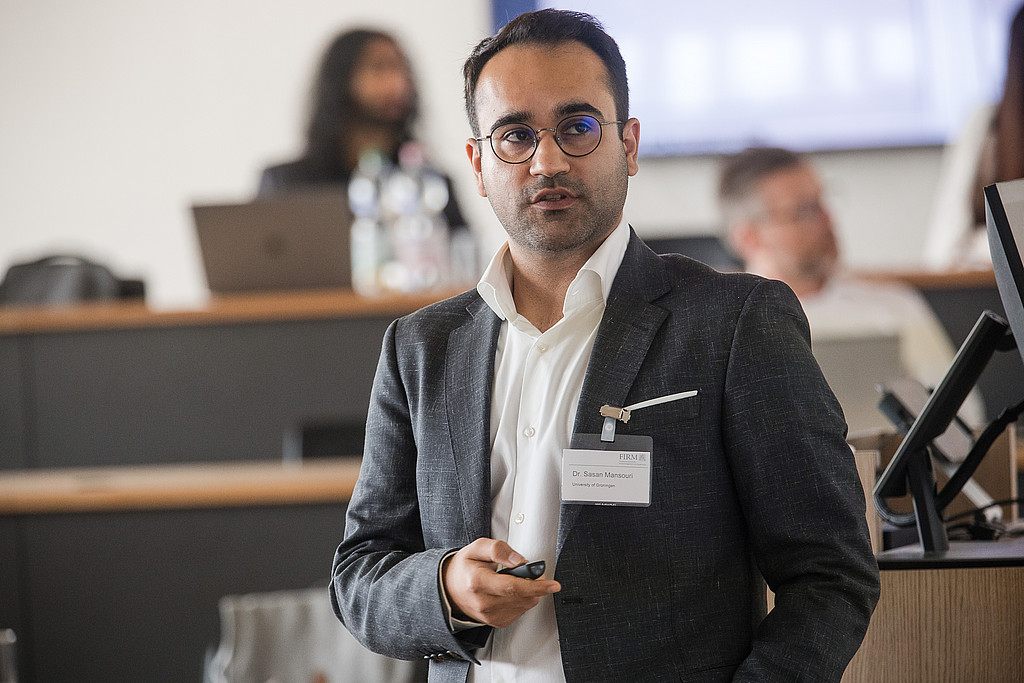
Sasan Mansouri is an Assistant Professor of Digitalization and AI at the Faculty of Economics and Business, University of Groningen , and a Junior Research Affiliate at the Leibniz Institute for Economic Research Halle (IWH) since February 2023. He is also an Affiliated Researcher at the Chair of Banking and Finance, Goethe University Frankfurt . His work integrates financial data science , natural language processing , and entrepreneurial finance to study information transmission dynamics in financial markets. Research Focus : Financial jargon's role in market efficiency, ESG metrics in sustainable entrepreneurship, AI-driven analysis of corporate disclosures, and regulatory impacts on banking. Teaching : Offers courses in Master Data Analytics , Natural Language Processing , and Mergers & Acquisitions , emphasizing AI applications in economics and finance. Entrepreneurial Ventures : Co-founded Very Bad Report (AI financial reporting) and Essence Scholar (AI academic research platform), and previously served as AI Advisor at Dealcode AI (2021-2022). His publications span journals like Management Science , Journal of Business Venturing , and Journal of Economic Behavior & Organization , along with working papers at SSRN and IWH . Current research explores AI's role in reducing information asymmetries and policy impacts on financial markets.
Prof. Uri Erez, born in 1971 in Tel Aviv, Israel, is a faculty member at the Department of Electrical Engineering-Systems, Tel Aviv University. He received his B.Sc. in Mathematics and Physics (1996), M.Sc. (1999), and Ph.D. (2003) in Electrical Engineering from Tel Aviv University. From 2003 to 2004, he was a Post-Doctoral Associate at MIT's Signals, Information and Algorithms Laboratory. Since 2005, he has been affiliated with Tel Aviv University's engineering faculty. Research Interests Information theory and digital communication Algorithms and signal processing for communication systems Space-time coding and dimension reduction Lattice structures in digital communication applications Contact: uri@eng.tau.ac.il | Office: Electrical Engineering Building, Room 120