Ao.Univ.Prof. Dipl.-Ing. Dr.techn. Andreas Rauber is an Associate Professor at TU Wien's Research Department E-Commerce. His work focuses on digital preservation, machine learning, and reproducible research. He leads projects like EOSC-Life (FAIR principles in life sciences) and PLANETS (long-term data access). Key affiliations include the Network Lab and TU Wien's Institute for Software Technology. His research emphasizes data citation frameworks, secure data infrastructure (OSSDIP), and ethical AI practices. He has advised over 20 PhD/Master’s students in areas like adversarial ML and privacy-preserving systems. Notable contributions include DBRepo (semantic databases) and the DBRepo infrastructure for relational data. He collaborates internationally on initiatives like EOSC support offices and cultural heritage projects linking ethnomusicology datasets.
H. Vincent Poor is a distinguished academic currently serving as the Dean of Princeton University's School of Engineering and Applied Science and the Michael Henry Strater University Professor of Electrical Engineering. He also holds a Visiting Professor position at Imperial College London's Electrical & Electronic Engineering department. B.E.E. and M.S. in Electrical Engineering from Auburn University M.A. and Ph.D. in EECS from Princeton University His research spans signal processing, information theory, and wireless systems, with a focus on robust techniques, stochastic analysis, and quantum communication. His work has driven advancements in MMSE detection, finite-blocklength coding, and quickest detection theory. He has advised 37 doctoral and 57 postdoctoral researchers, many of whom hold prominent roles globally. His recent publications highlight innovations in communication theory, quantum channels, and detection algorithms. These include foundational work on MMSE multiuser detection, iterative processing in wireless systems, and theoretical frameworks for quickest detection applications. 2011 IEEE Eric E. Sumner Award 2005 IEEE James H. Mulligan, Jr., Education Medal 2002 NSF Director's Award for Distinguished Teaching Scholars Multiple honorary doctorates and fellowships As principal investigator on over 50 research grants, Poor has led groundbreaking projects in signal processing and wireless networking. His visiting roles at institutions like Stanford, Harvard, and Imperial College further underscore his global academic influence.
Franziska Koch is a Senior Scientist / University Assistant in the Department of Water-Atmosphere-Environment (WAU) at the University of Natural Resources and Life Sciences, Vienna (BOKU), specializing in Alpine Hydrology and Remote Sensing. Her research focuses on hydrological modeling, snow dynamics, and climate change impacts in high-alpine regions, with extensive fieldwork at Mt. Zugspitze and other Austrian catchments. Her research interests include: Alpine Hydrology and Snow-Hydrological Modeling Remote Sensing and GNSS-based Snow Monitoring Climate Change Impacts on Water Cycles Glacier Melt Contributions to Runoff Gravimetric Monitoring of Cryospheric Processes Operational Reservoir Inflow Prediction Her recent publications and conference presentations emphasize the integration of superconducting gravimeters, satellite photogrammetry, and conceptual hydrological models to study snow and water dynamics in complex alpine terrain. These works reflect a strong trend toward multi-sensor, integrative approaches for monitoring hydrological storages and improving predictive capabilities under climate change. Scientific awards include: French Government Scholarship for Young Researchers (2021) SnowHydro 2020 Poster Award DACA-13 Poster Award (2013) ESA Integ Space Award (2013) LMUexcellent Mentoring Programme Scholarship (2010) Franziska Koch has actively supervised academic theses and contributed to knowledge transfer through public lectures and media engagement. She has participated in numerous national and international research initiatives, demonstrating strong collaboration with institutions such as LMU Munich, WSL/SLF Davos, and various European research networks. Her work supports climate adaptation strategies in alpine water resource management. She is involved in advanced monitoring projects such as G-MONARCH, which utilizes a superconducting gravimeter at Mt. Zugspitze for integrated observation of cryospheric and hydrological processes at catchment scale.
Prof. Alexander Onysko is a full-time Professor and Head of the Institute of English and American Studies at the University of Klagenfurt's Faculty of Cultural and Educational Sciences. His academic roles include membership in the Curricular Commission for English and American Studies and the Faculty Conference. His research focuses on cognitive linguistics, sociolinguistics, and world Englishes, with particular interest in language contact, multilingualism, and conceptual metaphors. Recent research projects explore interdisciplinary topics like media literacy, swarm intelligence in robotics, and sustainable business ecosystems. Notable publications in 2025 address online political avoidance, robotic exploration algorithms, and healthcare workforce retention during pandemics. He actively contributes to academic administration and has supervised multiple institutional innovation projects. His work bridges linguistic theory with practical applications in education and technology-driven solutions.
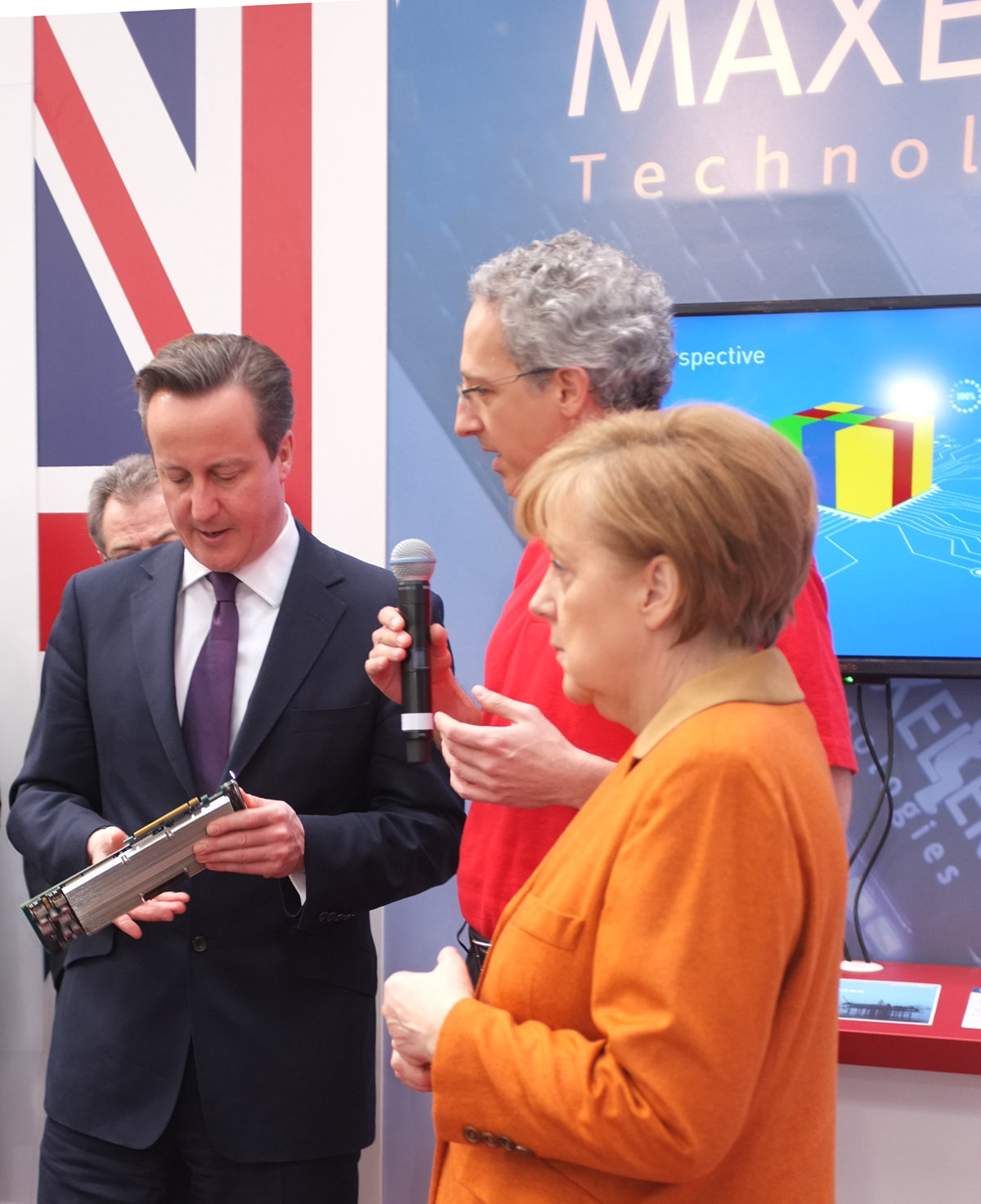
Oskar Mencer is a Professor in the Department of Computing at Imperial College London , where he has been a member of academic staff since 2000. He was also a Consulting Professor at Center for Computational Earth and Environmental Science , Stanford University (2009-2010). His research focuses on Multiscale Dataflow Computing , exploring the interaction of hardware and software systems through domain-specific representations, parallel programming, VLSI design, and compiler methodologies. He has contributed to fields including high-performance computing, FPGA optimization, and computational finance. Dr. Mencer's work has been recognized with a Special Award from Com.sult (2012), Imperial College Research Excellence Award (2007), and a Top EPSRC Advanced Fellowship (2001). He has received multiple best paper awards, including at ICFPT'08 and ASAP 2008, and his 2000 paper on stream architectures was recognized as historically significant in 2015. His publications demonstrate a strong emphasis on FPGA acceleration , custom architectures , and parallel processing across geophysics, finance, and neuroscience applications. Special Award for Dataflow Innovation (2012) Best Paper Award - ICFPT'08 Best Paper Award - ASAP 2008 He has served on technical committees for conferences such as FPL , DATE , and FPT , and leads the Computer Architecture Research Group (currently inactive).
Professor Ailbhe Ní Chasaide at Trinity College Dublin is a leading figure in phonetics, with expertise in voice quality, speech production, and Irish language prosody. She established Trinity’s Phonetics & Speech Laboratory and leads a multidisciplinary team focused on speech technology and endangered language preservation. Education PhD Experimental Phonetics, University of Wales, Bangor (1985) MA Linguistics, University of Wales, Bangor (1977) Maîtrise ès Lettres French Literature, Université de Bordeaux (1975) BA French/German, University College Galway (1973) Her research explores how voice quality interacts with prosody to convey emotion and linguistic meaning, alongside pioneering work in documenting and preserving the Irish language through speech technology. Key areas include experimental phonetics, speech acoustics, and Irish dialect intonation. Recent publications highlight affective prosody, cross-language voice quality analysis, and Irish language revitalization. These works span acoustic modeling, synthetic speech applications, and the role of prosody in linguistic identity. Scientific Awards Elected member of the ISCA IAC (2021) Elected to Council of the International Phonetic Association (2019) Government of Ireland Senior Research Fellowship (2003) Fellow Trinity College Dublin (1998) Fulbright Senior Research Fellowship (1987) Senior Research Fellowship, Oxford University (1982) Professor Ní Chasaide mentors a team of postdocs, research assistants, and PhD students. She has co-founded Irish postgraduate programs in phonetics and supervised numerous researchers. Her projects, including ABAIR (€3.85m) and FastNet (€1.12m), focus on speech technology and social interaction studies.
Silvia Miksch is a Full University Professor of Visual Analytics at TU Wien's Faculty of Informatics, leading the CVAST Center. She holds a PhD from the University of Vienna and has held roles including Head of the Department of Information and Knowledge Engineering at Danube University Krems. Her research focuses on Visual Analytics, Information Visualization, Temporal Data Analysis, and Medical Informatics. She has supervised numerous PhD and Master’s students, with notable advisees including Ignacio Baltazar Pérez Messina and Davide Ceneda. Her work bridges theory and practice, addressing challenges in Visual Analytics for healthcare, business intelligence, and digital humanities. Awards include the IEEE VGTC Technical Achievement Award (2023) and induction into the IEEE Visualization Academy (2020). She actively contributes to conferences like IEEE VIS and EuroVis as program chair and steering committee member. Her projects, such as 'VisuExplore' and 'DisCo', have received recognition for advancing visualization in medical and cultural domains. Key research areas include guidance-enriched systems, network visualization, and temporal reasoning. She explores applications in fraud detection, cultural heritage analysis, and pandemic data visualization. Her lab's tools, like 'Hermes' and 'COVIs', exemplify task-driven design for real-world data challenges.
Christian Fibich is a Researcher and Lecturer at the Department of Electronic Engineering, University of Applied Sciences Technikum Wien, Austria. He leads the Research Group Embedded Systems, focusing on FPGA reliability and high-level synthesis. His roles include project management for R&D initiatives like VECS (2013-2018), INES (2018-2023), and the 2024 Drohnentechnik integration project. Fibich holds an MSc in Embedded Systems from Technikum Wien and has been active in the field since 2010. Research interests include fault-tolerant FPGA design, reliability analysis of SRAM-based FPGAs, and high-level synthesis optimization. His work emphasizes practical applications of open-source tools and automated design exploration. Recent projects explore temperature-dependent fault effects and drone integration in academic programs. Publications span FPGA reliability, fault injection methods, and embedded systems design, with a focus on open-source IP cores and hardware security. His contributions include Fiji (a fault injection tool) and HLShield (a reliability framework for HLS).
Martin Riegler is a researcher at the Institute of Physics and Materials Science , part of the University of Natural Resources and Life Sciences, Vienna (BOKU). His work focuses on advanced material analysis and sustainable construction within the wood technology sector. Specializes in electrical resistivity measurements of wood Applies machine learning to wood machining acoustics Studies adhesive bondlines modified with carbon fillers Investigates moisture dynamics in wood Recent publications highlight his contributions to smart wood composites , non-invasive testing , and machine learning applications in wood processing. He has presented research at international conferences and collaborated with institutions like the Northern European Network for Wood Science and Engineering. Riegler's work intersects with Materials Science , Wood Technology , and Sustainable Engineering , particularly in optimizing particleboard production and wood moisture prediction . His research spans technical innovation and environmental stewardship in forestry applications.
Professor Vasileios Chatziioannou serves as Faculty Member and PhD Supervisor within the Department of Music Acoustics at the University of Music and Performing Arts Vienna. His academic leadership spans the Faculty of Music, where he guides doctoral candidates through the Structured Doctoral Program Performing Matters. His institutional role encompasses supervision across Ethnomusicology, Music in Society, and Musicology programs. His research focuses on the physics of musical instruments, with particular expertise in wind instrument aerodynamics and string-bow interaction mechanics. He employs advanced experimental techniques including particle image velocimetry (PIV) and high-speed motion capture alongside computational modeling. His work bridges theoretical acoustics with practical instrument design considerations, examining phenomena from tone hole geometry effects to friction dynamics in bowed strings. Analysis of his recent publications reveals a strong emphasis on energy-stable numerical methods for real-time simulation of musical instrument physics. His work consistently addresses the challenge of balancing computational efficiency with physical accuracy, particularly in modeling nonlinear phenomena like stick-slip friction and collision dynamics. The research trajectory shows increasing integration of experimental validation with computational models. While no specific scientific awards are documented in the provided materials, his sustained publication record in high-impact acoustics journals demonstrates significant scholarly contribution. His work regularly appears in specialized forums like the Journal of the Acoustical Society of America, particularly within special issues on musical instrument modeling. Professor Chatziioannou's supervision activities focus on computational and experimental approaches to musical instrument physics. His research program involves interdisciplinary collaboration between acousticians, instrument makers, and performers. Current projects include robotic replication of bowing techniques and 3D-printed instrument component optimization, reflecting his commitment to translating theoretical findings into practical applications for musicians and instrument designers.
Alexander Nemecek is a Professor and Head of the Faculty of Engineering since 2004. His academic background includes degrees of Dipl.-Ing. (Diplom-Ingenieur) and Dr. techn. (Doctor of Technical Sciences). He leads research in photodetection systems, sensor technologies, and microelectronics. Education: Dipl.-Ing. in Electrical Engineering Dr. techn. (PhD) in Technical Sciences Research Interests: Photodetector design and optimization High-speed analog-to-digital converters MEMS-based gas sensing systems Automated measurement systems for bioprocessing Key Projects: 2022–2025: Leading the THWS World Twin Robotics Network project as Principal Investigator (PI), focusing on Digital Education integration. Grants & Advising: Secured funding for interdisciplinary robotics initiatives through the THWS project. Collaborations include teams at the Faculty of Engineering and external institutions.
Thomas Neubauer is a PostDoc Researcher at the Department of Information Systems Engineering, Technische Universität Wien. His research focuses on Smart Farming, Explainable AI, and Digital Agriculture with applications in precision livestock farming and sustainable agricultural systems. He leads projects on Precision Livestock Farming (PLFDoc), Legume-cereal intercropping, and Agricultural Photovoltaics integration (PlusIQ). Key projects include: Austrian Competence Centre for Feed and Food Quality, Safety & Innovation (2025–2028) Austrian Science Fund (FWF)-funded work on legume-cereal intercropping (2023–2027) EU-funded ICT4DecisionMaking in Farming (2017–2021) His research spans Digital Twin development for agriculture, machine learning in crop rotation planning, and data security solutions for e-Health. He has supervised over a dozen PhD and Master’s students since 2007. Notable publications include work on reinforcement learning for crop optimization and digital twin frameworks in smart farming.
Albert Rafetseder is affiliated with the Faculty of Computer Science and the Research Group Cooperative Systems . He holds academic qualifications including Dr.techn., Bakk. (FH), and MSc degrees. His research focuses on mobile device technologies, networking performance evaluation, IoT systems, and ecodesign principles. Rafetseder has been actively publishing since 2010, with notable work in 2024 including contributions to IoT upgradeability frameworks and duplex communication protocols. His research fingerprints highlight expertise in service provider systems, control plane analysis, and qualitative/quantitative data methodologies. Collaborations span technical and interdisciplinary domains, evidenced by patents and conference contributions. Recent activities include public talks on digital ethics and privacy in online platforms.
Andrea M. Tonello is a Full Professor at the Institute of Networked and Embedded Systems, University of Klagenfurt, Austria, where he chairs the Embedded Communication Systems Lab. He previously held positions at the University of Udine, Italy, where he was an Associate Professor and founded the Wireless and Power Line Communication Lab (WiPLi Lab). His research spans power line communications, wireless systems, embedded communications, smart grids, and machine learning applications in signal processing. Doctor of Engineering, University of Padova (1996) Doctor of Research, Telecommunications, University of Padova (2003) His research interests focus on next-generation communication systems, including power line and wireless networks, signal processing, machine learning for communications, UAV systems, and smart grid technologies. He has made significant contributions to PLC channel modeling, full-duplex communications, and information-theoretic learning for communication systems. His work integrates theoretical innovation with practical implementation in real-world networks. The most recent publications highlight a strong trend toward integrating machine learning and information theory into communication systems, particularly in power line and wireless networks. Themes include f-divergence based classification, mutual information estimation, neural decoding (MIND), noise-robust receivers, and topology-aware machine learning for PLC quality prediction. There is also a notable focus on UAV control, full-duplex PLC, and digital pre-distortion techniques for high-speed converters. IET 2016 Premium Award Best Paper Award, ISPLC 2016 Best Student Paper Award, ISPLC 2016 Aerospace Best Paper Award, 2018 Best Paper Award, ISPLC 2021 Best PhD Dissertation Award, 2019 IEEE ComSoc Distinguished Lecturer (2018) Two Awards from IEEE ComSoc TC-PLC (2019) University of Klagenfurt Technology Scholarships (2019) Dr. Tonello has supervised numerous PhD and Master’s students, including notable advisees such as Nunzio A. Letizia, Davide Righini, and Babak Salamat. He has led over 10 institutional and multiple industrial research projects with a total funding exceeding 20 million euros. He played a key role in promoting international academic collaboration, including Erasmus agreements, joint PhD programs with INSA Rennes and Ecole Polytechnique de Grenoble, and a joint master’s program with the University of Klagenfurt. He founded and led the WiPLi Lab at the University of Udine, which received around 3 million euros in funding and involved over 60 researchers and students. He also founded WiTiKee s.r.l., a spin-off company specializing in PLC for smart grids. Currently, he chairs the Embedded Communication Systems Lab at the University of Klagenfurt, focusing on next-generation networked and embedded communication technologies.
Henri Ruotsalainen is a Researcher at the University of Applied Sciences St. Pölten (FH St. Pölten) , affiliated with the Institute of IT Security Research and the Department of Computer Science and Security . His work focuses on IoT security , wireless network protection , and sensor system resilience , with particular emphasis on LoRaWAN and critical infrastructure security . PhD in Technical Sciences (Dr. Techn.) from Vienna University of Technology (2011–2015) Diploma in Engineering (Dipl.-Ing.) from Helsinki University of Technology (2002–2010) Prior roles as University Assistant (Helsinki, 2007–2008) and Project Assistant (Vienna, 2011–2015) Ruotsalainen's research explores physical layer security for IoT, including radio-based key generation , supply voltage watermarking , and reactive jamming detection . His projects like LoRaKey and Substation Security aim to strengthen wireless communication integrity in industrial environments. Recent publications highlight trends in sensor network security and smart home vulnerabilities , with a focus on metadata differencing and attack countermeasures . Scientific contributions include: 15+ peer-reviewed articles in journals like Sensors and IEEE Transactions Participation in conferences including IEEE ETFA , ARES , and IT-SECX Development of security testbeds for LoRaWAN and critical infrastructure systems