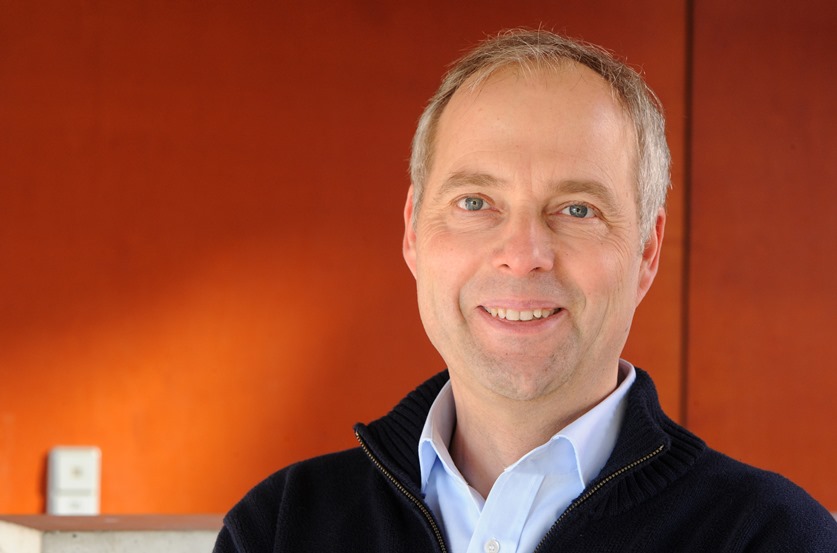
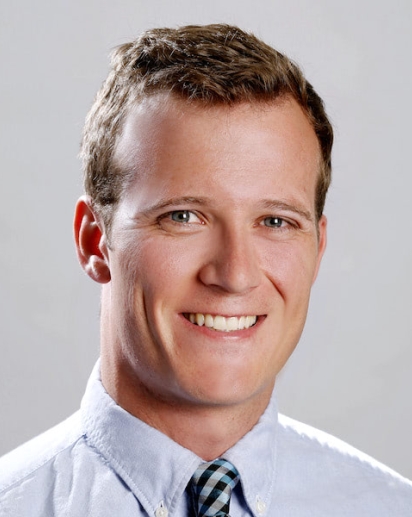
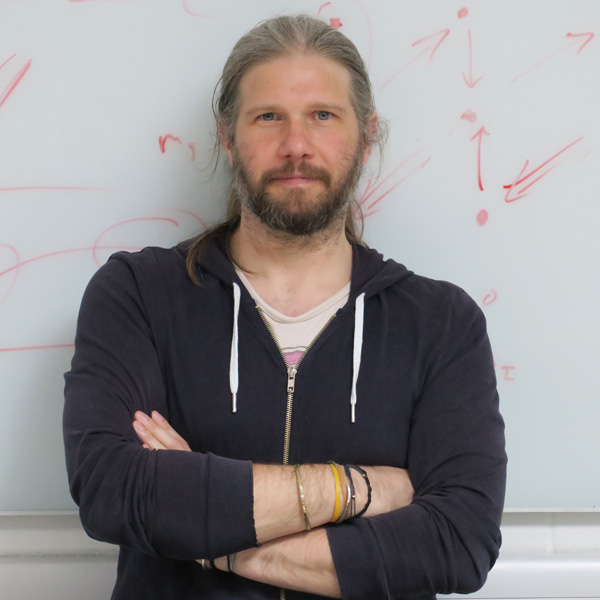
John Davis is a Professor in the Department of Physics at the University of Alberta, Faculty of Science. He holds a PhD and MSc from Northwestern University and a Bachelor’s from Washington University. His research focuses on nanomechanics, superfluidity, and superconductivity, particularly in confined geometries and quantum properties of nanomechanical systems. His lab develops superfluid-based technologies for dark matter detection and precision measurement. He has held academic positions since 2010, including roles at the Canadian Institute for Advanced Research and postdoctoral training at the University of Alberta with Prof. Mark R. Freeman. Education: PhD in Physics (2008), Northwestern University MSc in Physics (2003), Northwestern University Bachelor’s in Physics with Honors (2001), Washington University Research Interests: Superfluid nanomechanical resonators Ultralow-temperature superfluid 3He Nanofluidic cavity quantum electrodynamics Quantum-limited torque magnetometry Applications in dark matter detection and gravitational wave sensing His recent work emphasizes magnomechanics and optomechanical transduction , integrating superfluid systems with quantum sensors. Articles highlight advancements in cryogenic devices, nonlinear dynamics, and hybrid quantum systems. Ongoing projects include the HElium-based Light Operated Superfluid (HELIOS) dark matter detector. Grants & Labs: His lab operates a cryogen-efficient low-temperature facility, focusing on microfluidic quantum fluid experiments. Collaborations involve advanced photonic crystal cavities and diamond-based optomechanical platforms.
Ruonan Han is a Professor of Electrical Engineering and Computer Science at MIT and serves as Associate Director of the Microsystems Technology Laboratories (MTL) and Director of the MIT-MTL Center for Integrated Circuits and Systems . His research focuses on ultra-high-frequency microelectronic circuits , particularly addressing the 'terahertz gap' in sensing, metrology, security, and communication. He leads the Terahertz Integrated Electronics Group at MIT's MTL, established in 2014. Education: B.S. in Microelectronics, Fudan University (2007) M.S. in Electrical Engineering, University of Florida (2009) Ph.D. in Electrical and Computer Engineering, Cornell University (2014) Research Interests: Terahertz (THz) integrated circuits and systems High-frequency CMOS technologies Quantum sensing and magnetometry RF systems for imaging, radar, and molecular sensing Energy-efficient communication systems His work bridges electronic circuits , electromagnetics , and quantum physics , with applications in defense, healthcare, and environmental monitoring. Awards & Recognition: 2023 IEEE SSCS New Frontier Award 2020 NSF CAREER Award 2019 Intel Outstanding Researcher Award 3× IEEE RFIC Best Student Paper Awards (2012, 2017, 2021) Advising & Leadership: Ph.D. advisor to over 10 students (many recipients of MIT MTL Dissertation Awards) Co-advises with Prof. Anantha Chandrakasan and Prof. Tomás Palacios Editorial roles at IEEE Transactions on Quantum Engineering and VLSI Systems Technical committee member for ISSCC, RFIC, and IMS Labs & Teams: Terahertz Integrated Electronics Group at MIT MTL: Focuses on chip-scale THz systems, quantum devices, and next-generation RF circuits Collaborations with industry (e.g., Apple, MediaTek) and academic groups (e.g., D. Englund's lab at MIT)
Nathalie P. de Leon is an Associate Professor of Electrical and Computer Engineering at Princeton University and an Associated Professor of Physics. She is affiliated with the Princeton Plasma Physics Laboratory and co-leads the Co-Design Center for Quantum Advantage (C 2 QA). Her lab focuses on quantum hardware development using color centers in wide bandgap materials and superconducting qubits, with applications in quantum networks and nanoscale sensors. Ph.D., Chemical Physics, Harvard University, 2011 B.S., Chemistry, Stanford University, 2004 Her research spans optical materials , light-matter interactions , and quantum information processing , integrating nanophotonics , surface science , and quantum metrology . Recent publications highlight advances in diamond-based quantum sensors , superconducting circuit engineering , and noise/loss mitigation in quantum systems. Scientific Awards: APS Rolf Landauer and Charles H. Bennett Award in Quantum Computing (2023) DOE Early Career Award (2018) DARPA Young Faculty Award (2018) NSF CAREER Award (2018) Her lab has advised 22 graduate students and collaborates extensively with institutions like Princeton Plasma Physics Laboratory, University of Chicago, UZH, and Brookhaven National Laboratory. Current projects emphasize hybrid quantum devices , telecom band photonics , and many-body quantum physics .
Michael P. Bradley is a Professor in the Department of Physics and Engineering Physics at the University of Saskatchewan, affiliated with the College of Arts and Science. He holds a Ph.D. from MIT and is a Professional Engineer (P.Eng.). His research focuses on precision measurement techniques, plasma-based nanofabrication, and quantum metrology, including work on diamond NV-centre magnetometers and superconducting watt balance systems. He leads the University of Saskatchewan Plasma Physics Laboratory (U of S PPL) and has received a Canada-UK Joint Quantum Technology grant for quantum sensor development. Education BSc (Honours) in Applied Physics, University of New Brunswick Ph.D. in Physics, Massachusetts Institute of Technology (MIT) Research Interests Bradley specializes in quantum magnetometry , plasma processing , semiconductor nanostructures , and precision electromagnetic measurements . His lab develops novel techniques for materials characterization and fabrication, including plasma immersion ion implantation (PIII) for micro- and nano-scale engineering, graphene doping, and silicon photonics. Recent work includes advancements in diamond NV-centre magnetometry for quantum technologies. Grants & Collaborations Recipient of a prestigious Canada-UK Joint Quantum Technology grant (2023). Collaborated internationally, including at the Bureau International des Poids et Mesures (BIPM) in France, where he contributed to superconducting watt balance prototypes for redefining mass standards. Teaching Teaches courses in optics, thermodynamics, and planetary astronomy, including EP421: Optical Systems & Materials and ASTR104: Planetary Astronomy .
Professor Brant Gibson is a Deputy Dean of Research and Innovation and holds the rank of Professor in the School of Science at RMIT University. His research focuses on quantum technologies, particularly diamond-based systems including nitrogen-vacancy (NV) centers, fluorescent nanoprobes, and hybrid materials for sensing applications. He leads projects in quantum magnetometry, photonics, and biomedical imaging, with an emphasis on translating lab-based innovations into practical devices for fields like medical diagnostics and environmental monitoring. Brant’s work spans condensed matter physics, nanotechnology, and optical engineering, with notable contributions to diamond-doped optical fibers, quantum sensor development, and the application of nanodiamonds in biophotonics. His research integrates experimental physics with computational modeling to optimize material properties and sensor performance. He is actively involved in student supervision, offering guidance for Masters and PhD candidates in quantum engineering, materials science, and interdisciplinary applications. Current projects include quantum tensor gradiometry for navigation, bioimaging with near-infrared emitters, and silk-diamond composites for wound monitoring. Brant’s academic contributions are further reflected in over 150 peer-reviewed publications and collaborations across academia and industry. His work bridges fundamental research with real-world applications, emphasizing Australia’s role in global quantum technology advancements.
Prof. Patrick Maletinsky is a Full Professor and Head of the Department of Physics at the University of Basel. He leads the Maletinsky Research Group focused on quantum sensing and nanoscale magnetometry using nitrogen-vacancy (NV) centers in diamond. His academic journey includes a PhD from ETH Zurich (2010 Schläfli Prize recipient) and postdoctoral research at Harvard University. Current research emphasizes quantum technologies for imaging exotic materials and mesoscopic systems, with applications in condensed matter physics and quantum computing. Key projects include the QuantumLeap initiative and leadership in NCCR SPIN for silicon-based quantum computing. Education: PhD in Physics, ETH Zurich (2008) Studies at École Normale Supérieure Paris and JILA, Boulder Research interests span quantum sensing, nanoscale magnetometry, and NV center-based tools for probing magnetic materials. His group pioneered cryogenic nanoscale magnetometers and demonstrated imaging of cuprate superconductors. Awards include the Georg-H.-Endress Professorship (2012) and promotion to Associate Professor (2017) before becoming Full Professor and Department Head. Scientific achievements include coupling NV spins to mechanical oscillators, strain-based sensing, and nanophotonics in diamond nanostructures. His work bridges quantum technologies with condensed matter challenges, targeting exotic states like topological materials and strongly correlated systems.
Paul Stevenson is an Assistant Professor of Physics at Northeastern University's College of Science, leading the Stevenson Group. His research focuses on quantum sensing and biophysical dynamics using solid-state spins, particularly nitrogen vacancy centers in diamond. He develops nanoscale sensors for probing molecular motion and quantum communication technologies. Notably, his work bridges physics, chemistry, and biology, addressing challenges such as magnetism in complex systems and single-molecule imaging. He is a 2023 TIER1 Awardee and collaborates with institutions like Brown University and UC Berkeley. Stevenson's lab explores quantum materials and spintronics, leveraging interdisciplinary approaches to advance quantum hardware and biophysical understanding. His group's innovations include ultrasensitive magnetometers and tools for studying antiferromagnetic ordering. Contact: p.stevenson@northeastern.edu .
Philip Hemmer is a Professor in the Department of Electrical and Computer Engineering at Texas A&M University, affiliated with the College of Engineering. He holds a Ph.D. in Physics from MIT (1984) and a B.S. from the University of Dayton (1976). His research focuses on quantum optics, nanodiamond-based quantum sensing, and advanced optical materials for applications in quantum computing, biosensing, and thermal imaging. Key areas include solid-state quantum systems, upconversion nanoparticles, and fiber-optic sensor technologies. Dr. Hemmer's work spans interdisciplinary fields such as quantum communication, luminescent thermometry, and nanotechnology. His lab develops novel materials like GeV color centers in diamonds for high-precision sensing and explores applications in medical diagnostics, environmental monitoring, and fundamental physics. Awards include the National Science Foundation Fellowship and multiple AFOSR Star Team Awards. Education: Ph.D., Physics, Massachusetts Institute of Technology, 1984 B.S., University of Dayton, 1976 Awards: National Science Foundation Fellowship Summa Cum Laude, University of Dayton Air Force Research Laboratory Chief Scientist's Award AFOSR Star Team Award (three-time recipient) His recent publications emphasize quantum-enhanced biosensing, nanodiamond engineering, and fiber-optic quantum sensors. Research trends highlight innovations in thermal imaging using diamond defects, multiplexed sensing platforms, and scalable quantum technologies.
Jörg Wrachtrup is a Professor at the Department of Physics, Faculty of Mathematics and Physics, University of Stuttgart, and a Fellow at the Max Planck Institute for Solid State Research. He is recognized as one of the most cited physicists globally due to his groundbreaking work on diamond-based quantum sensors, particularly utilizing nitrogen-vacancy (NV) centers for ultra-precise measurements. His research focuses on advancing quantum sensing technologies with applications in neuroscience, medical diagnostics (e.g., next-generation MRI and NMR), and materials science. These sensors enable non-invasive, high-resolution detection of magnetic fields at the nanoscale, opening new frontiers in both fundamental physics and real-world technology deployment. Wrachtrup emphasizes interdisciplinary collaboration and early engagement with applied sciences and industry, advocating for partnerships between academia, Fraunhofer institutes, startups, and large enterprises to accelerate the commercialization of quantum technologies. He believes quantum sensing is ahead of quantum computing in terms of practical application and near-term impact. Scientific awards and recognitions are not mentioned in the provided text. He actively mentors students and leads a research group focused on quantum sensor development, though specific advisees are not listed. His lab collaborates closely with institutions like the Fraunhofer IAF, which develops diamond-based semiconductor qubits and sensor platforms. The team works on translating fundamental quantum phenomena into scalable, deployable technologies, with future goals including miniaturized, high-sensitivity sensors for integration into medical devices and potentially consumer electronics.
Mattias W Fitzpatrick is an Assistant Professor of Engineering and Adjunct Professor of Physics at Dartmouth College's Thayer School of Engineering. He specializes in quantum engineering, quantum sensing, and quantum computing using superconducting circuits. BA in Physics and Mathematics from Middlebury College (2013) PhD in Electrical Engineering (Applied Physics) from Princeton University (2019) His research focuses on quantum technologies, particularly in developing superconducting circuits for quantum information systems and exploring non-Euclidean lattice structures in quantum electrodynamics. He has also contributed to advancements in quantum sensor coherence times and time crystal phenomena. His recent publications highlight innovations in circuit QED lattices, hyperbolic geometries for quantum simulation, and material platforms for superconducting qubits. These works align with his expertise in non-Hermitian physics and quantum information applications. Intelligence Community (IC) Postdoctoral Fellowship Bede Liu Best Dissertation Award Princeton University Distinguished Teaching Award DARPA Young Faculty Award He serves as a reviewer for journals like Nature Physics and Physical Review Letters. His lab (FitzLab) develops quantum engineering solutions, and he teaches courses on distributed systems and quantum technologies. He received a $600,000 NSF grant for non-Hermitian physics research.
Dr. John Dabiri is the Centennial Professor of Aeronautics and Mechanical Engineering at Caltech, awarded the National Medal of Science in 2025 for achievements in aeronautical and biological engineering. His research spans bioinspired fluid dynamics, wind energy optimization, and biohybrid robotics for ocean exploration. Innovations include strategically clustered vertical-axis wind turbines for enhanced farm efficiency, biohybrid jellyfish robots for deep-sea monitoring, and fundamental contributions to vortex dynamics. Current projects involve visual anemometry using natural vegetation and quantum-enhanced flow sensing. Honors include the MacArthur Fellowship, Waterman Award, and membership on the President's Council of Advisors on Science and Technology. Leads the Dabiri Lab with over 30 PhD students and postdocs. Research Areas: Wind farm aerodynamics inspired by fish schooling Ocean mixing by swimming organisms Electromechanical enhancement of marine animals Environmental sensing via flow-structure interactions Awards: National Medal of Science (2025) G. Evelyn Hutchinson Award (2023) Alan T. Waterman Award (2020) MacArthur Fellowship (2010)
Mete Atatüre is a Professor of Physics in the Department of Physics at the University of Cambridge, UK. He has been with the University of Cambridge since 2007, progressing from Assistant Professor to Associate Professor and finally to full Professor in 2015. He is also affiliated with Quantum Cambridge and is a member of the Academy of Europe (elected 2021). His educational background includes a B.Sc. in Physics from Bilkent University (1996), a Ph.D. in Physics from Boston University (2002), and a Habilitation in Experimental Physics from ETH Zürich (2007). Dr. Atatüre's research focuses on quantum technologies and quantum information science. His work spans several interconnected areas: Optics of atomically thin quantum devices and emergent many-body physics based on layered materials heterostructures Light-matter quantum interfaces in solids for quantum network hardware Quantum optical control of spins and spin ensembles in semiconductors Nanoscale quantum sensing and imaging using diamond-based magnetometry His research has resulted in 85 publications with approximately 12,000 citations and an h-index of 48 (Google Scholar). Analysis of his recent publications reveals a strong focus on quantum information processing with 2D materials, particularly examining spin-photon interfaces, quantum entanglement in heterostructures, and nanoscale sensing applications. His work consistently bridges fundamental quantum phenomena with practical quantum technology implementations. His notable awards include: Thomas Young Medal and Prize from the Institute of Physics (2020) Election as Fellow of the Optical Society of America (2020) ERC Advanced Grant Award (2020) Science Person of the Year award from MSIC National Students' Choice (2016) Election as Fellow of the Turkish Science Academy (2012) Dr. Atatüre has delivered over 200 plenary, keynote, and invited talks worldwide and holds 3 international patents (with 2 pending) on quantum photonic devices. His work bridges fundamental quantum physics with practical quantum technologies, positioning him at the forefront of quantum information science research.
Dr. Claire Donnelly is a Research Professor and Lise Meitner Group Leader heading the Spin3D research group at the Max Planck Institute for Chemical Physics of Solids in Dresden, Germany, where she investigates three-dimensional magnetic systems using advanced imaging techniques. She holds a distinguished research position focused on nanoscale magnetism and spintronics. Education & Career Following her MPhys at the University of Oxford, Donnelly completed her PhD at ETH Zurich and Paul Scherrer Institute (2017). Her doctoral work on 3D magnetic systems received multiple honors. She subsequently held postdoctoral positions at ETH Zurich and the University of Cambridge as a Leverhulme Early Career Research Fellow before establishing her independent group at MPI-CPFS in 2021. Research Focus Donnelly specializes in developing cutting-edge X-ray magnetic tomography techniques to visualize 3D magnetization dynamics at the nanoscale. Her work encompasses: Three-dimensional magnetic nanostructures and topological spin textures Advanced imaging methods including X-ray vector nanotomography and soft X-ray laminography Chiral magnetic interactions and domain wall dynamics in complex geometries Her research bridges fundamental magnetism with potential applications in high-density data storage and quantum computing. Publication Trends Donnelly's recent publications demonstrate strong focus on three-dimensional characterization of magnetic systems, with recurring themes: nanoscale topological textures (skyrmions, Bloch points), advanced X-ray tomography techniques, chiral interactions in synthetic antiferromagnets, and curvature effects in magnetic nanostructures. Her work consistently integrates novel imaging methodologies with fundamental physics exploration. Honors APS Richard Greene Dissertation Award Werner Meyer-Ilse Memorial Award ETH Medal for outstanding doctoral thesis SPS Award for Computational Physics L'Oréal-UNESCO For Women in Science Fellowship European Magnetism Association Young Scientist Award Leadership As founder of the Spin3D group, Donnelly leads a research team developing next-generation magnetic imaging techniques. Her group focuses on creating novel approaches to visualize and manipulate 3D magnetic configurations in complex nanomaterials, with ongoing work in nanofabrication of magnetic architectures and time-resolved imaging of magnetization dynamics.
Sebastian Knauer is a researcher at the Faculty of Physics, University of Vienna, specializing in Nanomagnetism and Magnonics. His work bridges quantum technologies and materials science, focusing on magnonic devices, spin-wave spectroscopy, and magnetic heterostructures. Education: B.Sc., M.Sc., Ph.D. His research explores quantum magnonics, low-temperature magnetism, and inverse-design methodologies. Recent publications emphasize Yttrium-Iron Garnet (YIG) films, paramagnon propagation, and quantum Hamiltonian learning. Key trends in his publications include applications of magnonic computing, hybrid quantum systems, and nanostructured materials. Collaborations span projects like On-chip quantum MagNonIcs and Nanometer-thick YIG layers , with international partnerships in quantum technologies. Scientific awards include: Marie Skłodowska-Curie Individual Fellowship (2021) NFFA-Europe Research Infrastructure grant (2022) Top-10 MSCA Fellowship (2021) He contributes to experimental quantum model learning and advancing spin-wave-based computing architectures.
Benjamin Weiss is the Chair of the Program in Planetary Science and Robert R. Shrock Professor of Earth and Planetary Sciences at the Massachusetts Institute of Technology (MIT). He leads research in planetary magnetism and serves as Deputy Principal Investigator on NASA's Psyche mission, while also contributing as a Co-Investigator on the Mars Perseverance rover and Europa Clipper missions. Department of Earth, Atmospheric and Planetary Sciences MIT Planetary Magnetism Laboratory Director NASA Psyche Mission Deputy Principal Investigator Mars Perseverance Rover Co-Investigator Europa Clipper Mission Co-Investigator Weiss earned his bachelor's degree in physics from Amherst College before pursuing graduate studies in planetary science and geology at the California Institute of Technology, where he received his master's degree in 2001 and PhD in 2003. His doctoral dissertation on Martian meteorite ALH 84001 provided groundbreaking insights into ancient Martian climate and magnetic fields, demonstrating how meteorites could transfer materials from Mars to Earth without heat sterilization. As a specialist in magnetometry, Professor Weiss investigates the formation and evolution of planetary bodies through laboratory analysis, spacecraft observations, and fieldwork. His research spans nebular magnetic fields in the early solar system , planetesimal structures and dynamos , lunar magnetism and the early lunar dynamo , Hadean Earth and the origins of Earth's magnetic field , the Martian dynamo and changes in Mars' paleoclimate , and innovations in magnetic microscopy . The MIT Planetary Magnetism Laboratory, which he directs, develops high-sensitivity techniques to image magnetic fields in rock samples from meteorites, the lunar surface, and terrestrial sites. Analysis of Weiss's recent publications reveals a strong focus on Mars exploration through the Perseverance rover mission, lunar magnetism studies, and research on asteroid Psyche. His work increasingly integrates data from multiple NASA missions while advancing paleomagnetic techniques to understand planetary evolution and habitability throughout the solar system. Professor Weiss has received numerous prestigious honors including the James B. Macelwane Medal from the American Geophysical Union (2009), election as an AGU Fellow (2009), the Visiting Miller Professor Award from UC Berkeley (2014), and having Asteroid (8069) named 'Benweiss' by the International Astronomical Union (2012). Most recently, he was elected to the National Academy of Sciences (April 29, 2025). James B. Macelwane Medal, American Geophysical Union (2009) Fellow, American Geophysical Union (2009) Visiting Miller Professor Award, UC Berkeley (2014) Asteroid (8069) Benweiss named by IAU (2012) Elected to National Academy of Sciences (2025) As an academic leader, Weiss chairs MIT's Program in Planetary Science and mentors numerous graduate students in the Planetary Magnetism Laboratory. His research is supported by multiple NASA grants related to the Psyche mission, Mars exploration, and lunar science investigations. Weiss also contributes to international collaborations including missions with JAXA (Hayabusa 2), ESA (Rosetta), and SpaceIL (Beresheet). The MIT Planetary Magnetism Laboratory under Weiss's direction develops cutting-edge instrumentation for magnetic analysis, including the Quantum Diamond Microscope. His research team collaborates with scientists across multiple institutions and space agencies to analyze samples from meteorites, lunar missions, and Mars rovers, advancing our understanding of planetary formation and evolution.