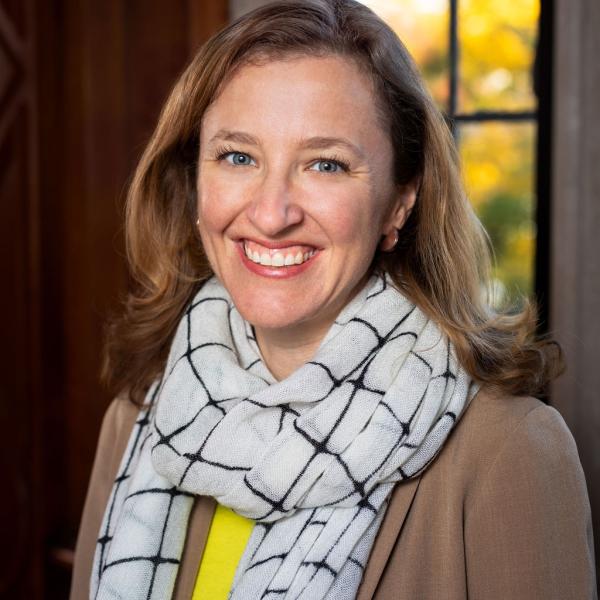
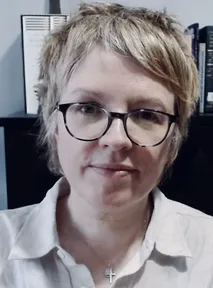
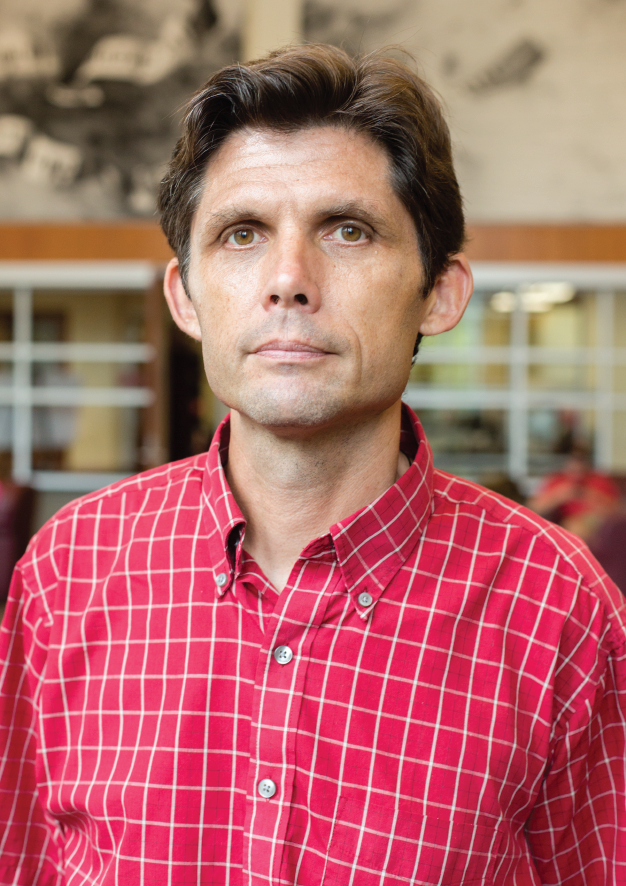
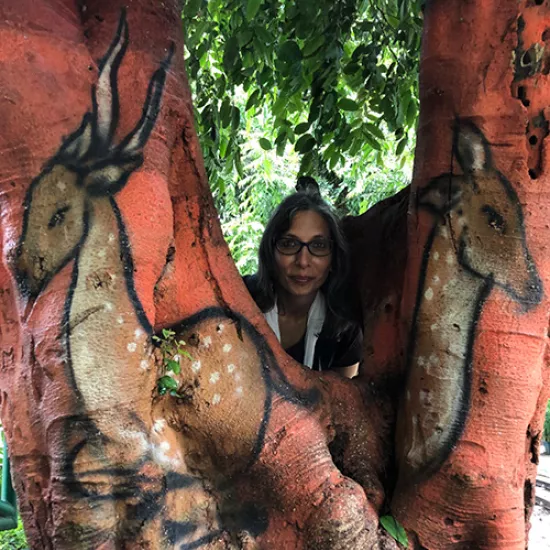
Julie Orlemanski is an Associate Professor and Director of Graduate Studies in the Department of English Language and Literature at the University of Chicago. She holds a Ph.D. and MA from Harvard University (2010) and a BA from the University of Georgia (2004). Her scholarly work bridges late medieval literature with contemporary theoretical debates in literary criticism, the history of science, and the philosophy of fictionality. Harvard University - Ph.D. and MA (2010) University of Georgia - BA (2004) Her research focuses on medieval medical discourse, the poetics of literary personhood, and the historiography of fiction. She is currently completing Making Literary Persons: A Poetics of Voice in Chaucer , which explores Chaucerian narratology, and developing a book on Bernard of Clairvaux's Sermons on the Song of Songs , considering how medieval writing virtualized embodied speech. Her 2019 monograph Symptomatic Subjects examines medical causation in pre-modern literature. Julie serves as Book-Review Editor for Exemplaria: Medieval, Early Modern, Theory (2025–) and has edited special issues on trans-regional medieval studies. Her recent publications analyze medieval fictionality, personification, and the ethical stakes of literary voice. She has presented at the English Institute Annual Conference and organized graduate research symposia.
Professor Emma Mason is a leading academic in the Department of English and Comparative Literary Studies at the University of Warwick . Her career spans roles as an educator, editor, and researcher with a focus on poetry, Christianity and literature, Catholic theology, and ecological themes in the long nineteenth-century . Editor of the Bloomsbury monograph series New Directions in Religion and Literature Co-editor of the Year's Work in Critical and Cultural Theory Director of the Comparative Religions and Literatures group at Warwick Her research explores spiritual materialism and ecological transformation , particularly through figures like Christina Rossetti. She is currently working on a study of Catholic mysticism in late 19th- to early 20th-century Europe. Mason's publications include Christina Rossetti: Poetry, Ecology, Faith (OUP, 2018) and co-edited volumes addressing religion in literary contexts. Recent Publications (2025-2027): Analysis of Newman's novels as ecological narratives Contributions to Cambridge and Oxford handbooks on religion and literature Editorial work on William Barnes' dialect poetry Studies on Victorian theological ecology and contemplation Scientific Awards: British Academy Postdoctoral Fellowship Mason supervises postgraduate research in poetry, religion, and affect theory . She is on study leave until Easter 2026 but remains active in editorial and collaborative projects.
Jamie H. Ferguson is an Associate Professor in the Department of English at the University of Houston, with a cross-appointment to the Honors College. He specializes in Renaissance and early modern literature, focusing on intersections between biblical hermeneutics, literary poetics, and translation theory. Renaissance Literature Shakespeare Studies Biblical Translation Great Books Tradition His research explores how theological debates shaped vernacular literary production in Early Modern Europe, with particular attention to textual materiality and interconfessional dialogues. Ferguson's publication record spans Latin, Italian, French, Polish, and English contexts. Recent projects include the annotated translation of Joachim du Bellay's Deffence et illustration de la langue françoyse and a forthcoming book on European Biblical Poetics . He has received multiple Martha Gano Houstoun Research Grants and been recognized with Honors College lecture awards.
Niamh Pattwell is Associate Professor and Head of School at the School of English, Drama and Film, University College Dublin. She holds a PhD from Trinity College Dublin and has been a faculty member at UCD since 2004, progressing from Lecturer in Old and Middle English to her current role. Her academic leadership extends to curriculum development, postgraduate teaching, and serving on university committees, including the Board of Trustees for UCD Volunteer Overseas. Her educational background includes a BA, H.Dip.Ed., H.Dip.T.Rel.Ed., and MA from University College Cork, and a PhD from Trinity College Dublin. She taught secondary school in Co. Wexford and Co. Cork before transitioning to higher education, holding teaching fellowships at Queen’s University Belfast and Trinity College Dublin. Niamh Pattwell's research focuses on the circulation and transmission of vernacular religious prose in the late Middle Ages. She has developed expertise in codicology, palaeography, and manuscript fragment studies, particularly through her work with Marsh's Library and the Index of Middle English Prose at Trinity College Dublin. Her scholarship explores the production, readership, and theological context of both orthodox and Wycliffite texts. Her recent publications show a consistent focus on Middle English religious prose, manuscript provenance, and the material culture of books. She has contributed to the Year's Work in English Studies and published on fragments, personal notebooks, and devotional texts, reflecting a deep engagement with the material and spiritual dimensions of medieval manuscripts. National Digital Learning Resources Award (2012) Broad Curriculum Post-doctoral Teaching Fellow, Trinity College Dublin (2003–2004) Irish Research Council for the Humanities and Social Sciences Postgraduate Scholarship (1999–2002) Niamh Pattwell has successfully supervised postgraduate students to MA and PhD completion and has led curriculum innovation at UCD, including the development of research-based modules on medieval manuscript fragments. She has secured internal research grants such as the HoS Research Support Scheme and has been actively involved in organizing major academic events, including the Early Book Society Biennial Conference in 2019 and 2023. Her teaching includes modules on King Arthur, medieval literature, and animal narratives, emphasizing student engagement with primary texts. She collaborates with institutions such as Marsh's Library and Trinity College Dublin and has contributed to public engagement through radio appearances and public lectures. Her work bridges academic research, teaching innovation, and cultural heritage preservation.
Kajri Jain is a Professor of Indian Visual Culture and Contemporary Art at the University of Toronto . She holds undergraduate appointments in the Department of Visual Studies (UTM) and graduate appointments in the Department of Art (St. George) , with cross-appointments at the Institute for Cinema Studies and the Centre for South Asian Studies . Education: PhD, Art History and Theory, University of Sydney MA, Art History and Theory, University of Sydney PEP, Visual Communication, National Institute of Design, Ahmedabad Research Interests: Jain’s work explores how images derive meaning not just from their visual content but from their production, circulation, and material use. Her research spans modern and contemporary Indian visual culture , including bazaar icons, monumental statues, theme parks, and representations of nature in religious and popular contexts. She employs ethnographic methods to examine the intersections of religion, politics, commerce, and aesthetics in postcolonial India. Her teaching and writing critically interrogate the legacies of European Romanticism and secular modernism in art history and visual studies. Publications & Themes: Jain has authored two major monographs— Gods in the Time of Democracy (2021) and Gods in the Bazaar (2007)—and numerous essays on topics such as mass reproduction, political iconography, urban nature, and postcolonial aesthetics. Her articles consistently engage with image theory, postcolonial critique, and the sensory politics of caste and religion in visual culture. Scientific Awards: No specific awards listed in the provided text. Advising & Affiliations: While no specific students are named, Jain teaches a wide range of undergraduate and graduate courses and is affiliated with multiple research centers at the University of Toronto. Her work bridges departments and disciplines, fostering interdisciplinary dialogue in South Asian visual studies. Labs & Teams: Jain is associated with the Graduate Department of Art History and the Centre for South Asian Studies at the Munk School of Global Affairs and Public Policy, University of Toronto.
Stephen M. Hart is a Professor of Latin American Film, Literature and Culture at University College London (UCL), affiliated with the School of European Languages, Culture and Society (SELCS) and the Department of Spanish, Portuguese and Latin American Studies. He is a General Editor at Tamesis Publishers and founder-director of the Centre of César Vallejo Studies at UCL. Education: BA (1980), MA (1984), PhD (1985) from University of Cambridge Academic Career: Lecturer at Westfield College (1984-1990), Associate/Full Professor at University of Kentucky (1991-1998), Senior Lecturer/Reader at UCL (1998-present) Specializing in Latin American literature, film, and culture, Hart has published extensively on César Vallejo and Santa Rosa de Lima, including critical editions of their works. His research spans literary theory, art history, and East-West relations, with a focus on documentary film-making and magical realism as a framework for understanding post-truth narratives. Recent publications address colonial sainthood processes, poetic modernism, and China-Latin America connections. He has directed documentary projects in Cuba since 2006 and received honors including the Order of Merit from the Peruvian Government and Honorary Doctorates from Peruvian institutions. Key Awards: Order of Merit for Distinguished Services (Peruvian Government, 2004), Honorary Doctorate (San Marcos University, 2004), Corresponding Member of Academia Peruana de la Lengua (2014) Leadership Roles: Director of UCL's ESRC DTC (2014), Director of Documentary Film-Making Summer School (Cuba, 2006-present) Teaching: Undergraduate courses on Latin American supernaturalism and cultural dilemmas; MA documentary film-making courses
Professor Kathryn Murphy is an Associate Professor in the Faculty of English Language & Literature at the University of Oxford and a Fellow and Tutor at Oriel College. Her research focuses on seventeenth-century literary and intellectual culture, blending literature, philosophy, theology, and art. She explores the interplay between form (poetic, rhetorical, and artistic) and thought, with a particular interest in essays, still-life painting, and the relationship between form and idea. Her recent projects include a biography of Robert Burton (author of The Anatomy of Melancholy ) and a study of metaphysical prose in the seventeenth century. She has also edited On Essays: Montaigne to the Present and writes essays on art, including analyses of still-life painting and devotional imagery. Her work frequently bridges literary studies and medical humanities, collaborating with the Oxford Health Biomedical Research Centre and the TORCH Medical Humanities Hub. She has curated exhibitions such as Melancholy: A New Anatomy (2021) and is preparing a 2026 exhibition on natural history. Murphy is a series editor for Edinburgh Critical Studies in Renaissance Culture and serves on the editorial boards of Cambridge Quarterly and Edinburgh Critical Studies . She contributes art criticism to Apollo and reviews Czech literature for the Times Literary Supplement . Her research emphasizes interdisciplinary exploration, examining how form—from sentences to paintings—serves as an instrument of thought. Current projects include a book on still-life painting and the immanence of meaning in objects, alongside ongoing studies of attention, distraction, and decision-making in early modern texts.
Wendy Salmond is a Professor of Art at Chapman University, holding the Martha Weidlein Masters Professorship in Art within the Wilkinson College of Arts, Humanities, and Social Sciences. She specializes in Russian and Soviet art, design, icons, architecture, the Romanov Family, and Russian Revolutionary Culture. Dr. Salmond received her academic training with a BA (Hons I) in Russian Language and Literature from the University of Otago in New Zealand (1978), followed by an MA in Slavic Languages and Literatures (1983) and a PhD in Art History (1989), both from the University of Texas at Austin. Professor Salmond is a renowned scholar of Russian and early Soviet art, architecture, and design, with particular expertise in exploring the intersection of diverse cultural traditions in Russia and the formation of national identity. Her research spans the Arts and Crafts movement, Art Nouveau, and Russian modernism, with a current focus on transformations in the perception and function of icons in Russia, from objects of devotion to works of art. She has made significant contributions to the study of Russian icons through extensive writing, lecturing, and curatorial work, including serving as a visiting curator at Hillwood Museum and Gardens and guest curator for exhibitions at Hillwood and The New York Public Library. Analysis of Professor Salmond's recent publications reveals a consistent focus on Russian religious and secular art, particularly icons and their evolving cultural significance. Her work spans historical periods from Imperial Russia through the Soviet era, with particular attention to the intersection of religious tradition and modern artistic movements. The 2020 publication 'Eternity in Low Earth Orbit: Icons on the International Space Station' demonstrates her innovative approach, examining how Russian Orthodox icons have been incorporated into the International Space Station as sacred objects, connecting terrestrial religious traditions with space exploration. Among her notable honors, Professor Salmond holds the Martha Weidlein Masters Professorship in Art at Chapman University. She has also been recognized through invitations to curate major exhibitions and edit significant scholarly volumes on Russian art. Professor Salmond teaches courses on European modernism, graphic design history, gender and Western art, art history methods, and Russian art, design, and visual culture of the Imperial and early Soviet era. Her teaching emphasizes close visual analysis, sustained discussion, and the development of research skills. As a prolific translator of texts on Russian art and culture, she has edited volumes on Sergei Konenkov, the Bolshevik sales of Russian art in the 1920s and 1930s, and the reception of Art Nouveau in Russia. Her scholarly work extends beyond traditional academic boundaries through her active engagement with museum curation and public scholarship, creating bridges between academic research and public understanding of Russian art and culture.
Rev. Dr. hab. Waldemar Żurek, Professor at the John Paul II Catholic University of Lublin, serves at the Center of Ecclesiastical Archives, Libraries and Museums (ABMK) within the Faculty of Theology. His academic career spans decades of dedicated research and publication in church history, particularly focusing on Eastern European Catholicism and the Salesian Order. As an active scholar, he continues to contribute significantly to ecclesiastical documentation and historical research. Professor Żurek's research interests center on ecclesiastical archives, parish documentation, and the history of religious orders, with particular emphasis on the Salesian Order's activities in Poland and Eastern Europe. His work explores the intersection of religious life with historical events, particularly during challenging periods like the communist era in Poland. He has developed expertise in analyzing parish inventories, visitation records, and chronicles to reconstruct religious life and administration across different historical periods. His extensive publication record demonstrates a consistent focus on documenting church history through meticulous examination of primary sources. The most recent works reveal trends toward comprehensive chronicles of religious institutions, detailed parish records analysis, and biographical studies of clergy members. His research spans multiple disciplines including religious studies, historical documentation, and Eastern European studies, with particular attention to regions like Pinsk, Lutsk, and Volhynia that have complex religious histories across changing political borders. Scientific Awards: Gold Medal for Long Service Professor Żurek has supervised numerous diploma theses including master's work on topics such as 'Social activities of Bishop Adolf Piotr Szelążek.' His editorial work includes significant publications like 'Kult Matki Bożej Ostrobramskiej w historii narodu polskiego' (The Cult of Our Lady of the Gate of Dawn in the History of the Polish Nation) and 'Ojciec Profesor Henryk Damian Wojtyska 1933-2009. Pasjonista, historyk Kościoła i dydaktyk' (Father Professor Henryk Damian Wojtyska 1933-2009. Passionist, Church Historian and Educator). He serves on the Scientific Council of the biannual journal 'Archives, Libraries and Church Museums' and is a member of the Theological Society of Józef Bilczewski in Ukraine. His work with the Center of Ecclesiastical Archives, Libraries and Museums represents a significant contribution to preserving and analyzing religious heritage. Through his leadership and scholarship, Professor Żurek has helped establish important methodologies for working with ecclesiastical documentation and has fostered international collaboration in church historical studies, particularly between Polish and Ukrainian scholars.
Elise Kleivane is an Associate Professor in Written Culture at the Department of Norse and Celtic Philology, Faculty of Humanities, University of Oslo. She has served as Head of Teaching at ILN (Institute of Language and Literature) from 2021 to 2024 and maintains an active research and teaching profile in Norse philology and related fields. Dr. Kleivane earned her PhD in Norse Philology from the University of Oslo in autumn 2011, following a Master of Arts in Norse Philology completed in spring 2003. Her academic journey has positioned her as a leading scholar in medieval Scandinavian writing culture. Her research focuses on epigraphy, runology, and medieval literacy, with particular emphasis on the intersection of written and material culture in medieval Norway. Kleivane examines how writing functioned in both public and private spheres, analyzing inscriptions in runes and Roman script as evidence of medieval communication practices. Her work bridges philology, archaeology, and cultural history to reconstruct literacy patterns in pre-modern Scandinavia. Recent projects have explored religious texts, biblical translations, and the role of writing in ecclesiastical contexts. Analysis of her publication record reveals a consistent trajectory through medieval epigraphy and literacy studies. Her work demonstrates increasing sophistication in connecting material evidence with textual analysis, moving from specific inscription studies to broader questions about writing culture. The pattern shows strong engagement with interdisciplinary approaches, combining philological expertise with archaeological and historical methodologies. Her research increasingly addresses questions of religious practice, vernacular literacy, and the transmission of knowledge in medieval Scandinavia. Among her significant appointments, she has been appointed to the Language Council's expert council for standardization and language observation (2023-2026) and to the Sources Commission (2023-2026), serving on the editorial board for the National Archives' scientific publication channels. Dr. Kleivane has secured substantial research funding, most notably leading the Norwegian Research Council-funded project 'Letters between runes and manuscripts' (2017-2021) and participating in the NORDCORP-funded 'Retracing the Reformation' project (2013-2017). She currently contributes to the Riksbanken Jubileumsfond-funded research program 'Modes of Modification' (2018-2025) as a member of its steering committee, where her research focuses on 'Texts in the Open and Out of Sight: Public and Private Communication in Epigraphy.' She teaches across multiple institutions including the University of Oslo and Stockholm University, covering subjects ranging from Norse literature and mythology to runology and medieval manuscript culture. Her teaching reflects her research interests in written culture across the medieval Scandinavian world.
Anna Bigelow is an Associate Professor of Religious Studies and Director of Graduate Studies at Stanford University. Her research focuses on Islamic Studies, South Asian and Middle Eastern Religions, emphasizing material culture and sacred spaces. She holds a BA from Smith College, MA from Columbia University, and PhD from UC Santa Barbara. Current projects include a comparative study of shared sacred sites in India and Turkey, exploring secularism's intersection with religious practices. Her notable works include Sharing the Sacred: Practicing Pluralism in Muslim North India (2010) and Islam through Objects (2021). She co-edited a special issue on Material Islam for the journal MAVCOR . Her research has been supported by the Carnegie Scholars Program and the Social Science Research Council. Bigelow advises graduate students on contemporary topics like Muslim minority populations, sacred space, and secularism. She emphasizes interdisciplinary methods combining ethnography, archival work, and cultural analysis. She collaborates with the Abbasi Program in Islamic Studies and the Center for South Asia at Stanford. Her articles analyze themes such as material religion, Sufi shrines, and postcolonial identities. She actively critiques the academic job market’s challenges, advising applicants to consider program fit and financial realities.
J. Ross Wagner is an Associate Professor of New Testament at Duke University's Divinity School since 2013. He holds a Ph.D. from Duke University (1999) and previously taught at Princeton Theological Seminary for 15 years. His research focuses on Pauline epistles, Septuagint studies, and theological exegesis, emphasizing how scriptural interpretation shaped early Jewish-Christian communities. Key works include Reading the Sealed Book (2013) and Heralds of the Good News (2002). Professor Wagner's teaching spans courses like New Testament Interpretation , Old Testament in the New , and Philippians/Philemon . He has co-investigated the Wabash Center grant Fostering a Culture of Teaching (2017–2022). His work bridges biblical scholarship with missional and contextual interpretation, as seen in studies applying Romans to post-hurricane Honduras. His scholarship intersects with Karl Barth Center collaborations and includes engagements with religious education initiatives. Current research continues exploring Paul's use of scripture, intertextuality, and the theological implications of Septuagint translation practices.
Lorenzo Geri is an Associate Professor in the Department of Modern Literature and Culture at Sapienza University of Rome's Faculty of Letters and Philosophy. His academic work focuses on Italian literature from the Middle Ages through the Renaissance, with particular expertise in Petrarchan studies, humanism, and Baroque literature. He teaches multiple courses including Italian Literature I, Texts and Questions of Italian Literature III, Italian Renaissance, and Italian Culture and Literature across various degree programs. Professor Geri's research spans eight major areas: meta-literary paths in Petrarch's work; Petrarch's relationship with religious culture; Petrarch's courtly connections; Italian lyric poetry from its origins to the 16th century; Baroque literary genres; Lucian's influence in the 15th century; connections between Italian and Northern European humanism; and Guicciardini's political experience. His work demonstrates deep engagement with textual analysis, historical context, and interdisciplinary approaches to literary studies. His recent publications show a strong focus on Petrarch's epistolary works, Erasmian studies, and Italian lyric poetry. The trend in his scholarship reveals increasing attention to the intersection of religious culture with literary production, particularly examining how theological concepts shape poetic expression across different historical periods. His editorial work on collections like 'Paths in Free Will' demonstrates his ability to synthesize complex interdisciplinary topics. Professor Geri has co-edited significant collections including 'Italian Lyric Poetry: A Fundamental Lexicon (13th-14th centuries)', 'Paths in Free Will: Theology, Philosophy and Literature from the Late Middle Ages to the Reformation', and 'Lirica e sacro tra Medioevo e Rinascimento'. His research has been supported by projects such as 'The political poetry in Curia from Avignon to Rome (1334-1513)' and studies on the manuscript circulation of Petrarch's anticurial texts. His office hours are held on Thursdays from 3-4pm, and he conducts exams in Room 1 of the Department of Modern Literature and Cultures on the fourth floor of the Faculty of Letters and Philosophy building.
Thomas Fulton is a Professor of English at Rutgers University since 2003. He specializes in early modern English literature with emphases on John Milton, William Shakespeare, and intersections of politics, religion, and book history. His research examines how biblical interpretation shaped literary and political thought in the Renaissance. Key works include Historical Milton (2010), The Book of Books (2021), and co-edited volumes like The Bible on the Shakespearean Stage (2018). He has held prestigious fellowships from the Folger Library, NEH, and Beinecke Library. Teaching highlights include leading a travel course to London's Royal Shakespeare Company and courses on Renaissance drama and political theory. Awards include the Goheen Prize and MLA's Best Special Award. Education: PhD Yale University, BA University of Wisconsin-Madison. Research interests span early modern manuscript culture, Reformation print networks, and the performative dimensions of religious texts. Current projects explore adversarial reading practices and gendered interpretations in early modern literature.
John R. Decker is an Associate Professor at the School of Information at Pratt Institute. He serves as Reviews Editor for Renaissance Quarterly , the journal of record for specialists in Art, Literature, and History of the Renaissance. Education: PhD in History of Art and Architecture from University of California, Santa Barbara MA in History of Art and Architecture from University of California, Santa Barbara MS in Data Analytics & Visualization from Pratt Institute Advanced Certificate in Information Experience Design from Pratt Institute BA in Art, Concentration in Art History from California State University, Stanislaus Dr. Decker is a historian with expertise in cultural heritage and data analytics. His research examines how images and objects function as tools of self-fashioning and investigates the role of visual and material cultures—including social media and the Internet—in asserting, mediating, and sustaining claims about "truth" and "reality" across socio-political contexts. He specializes in making complex issues accessible through data analysis, visualization, and storytelling, with particular attention to how audiences interact with information. His Information Experience Design training informs his commitment to creating usable, digestible, and engaging content. Analysis of Dr. Decker's recent publications reveals consistent focus on Renaissance studies, particularly audience reception and devotional practices in early modern Europe. His work bridges historical scholarship with contemporary data visualization techniques, demonstrating expertise in visual culture, material religion, identity formation, and historical intersections of technology and spirituality. His publications show increasing integration of digital humanities methodologies with traditional art historical research. As Reviews Editor for Renaissance Quarterly , Dr. Decker significantly contributes to scholarly discourse in Renaissance studies. His technical proficiency spans Python, R, SQL, HTML, CSS, and JavaScript, positioning him at the intersection of digital humanities and cultural heritage. He maintains an active presence on Mastodon where he engages with academic technology communities.