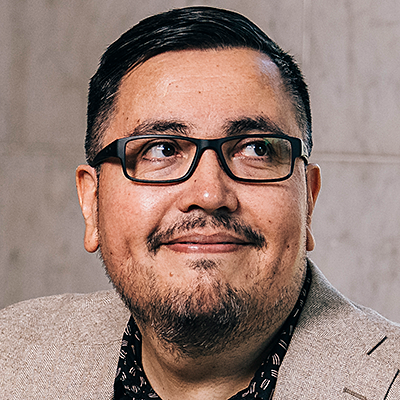
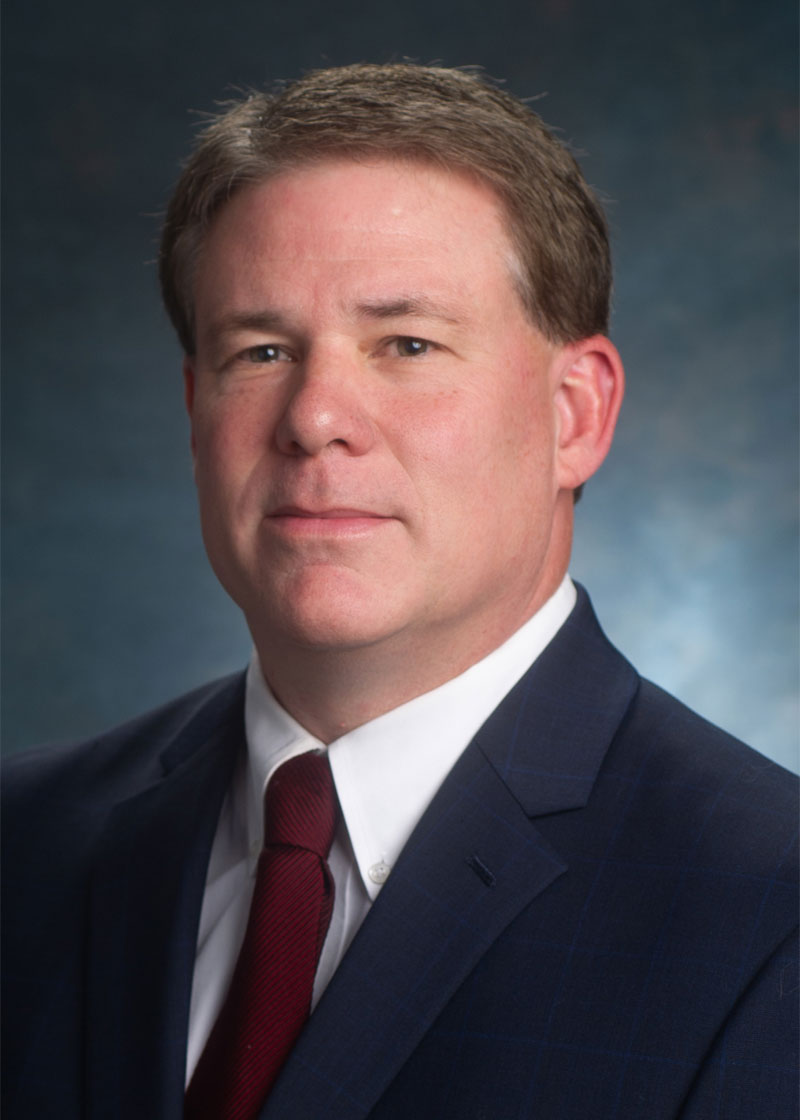
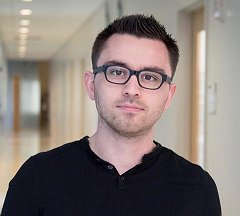
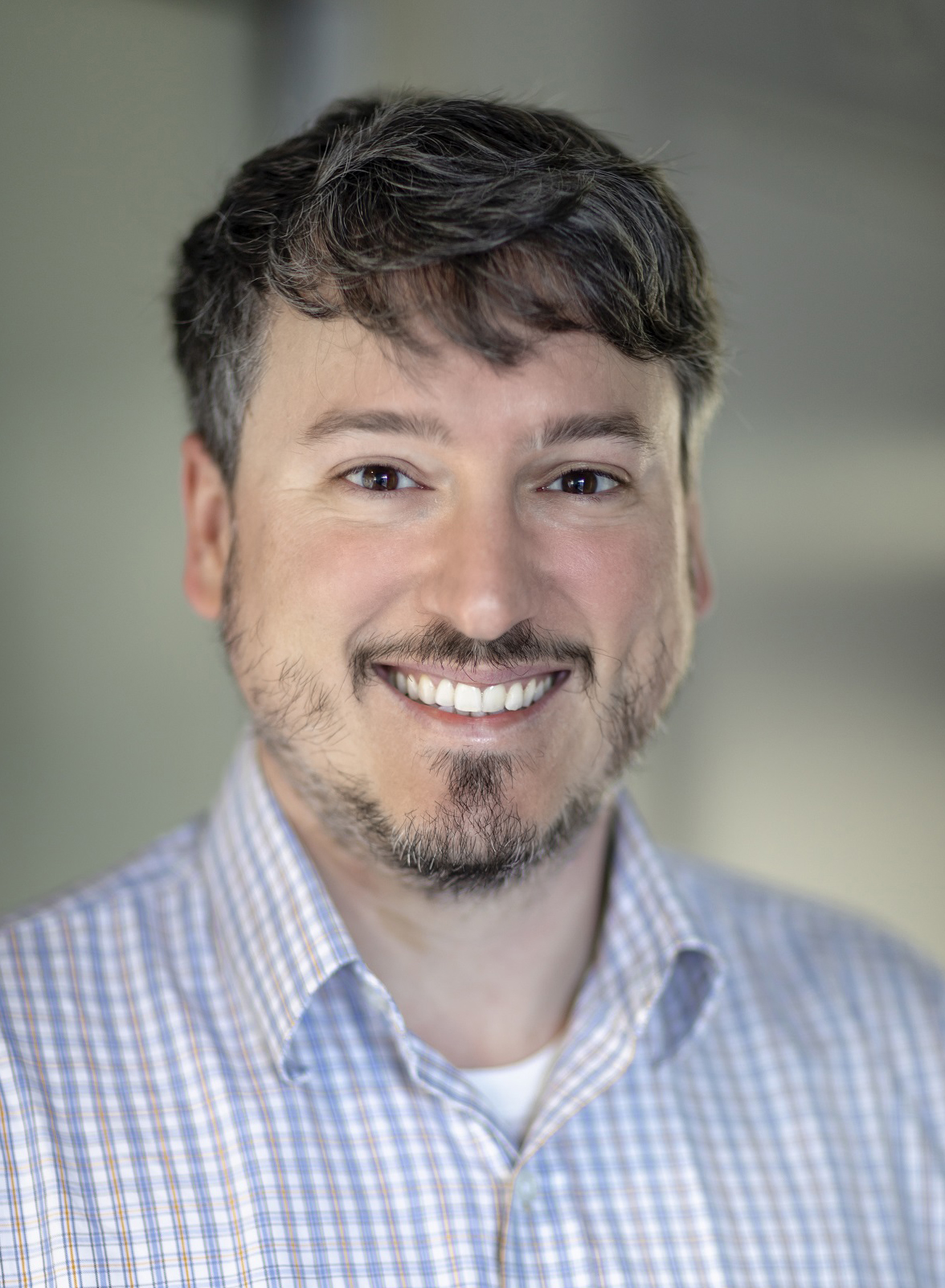
Andres Lucero is Associate Professor of Interaction Design at Aalto University's Department of Art and Media, specializing in human-computer interaction for mobile devices and interactive surfaces. His research integrates human-computer interaction, design methodologies, and playful interfaces. He holds a PhD from Eindhoven University of Technology and has industry experience from Nokia, where he led user-centered design projects as Senior Researcher. Research explores tangible interfaces, social wearables, museum experience design, human-AI collaboration, and cross-cultural co-design approaches. Recent projects investigate conversational agents in design processes, persona generation workflows, and freeform interactive devices. Dr. Lucero received the Honourable Mention Award at MUM 2020 for innovative interaction research. His work advances design methods through first-person perspectives, AI integration, and novel interaction paradigms.
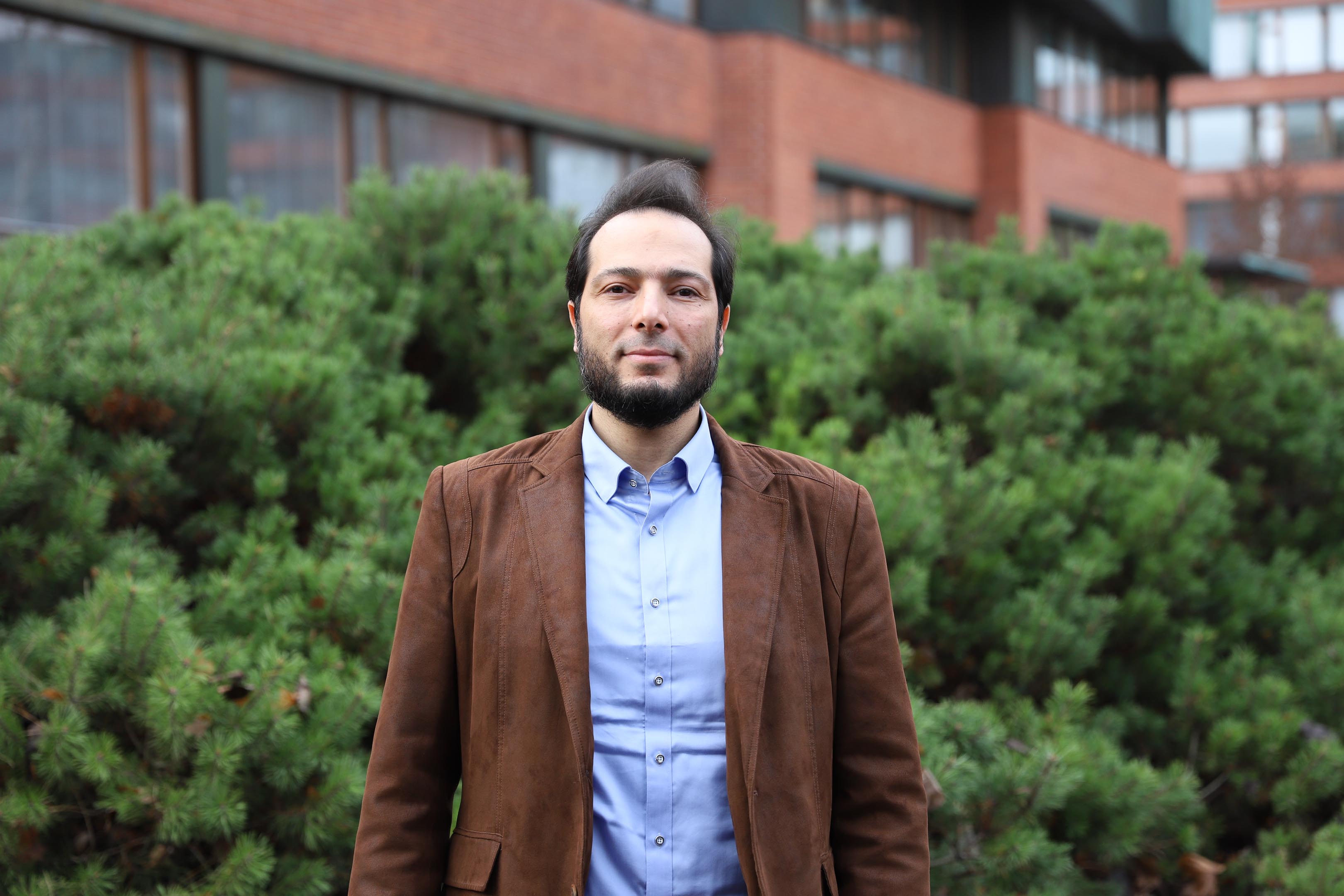
Mohamed Noureldin is an Assistant Professor at the Department of Civil Engineering, Aalto University , Finland, with prior academic roles at Sungkyunkwan University, South Korea (2015–2022). His expertise lies in integrating Artificial Intelligence (AI) with Structural Health Monitoring (SHM) , Structural Digital Twin , Predictive Maintenance , and Seismic Retrofitting . Research Focus : AI-powered sustainable structural design, smart retrofitting, predictive maintenance, structural material innovation, and next-generation performance-based seismic/wind design. Industrial Experience : 20+ years in offshore/onshore structural engineering (Hyundai Heavy Industries, Samsung Engineering, Arab-Swiss Engineering Company, Zuhair Fayez Partnership). Teaching : Courses in structural analysis, seismic design, dynamics, and reinforced concrete at Aalto and Sungkyunkwan Universities. Laboratory : Leads the Structural Design AI Lab (SDAI), focusing on AI-driven resilient infrastructure. Contact : mohamed.noureldin@aalto.fi , +358504544861. His publications explore cutting-edge applications of AI, ML, and DL in seismic retrofitting, structural durability, soil stabilization, and hybrid damping systems. Collaborative work emphasizes life-cycle cost assessment and augmented reality for predictive maintenance.
Mr. Richardo Khonasty is a Senior Research Engineer at the School of Mechanical and Mechatronic Engineering, part of the Faculty of Engineering and Information Technology at the University of Technology Sydney (UTS). He has held appointments at UTS since 2019, including roles at the Centre for Autonomous Systems and Robotics Institute. He also serves as a Tutor since 2016. PhD in Robotics (2020), UTS B.Eng. in Mechanical and Mechatronic Engineering (2014), UTS Khonasty's research focuses on robotics and human-robot collaboration, with applications in surgical robotics (total hip replacement), industrial automation (abrasive blasting), and green wall inspection systems. His work emphasizes kinematic accuracy, adaptive control schemes, and cost-effective robotic solutions. His recent publications explore robotic-assisted burring for orthopedic surgery, damping strategies for singularity management, and exoskeleton design frameworks. Khonasty is currently involved in funded research related to hydraulic tooling safety under the BTP - Stage 2 - IntelliForce Tooling grant.
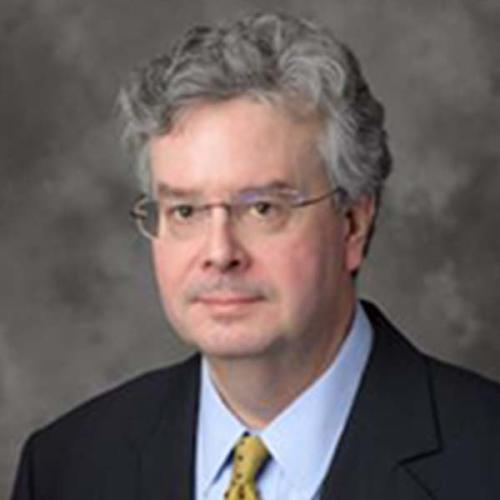
Thomas Hacker is a Professor in the Department of Computer and Information Technology at Purdue Polytechnic Institute, Purdue University. His research focuses on cloud computing, high-performance computing, operating systems, computer networking, and cyber infrastructure . He holds a Ph.D. and M.S. in Computer Science & Engineering from the University of Michigan, along with dual B.S. degrees in Computer Science and Physics from Oakland University. Education: PhD (Computer Science & Engineering), University of Michigan (2004) MS (Computer Science & Engineering), University of Michigan (1993) BS (Computer Science, Mathematics Minor), Oakland University (1989) BS (Physics), Oakland University (1989) Dr. Hacker's research spans cloud and grid computing, operating systems, and distributed systems , with applications in earthquake engineering data systems and AI-driven infrastructure analysis. His recent work explores extended layer 2 networking for bare-metal provisioning ( 2023 IEEE Cloud Summit ) and machine-supported bridge inspection using artificial intelligence ( Transportation Research Record, 2023 ). Notable scientific contributions include 15+ publications on topics like cyberinfrastructure for earthquake engineering, container-based virtualization, and data-intensive systems. His work has been recognized with awards such as the NSF CAREER Award (2010) and multiple Purdue Seed for Success Awards . Key Scientific Awards: NSF CAREER Award (2010) Purdue Seed for Success Awards (2008-2013) ASEE Information Systems Division Best Paper Award (2012) College of Technology Outstanding Faculty in Discovery Award (2010) He has held leadership roles at Purdue, including Department Head (2018-2021) and Interim Department Head (2011-2016) . His career spans academic positions at Indiana University, University of Michigan, and industry roles at Storage Technology Corporation.
Paolo Gardoni is the Alfredo H. Ang Family Professor and an Excellence Faculty Scholar in the Department of Civil and Environmental Engineering at the University of Illinois Urbana-Champaign, with additional professorial appointments in Industrial & Enterprise Systems Engineering and Biomedical & Translational Sciences. He also serves as Director of the MAE Center and Editor-in-Chief of Reliability Engineering & System Safety. Education Ph.D. in Civil Engineering, University of California, Berkeley (2002) M.A. in Statistics, University of California, Berkeley (2001) M.Eng. in Structural Engineering, University of Tokyo (1997) Laurea (BS+MS equivalent) in Structural Engineering, Politecnico di Milano (1997) Research Interests Gardoni’s scholarship integrates probabilistic methods with large-scale infrastructure systems to advance reliability, risk, and life-cycle analysis. His work quantifies the performance of deteriorating systems under natural and anthropogenic hazards, models societal impacts of disasters, and develops decision frameworks for sustainable and resilient infrastructure. He also examines ethical, social, and legal dimensions of risk, and investigates optimal strategies for hazard mitigation, disaster recovery, and climate adaptation. Across more than 250 refereed journal papers, he has advanced sub-fields ranging from probabilistic mechanics and earthquake engineering to catastrophe bond pricing and engineering ethics, leveraging tools such as stochastic differential equations, Bayesian networks, and physics-informed machine learning. Awards & Honors Alfredo Ang Award on Risk Analysis and Management of Civil Infrastructure (ASCE, 2021) Best Paper Awards in ASCE Journal of Sustainable Water in the Built Environment (2019) and Geotechnical Research (2018 Telford Premium Prize) Fellowships and named professorships: Alfredo H. Ang Family Professor, Excellence Faculty Scholar, and courtesy or honorary professorships at Tsinghua, IIT Guwahati, Tongji, Jianghan, and Loughborough universities. Research Leadership & Funding Gardoni has secured over $58 million in research funding from NSF, DHS, NIST, USAID, Qatar National Research Fund, and other agencies. He directs the MAE Center—formerly an NSF Engineering Research Center—focused on multi-hazard engineering approaches, and is Editor-in-Chief of Reliability Engineering & System Safety (Elsevier, IF 9.4). He founded and formerly led the journal Sustainable and Resilient Infrastructure (Taylor & Francis) and serves on editorial boards of nine additional journals. Advising & Mentorship He has graduated 27 PhD and 35 Master’s students, many of whom now hold faculty positions worldwide. His group maintains an active pipeline of doctoral and post-doctoral researchers working on resilience analytics, infrastructure monitoring, and risk-informed decision-making. Laboratories & Collaborations He leads the MAE Center and is affiliated with the Critical Infrastructure Resilience Institute (CIRI) and the Biomedical and Translational Sciences group. International collaborations span the UK (Loughborough), India (IIT Guwahati), and China (Tsinghua, Tongji, Jianghan), fostering cross-disciplinary research in reliability and resilience engineering.
Itsik Pe'er is a Full Professor and Vice-Chair in the Department of Computer Science at Columbia University's Fu Foundation School of Engineering & Applied Science, and holds a joint appointment as Professor of Systems Biology at the Vagelos College of Physicians and Surgeons. His research focuses on computational methods in human genetics, including genetic variation analysis, disease association studies, and algorithm development for genomic data. He leads the Itsik Pe'er Lab of Computational Genomics, which develops tools like Xplorigin, Germline, and SEACells to address challenges in genomics and medical research. His work spans machine learning applications in healthcare, microbiome analysis, and cancer genomics. Notable contributions include studies on hypertensive disorders in pregnancy, bias correction in predictive models, and the development of non-Euclidean learning libraries like Manify. Pe'er has advised students including Vladimir Vacic, Anat Kreimer, and Arthi Ramachandran, and collaborates on grants addressing genetic epidemiology and computational biology. His lab's location is in the Computer Science Building at Columbia's Morningside Campus.
Associate Professor Ng Bing Feng leads research in Additive Manufacturing, Aerospace Engineering, and Thermofluids at Nanyang Technological University's School of Mechanical & Aerospace Engineering. As Cluster Director for Smart & Sustainable Building Technologies at NTU's Energy Research Institute, he oversees projects spanning energy-efficient cooling technologies, advanced filtration systems, and bio-inspired materials. His interdisciplinary work integrates advanced manufacturing with environmental engineering, focusing on sustainable solutions for air quality management and thermal regulation. Current research explores radiative cooling technologies, acoustic agglomeration for emissions control, and crashworthy structures via biomimetic design. Professor Ng's publications demonstrate consistent innovation in multi-scale manufacturing and fluid dynamics, with growing emphasis on sustainable urban technologies. Methodologies combine experimental fluid dynamics with computational modeling and AI-driven design. Leadership Roles: Cluster Director, Energy Research Institute @ NTU Principal Investigator for multiple industry collaborations in sustainable materials Research Output: 42+ publications in high-impact journals Multiple patents in filtration technologies and cooling systems
Benjamin Lange is a Research Professor and Junior Research Group Leader in the Ethics of AI and Machine Learning at Ludwig Maximilians University of Munich (LMU) and the Munich Center for Machine Learning (MCML). He is also an Associate Research Fellow at the Oxford Uehiro Institute for Practical Ethics and a member of LMU's Zentrum für Ethik und Philosophie in der Praxis (ZEPP). His research bridges foundational ethical theory with practical challenges in technology, business, and organizational ethics. Lange holds a BSc from the London School of Economics, and a B.Phil and D.Phil from the University of Oxford. He previously held visiting positions at Google’s Responsible Innovation team and the University of Hamburg. His research focuses on ethical frameworks for AI, digital ethics, and corporate responsibility. Key themes include the ethics of human-AI collaboration, moral partiality in relationships, and organizational ethics. He has advised the European Commission on AI governance and developed assurance audit methodologies for algorithmic systems, including work for NYC’s AI Bias Law. His consulting practice focuses on helping organizations build ethical cultures through capabilities like moral imagination and compliance frameworks. Lange’s work has been featured in media such as CBS News, Business Insider, and ZDF heute journal. He is completing a book on the ethics of interpersonal relationships and partiality, aiming to connect philosophical insights with practical applications. His recent publications explore moral imagination in engineering teams, bias mitigation in AI systems, and the ethical implications of digital duplication technologies. He advises Fortune 500 companies, startups, and public institutions across sectors including finance, technology, and education. His approach emphasizes aligning ethical practices with organizational growth and social impact through tailored ethical frameworks and stakeholder engagement strategies.
Armelle Choplin is an Associate Professor at the University of Geneva's Department of Geography and Environment within the Geneva School of Social Sciences, and affiliated with the Global Studies Institute since 2019. She serves as Director of the Institute of Environmental Governance and Territorial Development (IGEDT), leading research on urban transformations in the Global South. Research Focus Her research examines urban policies, social transformations, and development challenges in African cities and the Global South. Core interests include: urban planning dynamics, governance frameworks, construction industry impacts, poverty alleviation, sustainable development pathways, globalization effects, digital innovation in urban contexts, and postcolonial urban studies. Her geographical specialization focuses on West Africa and MENA regions. Publication Analysis Recent publications (2017-2024) demonstrate consistent focus on material urbanism, governance innovations, and spatial justice in African cities. Key thematic clusters include: urban material flows (concrete, energy), participatory planning methods, transnational urban corridors, and postcolonial urban theory. Methodologically, her work combines spatial analysis with political economy and ethnographic approaches. Research Leadership She directs multiple international projects including: Global Urb: Global Urbanism from the South MatéRhône: Construction materials in Rhone Valley West African Coastal Corridor study (Accra-Lagos axis) URBACOT: West African Coastal Urban Dynamics Observatory Map&Jerry: Participatory mapping in Cotonou Student Advising Currently supervising eight doctoral candidates researching urban development topics across Africa. Her teaching portfolio includes courses on urban globalization, metropolitan governance, spatial justice, and regional project development at both bachelor's and master's levels.
Allen Murphree is an Assistant Professor in the Department of Civil, Construction, and Environmental Engineering at the University of Alabama at Birmingham (UAB). He joined UAB as a full-time faculty member after over 24 years of professional experience in civil engineering, construction management, and architectural fields. His teaching and research focus on construction engineering and management, including specialized areas such as construction project management, risk management, safety, ethics, scheduling, estimating, and Building Information Modeling (BIM). Education: B.S., Architectural Engineering M.S., Civil Engineering (Construction Management) Certifications: Alabama Licensed Contractor, Georgia Engineer Intern, Certified Professional Building Designer (CPBD), and additional industry certifications. Dr. Murphree's expertise bridges academia and industry, emphasizing practical applications in construction project lifecycle management. He is actively involved in graduate education within the Construction Engineering Management (CEM) track and maintains an office in Hoehn Engineering Building, Room 310.
Dr. Angela Siegel is an Assistant Professor and Assistant Dean, Academic Outreach in the Faculty of Computer Science at Dalhousie University, Halifax, Canada. She is actively involved in both academic leadership and research. Education: Ph.D. in Mathematics (Combinatorial Game Theory), Dalhousie University, 2011 M.Sc. in Mathematics, Dalhousie University, 2005 B.Sc. in Mathematics & Marine Geophysics, 1997 Her research focuses on combinatorial game theory, graph theory, discrete mathematics, and number theory, with a strong emphasis on computer science education and inclusive teaching . She investigates the challenges students face when transitioning into computer science programs, aiming to improve pedagogical approaches and support systems. Her work bridges theoretical mathematics and practical educational innovation. The recent publications highlight a dual focus: theoretical contributions to combinatorial games (e.g., partizan games, placement games, geography variants) and applied research in computing education, particularly student transition and inclusive practices. Her interdisciplinary work spans mathematics, computer science, and educational theory. Scientific Awards: Dr. Siegel has supervised and collaborated with students and researchers on topics including student transition into higher education computing, LEGO-based pedagogy, and workplace readiness. While no specific grants are listed, her repeated presentations and publications suggest active research funding and scholarly engagement. She has contributed to major conference proceedings and book volumes such as Games of No Chance . She is associated with research teams focused on combinatorial games and computer science education innovation, often collaborating with scholars like Richard Nowakowski, Neil McKay, and Mark Zarb. Her work in inclusive teaching and student support reflects a commitment to building accessible and equitable learning environments in computing.
Frank L. Hammond III serves as Assistant Professor at Georgia Tech's Woodruff School of Mechanical Engineering since April 2015, directing the Adaptation Robotic Manipulation (ARM) Laboratory. A Carnegie Mellon PhD graduate, he previously held postdoctoral positions at MIT and Harvard as a Ford Fellow. His interdisciplinary work bridges mechanical engineering, biomedical applications, and computational design. Education Ph.D. in Mechanical Engineering, Carnegie Mellon University M.S. in Mechanical Engineering, University of Pennsylvania M.S. in Electrical Engineering, University of Pennsylvania B.S. in Electrical Engineering & Biomedical Engineering, Drexel University Hammond's research pioneers adaptive robotic manipulation (ARM) systems that operate in unstructured human environments through bioinspired computational design. His lab develops xenomorphic (non-biomorphic) robots using soft pneumatic actuation, flexible electronics, and machine learning to achieve biological-level versatility. Key application domains include wearable human augmentation devices , haptic-enabled surgical teleoperation , and autonomous soft platforms for medical and industrial use. The ARM methodology integrates empirical biomechanics characterization with simulation-driven optimization and rapid prototyping. Analysis of his 15 most recent publications (2023-2025) reveals three dominant trends: (1) Medical rehabilitation breakthroughs through intention-driven exoskeletons with soft bioelectronics, (2) Novel locomotion strategies for soft robots in complex environments (sand, water, cluttered spaces), and (3) Advanced haptic feedback systems leveraging multimodal sensory substitution for proprioceptive restoration. These works consistently bridge biomechanics, control theory, and human factors. Awards Ford Postdoctoral Research Fellowship at Harvard School of Engineering Hammond actively mentors graduate researchers including PhD candidates Lucas Tiziani (soft actuators) and Bangyuan Liu (earthworm robotics), and Master's student Alex Hart (pediatric haptics). His lab secures research funding for projects like tunable mechanical interfaces for neuropathy treatment and cognition-focused wearable devices, with strong industry and clinical partnerships evident in co-authored medical device publications. The ARM Lab maintains robust collaborations across Georgia Tech's robotics, neuroscience, and biomedical engineering communities. The Adaptation Robotic Manipulation Laboratory operates from Whitaker Building Room 4102, housing specialized facilities for soft robot fabrication (3D printing, shape deposition manufacturing) and biomechanics testing. Current projects include pediatric haptic feedback displays, biomimetic swimming robots, and kirigami-skinned earthworm robots for subsurface locomotion. The lab emphasizes translational research with multiple pending medical device patents and active participation in K-12 STEM outreach programs.
Deian Stefan is an Associate Professor at the University of California San Diego (UCSD) in the Department of Computer Science and Engineering . His research spans security , programming languages , and systems , with a focus on building principled and practical secure systems. He has served as a co-founder and Chief Scientist at Intrinsic (acquired by VMWare) and contributed to standards bodies like the W3C WebAppSec and Node.js Security Working Groups . His research interests include: Secure Systems : Web frameworks, browser designs, sandboxing, runtime systems Language-Based Security : Constant-time programming, memory safety, information flow control Verification : Security verification, static/symbolic analysis tools WebAssembly and JavaScript JITs security Deian Stefan has received multiple scientific awards , including several Distinguished Paper Awards at venues like POPL, ICFP, and USENIX Security, as well as the IEEE Cybersecurity Award for Practice (2022) and CSAW 2020 First Place for Applied Research. He has taught courses on Computer Security (CSE 127, CSE 227) and advanced topics in Building Secure Systems (CSE 291) using Rust, WebAssembly, and blockchain security. His work has been supported by collaborations with industry and academia, including projects like RLBox and COWL .
Elliott Ash is an Associate Professor of Law, Economics, and Data Science at ETH Zurich's Center for Law & Economics. He holds a Ph.D. in Economics and J.D. from Columbia University, a B.A. in Economics, Government, and Philosophy from the University of Texas at Austin, and an LL.M. in International Criminal Law from the University of Amsterdam. His research focuses on empirical legal studies using econometrics, NLP, and ML, examining topics like judicial behavior, legislative impact, and AI-driven governance. He has been funded by the ERC, Swiss NSF, and others. Research Interests: Elliott explores automation of legal decisions, text-as-data analysis in law, and the intersection of AI with legal systems. He develops tools like BallotBot and LePaRD to enhance legal transparency and public understanding. His work bridges law, economics, and computer science, with publications in top journals like the American Economic Journal and Review of Economics and Statistics . Teaching: Courses include Building a Robot Judge , Natural Language Processing for Law , and Big Data for Public Policy . He co-organizes the Zurich Workshop in AI+Economics and Monash-Warwick-Zurich Text-as-Data Workshops. Awards: European Research Council Starting Grant, Swiss National Science Foundation Grant, and multiple grants from U.S. and Swiss institutions. His work has been featured in NPR , VoxEU , and Georgetown Law Journal . Labs/Teams: Leads the Swiss AI Initiative's Human-AI Alignment team, collaborates with the CEPR on Political Economy research, and serves as an Economic Journal Associate Editor.
Professor Hong Hao is a John Curtin Distinguished Professor at Curtin University, affiliated with the School of Civil and Mechanical Engineering and the Curtin Research Centre for Infrastructural Monitoring & Protection. His expertise spans Structural Dynamics, Earthquake Engineering, Blast and Impact Engineering, and Structural Health Monitoring. He holds prestigious roles like Fellow of ATSE, ISEAM, and ASCE, and has led organizations such as the International Association of Protective Structures and the Australian Earthquake Engineering Society. Education: BE (Tianjin University, 1982), MSc (UC Berkeley, 1985), PhD (UC Berkeley, 1989). Awards include the Tan Chin Tuan Fellowship and multiple Ko Medals. He has authored over 200 journal articles, with recent work focusing on blast-resistant materials, seismic fragility, and AI-driven structural health monitoring. His research emphasizes resilient infrastructure, including metaconcrete structures, corrosion-resistant materials, and sensor-based damage detection. Ongoing projects involve smart tunnel safety under BLEVE explosions and modular building systems.