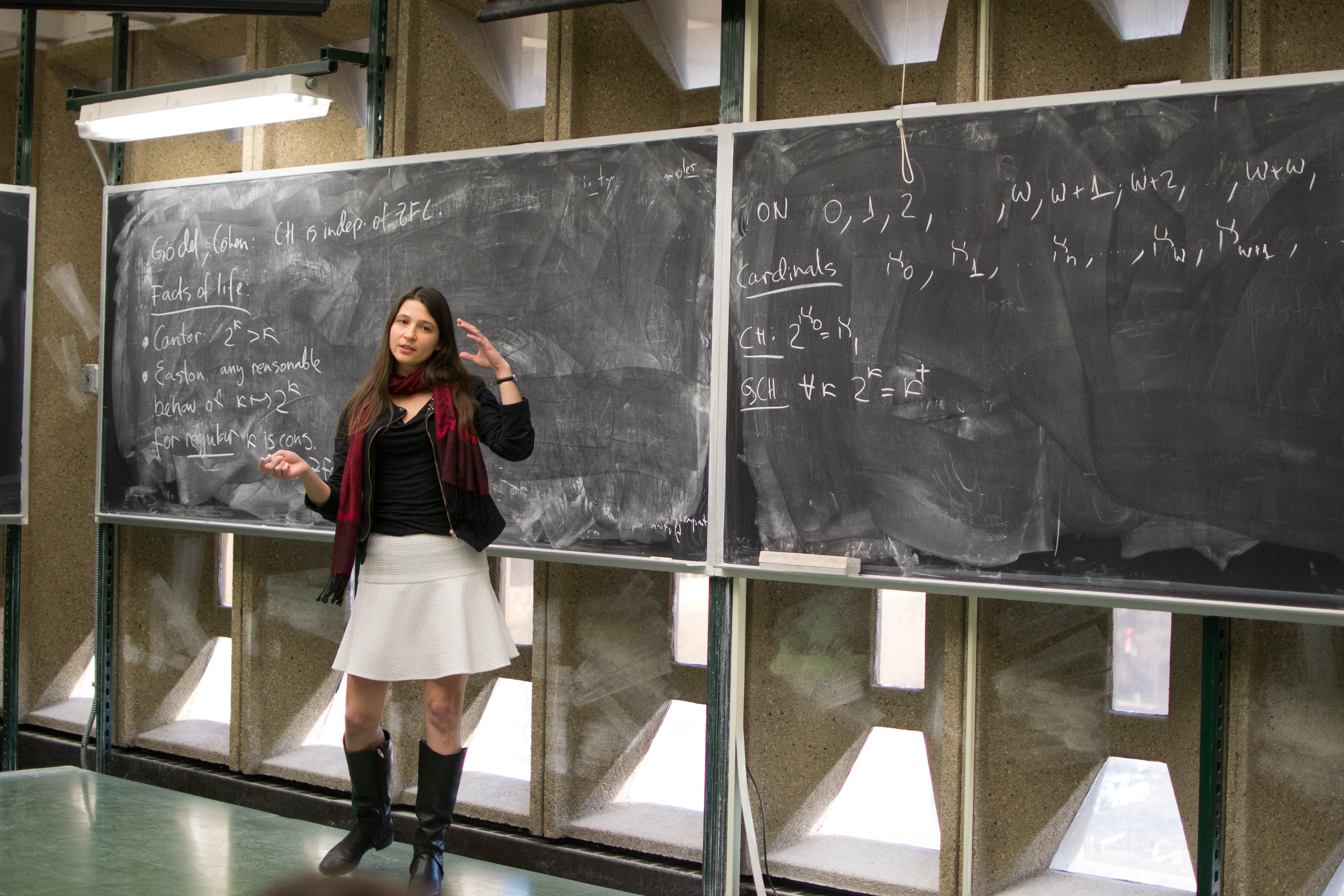
Dr. Jun Le Goh is an Assistant Professor in the Department of Mathematics at the National University of Singapore (NUS). His research focuses on mathematical logic, set theory, computational complexity, computability theory, and combinatorics. He holds a Bachelor of Science (Honors, Class 1) from NUS (2013) and a Ph.D. in Mathematics from Cornell University (2019). His work bridges foundational areas of mathematics with computability theory, particularly in reverse mathematics and Weihrauch reducibility. Notable contributions include analyzing the complexity of Halin's infinite ray theorems, studying descending sequences in ill-founded linear orders, and exploring enumeration oracles in PA relativization. His research often intersects with proof theory, recursion theory, and algorithmic information theory. Dr. Goh collaborates with institutions globally, publishing in journals like the Journal of Mathematical Logic, Annals of Pure and Applied Logic, and Computability. His preprints and conference proceedings further highlight his engagement with cutting-edge topics in computability and logic.
Sue Widdicombe is a Senior Lecturer in the Department of Psychology within the School of Philosophy, Psychology and Language Sciences at the University of Edinburgh. She teaches Social Psychology at second-year undergraduate level, Qualitative Methods in Psychology at third-year level, and supervises final honours projects. At postgraduate level, she instructs Qualitative Methodologies in Psychological Research and Problem-based Social Psychological Research while supervising MSc projects. Her academic profile combines rigorous teaching with active research supervision and methodological innovation. Her research program centers on discursive psychology and conversation analysis as frameworks for examining language in social interaction. Key foci include identity construction in everyday talk, the delicate management of self-praise and authenticity claims, resistance to identity ascriptions, and negotiation of agency. She investigates these processes across diverse contexts including youth subcultures, cross-cultural interactions, religious identity, health communication, and climate activism. Her methodological approach emphasizes how psychological phenomena emerge through interactional practices rather than pre-existing mental states. Analysis of her fifteen most recent publications reveals consistent application of discursive and conversation analytic methods to examine identity work across social domains. Her work demonstrates increasing engagement with contemporary societal issues, particularly climate activism in media contexts, while maintaining theoretical rigor in identity research. The publications span clinical health settings (ART adherence), digital communities (online emo groups), cross-cultural fieldwork (Syria), and broadcast media (climate interviews), showcasing methodological adaptability. Widdicombe currently supervises four PhD students: Paula Greenlees, Lasse Schaefer, Kayleigh Smith, and Miranda Heath. Her supervision focuses on discursive psychological approaches to self and identity, climate activism, and psychology in social interaction. She has established collaborative networks with scholars including Cristina Marinho, Rahul Sambaraju, and Eric Laurier, leading to interdisciplinary projects that bridge academic research and practical applications in healthcare, media, and social justice contexts. Her research group engages with real-world interactional data through workshops on telephone helplines, HIV medication adherence, and racism reporting. Current initiatives include a four-country feasibility study on public engagement with climate news (UK, India, Portugal, Brazil) and investigations into 'trial by social media' regarding domestic violence allegations. These projects emphasize the practical utility of conversation analysis in addressing pressing social phenomena while advancing theoretical understanding of identity construction.
Dr. Manlio Valenti is a Lecturer in Computer Science at Swansea University specializing in theoretical computer science. His research focuses on computability theory, computable analysis, and Weihrauch reducibility within the School of Mathematics and Computer Science. His work explores foundational aspects of computation, particularly the mathematical structures underlying computable functions and reducibility relations. Research examines the Weihrauch lattice, computational aspects of mathematical theorems, and categorical approaches to reducibility. Dr. Valenti's publications demonstrate consistent focus on the Weihrauch lattice and computable analysis, with recent work investigating lattice structures, jump operators, and connections to reverse mathematics. Publications appear in theoretical computer science and mathematical logic venues.
Marianna Nicolosi Asmundo is an Associate Professor of Mathematical Logic (MAT/01) at the Department of Mathematics and Computer Science (DMI) of the University of Catania. She earned her PhD from the same university in 2003 and serves as a proposing member of CINUM - Interdepartmental Center for Humanistic Computing. Teaches undergraduate and graduate programs in Mathematics Master's Degree Programs in Computer Science Textual Sciences for Digital Professions (Department of Humanities) Her research spans automatic deduction, tableaux-based deductive systems, decision procedures in elementary set theory and non-classical logic, interactive theorem proving, knowledge bases, ontologies, and reasoning services for the semantic web. Recent publications emphasize ontology interoperability, blockchain-based knowledge representation, and set-theoretic reasoning frameworks. She contributes to ontologies for cultural heritage (Saint Gall monastery modeling, archaeological Sicilian landscapes) and blockchain applications. Collaborates extensively with researchers like D. Cantone and D.F. Santamaria on description logic systems. Active member of CINUM - Interdepartmental Center for Humanistic Computing Supervises thesis projects on semantic web and blockchain ontologies
Piotr Szewczak is a Senior Lecturer at the Faculty of Mathematics and Natural Sciences, Cardinal Stefan Wyszyński University (UKSW). He is actively involved in research related to set-theoretic topology, covering properties, and selection principles. His work focuses on foundational aspects of topology, including Menger and Hurewicz properties, productivity of paracompactness, and interactions between combinatorics and topological spaces. The trends in his recent publications highlight interdisciplinary connections with forcing models, game theory, and ultrafilter dynamics. His contact information includes the email p.szewczak@uksw.edu.pl , and he holds regular consultations in room 1224.
Anne Catherine Gieshoff is a Researcher at the ZHAW School of Applied Linguistics, affiliated with the Institute of Multilingual Communication. Her work focuses on cognitive aspects of interpreting, technology integration in language professions, and multilingual healthcare communication. She holds a Ph.D. from Johannes Gutenberg University Mainz (2018) and has extensive professional experience in translation and cross-border project management. Education includes a Ph.D. in Interpreting Studies (2018), M.A. in Conference Interpreting (2013-2018), and studies in multilingual communication at institutions across Europe. Her research explores cognitive load in interpreting, augmented reality applications, and ELF (English as a Lingua Franca) dynamics in professional settings. Recent publications address topics like augmented reality usability for interpreters, cognitive load measurement frameworks, and machine translation in healthcare. She leads projects such as 'Use of machine translation apps in clinical contexts' and 'Assessment of multimodal interpreting technologies'. Key Projects: DigiLinguo (language barriers in public institutions), AR interpreter usability studies, and ELF density analysis Teaching: Courses on descriptive statistics, multilingualism in professional contexts, and communication science in virtual spaces Labs/Teams: Member of TREC (Translation, Research, Empiricism and Cognition) and IATIS (International Association for Translation and Intercultural Studies)
Eric Balkanski serves as Assistant Professor of Industrial Engineering and Operations Research at Columbia Engineering, Columbia University, and is an Affiliated Member of the Foundations of Data Science Institute. His academic home integrates theoretical computer science with operations research methodologies. Balkanski earned his PhD in Computer Science from Harvard University, establishing foundational expertise in algorithmic theory before joining Columbia's faculty. His research pioneers algorithms with predictions —a transformative paradigm blending machine learning insights with classical optimization. Key thrusts include exponentially faster submodular optimization for data summarization and recommendation systems, strategyproof mechanism design incorporating predictive advice, and fairness-aware online algorithms . This work bridges theoretical guarantees with real-world applications in network analysis and decision-making under uncertainty, often yielding breakthroughs in computational efficiency. Recent publications (2022-2025) reveal a dominant trend toward prediction-augmented frameworks across scheduling, correlation clustering, and facility location. His submodular optimization advances enable orders-of-magnitude speedups, while fairness-oriented work introduces novel cost-free fairness models for online settings. The consistent focus on theoretical foundations of learning-augmented algorithms positions him at the forefront of this emerging field. His accolades demonstrate exceptional scholarly impact: ACM SIGecom Doctoral Dissertation Honorable Mention Award Google PhD Fellowship Smith Family Graduate Science and Engineering Fellowship Best Paper Award at CIAA 2013 Andrew Carnegie Society Scholar Balkanski co-founded Robust Intelligence (an AI security startup), translating theoretical work into practical cybersecurity applications. His NSF-funded collaborative research on 'Mechanisms with Predictions' indicates active grant leadership, though specific student advising details remain unpublicized. The absence of formal lab descriptions suggests integration within Columbia's broader data science and operations research ecosystems. As an early-career researcher, Balkanski demonstrates remarkable productivity with 15+ high-impact publications since 2022, primarily in top-tier venues like STOC, NeurIPS, and EC. His trajectory suggests continued leadership in bridging algorithmic theory with machine learning applications.
Clinton Conley is an Associate Professor and Director of Graduate Studies in the Department of Mathematical Sciences at Carnegie Mellon University, part of the Mellon College of Science. He holds a Ph.D. in Mathematics from UCLA and has held postdoctoral appointments at the Kurt Gödel Research Center (Vienna, Austria) and Cornell University. His research focuses on descriptive set theory, measurable group actions, and Borel graphs, exploring intersections with ergodic theory, combinatorics, and set theory. Key research areas include measurable chromatic numbers, Borel combinatorics, and hyperfinite equivalence relations. His work often bridges abstract set-theoretic principles with concrete problems in dynamics and graph theory. Notable awards include the Julius Ashkin Award. Education: Ph.D. in Mathematics, University of California, Los Angeles Postdoctoral Appointments: KGRC (Vienna), Cornell University Recent publications span topics like measurable regular subgraphs, quasi-invariant measures, and hyperfiniteness in Borel combinatorics. Teaching includes advanced courses on descriptive set theory, set theory, and mathematical paradoxes. Advising and grants sections remain unspecified in available data. No lab or team affiliations are noted.
Dima Sinapova is a Professor of Mathematics at Rutgers University, where she is affiliated with the Department of Mathematics. Her research interests lie in Mathematical Logic and Set Theory, particularly focusing on combinatorial set theory, forcing techniques, large cardinals, and consistency results. Affiliations: Rutgers University, Department of Mathematics. Teaching: Courses include Abstract Algebra II (Spring 2025) and Axiomatic Set Theory (Fall 2024). Research Interests: Professor Sinapova's work centers on foundational aspects of mathematics, including the study of tree properties, singular cardinal hypotheses, and advanced forcing methods. Her contributions explore the boundaries of consistency results and large cardinal axioms, with applications to combinatorial principles and cardinal arithmetic. Her recent publications (2023-2016) reflect a focus on Prikry forcing, square principles, and the interplay between combinatorial set theory and large cardinal axioms. These works often involve collaboration with leading researchers in the field. Organizations: Organized conferences such as the MAMLS Fall Fest 2024, MAMLS Spring Fling 2022, and Logic Fest in the Windy City 2019. Contributed to workshops and panels promoting graduate studies in mathematics. Her academic activities include mentoring through teaching and conference leadership, fostering collaboration in set theory and logic.
Artem Chernikov is a Professor and the Michael Brin Endowed Chair in Mathematics at the University of Maryland, College Park. Previously, he held positions at UCLA from 2015-2023, including roles as Assistant Professor (2015-2018), Associate Professor (2018-2022), and Professor (2022-2023). His research focuses on model theory, particularly Shelah's classification theory (stability, simplicity, NIP/NTP2 properties) and its applications to algebra, geometry, combinatorics, and computer science. He has supervised numerous graduate students and postdoctoral researchers, including notable advisees like Alex Mennen and Chuyin Jiang. Education includes a Ph.D. in Mathematical Logic from Université Claude Bernard Lyon 1 (2012), advised by Itaï Ben Yaacov, and a M.Sc. from Humboldt University Berlin (2009). He also held postdoctoral fellowships at the Hebrew University of Jerusalem, MSRI Berkeley, and Université Paris Diderot. Key awards include the 2023 NSF Research Grant, 2020 Simons Fellowship, 2017 NSF CAREER Award, and the 2013 Sacks Prize for best doctoral dissertation in mathematical logic. His work bridges model theory with combinatorics, topological dynamics, and valuation theory, yielding results in hypergraph regularity, invariant measures, and algebraic structures. Teaching includes advanced courses on model theory, stability, and combinatorics. He co-organized major conferences like the 2025 Model Theory and Applications conference in Warwick and the 2023 EMS Summer School in Leeds. His research outputs include over 30 peer-reviewed papers and invited talks globally, reflecting interdisciplinary impact.
Juan P. Aguilera is a researcher at the Institute of Discrete Mathematics and Geometry at TU Wien, Austria. His research focuses on mathematical logic, particularly in proof theory, set theory, reverse mathematics, and infinitary logics. He actively participates in academic events, including organizing workshops and giving invited talks globally. His research interests span foundational questions in logic, including Gödel logics, determinacy axioms, and structural reflection principles. He contributes to interdisciplinary areas such as the model theory of non-classical logics and applications of infinitary proof systems. Aguilera has been involved in major logic events like the Logic Colloquium 2025 (TU Wien) and co-organized the Philosophical Transactions of the Royal Society special issue on proof theory (2023). He has given talks at institutions like Ghent University, the University of Hamburg, and ITAM (Mexico City). No scientific awards are explicitly listed, but his prolific engagement in academic conferences and editorial work highlights his contributions to the field. He has secured grants and leads collaborative projects, though specific grant details are not provided. He is affiliated with TU Wien's discrete mathematics group and collaborates internationally on logic and set theory research.
Jonathan A. Kelner is a Professor of Applied Mathematics at the Massachusetts Institute of Technology (MIT) and a member of the Computer Science and Artificial Intelligence Laboratory (CSAIL) . His research bridges pure mathematics and algorithms, focusing on spectral graph theory, combinatorial optimization, and distributed computing.
Felix Weilacher is an NSF Postdoctoral Fellow at the University of California, Berkeley. His research lies at the intersection of mathematical logic and combinatorics, focusing on Borel, measurable, and computable combinatorics of graphs. Contact: weilacher@berkeley.edu , Office: 837 Evans Hall. Research Interests : Combinatorics of graphs in descriptive set theory contexts Interconnections between computability, Borel structures, and graph theory Applications of the Local Lemma in Borel settings Edge colorings and chromatic numbers for locally finite graphs GitHub Contributions : dst : Descriptive set theory formalization in Lean Borel Determinacy Formalization : Lean 4-based proof of Martin’s theorem Scientific Awards : NSF Postdoctoral Fellowship Notable Projects : Projective Hex : Implementation of Bill Taylor’s game
Ryo Ito is an Associate Professor at Waseda University's Faculty of Letters, Arts and Sciences. His research focuses on early analytic philosophy, philosophy of logic, and inferentialism, with a particular emphasis on Bertrand Russell's work. He holds a PhD from the University of St Andrews and Stirling University, awarded in 2017, and previously served as a JSPS Research Fellow at Keio University (2019-2021). Education: PhD in Philosophy (2017) from University of St Andrews & Stirling University; Master's (2011) and Bachelor's (2009) from Kyoto University. Ryo's research explores the intersection of logic, metaphysics, and educational philosophy. His work addresses conceptual challenges in mathematics education through inferentialism, the historiography of philosophy, and Russell's metaphysical conception of logic. He has presented extensively on topics such as rule-following paradoxes, logical coordinates, and the role of variables in philosophical discourse. Scientific Awards: Ishimoto Award (2023, Philosophy of Science Society, Japan) Encouragement Award (2019, Japan Association for Philosophy of Science) Ryo actively participates in interdisciplinary research projects funded by JSPS, including studies on type theory, free will, and rule-based reasoning. His teaching spans seminars on Anglo-American philosophy, history of Western thought, and graduate-level research guidance.
Rohan French is an Associate Professor in the Department of Philosophy at the University of California, Davis (UC Davis), where he has been employed since 2018. Previously, he was a post-doctoral researcher at the University of Groningen in the Netherlands. Education: Ph.D. in Philosophy, Monash University (2011) B.A. in Philosophy and Computer Science, Monash University (2006) Research Focus: French specializes in philosophical logic with emphasis on: Modal and non-classical logics Proof theory and semantic paradoxes Formal methods in philosophy Substructural approaches to logic Logic translation and expressivity Publications Overview: His scholarly output primarily explores technical aspects of logic systems, including model theory, dialogical frameworks, and paradox resolution. Recent works demonstrate consistent focus on valuational semantics, proof-theoretic structures, and applications of non-classical logics to philosophical problems. Collaborative research features prominently in his publication record.