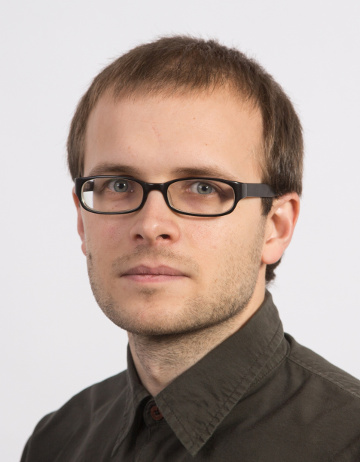
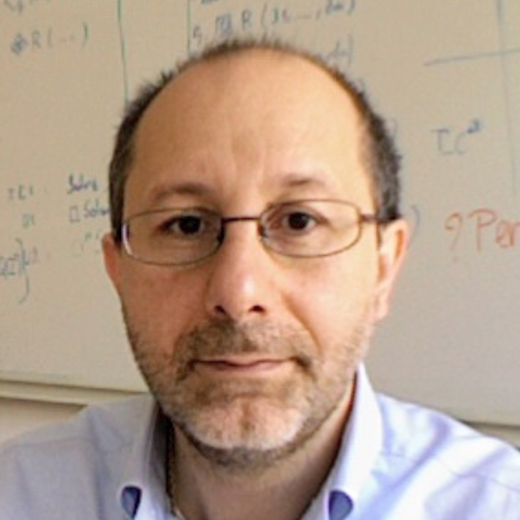
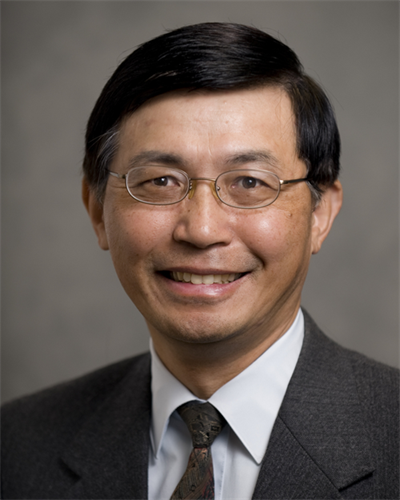
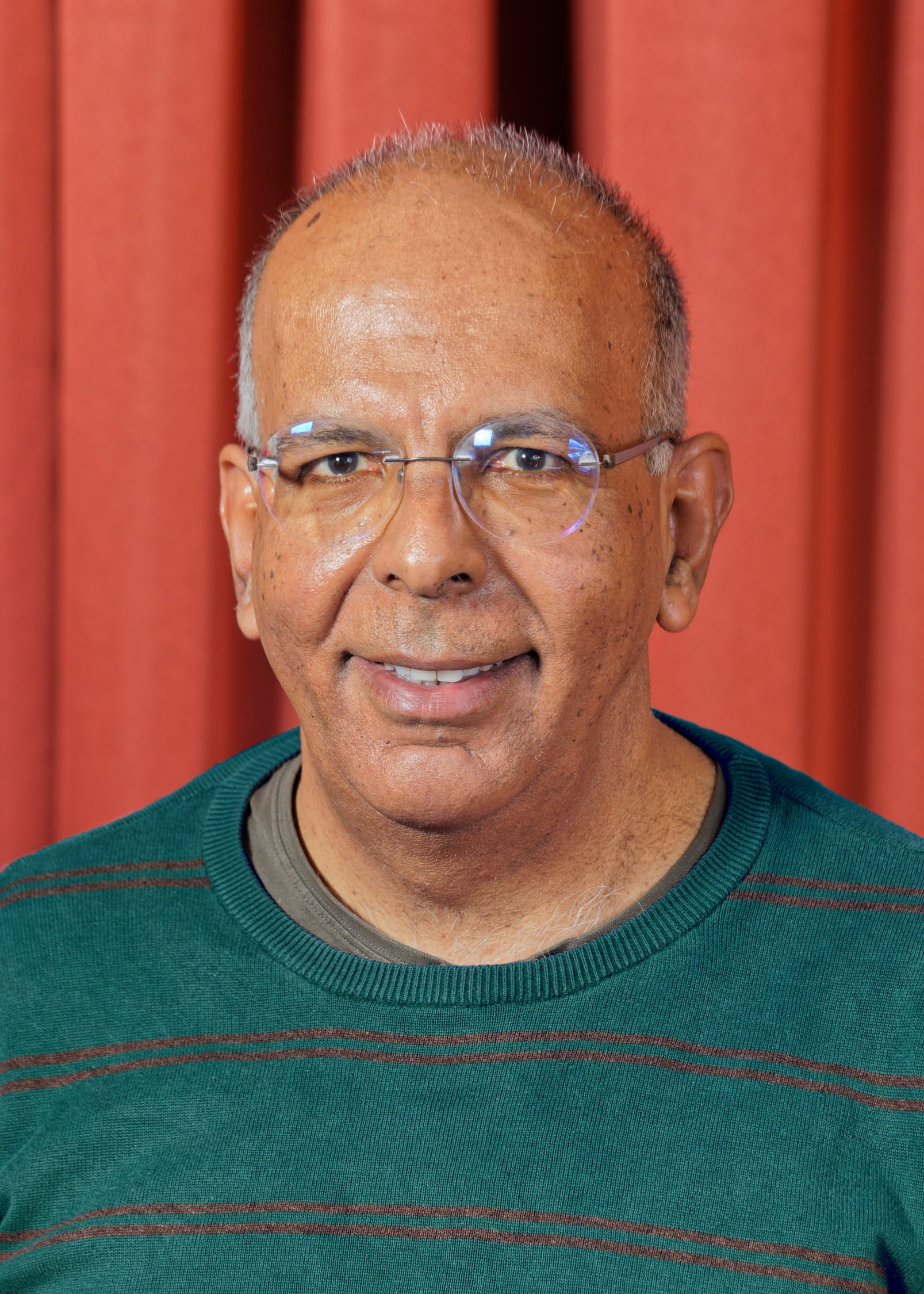
Randolph Goldman, Ph.D., is an Associate Professor of Mathematics and Chair of the Department of Mathematics at Hawaii Pacific University within the College of Natural and Computational Sciences. He specializes in mathematical logic and related theoretical disciplines. Education: Ph.D. in Logic and Methodology of Science from UC Berkeley Research interests span Mathematical Logic, Modal Logic, Metamathematics, Recursion Theory, Model Theory, and Set Theory. His work explores Gödel's theorems, non-standard analysis, and computational complexity. Teaching achievements include mentoring undergraduate students in graduate-level logic theorems and producing advisees accepted to elite programs at UC Berkeley and MIT. Courses taught range from foundational mathematics to advanced topics like Real Analysis and Topology. Professional activities involve editorial work as managing editor of the Australasian Journal of Logic at Victoria University of Wellington.
Stefan Borgwardt is a Researcher and Teaching Associate at the Chair of Automata Theory, Faculty of Computer Science, Technische Universität Dresden, working under Prof. Franz Baader. He leads key research projects such as Practical Planning with Ontologies (PPO) and contributes to the Center for Perspicuous Computing (CPEC), funded by DFG and SNF. His work bridges theoretical logic and practical AI systems. Research Interests: Knowledge Representation and Reasoning Description Logics and Ontology-Mediated Query Answering Explainable AI and Proof Visualization (Evee/ Evonne systems) Temporal, Fuzzy, and Probabilistic Logics Automated Planning with Ontologies Logic-Guided Natural Language Generation His recent publications (2021–2025) show a strong trend toward explainability in logical reasoning, with a focus on modular, interactive, and user-friendly proof systems. He investigates reasoning complexity in expressive description logics and develops practical tools for ontology explanation and planning. His work often combines symbolic AI with real-world applications such as sensor data interpretation and autonomous systems. Scientific Awards: Harold Boley Distinguished Paper Award (RuleML+RR'23) Best Paper Award (RuleML+RR'22, JELIA'19, AI'15) Quality Champion for ECAI'23 reviewing Commerzbank Award for PhD thesis (2014) Distinguished Student Paper Awards (DL'14, DL'13) N. J. Lehmann Award (2011) Stefan Borgwardt actively advises and collaborates with students and early-career researchers on projects involving explanation, planning, and reasoning. He has secured competitive funding through DFG and SNF grants and plays a leadership role in the KR community as PC co-chair, senior PC member, and steering committee member for major conferences like DL, KR, and JELIA. He is also a reviewer for top-tier journals including Artificial Intelligence and Journal of the ACM . Labs and Teams: He is a core member of the Chair of Automata Theory at TU Dresden and contributes to the Center for Perspicuous Computing (CPEC), where he works on projects A3 (Description Logic Explications) and E2 (Safe Handover in Mixed-Initiative Control) in collaboration with Vera Demberg and Antonio Krüger.
Alessandro Artale is an Associate Professor in the Faculty of Computer Science at the Free University of Bozen-Bolzano, where he is affiliated with the KRDB Research Centre. His research spans theoretical and applied aspects of knowledge representation, ontologies, and temporal reasoning. He earned his PhD in Computer Science from the University of Florence in 1994 and has held research and academic positions at CNR-LADSEB, IRST (now FBK), and UMIST (University of Manchester). PhD in Computer Science, University of Florence, 1994 His research interests include: Description Logics Ontologies and Conceptual Modelling Temporal and Computational Logics Knowledge Representation and Databases Artificial Intelligence and Natural Language Semantics His recent scholarly activities are reflected in his participation in leading international conferences such as AAAI, IJCAI, ECAI, KR, DL, TIME, and FoIKS. These publications and committee roles highlight a consistent focus on formal methods in AI, particularly in the areas of description logics, temporal reasoning, and ontology-based systems. The research demonstrates a strong theoretical foundation with applications in semantic web technologies and knowledge-driven systems. Notable scientific contributions include: Principal Investigator of the EPSRC project on Temporal Databases using Description Logics (2001–2004) Member of the KnowledgeWeb Network of Excellence Member of the InterOp Network of Excellence Member of the ESPRIT DWQ project on Data Warehouse Quality Artale has advised numerous Master's and PhD students through project supervision and has organized academic events such as the TIME and DL workshops. He has served on the program committees of over 50 international conferences and workshops, demonstrating extensive engagement with the research community. His teaching includes core computer science courses in algorithms, formal languages, compilers, and discrete mathematics. He is actively involved in research labs and teams including: KRDB Research Centre, Free University of Bozen-Bolzano Collaborations with European research networks (KnowledgeWeb, InterOp)
Chorng Hwa Chang is an Associate Professor in the Department of Electrical and Computer Engineering at Tufts University. He joined the faculty in 1987 and currently directs the Computer Engineering Program and the Tufts Wireless Lab (TWL). His research focuses on computer architecture, wireless communications, IoT protocols, and engineering education. Education: Ph.D., Electrical and Computer Engineering, Drexel University (1987) M.S., Computer Science, Montana State University (1983) B.S., Engineering Science, National Cheng Kung University (1977) Research Interests: Dr. Chang’s work spans wireless sensor networks, 6LoWPAN protocols, WiFi backtracking, and IoT implementations. His projects include the TWL Lab’s initiatives in smart healthcare systems and autonomous robotic networks. Recent publications highlight innovations in GPU-accelerated algorithms, cloud shape classification, and interferometric positioning systems. Grants & Advising: He advises numerous graduate and undergraduate students on projects like motion detection systems, IoT platforms, and sensor network optimization. His lab collaborates on military and civilian applications, including border surveillance and healthcare monitoring. Labs/Teams: Director of the Tufts Wireless Lab (TWL), leading cross-disciplinary research in wireless communication and embedded systems.
Professor Anuj Dawar is a leading academic in Theoretical Computer Science at the University of Cambridge's Department of Computer Science and Technology. He holds a PhD from the University of Pennsylvania (1993) and has been a faculty member since 1999. His research focuses on computational complexity via logic, descriptive complexity, and finite model theory, with applications to databases, verification, and games. Education: PhD in Computer Science, University of Pennsylvania (1993) Masters, University of Delaware Bachelor's, Indian Institute of Technology (Delhi) Research Interests: His work bridges logic and computation, investigating limits of symmetric algorithms and complexity through formal languages. Notable themes include: Descriptive complexity and homomorphism preservation Finite model theory and its applications Algorithmic model theory and constraint satisfaction Professional Activities: Editor-in-Chief, ACM Transactions on Computational Logic Former president of European Association for Computer Science Logic Committee roles for Gödel Prize, Church Award, and Nerode Award Advising & Teaching: Supervised over 15 PhD students and taught advanced courses like Quantum Computing, Complexity Theory, and Foundations of Functional Programming. Currently on sabbatical (2024–25).
Andreas Brannstrom is a Postdoctoral Fellow at the Department of Computing Science, Umeå University, Sweden, conducting research on formal and neuro-symbolic methods for trustworthy, human-centered artificial intelligence. His work spans theoretical foundations in knowledge representation to applied verification of interactive systems and intelligent decision support. His research focuses on formal verification of human-agent interaction, neuro-symbolic AI integration, and ethical AI development. Key methodologies include Answer Set Programming (ASP), formal argumentation, and Description Logic (DL), targeting applications in deception detection, computational empathy, and behavior-change systems. Recent work emphasizes security in information-seeking dialogues and socio-technical aspects of AI deployment. Analysis of his 2023-2025 publications reveals a dominant trend in verifying social engineering vulnerabilities through formal methods, with significant contributions to machine ethics ontologies and multicultural affective computing. His research consistently bridges theoretical AI frameworks with real-world applications in healthcare, industrial logistics, and public safety. Brannstrom is affiliated with Umeå University's Agents and Reasoning Group, Formal Methods for Trustworthy Hybrid Intelligence, and Responsible Artificial Intelligence research groups. His active projects include "Strategic Argumentation to deal with interactions between intelligent systems and humans" (2020-2024) and "Collaborative mixed-reality aid for children with autism" (2019-2020), demonstrating commitment to socially impactful AI research.
Tanya Braun is a Junior Professor in the Institute of Computer Science at the University of Münster, Department of Mathematics and Computer Science. She leads the Data Science research group, focusing on statistical-relational AI, human-aware AI, and text understanding. Her work bridges formal AI methods with real-world applications in healthcare, digital humanities, and public sector systems. Education: Bachelor's and Master's in Computational Informatics, Hamburg University of Technology Doctorate in Computer Science, University of Lübeck (2020), thesis: 'Rescued from a Sea of Queries - Exact Inference in Probabilistic Relational Models' Her research centers on probabilistic inference in relational domains , with a focus on lifted inference techniques that exploit symmetries to scale reasoning. She investigates human-aware AI , particularly how AI systems can reconcile learned models with human expectations to improve explainability and trust. Her work on text understanding addresses challenges in data-scarce settings such as digital humanities, where traditional large language models fail. She has developed methods for identifying and enriching subjective content descriptions, topic modeling in specialized domains, and feedback-driven model improvement. The 15 most recent publications highlight a strong trajectory in lifted inference, model compression, privacy-preserving AI, and explainability . Her work integrates formal AI foundations with practical concerns in high-stakes domains like healthcare. She frequently publishes in top venues such as AAAI, IJCAI, ECAI, and Artificial Intelligence, often in collaboration with Ralf Möller, Marcel Gehrke, and Jan Speller. Scientific Awards: No specific awards listed in the provided text. Tanya Braun actively advises students and leads the HAPPI project, which focuses on human-AI model reconciliation using lifted probabilistic inference. She has supervised multiple theses and mentored researchers including Jan Speller (PostDoc), Nazlı Nur Karabulut, and Sagad Hamid. She has secured funding from the Ministry of Culture and Science of North Rhine-Westphalia for her research. She is deeply involved in academic service: serving as program co-chair for KI 2025, guest-editing special issues in journals like Künstliche Intelligenz and Annals of Mathematics and Artificial Intelligence , and organizing major conferences including ICCS and KR. Labs and Teams: She leads the Data Science Group at the University of Münster, which conducts research in AI, probabilistic modeling, and data science. The group is actively involved in teaching and mentoring students in advanced AI topics.
Carsten Lutz is a Professor at the University of Leipzig, Faculty of Mathematics and Informatics, Institute of Informatics, where he leads the Department of Foundations of Knowledge Representation. He joined the university in April 2022 after previously holding positions at other institutions. His extensive service to the academic community includes numerous roles as Program Committee Chair, Area Chair, and Senior PC Member for major conferences in artificial intelligence, database theory, and knowledge representation. Professor Lutz's research focuses on the theoretical foundations of knowledge representation, with particular emphasis on description logics, ontology-mediated querying, and the intersection of database theory with artificial intelligence. His work bridges formal logic with practical applications in semantic technologies. His research has led to significant contributions in understanding the computational properties of knowledge representation formalisms and developing efficient query processing techniques. His recent publications demonstrate a continued focus on the theoretical aspects of knowledge representation, with increasing attention to connections with machine learning, particularly in areas like graph neural networks and PAC learning of logical concepts. The research trends show a consistent thread of applying logical methods to analyze and improve modern AI systems while maintaining strong theoretical foundations. Scientific Awards: Fellow of the Asia-Pacific Artificial Intelligence Association (AAIA) 2022 EurAI (formerly ECCAI) fellow 2016 IJCAI2023 distinguished paper award PODS2023 Best Paper Award PODS2023 Test of Time Award for PODS2013 paper on Ontology-Mediated Querying "AI Ten to Watch" award of IEEE Intelligent Systems Magazine Professor Lutz has been highly active in academic service, serving as PC Co-Chair for IJCAR2026, Area Chair for KR2025 and IJCAI2025, and PC Member for numerous prestigious conferences including ICDT2026, PODS2025, and DL2025. His commitment to reducing academic carbon footprint through reduced conference travel is noteworthy. He has also developed several software systems including Grind, Combo, and Spell that implement theoretical advances in ontology-mediated querying and concept learning.
Roles and Affiliation: Emelie Shanks is a Senior Lecturer and Associate Professor at Stockholm University , affiliated with the Department of Social Work . She serves as Vice Head of Department and co-leads the research group on Marketisation and Competitive Tendering for Social Work . Research Interests: Her work focuses on the implications of marketisation and privatisation for social work, including: Marketisation of municipal social services Workforce management and agency workers in public social services Residential care for children and youth Workplace violence in home-based and non-institutional social work Organisational conditions for social work managers Publication Trends: Recent articles examine client-initiated violence in home care, privatisation of child residential care, and the role of market logic in therapeutic content decisions. Her work spans both empirical studies and theoretical analyses of professional identity under managerialism. Leadership and Collaborations: Dr. Shanks collaborates with researchers like Tommy Lundström and David Pålsson. She contributes to interdisciplinary projects such as Social services as an arena for crime prevention , which involves the Department of Criminology and the Social Affairs Administration of Stockholm.
Assoc. Prof. Dr. Ali GÜLBAĞ is an academic at the Faculty of Computer and Information Sciences , Sakarya University , specializing in Computer Engineering . His career spans over two decades, focusing on FPGA-based hardware design, machine learning applications, and educational methodologies in computer architecture. Doctorate (2003-2006): Quantitative determination of volatile organic compounds using artificial neural network and fuzzy logic-based algorithms MSc (1998-2000): Building automation using telephone lines BSc (1994-1998): Electrical-Electronics Engineering His research interests include Artificial Neural Networks , FPGA Design , and Water Resource Management , with applications in seismic event differentiation, environmental modeling, and educational technologies. Recent work emphasizes water consumption prediction using machine learning. Key projects: BZK.SAU.FPGA microcomputer architecture , Remote FPGA laboratories Publications demonstrate expertise in combining machine learning techniques (ANNs, gradient boosting, random forests) with hardware implementations for real-world problem-solving.
Professor Eren Ozceylan is a faculty member at Gaziantep University, Faculty of Engineering, Industrial Engineering Department . He holds a PhD in Computer Engineering from Selcuk University (2013), an MSc in Industrial Engineering (2010), and a BSc in Industrial Engineering (2007). His research focuses span Supply Chain Management , Logistics and Transportation , Modeling and Optimization , and Humanitarian Logistics , with a strong emphasis on GIS-based spatial analysis , Fuzzy Logic , and Industry 4.0 technologies. Education: PhD (2013) in Computer Engineering, Selcuk University MSc (2010) in Industrial Engineering, Selcuk University BSc (2007) in Industrial Engineering, Selcuk University His work integrates Multicriteria Decision Analysis (MCDM) with Mathematical Programming , addressing challenges in Sustainable Supply Chains , Refugee Camp Location Planning , and Smart Manufacturing . Recent publications highlight applications of Blockchain for supplier selection, AI-assisted translation in logistics, and Drone-based inventory management . He has authored 25 book chapters and 125 peer-reviewed journal articles, often collaborating with researchers like Ibrahim Mirac Eliguzel, Suleyman Mete, and Cihan Cetinkaya. Scientific contributions include pioneering studies on Disassembly Line Balancing for end-of-life products, GIS-based Maximum Coverage Models for humanitarian depots, and Fuzzy AHP-WASPAS frameworks for electric vehicle charging stations. His work appears in high-impact journals such as Expert Systems with Applications , IEEE Transactions on Engineering Management , and Journal of Cleaner Production , with a focus on Q1/Q2 quartile journals and SCI/SSCI indexing . Professor Ozceylan's methodological toolkit includes Hybrid Metaheuristics (e.g., Discrete Crow Search, Beam Search), Entropy Weighting , and Spherical Fuzzy Sets . He has presented at 218 international/national conferences, addressing topics like Autonomous Systems , ERP Integration for Industry 4.0 , and AI in Last-Mile Delivery . His research bridges theoretical innovation with real-world applications in sectors ranging from Textiles to Public Transportation in Turkey-Syria border regions.
Professor Jun Liu is a Professor of Artificial Intelligence and Director of the Artificial Intelligence Research Centre (AIRC) at the School of Computing, Ulster University. With over 270 publications and more than £18 million in research funding, he is a leading figure in artificial intelligence, particularly in trust and explainable AI systems and logic-based reasoning methods. Dr. Liu received his BSc and MSc degrees in Applied Mathematics, and PhD degree in Information Engineering from Southwest Jiaotong University, Chengdu, China, in 1993, 1996, and 1999, respectively. Prior to joining Ulster University, he held postdoctoral positions at The University of Manchester, UK (Feb. 2002 - Dec. 2004) and the Belgian Nuclear Research Centre (SCK*CEN) (Mar. 2000 - Feb. 2002). Professor Liu's research focuses on trust and explainable data-knowledge integrated AI decision models with applications in safety and risk analysis, policy decision making, security/disaster management, and healthcare; and logic and automated reasoning methods for intelligent systems, including resolution-based automated reasoning and lattice-valued logics for handling incomparability, inconsistency, and imprecision. His work spans theoretical foundations to practical applications in smart homes, healthcare, and industrial settings. His recent publications demonstrate a strong trend toward developing more trustworthy and explainable AI systems, with particular emphasis on belief rule-based approaches for handling uncertainty in decision-making. The research spans multiple domains including smart home activity recognition, medical imaging, food quality analysis, and environmental monitoring, showing the versatility and applicability of his methodologies. Ulster University best computer science paper award for 2016 IEEE Senior Member including IEEESMC and IEEECI Fellow of the UK Higher Education Academy Associate Editor of IEEE Transaction on Fuzzy Systems Current Chair of IEEE CIS Emergent Technologies Technical Committee As Director of the Artificial Intelligence Research Centre, Professor Liu has secured significant research funding as principal investigator and co-investigator. His current projects include "The use of Agentic AI in judicial decision-making" funded by EPSRC and "Adaptive Modeling Method for Deep Belief Rule Base" for smart home applications. He serves on editorial boards of multiple high-impact journals and organizes international conferences including the 23rd UK Workshop on Computational Intelligence. The Artificial Intelligence Research Centre under Professor Liu's leadership focuses on developing cutting-edge AI methodologies with practical applications. The center collaborates extensively with industry partners including BT through the BTIIC Phase 2 initiative and PwC through their Advanced Engineering and Research Centre, ensuring research has real-world impact across multiple sectors.
Rolf Drechsler is a Full Professor and Head of the Group of Computer Architecture at the University of Bremen's Institute of Computer Science since 2001, and Director of the Cyber-Physical Systems Group at DFKI Bremen since 2011. He holds an adjunct professorship at the Indian Statistical Institute and has been affiliated with Duke University. Education: Diploma (1992) and Dr. phil. nat. (1995) in Computer Science from Goethe University Frankfurt Academic Leadership: Dean of Mathematics and Computer Science Faculty (2018-2025), Vice Rector for Research (2008-2013) His research focuses on formal verification , RISC-V architectures , and quantum/in-memory computing . Recent work explores LLM integration in hardware testing and polynomial-based verification techniques. Publications from 2024-2025 span IEEE Transactions , DATE , and DAC , emphasizing automated verification , quantum circuit mapping , and LLM-driven testbench generation . Scientific Awards IEEE/ACM Best Paper Awards (2013, 2018) Berninghausen-Preis for Innovative Teaching (2018) IEEE Fellow (2015) Founder Award for Solvertec (2013) He has served on program committees for DAC, ICCAD, DATE, and founded graduate schools in Embedded Systems and System Design under Germany's Excellence Initiative.
Marco Console is a tenured Assistant Professor (Ricercatore a Tempo Determinato di cat. B) at the Department of Computer, Control and Management Engineering (DIAG) of Sapienza University of Rome. His research focuses on knowledge representation, ontology-based data management, and the quality of data preparation, with recent emphasis on querying incomplete and heterogeneous data. Education: PhD in Engineering in Computer Science, Sapienza University of Rome, 2017 Research Interests: Console investigates foundational and practical aspects of Knowledge Representation and Reasoning , especially ontology-mediated query answering and data quality . His work spans semantic technologies , incomplete data , and explainable AI , aiming to provide users with meaningful and informative answers over large, heterogeneous knowledge bases. Across his latest publications he explores informativeness measures for query results, disaggregated data architectures for scalable workflows, and semantic explanations of machine-learning classifiers through ontologies, demonstrating a cohesive agenda that bridges symbolic AI and data management. Scientific Awards: Best Paper Award, International Conference on Principles of Knowledge Representation and Reasoning (KR), 2018 Editorial Service: Guest Editor, ACM Journal of Data and Information Quality (JDIQ), Special Issue on Quality Aspects of Data Preparation, 2022.
Maurizio Lenzerini is a Full Professor at the Department of Computer, Control and Management Engineering Antonio Ruberti , Sapienza University of Rome. He is a leading international expert in Ontology-Based Data Management , Description Logics , and Data Integration , with foundational contributions to Semantic Web technologies and service composition. ACM Fellow (2009) AAAI Fellow (2021) Peter P. Chen Award (2022) ACM Recognition of Service Award (2008) His research spans Artificial Intelligence , Database Theory , and Service-Oriented Computing , focusing on inference mechanisms, query rewriting, and knowledge graph ecosystems. He has pioneered MASTRO , a tool for ontology-based data access, and led European projects in data interoperability. Recent publications highlight advancements in knowledge graph lifecycle management , semantic classifier explanations , and quality-aware data integration . As PODS 2024 Executive Committee Chair , he shapes database theory research agendas. Teaching includes courses on Databases , Data Management , and Logic in Computer Science , with materials on SQL, ER modeling, and relational algebra.