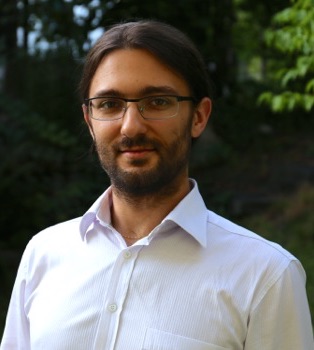
Sandy Ingram is a Lecturer at EPFL affiliated with the School of Engineering and Department of Microengineering. They teach courses in software architecture focusing on modern practices like agile project management, design patterns, robust code development, and DevOps automation. Previously advised PhD student Rania Islambouli. Their role is listed as 'Hôte' (host) within the EPFL STI-SMT-SMT-ENS organizational structure. Teaching responsibilities include advancing industrial software architecture education through critical application development methodologies. Courses emphasize specifications, testing automation, and continuous integration/deployment processes.
Maciej Besta is a leading researcher at ETH Zurich's Institute for Computing Platforms, where he heads research initiatives at the Scalable Parallel Computing Lab (SPCL) and contributes to the ETH Future Computing Laboratory (EFCL). Working under the mentorship of Professor Torsten Hoefler, he has established himself as a prominent figure in high-performance computing, graph processing, and large language models. Position: Researcher at Institute for Computing Platforms, ETH Zurich Research Leadership: Head of Sparse Graph Computations and Large Language Models Research at SPCL Collaboration: Leads project management for SPCL's contributions to ETH Future Computing Laboratory Besta's research spans multiple abstraction levels, from hardware and network topologies to middleware, algorithms, and programming models. His primary focus areas include graph-enhanced language models, graph neural networks, graph databases, and sparse models, with applications across various computational settings. He approaches these problems through rigorous performance modeling and formal reasoning, emphasizing both scalability and practical implementation. His recent publications reveal a clear trend toward integrating graph structures with language models and AI systems. Besta has pioneered work on graph databases, knowledge graphs of thoughts, and higher-order graph neural networks, while maintaining his strong foundation in high-performance computing and network topology design. His research bridges traditional HPC with cutting-edge AI, creating novel approaches for efficient large-scale computation. IEEE TCSC Award for Excellence in Scalable Computing (Early Career, 2023) Multiple Best Paper Awards at Supercomputing conferences (2022, 2023) ACM SIGHPC Doctoral Dissertation Award (2022) ETH Medal for outstanding doctoral thesis (2021) Fellow of The Explorers Club (2022) Besta actively mentors ETH Zurich students through semester projects, Bachelor's, and Master's theses, focusing on graph processing and related computer science challenges. His mentorship extends beyond technical guidance, incorporating lessons from his extensive polar and mountaineering expeditions that emphasize mental resilience, efficient risk management, and leadership. He has supervised numerous student projects that have resulted in high-impact publications at top-tier conferences. As a core member of the Scalable Parallel Computing Lab, Besta collaborates with researchers across ETH Zurich and international institutions. His unique approach integrates insights from extreme environment expeditions into research methodology, creating a distinctive framework for tackling complex computational problems. The lab's work under his leadership spans theoretical modeling, practical implementation, and real-world deployment of high-performance systems.
Cesare Alippi is a Full Professor at the Faculty of Informatics, Università della Svizzera italiana (USI), and also holds a professorship at Politecnico di Milano, Italy. He serves as a visiting Professor at Guangdong University of Technology (China) and Consultant Professor at Northwestern Polytechnic of Xi'an (China). His academic leadership extends to multiple international institutions where he has served as a visiting researcher including UCL (UK), MIT (USA), ESPCI (France), CASIA (China), A*STAR (Singapore), and University of Kobe (Japan). Professor Alippi's research interests center around graph-based learning, adaptation and learning in non-stationary environments, and intelligence for embedded, cyber-physical systems and IoT. His work bridges theoretical foundations with practical applications in sensor networks, environmental monitoring, and industrial processes. He has established significant research infrastructure including the Wireless Embedded Systems (WEmSy) Lab and the Internet of Things Lab, with notable deployments for marine environment monitoring in Queensland, Australia and the Fiji Islands, as well as rockfall and landslide monitoring systems across Italy and Switzerland. His research output shows a clear evolution toward graph-based deep learning approaches for time series analysis, anomaly detection, and spatiotemporal forecasting, reflecting the growing importance of graph neural networks in handling complex relational data in non-stationary environments. Major Awards: IEEE CIS Enrique Ruspini Meritorious Service Award (2024) IEEE CIS Outstanding Computational Intelligence Magazine Paper Award (2018) Gabor Award from International Neural Network Society (2016) IBM Faculty Award (2013) IEEE Instrumentation and Measurement Society Young Engineer Award (2004) Professor Alippi has held significant leadership roles including Past Board of Governors member of the International Neural Network Society, Past member of the Administrative Committee of the IEEE Computational Intelligence Society, and Past Vice-President for Education of the IEEE Computational Intelligence Society. He has served as Associate Editor for Proceedings of IEEE and several other prestigious journals. His research has been supported through numerous grants including an IBM Faculty Award in 2013 specifically for research on Intelligent Embedded Systems working in non-stationary environments. His research infrastructure includes the Wireless Embedded Systems (WEmSy) Lab and the Internet of Things Lab, with notable deployments including a sophisticated automatic, adaptive, sustainable and reliable wireless monitoring system for marine environments deployed in Queensland, Australia (2007) and under deployment at the Fiji Islands (2014-2015). He has also led several top-world deployments for rockfall and landslide monitoring across Italy and Switzerland since 2010, demonstrating the practical impact of his research in real-world harsh environments.
Prof. Dr. Kurt Stockinger is a Professor of Computer Science at ZHAW School of Engineering and holds a doctorate at the University of Zurich . He serves as Head of the MAS Data Science program and co-leads the ZHAW Datalab . His research focuses on Intelligent Information Systems , bridging information systems, natural language processing, and machine learning. Affiliated with the University of Zurich, he contributes to Quantum Machine Learning and Open Data Exploration initiatives. Stockinger's educational background includes a PhD in Computer Science (University of Vienna & CERN), a Master in Business Informatics (University of Vienna), and a CAS in Didactics & Methodology (ZHAW). He has taught courses in Quantum Computing , Big Data for Natural Sciences , and Data Science programs at ZHAW and University of Zurich. His research spans Data Science , Big Data , Natural Language Query Processing , Knowledge Graphs , and Quantum Machine Learning . Recent publications focus on quantum autoencoders , hybrid quantum neural networks , and prompt engineering for knowledge graph question answering. He has developed frameworks like ScienceBenchmark for real-world NL-to-SQL evaluation and NQuest for natural language query exploration. Scientific awards include the Best Paper Award at 7th Swiss Conference on Data Science (2020) He leads major projects such as DataGEMS (Data Discovery Platform, Horizon Europe) Digital Health Zurich (Clinical Innovation Lab) INODE4StatBot.swiss (NL-to-SQL Translation) GraphQueryML (Graph Database Optimization) ScienceBenchmark (NL-to-SQL Evaluation) Stockinger's work intersects with computer vision , biomedical data , and industrial applications , demonstrated through collaborations with institutions like Lawrence Berkeley National Laboratory, CERN, and University of Washington. He has contributed to establishing QuantumBasel and ZHAW Datalab as research hubs.