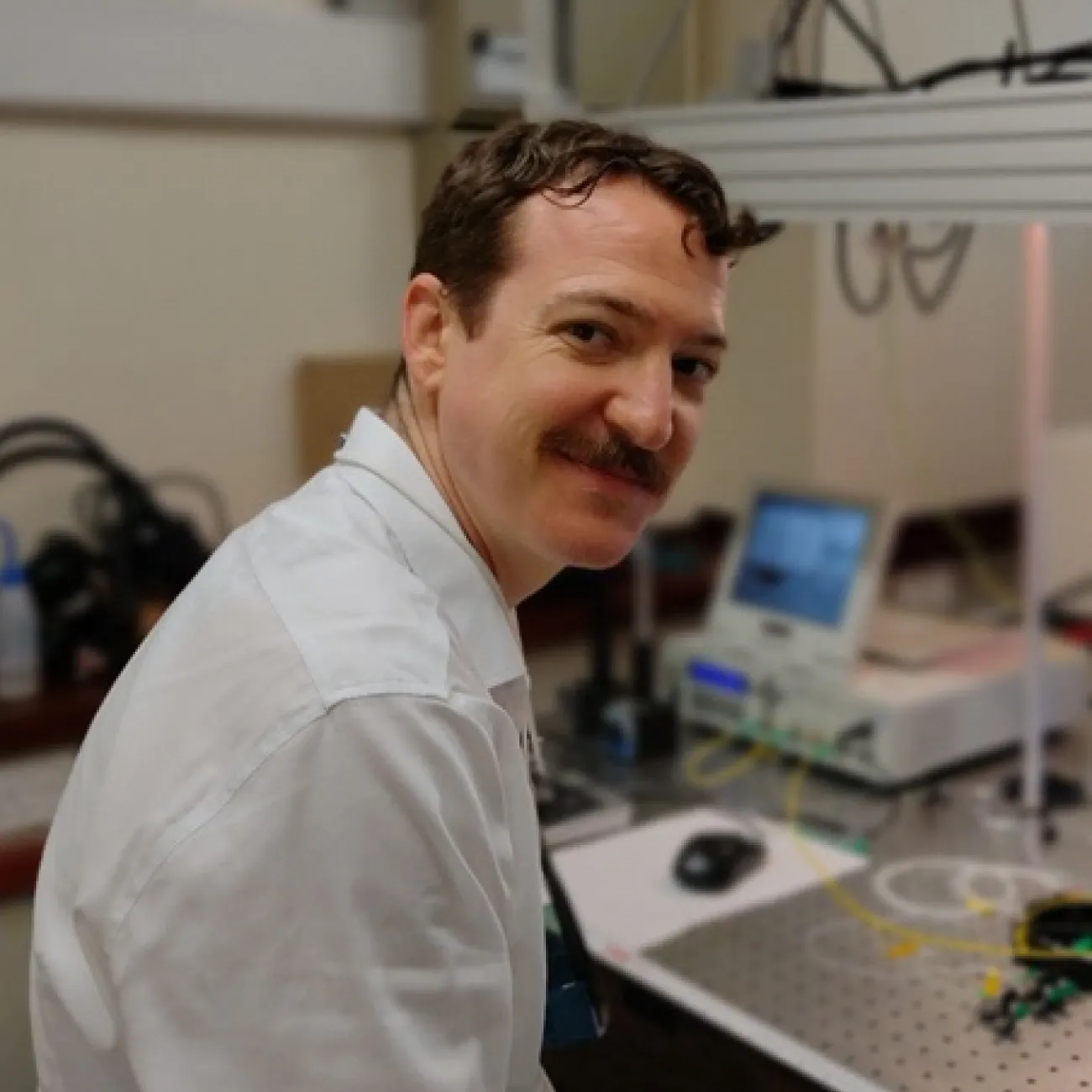
Professor Duncan Paul Hand is a distinguished academic at Heriot-Watt University, holding dual appointments in the School of Engineering & Physical Sciences and the Institute of Photonics and Quantum Sciences. He specializes in applied photonics, with expertise in laser technology and its applications across diverse sectors including aerospace, medical devices, and defense. He leads the £12M Medical Device Manufacturing Centre (MDMC) and directs a £1M project on ultra-short pulsed laser welding. His career includes roles such as Assistant Vice Principal Research and Impact, and Acting Deputy Principal (Pro-VC) Research and Impact. Education: BSc in Physics with Electronics (University of St Andrews, 1986); PhD in Optical Fibres (University of Southampton, 1991). Professional milestones include promotions from Research Associate (1991) to Professor of Applied Photonics (2003), alongside leadership in academic administration. His research focuses on photonics-enabled manufacturing, laser material processing, and sustainable engineering solutions aligned with UN SDGs. Research interests emphasize industrial collaborations with firms like Renishaw and Leonardo, advancing applications in medical device fabrication, optical materials, and energy-efficient technologies. Recent work includes innovations in laser welding of optical materials and stress management in bonded components. He oversees the Pico Second Laser Machining facility and has contributed to over 398 research outputs, with datasets and activities highlighting advancements in microfluidics, anti-counterfeiting holography, and laser beam shaping.
Austin Taranta serves as a Professor at the University of Southampton's Optoelectronics Research Centre (ORC), where he leads research and enterprise initiatives within the Hollow Core Fibres Group. Since joining the ORC in 2016, he has driven advancements in hollow core fibre technology for defence and space applications, authored over 50 peer-reviewed publications, secured significant research funding, and manages key industrial partnerships including a Microsoft research contract. His work bridges fundamental fibre physics with practical sensor development. His academic background includes a BSc in Chemical Engineering from the Massachusetts Institute of Technology (2006) and a PhD in Optoelectronics from the University of Southampton (2024). Prior to academia, he gained industry experience as Senior Optical Engineer at Honeywell Aerospace's Strategic Sensors Group developing fibre-optic gyroscopes. Taranta's research focuses on exploiting the unique properties of hollow core fibres for next-generation sensing systems. Key areas include: Hollow core antiresonant fibre guidance physics Gas pressure and temperature dynamics in hollow fibres Polarization behavior in nodeless antiresonant structures Novel sensor architectures for defence applications Bend-insensitive fibre designs for telecom integration Non-destructive characterization methodologies Analysis of his 2023-2024 publications reveals concentrated efforts on solving manufacturing challenges, environmental stability issues, and sensor integration barriers in hollow core fibre technology. His work demonstrates strong industry alignment through Microsoft collaborations and defence-focused applications, particularly in distributed sensing systems and next-generation gyroscopes. No specific scientific awards or medals are listed in the provided text, though his profile notes responsibility for multiple research awards and patent holdings including optical time domain reflectometry innovations. Taranta actively supervises PhD candidates Amalie Gjelsvik and Chiang Ping Saw (part-time), while managing industrial research contracts and academic partnerships. His funding portfolio includes strategic defence projects through Honeywell Aerospace and Microsoft collaborations, supporting the Hollow Core Fibres Group's translational research pipeline. He leads the Hollow Core Fibres Group within the ORC, focusing on commercializing hollow core antiresonant fibre technology through the Hollow Core Fibres Group. Current work targets polarization control, environmental resilience, and sensor integration with industry partners to develop deployable systems for aerospace and defence sectors.
Mohammed Islam is a Full Tenured Professor of Electrical Engineering and Computer Science at the University of Michigan, Ann Arbor. He holds joint appointments in the Biomedical Engineering Department and the University of Michigan Medical School, Department of Internal Medicine. His research focuses on supercontinuum lasers and their applications in healthcare, defense, and photonics. He has pioneered advancements in nonlinear optics, Raman amplifiers, and fiber laser technology, with over 135 refereed publications and 145 patents. His entrepreneurial ventures include companies like Xtera Communications and Omni MedSci, commercializing technologies for telecommunications, healthcare, and national security. Key awards include the OSA Adolf Lomb Medal (1992), IEEE Fellow (2004), and the Distinguished University Innovator Award (2007). Education: B.S., M.S., and Sc.D. in Electrical Engineering from MIT (1981–1985). Professional experience includes roles at AT&T Bell Laboratories (1985–1992) and leadership in academic and industrial innovation. Research themes include non-invasive glucose monitoring, cancer tissue discrimination, and 3D printing with supercontinuum lasers. He teaches courses on photonics, entrepreneurship, and patent law. His group’s work spans biomedical applications (e.g., visceral fat ablation for diabetes treatment), defense-related active remote sensing, and high-power mid-IR supercontinuum lasers. Ongoing projects include functional near-infrared spectroscopy via nasal catheters and enhancing additive manufacturing with SWIR lasers.
Núria Agell Jané is a Full Professor in the Department of Operations, Innovation and Data Science at ESADE Business School. She also serves as a researcher at the ESADE D3 - Institute for Data-Driven Decisions. With a PhD in Applied Mathematics from UPC (Universitat Politècnica de Catalunya), her academic career spans several decades with significant contributions to artificial intelligence and decision science. Her research focuses on developing Artificial Intelligence techniques for decision making under uncertainty. Specifically, she works on systems with automatic learning, qualitative and fuzzy reasoning, multi-criteria decision making, group decision systems, recommendation systems, and consensus modeling. Her methodological approach combines theoretical foundations with practical applications in business contexts, particularly in marketing and strategic decision making. Her recent publications demonstrate a strong trend toward applying hesitant fuzzy linguistic approaches to complex decision problems across diverse domains including media analysis, food waste reduction, healthcare fraud detection, and sustainable energy planning. These works consistently integrate AI methodologies with real-world business challenges, showing her commitment to bridging theoretical research with practical applications. Professor Agell has directed or co-directed 11 doctoral theses and maintains active research collaborations with institutions including The University of Edinburgh Business School. She coordinates the Research Group Judgements and Decisions in the Market Place (JUICE), which focuses on applying AI to business decision contexts. Her research has been supported by multiple projects related to AI applications in marketing and business strategy.
Sanjoy Paul is an Associate Professor at the University of Technology Sydney (UTS) Business School, specializing in supply chain management and operations research. He holds roles as Associate Editor of Business Strategy and the Environment and Global Journal of Flexible Systems Management . His research focuses on supply chain resilience, risk modeling, and sustainable practices, with applications to global disruptions like pandemics and IT outages. Paul has published in top-tier journals such as the European Journal of Operational Research and secured grants from government bodies including the Department of Defence. Education and Career: Prior to UTS, he worked at RMIT University and Bangladesh University of Engineering and Technology. He holds a PhD from UNSW, recognized with the Stephen Fester Prize for outstanding thesis. His career spans academic roles from Lecturer (2017) to Senior Lecturer (2019) before his current position since 2023. Research Contributions: Paul’s work bridges theoretical models and real-world applications, including recovery frameworks for supply chains during crises and strategies for sustainable practices in post-pandemic contexts. He frequently advises media on supermarket pricing, supply chain disruptions, and business strategies, appearing in outlets like The Guardian and ABC News . Awards and Recognition: His honors include the ASOR Rising Star Award, Research with Relevance Award, and inclusion in the top 2% global scientists (2020–2023). He has contributed to policy debates on supermarket competition, EV market dynamics, and Australia’s industrial strategies.
Dr. Yan Ma is a Research Fellow at the University of Wollongong's School of Mechanical, Materials, Mechatronic and Biomedical Engineering. She holds a PhD from the same institution (2015) and prior degrees from Northeastern University and Kunming University of Science and Technology. Her expertise spans material science and mechanical engineering, with focuses on advanced materials like steels, titanium alloys, intermetallics, and additive manufacturing techniques. Dr. Ma has led or contributed to significant projects including Baosteel-Australia Joint Research & Development Centre (BAJC) initiatives, Defence Materials Technology Centre (DMTC) projects, and industry consulting. Her research emphasizes welding metallurgy, material characterization, and multi-partner collaborations with organizations like ANSTO. She currently supervises PhD research on solidification behavior in high-nitrogen/molybdenum alloys. Key research interests include additive manufacturing processes, microstructural analysis of alloys, and improving material performance through in-situ alloying. Her funded work addresses challenges in pipeline integrity, defect mitigation, and next-generation materials for aerospace and industrial applications. She actively engages in teaching programs like ENGG542 and organizes events such as Materials Discovery Day. Dr. Ma’s publications (over 25 articles) explore topics like neutron diffraction for stress analysis, corrosion behavior of additively manufactured materials, and radiation effects on titanium aluminides. She is fluent in English and Mandarin, with peer-review capabilities in both languages.
Dr. Fletcher Lu is an Associate Professor in the Department of Information Technology at the Faculty of Business and Information Technology, Ontario Tech University. His academic journey includes a PhD in Artificial Intelligence (specializing in Machine Learning) and a Master of Mathematics in Scientific Computation, both from the University of Waterloo. He also holds a Bachelor of Math in Computer Science from the same institution. His postdoctoral research at the Canadian Institute of Chartered Accountants (CIAC) focused on insurance fraud detection. His education includes: PhD in Artificial Intelligence, University of Waterloo Master of Mathematics in Scientific Computation, University of Waterloo Bachelor of Math in Computer Science, University of Waterloo Dr. Lu’s research interests span health informatics, fraud detection (including cybercrime and insurance fraud), and the application of machine learning and numerical analysis to business and health challenges. He has developed mobile technology applications to improve youth fitness and pioneered adaptive fraud pattern analysis in health insurance data. His work intersects with cybersecurity, data analytics, and gaming, emphasizing real-world collaborations with organizations such as Manulife Financial, the Canadian Department of National Defence, and Medavie Blue Cross. His recent publications highlight trends in supply chain resilience, optimization methodologies, and disruption risk analysis. These include studies on EV infrastructure planning, stochastic distribution networks, and Benders decomposition strategies for reliable systems design. Dr. Lu has received significant awards, including: First place at CORS 2014 Practice Prize Third place at INFORMS 2013 interactive poster sessions His research has been funded by the National Science Foundation, Ontario Partnership for Innovation and Commercialization, and NSERC. He is affiliated with the Business Analytics & AI Research Group, contributing to decision-making systems and data-driven solutions for business and health sectors.
Dr. Jenny Burbage is an Associate Professor in Applied Biomechanics & Women's Health at the University of Portsmouth, affiliated with the School of Psychology, Sport and Health Sciences. She holds roles in the Faculty of Science and Health, Centre for Integrated Health and Wellbeing, and Centre of Excellence in Defence, Risk & Resilience. Her research focuses on breast biomechanics, breast health challenges in occupational and athletic populations, and the design of functional breast support solutions. Education: BSc (Hons) in Sports Science (2006, University of Portsmouth), MSc in Sport and Exercise Biomechanics (2006–2007, University of Chichester), PhD in breast support implications for female recreational athletes (2013, University of Portsmouth). She is a Fellow of the Higher Education Authority. Research Interests: Breast biomechanics, mastalgia, breast support technologies, and health issues in military, equestrian, and sports populations. Her work emphasizes improving breast health awareness and functional support for special populations through interdisciplinary approaches. Key Contributions: Published 37+ peer-reviewed articles, including studies on breast support in British Army recruits, equestrians, and global sports bra usage patterns. Collaborates with military and sports organizations to address practical health challenges. Awards: Fellow of the Higher Education Authority. Actively supervises PhD students in breast biomechanics and functional support research. Labs/Teams: Research Group in Breast Health, Centre for Integrated Health and Wellbeing. Engages in commissioned research for organizations like the British Army.
Rob Basten is an Associate Professor in the Department of Industrial Engineering and Innovation Sciences at Eindhoven University of Technology (TU/e). He has been with TU/e since October 2014, initially as an Assistant Professor before being promoted. His work focuses on operations management and behavioral operations management, with particular expertise in maintenance, spare parts supply, and after-sales services for high-tech equipment. Basten's research is highly applied, often conducted in collaboration with industry partners such as ASML, NXP, Canon Production Printing, Marel Poultry, and the Ministry of Defence. Dr. Basten's educational background includes: Master's in Industrial Engineering and Management (2004) from University of Twente Master's in Computer Science (2005) from University of Twente PhD in Operations Management (2010) from University of Twente Rob Basten's research centers on improving after-sales services for high-tech equipment, with a focus on incorporating new technologies such as 3D printing and IoT. His work spans both analytical and empirical approaches, with increasing emphasis on behavioral operations management as human decision-makers interact with AI-based decision support systems. Basten investigates how to design and control after-sales service supply chains when spare parts can be 3D printed, and how to optimize maintenance policies for complex systems. His interdisciplinary research bridges operations management, maintenance engineering, and human behavior. Analysis of Basten's recent publications reveals a strong focus on the application of new technologies in after-sales services. Key trends include the integration of additive manufacturing in spare parts supply chains, condition-based and predictive maintenance driven by Industry 4.0 technologies, and the behavioral aspects of human-AI collaboration in maintenance decision-making. His work frequently addresses challenges in high-tech manufacturing contexts, particularly semiconductor equipment, with a growing emphasis on Industry 5.0 concepts that integrate human-centered approaches with advanced technologies. Dr. Basten has received recognition for his work, including: Finalist for the 2020 Daniel H. Wagner Prize for Excellence in Operations Research Practice ISIR Best Student Paper Award 2018 Rob Basten actively supervises numerous PhD students and has led several major research projects. He currently supervises nine PhD students including Maryam Azani, Ragnar Eggertsson, Bibi de Jong, Zhao Kang, Niccolò Maccarini, Aran Nasiri, Bas van Oudenhoven, İpek Tanıl, and Alireza Yazdani. He has successfully guided six PhD students to completion. Basten has been project leader and work package leader in significant research initiatives including ProSeLoNext (funded by NWO with industry co-funding), PrimaVera, SINTAS, and OCPROM projects. His research is consistently supported by both public funding agencies and industry partnerships, reflecting the practical relevance of his work. Basten is an active member of the Operations, Planning, Accounting & Control group at TU/e and contributes to the EAISI High Tech Systems initiative. He has organized key academic events including the first two editions of the Maintenance Research Day and the Behavioral Operations Conference 2019. His work connects academic research with industry practice through ongoing collaborations with leading high-tech companies, creating a dynamic research environment focused on solving real-world challenges in maintenance and service logistics.
Ricardo J. Machado is a Full Professor of Information Systems Engineering at the University of Minho, where he founded this disciplinary area. He currently serves as President of the CCG/ZGDV Institute and has held strategic roles including Vice-Rector of UMinho. He is a member of the Board of GraphicsVision.AI, the leading academic network in Europe in computer graphics and vision. DEng in Electrical and Computer Engineering (U.Porto) MSc and PhD in Computer Science and Engineering Dr. Habil in Information Systems Engineering (UMinho) Certified Software Product Manager (ISPMA) Cybersecurity and Crisis Management programme from Portuguese National Defence Institute Professor Machado's research focuses on modeling and requirements engineering, systems architecture, process and project management, information semantics, ontologies, and cognitive computing. He has developed several methods and tools including the 4SRS method and the shobi-PN meta-model for requirements analysis, software architecture, ontology computation, and project portfolio management. His work bridges theoretical frameworks with practical industrial applications across various sectors. His recent publications demonstrate a strong trend toward digital transformation across multiple domains including smart cities, healthcare systems, industry 4.0, and higher education. The research shows increasing integration of semantic interoperability, logical architecture design, and data management frameworks. His work consistently addresses the challenges of aligning business processes with technical implementations while focusing on practical applications in real-world settings. IEEE MGA Achievement Award APLOG Excellence Award TAA Textbook Award nomination by Springer Professor Machado has supervised nearly one hundred PhD and MSc students, many of whom now hold leadership roles in academia and industry. He has led over 50 R&I projects funded by FCT, ANI, IAPMEI, and the European Union, partnering with institutions including Carnegie Mellon University, MIT, Fraunhofer, and Bosch. His project portfolio spans requirements engineering, systems architecture, and digital transformation initiatives across multiple sectors including healthcare, manufacturing, and smart cities. He founded the SEMAG research group at ALGORITMI and the EPMQ department on Software Engineering and Intelligent Data at CCG/ZGDV. As Director of the ALGORITMI Research Centre, he coordinated UMinho's participation in strategic initiatives such as CEDT, CMU | Portugal, EIT Digital, EUHubs4Data, and Gaia-X Portugal. He also co-founded DTx and ProChild CoLabs, and TICE.pt and CSCP Clusters.
Sunil Aryal is an Associate Professor of Data Science at the School of Information Technology, Faculty of Science Engineering and Built Environment, Deakin University, Australia. He received his PhD and Master by Research degrees from Monash University Australia and has published over 70 papers in top-tier international venues in Artificial Intelligence, Machine Learning and Data Mining. Dr. Aryal's educational background includes: Graduate Certificate of Higher Education Learning and Teaching, Deakin University (2020) PhD in Computer Science, Monash University (2017) Master of Information Technology (Research), Monash University (2012) Master of Information Technology (Coursework), University of Southern Queensland (2008) Bachelor of Information Technology, Purbanchal University, Nepal (2005) His primary research interests focus on making Machine Learning and Data Mining algorithms robust and flexible to handle heterogeneous, noisy and uncertain data in real-world problems. His work spans across several specific areas including anomaly detection, clustering, kernel/similarity-based learning, ensemble methods, learning from limited data, reinforcement learning, natural language processing, and computer vision. Dr. Aryal is particularly interested in applying these techniques to solve challenges in Defence, National Intelligence, Engineering, Manufacturing, Healthcare and Education. Dr. Aryal co-leads the Machine Learning for Decision Support (MLDS) Research Group at Deakin University and has secured over AUD 4.5 million in external research funding. His research is supported by diverse organizations including US and Australia Defence Agencies, the Australian Office of National Intelligence, Worksafe Victoria, the Victorian State Department of Education and Training, the Technology Innovation Institute (TII) UAE, and Table Tennis Australia (TTA). His notable awards include multiple Deakin University research and teaching awards, the Australian Postgraduate Award for his PhD studies, and several student travel awards during his doctoral candidature. Dr. Aryal actively supervises numerous PhD and Master's students and has contributed significantly to teaching in various courses at Deakin University and previously at Federation University. He serves on several university committees and contributes to the research community as a reviewer, program committee member, and editor for various journals and conferences.
Dr. Ip-Shing Fan is a Senior Lecturer in Enterprise Systems at Cranfield University's IVHM Centre, with academic career spanning over three decades. His work bridges technology implementation, organizational behavior, and complex system interactions across aerospace, manufacturing, and healthcare domains. Dr. Fan leads the Digital MRO and Hangar laboratories at Cranfield's DARTeC Initiative and serves as Course Director for the MSc in Aviation Digital Technology Management. PhD in Computer Integrated Manufacturing from Cranfield University BSc in Industrial Engineering (First Class Honours) from Hong Kong Commonwealth Scholarship recipient His research focuses on socio-technical systems in technology implementation, with specialization in Digital Twin applications for aircraft health management, Industrial Automation in aerospace contexts, and Human Factors in maintenance operations. He established the European BEST research consortium for enterprise system implementation knowledge and develops solutions for Predictive Maintenance , Robotic Inspection systems, and Agile Manufacturing frameworks. Key publication trends show expertise in Aerospace Informatics (2022-2025), Enterprise System Implementation (1995-2010), and Supply Chain Knowledge Modeling (2008-2010). Recent work addresses AI Document Reconciliation , Autonomous Inspection Systems , and 3D Printing Applications in aviation maintenance. Dr. Fan chairs the BCS Beds Bucks Northants Branch and has consulted for industry leaders including Boeing, BAE Systems, and SAP. His career combines academic research with practical implementation across Digital Transformation in aviation, Operational Optimization in healthcare, and Knowledge Engineering standards development.
Calvin Ralph is a Senior Lecturer in Mechanical Engineering at the School of Engineering, Ulster University, Belfast campus. His research focuses on composite materials and their mechanical behavior under impact loading, with a particular emphasis on novel 3D woven structures and natural/synthetic fibre hybrids. Key research areas include: 3D Woven Composite Architecture Basalt and Carbon Fibre Reinforcement Impact Resistance and Energy Absorption Sustainable Textile Supply Chains Smart Composite Manufacturing Recent work explores biomimetic design principles for composite optimization and green manufacturing initiatives in Northern Ireland. His projects often involve collaboration with industry partners and government agencies.
Professor Yinong Liu is a Professor of Materials Engineering in the School of Engineering at The University of Western Australia, where he serves as Associate Dean (International) for the Faculty of Engineering and Mathematical Sciences. He began his academic career at UWA in 1994 after postdoctoral research in France, and has held significant leadership roles including Head of the School of Mechanical and Chemical Engineering and Deputy Dean of the Faculty of Engineering, Computing and Mathematics. Education: B.Eng. from Beijing University of Science and Technology (1982) PhD from The University of Western Australia (1991) Postdoctoral Fellow at Institut National Polytechnique de Grenoble, France (1993) Research Focus: Professor Liu pioneers research in elastic strain engineering and lattice strain machining to achieve ultra-large elastic strains (10-20× conventional limits) in metallic materials. His work bridges nanoscale phenomena with macroscopic applications, enabling unprecedented control over functional material properties. Current investigations span shape memory alloys, metallic composites, superalloys, and nanomaterials for MEMS technology, with publications in Science , Advanced Materials , and Nano Letters . Research Trends: Recent 2025 publications reveal three converging trajectories: 1) Additive manufacturing of NiTi shape memory alloys with in-situ TEM characterization of phase transformations, 2) Creep mechanisms in nickel-based superalloys through γ′ size manipulation, and 3) Atomic-scale studies of R-phase behavior under grain confinement. These works demonstrate growing integration of advanced manufacturing, nanoscale characterization, and elastic strain engineering for next-generation aerospace and biomedical materials. Scientific Recognition: France-Australia Postdoctoral Fellowship Japan Society for the Promotion of Science Senior Invitation Fellowship Academic Leadership: Professor Liu has supervised over 30 PhD completions and secured 62 competitive grants, including ARC projects on amorphous metals and superelasticity. His editorial roles include Associate Editor for Shape Memory and Superelasticity and Functional Materials Letters , while his professional service encompasses chairing Engineers Australia's Nanoengineering Committee and serving on the ARC College of Experts. He maintains adjunct professorships at seven international institutions including University of Tsukuba and Katholieke Universiteit Leuven. Research Infrastructure: His work leverages the UWA Defence and Security Institute facilities and acoustic levitation technology developed through multi-institutional ARC collaborations, enabling advanced studies of multi-phase material systems under containerless conditions.
Mitch Dunn serves as an Advance Queensland Industry Research Fellow within the School of Mechanical and Mining Engineering at The University of Queensland, affiliated with the Centre for Advanced Materials Processing and Manufacturing (AMPAM). His research integrates materials science with electromagnetic applications, focusing on functional composites for aerospace and defence systems. Educational background: PhD in Mechanical Engineering (2018), The University of Queensland Bachelor of Engineering (Honours) (2011), The University of Queensland Research interests center on three interconnected domains. First, functional composite antenna structures for aerospace applications including load-bearing antennas and hypersonic vehicle systems. Second, nondestructive testing methodologies using nonlinear ultrasonics for damage detection in composites. Third, hybrid composite material development with emphasis on thermoset-thermoplastic systems and cost-effective manufacturing. His work bridges theoretical modeling with industry-driven applications, particularly in defence technology. Publication trends reveal consistent focus on composite material characterization (85% of works), with growing emphasis on RF-composite integration (40% of recent works). Key methodological approaches include nonlinear ultrasonics (65% of publications), finite element analysis (50%), and experimental validation of multifunctional structures. Key recognition: Advance Queensland Industry Research Fellowship Dunn actively supervises research projects including functional composite antennas for UAVs and hypersonic vehicle antenna systems. Current funding includes National Intelligence Discovery Grants for compact multi-mode antennas (2025-2027) and Advance Queensland grants for hypersonic vehicle antennas (2025-2028). Past projects include Defence Materials Technology Centre initiatives on functional antenna structures and high-temperature sub-assemblies. As part of the UQ Composites group within AMPAM, Dunn collaborates on industry technology development projects focused on functional composite materials and conformal antenna structures, with strong links to defence and aerospace sectors.