Verena Siewers is a Research Professor at the Department of Biology and Biological Engineering, Chalmers University of Technology. Her work focuses on synthetic biology and metabolic engineering of yeast cell factories for producing biofuels, pharmaceuticals, nutraceuticals, and bioplastics, with particular emphasis on developing biosensor tools for pathway optimization. Key research themes: yeast-based biosensors, lipid metabolism engineering, CRISPRi/a applications, and dynamic gene regulation Notable projects include: Development of acetic acid tolerance mechanisms Optimization of fatty acid ethyl esters production Engineering phosphoketolase pathways for acetyl-CoA overproduction Her recent articles reveal trends in: CRISPR-mediated pathway engineering Stress response transcriptional profiling Heterologous plant gene expression in yeast Promoter and transcription factor engineering Funding sources: VINNOVA Novo Nordisk Foundation Carl Tryggers Stiftelse EU Horizon grants Swedish Research Council (VR) Formas
Rickard Sandberg is an **Associate Professor** and **Center Director** at the **Department of Entrepreneurship, Innovation and Technology** at the **Stockholm School of Economics (SSE)**. His work bridges econometrics, statistics, and business analytics with a focus on time series analysis, machine learning applications, and sustainability measurement. **Research Interests**: Machine Learning, Deep Learning, Data Analytics, Predictive Analytics, Forecasting, Nonlinear Time Series Modelling, Structural Economic Modelling, Econometrics, and Measuring Sustainability. His research emphasizes theoretical advancements in statistical methods and their practical application in economic and business contexts. **Key Contributions**: His publications explore unit root testing in nonlinear models, ESG rating challenges, and the impact of energy policies. Notable works include analyzing Scandinavian unemployment trends, cartel damage calculations, and Nordic companies' data-driven transformations. His 2023 paper on ESG ratings proposes solutions for consistency in ambiguous evaluation systems. **Teaching & Outreach**: Teaches advanced econometric time series courses (e.g., MSc 5314) and actively engages in international academic collaborations through presentations in Japan and Brazil. His work on AI for sustainability highlights interdisciplinary outreach efforts. **Labs/Teams**: Leads research initiatives within SSE’s Department, focusing on entrepreneurship and innovation through data and economic modeling frameworks.
Andreas J. Kassler is a Full Professor of Computer Science at Karlstad University, Sweden, where he has been since 2005. He co-chairs the Distributed Systems and Communication (DISCO) group and focuses on networking, cloud computing, and wireless networks. His research includes software-defined networking, future internet architectures, and network optimization. He has authored/co-authored over 130 peer-reviewed publications, holds 6 patents, and serves on editorial boards of journals like Journal of Internet Engineering . Education : Ph.D. in Computer Science, Universität Ulm (2002) Docent (Habilitation), Karlstad University (2007) M.Sc. in Mathematics/Computer Science, Universität Augsburg (1995) Research Interests : Software Defined Networking (SDN) Programmable Dataplanes Wireless Mesh Networks Time-Sensitive Networking (TSN) Edge Computing Machine Learning for Network Optimization Recent Directions : His work spans TSN scheduling, hybrid P4 solutions for 5G, and explainable AI in energy communities. He explores network resilience, latency optimization, and multi-objective control in microgrids. Service Contributions : Track co-chair for VTC 2015 General chair for Wired/Wireless Internet Communications (WWIC) 2013 Editor-in-Chief of IARIA Journal on Advances in Internet Technology Labs/Teams : Leads DISCO group at Karlstad University. Collaborates with global teams on projects like mmWave backhaul networks and SDN-enabled industrial control systems.
Peter Hedström is a Professor of Materials Science at the Department of Materials Science and Engineering, KTH Royal Institute of Technology. He leads the Hultgren Laboratory for Materials Characterization and directs the Center for X-rays in Swedish Materials Science (CeXS) and the Vinnova competence center NEXT. His research focuses on advanced materials characterization, structure-property relations, and materials design, particularly in metallic alloys, steels, ceramics, and composites. He co-founded companies Ferritico and Scatterin based on his research. Hedström’s work leverages large-scale infrastructure like synchrotron and neutron methods, with key projects including ENDUREIT for improving duplex stainless steels and Track-AM for additive manufacturing analysis. Education: PhD from Luleå University of Technology. Earlier roles at MEFOS/Swerim before joining KTH in 2008. Research Interests: Phase transformations, materials characterization (e.g., synchrotron/X-ray/neutron techniques), additive manufacturing, machine learning applications, and fatigue mechanics. His group explores topics like low-temperature embrittlement, microstructure-strength relationships, and cemented carbide sintering. Articles Trends: Recent work emphasizes in-situ observations of phase separation, precipitation kinetics, and microstructural stability under fatigue. Studies often integrate computational modeling with experimental methods, highlighting interdisciplinary approaches. Grants/Projects: Directs CeXS (hosting the Swedish beamline P21 at PETRA III) and NEXT. Active in EIT Raw Materials (ENDUREIT) and MMD initiatives. Supervises PhD/postdoc projects in neutron scattering, Mg-AM, and machine learning. Labs/Teams: Hultgren Laboratory, SwedNess graduate school, and collaborations with industrial partners like Ferritico.
Joakim Lindblad is a Professor at the Department of Information Technology, Uppsala University , and holds affiliated roles as Senior Research Associate at the Mathematical Institute of the Serbian Academy of Sciences and Arts, and Head of Research at Topgolf Sweden AB. With over two decades of expertise in image analysis and machine learning , his work bridges computational methods with biomedical applications. Key affiliations: Uppsala University, Serbian Academy of Sciences, Topgolf Sweden Specializations: Deep Learning, Multimodal Image Registration, Quantitative Microscopy His research focuses on reliable image processing frameworks that integrate intensity and spatial information , particularly for biomedical applications . Recent publications highlight innovations in autofluorescence-based cancer detection , self-supervised one-class learning for sparse instance identification, and rotation-equivariant CNNs for robust analysis of cytology images. Recent article trends demonstrate expertise in multimodal image analysis (2024: 3 papers), oral cancer detection (2025: 2 papers), and multiscale biomedical imaging . His 2025 work on the Uppsala Storytelling Dataset introduces novel frameworks for multimodal dataset creation in AI research. While no scientific awards are explicitly mentioned, his extensive publication record (2000-2025) across top venues like Pattern Recognition , PLOS ONE , and IEEE Transactions indicates significant academic impact. His methodological contributions span stochastic distance transforms , fuzzy set defuzzification , and multimodal image registration techniques. Collaborative work with researchers like Nataša Sladoje and interdisciplinary teams has produced innovations in automated cytology analysis , TEM image enhancement , and AI-driven medical diagnostics . His 2021-2022 projects introduced contrastive learning approaches for multimodal image registration and explainable AI frameworks for infant engagement analysis.
Fredrik Sandin is a Professor in the Department of Computer Science, Electrical and Space Engineering at Luleå University of Technology, where he leads the Machine Learning research group with approximately thirty members. His work focuses on neuromorphic technologies and the intersection of machine learning with computational physics to solve challenging real-world interaction problems. He coordinates the 'Teknisk fysik och elektroteknik' program at LTU and has been instrumental in establishing neuromorphic research activities at the university. Luleå University of Technology, Department of Computer Science, Electrical and Space Engineering Member of WASP (Wallenberg AI, Autonomous Systems and Software Program) and ELLIS (European Laboratory for Learning and Intelligent Systems) Coordinator of Neuromorphic Innovation Platform Sweden with KTH, Lund University, Uppsala University, FOI, ABB, Ericsson, and SAAB Fredrik earned his PhD in Physics from Luleå University of Technology in 2007, with thesis work focusing on dense states of matter in neutron stars. His academic journey began with an MSc diploma work in ATLAS at CERN in 2001, followed by postdoctoral research in computational physics at IFPA in Belgium (2008-2009) and brain-like computing at EISLAB with Prof. Jerker Delsing (2010-2011). Professor Sandin's research interests center around neuromorphic technologies, particularly neuromorphic computing and spiking neural networks. He investigates sensor/detector and intelligent systems co-design where constraints like energy, power, latency, and dynamic range challenge conventional digital approaches. His work spans mixed-signal neuromorphic circuits, algorithms, and systems, as well as machine learning projects involving industrial data and collaboration. He has been a key figure in establishing neuromorphic research at LTU, supported by The Kempe Foundations, particularly through the 2014 Gunnar Öquist Fellowship. His recent publications demonstrate a strong interdisciplinary focus spanning quantum phase transitions, particle physics detector optimization, renewable energy materials, and the integration of large language models into control systems. This diverse portfolio reflects his approach connecting machine learning with fundamental physics and practical engineering applications, particularly in neuromorphic computing and intelligent systems design, with emphasis on solving real-world problems through co-design of hardware and algorithms. Gunnar Öquist Fellowship Award and 3 MSEK grant from The Kempe Foundations ISSP award for an Original Work in Theoretical Physics (signed by Prof. 't Hooft and Prof. Zichichi) New-Talents award for original work in theoretical physics at the International School of Subnuclear Physics in Erice Professor Sandin has supervised numerous PhD students working on topics ranging from neuromorphic TinyML to materials for neuromorphic computing, privacy-preserving machine learning at the edge, and intelligent fault diagnosis. He has secured substantial research funding from various sources including Vinnova, ÅForsk, Kempe Foundations, WASP-WISE, and EU programs like ECSEL JU Arrowhead Tools and ITEA3 AutoDC. His current major projects include the Neuromorphic Innovation Platform Sweden and several initiatives focused on neuromorphic condition monitoring and computing, with total funding exceeding 30 MSEK in the past five years. He leads the Machine Learning group at LTU, which collaborates extensively with industry partners including ABB, Ericsson, SAAB, SKF, and RISE. The group is active in developing neuromorphic technologies for wireless sensor networks, condition monitoring systems, and next-generation intelligent systems that address energy, power, and latency constraints that challenge conventional digital approaches.
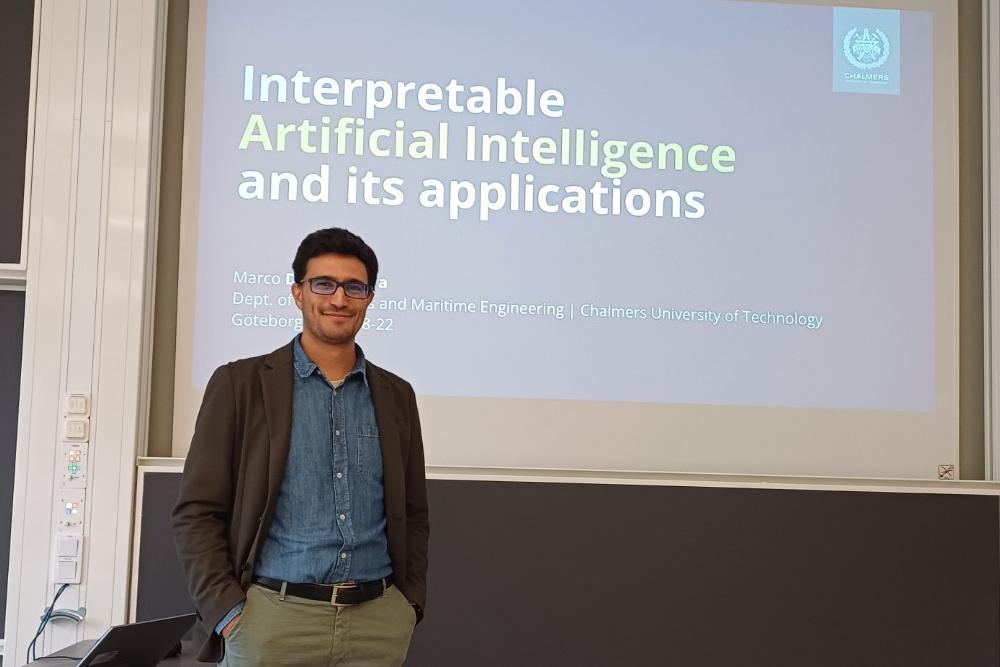
Marco L. Della Vedova is a Senior Lecturer in Applied Artificial Intelligence at Chalmers University of Technology, Sweden. He works in the Vehicle Engineering and Autonomous Systems division within the Department of Mechanics and Maritime Sciences, as part of Prof. Mattias Wahde's research group. Since 2025, he has served as Director of the Data Science and AI master's programme (MPDSC) at Chalmers, where he teaches courses including Introduction to Artificial Intelligence and Digitalization in Sports. Dr. Della Vedova earned his academic foundation at the University of Pavia, Italy, where he completed his BSc (2006), MSc (2009), and PhD (2013) in Computer Engineering. His doctoral research focused on "Real-Time Physical Systems and Electric Load Scheduling" under Prof. Tullio Facchinetti. During his PhD studies, he spent a year at U.C. Berkeley hosted by Prof. Francesco Borrelli at the Model Based Predictive and Distributed Control Lab. His research spans multiple AI domains with a strong emphasis on interpretability. Dr. Della Vedova develops interpretable methods for conversational AI, naturalness evaluation of forests using canopy height models, and geospatial applications. His work bridges theoretical AI with practical societal benefits, particularly in environmental monitoring, transportation systems, and orienteering. He has previously contributed to cloud computing, hate speech detection, and cyber-physical energy systems, demonstrating his interdisciplinary approach to AI research. Dr. Della Vedova's publication record reveals a consistent trajectory of impactful research across multiple domains of artificial intelligence. His recent work shows a strong focus on interpretability in AI systems, with significant contributions to natural language processing, geospatial analysis, and causal inference. The research demonstrates both theoretical depth and practical applications, particularly in environmental monitoring and social media analysis. His methodology often combines traditional machine learning approaches with novel interpretability techniques, creating bridges between complex AI systems and human understanding. Dr. Della Vedova has received several prestigious recognitions for his work: Best PhD thesis award from the Order of the Engineers of Bergamo (2013) Italian champion of Il Cervellone (2012) Top Italian performer in IEEEXtreme 6.0 programming competition (148th overall globally, 2012) Premio Arturo Schena award from Fondazione Credito Valtellinese (2010) With over 50 students supervised through bachelor's and master's theses, Dr. Della Vedova has established himself as a dedicated mentor in the AI community. His current PhD students include Minerva Suvanto working on interpretable NLP and Vivien Lacorre developing AI for railway infrastructure inspection. His supervision spans diverse topics from forest naturalness evaluation to hate speech detection and transportation optimization. Beyond formal supervision, he actively contributes to educational initiatives including serving as Director of Chalmers' Data Science and AI master's program and developing innovative teaching methods that connect theoretical concepts with real-world applications. Dr. Della Vedova is deeply embedded in both academic and professional communities. He leads the Applied Artificial Intelligence research group at Chalmers while maintaining strong connections with European research networks through projects like the ERASMUS+ EUrienteering initiative. His interdisciplinary approach is reflected in collaborations across computer science, environmental science, and social sciences. Notably, he applies his AI expertise to orienteering both as a researcher developing localization methods and as a licensed Event Advisor for the International Orienteering Federation, demonstrating how his professional and personal interests converge in innovative ways.
Summary Pawel Andrzej Herman is an Associate Professor at the Division of Computational Science and Technology within the School of Computer Science and Communication (CSC) at KTH Royal Institute of Technology. His research focuses on computational neuroscience, brain-inspired AI, and machine learning applications in healthcare and cognitive science. He teaches multiple courses including Artificial Neural Networks and Deep Architectures , supervises degree projects across computer engineering and electrical engineering disciplines, and actively contributes to interdisciplinary research initiatives. His work bridges theoretical neuroscience with practical AI solutions, emphasizing synaptic plasticity models, neuromorphic computing, and medical diagnostic systems. Key areas include olfactory perception modeling, working memory mechanisms, and FPGA-accelerated neural networks. He collaborates internationally on projects such as AI-driven medical imaging and cognitive neuroscience studies. Dr. Herman’s research has been published in high-impact journals and conferences, with recent contributions to understanding neural mechanisms of odor naming deficits, beta/alpha oscillations in working memory, and spiking neural network architectures. His technical leadership spans HPC frameworks like StreamBrain and interdisciplinary tools for scientific data storage (NoaSci).
Federica Viola is a Researcher at Linköping University, affiliated with the Department of Health, Medicine and Caring Sciences (HMV) and the Division of Diagnostics and Specialist Medicine (DISP). She is part of the Cardiovascular Magnetic Resonance Group (CMR) and the HEART4FLOW initiative. Her primary research focuses on improving cardiovascular 4D flow MRI data quality, hemodynamic modeling, and applying deep learning techniques for automated analysis in clinical settings. Key affiliations include the Center for Medical Image Science and Visualization (CMIV), which develops advanced imaging tools for healthcare. She collaborates with faculty members such as Professors Tino Ebbers, Petter Dyverfeldt, and Carljohan Carlhäll on projects integrating imaging and computational models to study cardiovascular diseases like hypertension and diabetes. Her research emphasizes personalized medicine, combining 4D flow MRI with mathematical models to assess diastolic function, quantify blood flow dynamics, and evaluate treatment effects. Recent work addresses challenges in reproducibility of cardiac models and automated segmentation using AI. Her contributions span cardiovascular imaging technology, hemodynamic analysis, and interdisciplinary collaborations in the Circulation and Metabolism (CircM) strategic network. She actively publishes in journals like Scientific Reports , Journal of Cardiovascular Magnetic Resonance , and Frontiers in Cardiovascular Medicine .
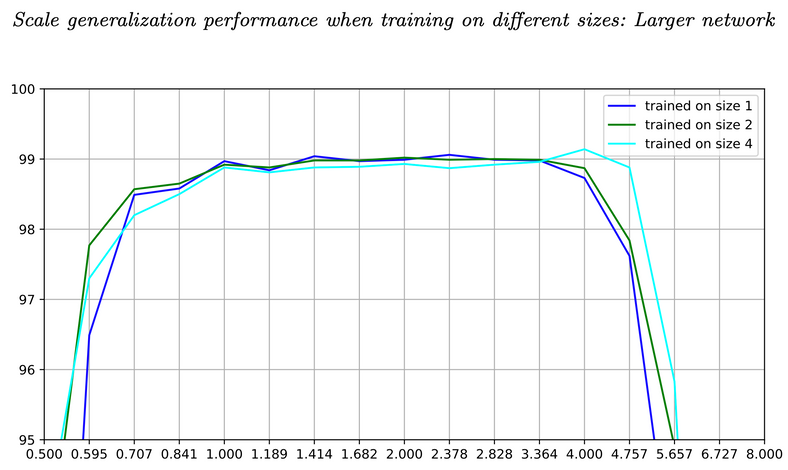
Tony Lindeberg is a Professor of Computer Science—Computational Vision at KTH Royal Institute of Technology, affiliated with the Division of Computational Science and Technology. He teaches the course Image Analysis and Computer Vision (DD2423). His research focuses on scale-space theory, early vision, and computational modeling of biological and auditory vision systems. Key contributions include theories on receptive fields, time-causal spatio-temporal models, and feature detection algorithms. Research interests span computational neuroscience, medical image analysis, and spatio-temporal recognition. Lindeberg has pioneered work on scale-invariant image features, affine transformations, and Galilean diagonalization for motion analysis. He is the author of the foundational book Scale-Space Theory in Computer Vision (1993). His work bridges computer vision and biological vision systems, with applications in gesture recognition, dynamic texture analysis, and neural networks. He leads the Vision Lab and Computational Brain Science Lab at KTH, emphasizing theoretical rigor and practical algorithms for visual perception tasks.
Krister Wolff is an Associate Professor of Adaptive Systems at the Department of Mechanics and Maritime Sciences (M2) at Chalmers University of Technology. He also serves part-time as Vice Head of Department for Education. His research focuses on applying artificial intelligence, machine learning, and bio-inspired methods to robotics, autonomous systems, and self-driving vehicles. He teaches in the international Master's program in Complex Adaptive Systems. His work includes projects such as AI-supported vehicle suspension design, propeller optimization using genetic algorithms, and developing interactive robots for social distancing in healthcare settings. He has contributed to over 39 publications and 9 research projects, collaborating with organizations like VINNOVA and the Swedish Transport Administration. Notable projects include ISOLDE for hospital robots and Tactical Decision-Making in Autonomous Driving funded by the Wallenberg Foundation. Key areas of expertise include reinforcement learning for autonomous vehicles, evolutionary algorithms in design optimization, and driver behavior modeling in critical scenarios. His research bridges theory and practical applications, emphasizing collaboration between academia and industry.
Tobias Andermann serves as an Assistant Professor at Uppsala University's Department of Organismal Biology, specializing in Systematic Biology. He leads the Biodiversity Data Lab, an interdisciplinary research group combining ecology, molecular biology, geomatics, and machine learning to address the biodiversity crisis through innovative computational approaches. His research focuses on quantifying biodiversity loss using AI-driven analysis of environmental DNA, remote sensing data, and fossil records. Key interests include modeling extinction rates across geological timescales, developing standardized biodiversity assessment methods, and predicting species distribution changes under anthropogenic pressures. His work demonstrates current extinction rates are 2000-10,000 times higher than natural background levels, comparable to historical mass extinction events. Methodologically, Andermann integrates machine learning with large-scale environmental DNA datasets and high-resolution remote sensing to develop predictive models of biodiversity distribution. His lab pioneers field sampling protocols for environmental DNA collection and AI frameworks that translate remote sensing data into biodiversity metrics for unsurveyed sites. The Biodiversity Data Lab maintains a dynamic, non-hierarchical research environment focused on high-impact solutions to the biodiversity crisis. Current projects include developing environmental DNA protocols for fungi and insects, analyzing land-use impacts on species communities, and creating neural network models for cross-scale biodiversity forecasting. The lab emphasizes practical applications for conservation policy, notably supporting the UN's 30% protected area target established at COP15.
Nacira Agram is an Associate Professor at Kungliga Tekniska Högskolan (KTH), specializing in stochastic analysis, mean-field processes, and mathematical finance. She contributes to education through roles as Examiner and Teacher in advanced financial mathematics courses. Research Focus: Her work centers on stochastic differential equations with applications to financial markets, energy systems, and population modeling. Key areas include conditional McKean–Vlasov jump diffusions, singular control of stochastic Volterra equations, and deep learning applications in stochastic modeling. Publications: Recent research explores mean-field control, optimal stopping, and SPDEs with space interactions, emphasizing advanced mathematical techniques for financial and ecological systems. Teaching: Currently involved in courses like Financial Derivatives and Martingales and Stochastic Integrals , where she serves as course responsible and examiner.
Dr. Pei Huang is a Senior Lecturer in Energy Engineering at Dalarna University, Sweden, working within the Department of Information and Technology. His academic career focuses on multidisciplinary research at the intersection of energy systems, electromobility, and sustainable urban development, with significant contributions to both teaching and research in renewable energy and energy efficiency. Dr. Huang received his Ph.D. from the City University of Hong Kong in 2017. His educational background has provided a strong foundation for his current research in energy systems and sustainable technologies, bridging engineering principles with practical applications in the energy transition. Dr. Huang's research interests span several critical areas in modern energy systems. He specializes in peer-to-peer energy sharing, urban energy systems, and electromobility, with particular focus on electric vehicles as mobile power sources. His work also encompasses positive energy districts, district heating systems, building energy efficiency, and HVAC systems. A distinctive aspect of his research involves applying machine learning to address uncertainty in energy systems, creating more resilient and adaptive solutions for the energy transition. His multidisciplinary approach connects energy engineering with computer science, urban planning, and sustainability science. Analysis of Dr. Huang's recent publications reveals a strong emphasis on integrating electric vehicles into energy systems as flexible resources. His work demonstrates how vehicle-to-grid technology can enhance grid resilience and enable community energy sharing through innovative solutions like the Electric Vehicle based virtual Electricity Network (EVEN). There's also a notable focus on applying artificial intelligence to optimize energy systems, particularly in data-scarce scenarios where he combines clustering analysis and transfer learning. His research bridges the gap between theoretical models and practical implementation, with several studies based on real-world data from Sweden, demonstrating immediate relevance to current energy challenges. Dr. Huang has been highly successful in securing research funding, with approximately SEK 10 million secured for projects at Dalarna University. His current research portfolio includes: PI for a 2023-2026 Energy Agency project on enhancing grid resilience through electric vehicle-based virtual electricity networks (SEK 2.64 million) PI for a 2023-2026 FORMAS project on photovoltaic and electric vehicle utilization (3.75 million SEK, with a competitive success rate of 13.8%) Co-PI and national coordinator for a 2023-2026 CETPartnership project on thermal energy storage in district heating (2.32 million Euro) Co-PI for a 2024-2026 Swedish Energy Agency project on electric vehicles for frequency regulation (3.25 million SEK) Dr. Huang serves on the editorial board of the journal Buildings and has published extensively, with 49 journal articles, 1 book, 5 book chapters, and 19 conference papers to his name. His research has active participation in IEA tasks, demonstrating international recognition of his expertise. In addition to his primary energy research, Dr. Huang has made significant contributions to neuroscience, particularly in Parkinson's disease diagnostics and treatment, showing the breadth of his interdisciplinary approach.
Peiyuan Chen is an Associate Professor at the Department of Electric Power Engineering, Chalmers University of Technology. He holds a B.Eng. from Zhejiang University (2004), an M.Sc. from Chalmers (2006), and a Ph.D. from Aalborg University (2010). His research focuses on power system operation and planning with wind power integration, emphasizing time series modeling, statistical analysis, and optimization. He contributes to projects on grid-forming converters, inertia estimation, frequency control, and renewable energy system stability. Research Interests: • Power Systems and Renewable Integration • Grid-Forming Converters and Stability Analysis • Time Series Modeling and Statistical Methods • Machine Learning for Energy Applications • Frequency Control and Synthetic Inertia Recent Publication Trends include studies on deep learning for heating load classification, wind turbine type optimization, fault ride-through capabilities, and inertia estimation in converter-dominated grids. His work bridges theoretical power system analysis with practical implementations in Nordic and European energy networks. Projects (2017-2024) include grants from the Swedish Energy Agency, Swedish Research Council (VR), and collaborations with institutions in Sweden, China, and Italy. Key areas: grid strength metrics, multiport converter applications, and citizen energy communities.