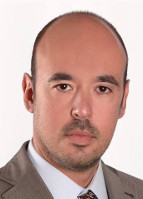
Prof. Dr. Marcus Vetter is the founder and director of the Institute for Applied Artificial Intelligence and Robotics (A²IR) at Mannheim University of Technology's Faculty of Information Technology. His work bridges Deep learning Medical imaging and navigation Embedded systems Real-time computing Software engineering for medical devices He has taught courses including Deep Learning Methods, Image-Guided Medicine, and Embedded Systems. Education Computer Science, Technical University of Mannheim, 1999 Doctorate ('summa cum laude superato') in 'Image-based navigation systems', University of Heidelberg, 2003 Research focuses on AI-driven medical imaging tools, real-time deformation models, and open-source frameworks like MITK. His 15 most recent publications span 6D pose estimation for medical robotics Spectroscopy-based diagnostics Formal software verification Gesture and gaze recognition interfaces UAV drive train optimization Scientific achievements Doctorate with distinction (2003) Co-founder of MITK open-source project Director of A²IR institute since 2007 He has received BMBF grants for real-time deformation models and tracking systems, and has led development of navigation systems for laparoscopic surgery and cardiac ablation procedures.
Anna David is a Professor of Obstetrics and Maternal Fetal Medicine at University College London (UCL) . She serves as Director of the EGA Institute for Women’s Health and Deputy Director of Tommy's National Centre for Preterm Birth Research . David is also Visiting Professor at Katholieke Universiteit Leuven and holds the Professor Tan Seang Lin, Dr Grace Tan and OriginElle Fertility Distinguished Chair in Women’s Health since 2025. Education: BSc in Medical Science, University of St Andrews (1989) MB ChB, University of Manchester (1992) PhD in Fetal Gene Therapy, UCL (2005) Research Interests: David leads the Prenatal Therapy Group at UCL, focusing on developing prenatal treatments for severe fetal disorders. Her work spans fetal gene therapy , maternal VEGF gene therapy for growth restriction , fetal stem cell transplantation , and advanced imaging for fetal surgery . She also investigates preterm birth prediction/prevention and fetal growth restriction . Scientific Awards: Fellow of the Royal College of Obstetricians & Gynaecologists (2016) NIHR Senior Lectureship in Women’s Health (2008) Leadership & Collaboration: She is Lead for Women's Health Shadow Theme at the NIHR UCLH Biomedical Research Centre and Head of the Research Department of Maternal Fetal Medicine since 2016. David collaborates with institutions like KU Leuven and organizations such as Tommy's and Magnus Growth .
Jef Vandemeulebroucke is a researcher at the Department of Electronics and Informatics , Vrije Universiteit Brussel (VUB) , specializing in medical imaging, computer vision, and augmented reality applications in healthcare. His work bridges artificial intelligence with radiology and biomechanics , focusing on automated segmentation, predictive modeling, and real-time surgical navigation systems. Research interests include: Medical image analysis for disease prognosis (e.g., COVID-19 severity , neurosurgical drains ) Development of MedShapeNet , a 3D medical shape dataset for computer vision Augmented reality systems in orthopedic and neurosurgical interventions AI-driven fluorescence endoscopy and dynamic CT for joint kinematics Key trends in his 140+ publications emphasize deep learning , image registration , and 4D-CT applications . Supervised theses include brain age prediction and chest radiography automation. Active in 38 projects (e.g., AI-NIMO , TumorScope ), he collaborates with institutions like the Universitair Ziekenhuis Brussel (UZB) and FWO (Fund for Scientific Research-Flanders).
Dr. Mingfeng Wang is a Senior Lecturer in Robotics and Autonomous Systems at Brunel University London, affiliated with the Department of Mechanical and Aerospace Engineering within the College of Engineering, Design and Physical Sciences. His research focuses on specialized robotic systems including continuum, legged, soft, precision farming, and miniaturized robots. Chartered Engineer (CEng) with Engineering Council UK Fellow of the Higher Education Academy (FHEA) Member of IEEE, IEEE-RAS, IMechE, and IFToMM Editorial roles: Associate Editor of International Journal of Advanced Robotic Systems (JCR-Q3); Associate Editor of Frontiers in Robotics and AI (JCR-Q2); Editor of Information Processing in Agriculture (JCR-Q1), Biomimetic Intelligence and Robotics (JCR-Q1), and STEM Education Research expertise includes: Continuum Robotics : Design of extra-slender continuum robots (diameter-to-length ratio Legged Robotics : Parallel mechanism-based biped and hexapod robots for extreme environments Miniaturized Robotics : Active locomotion and drug delivery in capsule endoscopes Soft Robotics : Compliant end-effectors and bio-inspired designs Precision Farming : Laser weeding systems and agricultural automation Key scientific awards: BRIEF award (2022) TAROS Best Paper Post Nomination (2022) IFToMM Asian-MMS Best Paper Award (2014) Recent publications focus on: Cochlear implant surgery robotics Passive compliance in train fluid servicing Snake-biomimetic sealing surfaces Parallel kinematic manipulators Capsule endoscope image enhancement Professional services include conference organization (TAROS 2023/2024 Steering Committee; TAROS 2024 Programme Chair) and journal refereeing for IEEE-ASME Transactions on Mechatronics and Scientific Reports.
Ramón Luis Rizo Aldeguer is a University Professor in the Department of Computer Science and Artificial Intelligence at the Higher Polytechnic School of the University of Alicante. He has held this position since 1996 and continues to be actively involved in teaching and research as recently as 2025. He previously served in various leadership roles including Director of the Department of Computer Science and Artificial Intelligence (1997-2004) and Deputy Director of the Institutional Projects Area at the University of Alicante (2012-2020). His educational background includes a PhD in Computer Science from the Polytechnic University of Valencia (1992) and a degree in Mathematics from the University of Valencia (1977). He has been a member of the Spanish Association for Artificial Intelligence since 1990 and has held leadership positions within the organization. Rizo Aldeguer's research focuses on artificial intelligence with particular emphasis on swarm robotics, UAV deployment, and deep reinforcement learning. His work bridges theoretical foundations with practical applications in robotics and autonomous systems. He has made significant contributions to educational methodologies, particularly in integrating computational tools into engineering education. His publication record shows a consistent trajectory in swarm intelligence and robotics, with recent publications (2018-2023) demonstrating increasing sophistication in applying deep reinforcement learning to complex multi-agent systems. His research spans both theoretical advancements and practical implementations in robotics and autonomous systems. Fifteen five-year research periods (trienios) Six teaching merit periods Five six-year research periods (sexenios) President of Organizing Committee of VI Conference of Spanish Association for Artificial Intelligence (1995) President of Scientific Committee of CAEPIA (1999) Rizo Aldeguer has supervised 14 doctoral theses, with many receiving the highest honors (SOBRESALIENTE CUM-LAUDE). He has participated as a researcher in over 30 competitive public research projects, serving as principal investigator in 12 of them. His educational projects include innovative teaching methods and the development of computational tools for engineering education. He has been instrumental in the design and implementation of computer science programs at both the University of Alicante and the Polytechnic University of Valencia. He is a founding member of the University Institute for Computer Research and directed the Industrial Computing and Artificial Intelligence research group from 1992 to 2004. His current research continues to focus on swarm robotics and intelligent systems, with active participation in the Valencian Graduate School and Research Network of Artificial Intelligence since 2021.
Prof. Yan Tina Luximon is a Full Professor and Associate Dean (Research) at the School of Design, The Hong Kong Polytechnic University. She chairs the School Research Committee, leads the Asian Ergonomics Design Lab, and serves as Deputy Discipline Leader for BA (Product Design). Her work bridges ergonomics, AI design tools, and 3D human modeling in cross-cultural contexts. Education: PhD in Ergonomics from The Hong Kong University of Science and Technology Research interests span Ergonomics in product design 3D digital human modeling for AI applications Anthropometry and cultural design differences Statistical modeling for head/face product development Human-computer interaction and AI visualization Recent publications focus on AI-enhanced 3D head modeling, ergonomic healthtech products, and cross-cultural design psychology, with applications in robotics, mobile technology, and medical devices. Scientific awards include: Gold Medal with jury congratulations at Geneva Inventions 2024 Silver Award at IDEA 2023 for adaptive eyewear design Best Innovation Award at ACED Japan 2017 She supervises postgraduate research and leads projects funded by the General Research Fund (RGC GRF) and Laboratory for AI in Design, including AI Powered Ergonomic Product Design (2025) and 4D Head Movement Prediction (2024).
Samuel McDermott is an Associate Teaching Professor at the Department of Chemical Engineering and Biotechnology , University of Cambridge. He serves as the Sensor CDT Programme Manager , focusing on interdisciplinary research in healthcare, biotechnology, and open-source hardware. His research spans machine learning applications in medical imaging , laboratory automation , and web-of-things (WoT) integration for scientific equipment. Recent work emphasizes federated learning in healthcare, blood cell morphology classification, and low-cost diagnostic tools. Key article trends include: deep diffusion models for malaria detection , open-source microscopy platforms like OpenFlexure, and AI-driven clinical data generalization . His projects often combine 3D-printed hardware and IoT-enabled laboratory systems .
Raghavendra Ramachandra is a Professor at the Department of Information Security and Communication Technology (IIK) , within the Faculty of Information Technology and Electrical Engineering at the Norwegian University of Science and Technology (NTNU) in Gjøvik. His research focuses on biometric systems, particularly in face, fingerprint, and finger vein recognition, with emphasis on presentation attack detection, morphing attack detection, and deep learning applications. Current research projects include: SALT (2022-2026) : Developing privacy-preserving facial biometric authentication systems. OffPAD (2022-2025) : Creating cryptographic tools and presentation attack detection for fingerprint biometrics. SWAN (2015-2020) : Developing biometric countermeasures against presentation attacks. His recent publications demonstrate technical expertise in: Face morphing attack detection using vision transformers and point cloud networks Image fusion techniques for multispectral biometrics GAN-based synthetic data generation for security evaluation Explainable AI approaches for biometric verification Professor Ramachandra also supervises PhD and Master’s students, and has extensive experience in leading national and EU research initiatives.
Tanvir Arafin serves as an Assistant Professor in the Department of Cyber Security Engineering at George Mason University, where his research focuses on hardware security and trust mechanisms for emerging computing platforms. With publications in premier venues including IEEE Transactions on Very Large Scale Integration Systems, IEEE Transactions on Computers, and ACM International Conference on Computer-Aided Design, he addresses critical security challenges in next-generation systems through rigorous hardware-software co-design approaches. His research portfolio spans Hardware Security, Trusted Computing, and IoT Security, with specialized expertise in Side-Channel Attacks and Secure Hardware Design. Dr. Arafin investigates electromagnetic side-channel vulnerabilities in O-RAN networks, develops countermeasures for autonomous vehicle cybersecurity, and pioneers RRAM-based security solutions for memory-constrained devices. His work bridges theoretical security models with practical implementations, emphasizing real-world applicability in edge computing environments and autonomous navigation systems. Current projects explore machine learning integration for anomaly detection in connected vehicles and secure acceleration of cryptographic operations. Analysis of Dr. Arafin's 2022-2025 publications reveals strategic focus areas: electromagnetic fingerprinting for radio units in O-RAN (2025), spatial acceleration of Kolmogorov-Arnold Networks (2025), and NTT-based cryptography accelerators (2024). His research demonstrates consistent innovation in securing autonomous navigation systems and edge devices, with emerging work on in-memory computing architectures using resistive memory technologies. Key trends include hardware-centric defense against model inversion attacks, voltage overscaling for lightweight authentication, and robust multi-robot coordination in dynamic environments. Scientific Awards: No scientific awards, fellowships, or medals were documented in the source materials. Dr. Arafin leads significant collaborative research, including the NSF CISE-MSI grant (DP: CNS) for edge-based robust multi-robot systems. His educational initiatives feature Capture-the-Flag competitions targeting underrepresented students in cybersecurity. Current grant activities emphasize practical security solutions for autonomous navigation, multi-robot coordination, and IoT edge devices, with demonstrated focus on translating research into deployable countermeasures for real-world threats in dynamic operational environments.
Anthony Clark is an Assistant Professor of Computer Science at Pomona College, where he has been teaching since 2020. Previously, he served as an Assistant Professor at Missouri State University from 2016 to 2020. He directs the ARCS (Autonomous Robotics and Complex Systems) Lab, which focuses on improving the robustness and adaptability of autonomous robots, particularly small-scale systems that can navigate unpredictable terrain and adapt to potential damage. Clark earned his Ph.D. in Computer Science from Michigan State University in 2016, where he worked under Dr. Philip K. McKinley, and his B.S. in Computer Engineering from Kansas State University, graduating magna cum laude. His research centers on making autonomous robots more robust and adaptive through optimization algorithms and multimodal systems. He specializes in evolutionary robotics, computer vision, neural networks, and simulation methods for developing control systems that leverage multiple locomotion mechanisms. His recent work demonstrates strong trends across several domains: developing hybrid locomotion systems (wheel/leg transformations), applying deep learning to terrain classification and pathfinding, using simulation environments for training, and exploring pretraining techniques for evolutionary robotics. His research shows a consistent focus on bridging simulation and real-world applications while addressing challenges in robot adaptability and robustness. Faculty Excellence in Teaching, Missouri State University (2018) Best Paper Award, Workshop on Evolutionary and Reinforcement Learning (2013) Best Paper Award, ALIFE Conference, Behavior and Intelligence Track (2012) Outstanding Reviewer, Elsevier (2018) Master Advisor Certification, Missouri State University (2017) Clark has advised numerous undergraduate and graduate students through the ARCS Lab, with current research involving projects like the Adabot (a robot with multiple locomotion mechanisms) and thermal semantic segmentation for aerial field robots. His teaching portfolio includes courses on data structures, algorithms, neural networks, computer systems, and mobile robotics. He has also served as a Visiting Associate at Caltech's ARC Lab from 2023-2024, working with Dr. Soon-Jo Chung. The ARCS Lab develops simulation environments, optimizes control systems, and fabricates physical robots. Current projects include the Adabot with its geared coaxial shaft mechanism for hybrid locomotion, thermal semantic segmentation using satellite data, and creating dynamic simulation environments with Unreal Engine 5. The lab emphasizes practical applications of theoretical research while training students in both hardware and software aspects of robotics.
Ahmad Lotfi is a Professor of Computational Intelligence and Head of Department of Computer Science at Nottingham Trent University , with a Visiting Professor role at Tokyo Metropolitan University . He leads the Computational Intelligence and Applications (CIA) research group and has supervised over 30 PhD students to completion. PhD in Learning Fuzzy Systems (University of Queensland, 1995) MTech in Control Systems (Indian Institute of Technology, India) BSc in Control Systems (Isfahan University of Technology, Iran) His research spans computational intelligence , ambient intelligence , robotics , and machine learning , with applications in dementia monitoring , smart environments , and healthcare technology . Recent work focuses on using thermal sensor arrays for privacy-preserving human activity analysis. He has secured funding from Innovate UK , EPSRC , The Royal Society , and Horizon 2020 , with projects like iCarer (assistive living), SmartBerry (agricultural AI), and BigSpark (financial data augmentation). His 15 most recent articles demonstrate expertise in Wi-Fi-based activity recognition , EEG fall detection , and thermal sensor fusion . Senior Member IEEE Member of British Computer Society (MBCS) Editorial roles in Soft Computing and Journal of Ambient Intelligence and Smart Environments He has served as Program Chair for conferences like PETRA and ICCRT , and as Keynote Speaker at PETRA 2023 . His 28+ years of academic leadership include organizing UKCI and UKRAS conferences.
Denny Yu is an Associate Professor at the Edwardson School of Industrial Engineering, Purdue University. His work bridges human factors, neuroergonomics, and healthcare safety through advanced sensor systems and AI. Primary Affiliation : Edwardson School of Industrial Engineering, Purdue University Research Themes : Surgical ergonomics, autonomous vehicle human factors, cognitive workload assessment, multimodal physiological sensing Dr. Yu's research focuses on neuroergonomics and human-robot interaction , particularly in surgical and transportation contexts. His team develops sensor-based systems for workload monitoring, including: EEG-eye tracking fusion for situation awareness Wearable exoskeletons for surgical posture support Computer vision tools for lifting task risk analysis Smart infusion pump usability frameworks AI-driven surgical coaching systems Recent publications emphasize deep learning applications in soft tissue deformation estimation and real-time adaptive systems for robotic surgery augmentation. His work spans both occupational health (veterinary surgeons, airport workers) and medical device innovation domains.
Stavros Vologiannidis serves as an Assistant Professor in the Department of Informatics, Computer and Telecommunications Engineering at the International University of Greece. His academic career spans both teaching and research in control theory, robotics, and machine learning applications. Previously, he was associated with the Mathematics Department at Aristotle University of Thessaloniki where he completed his education and conducted postdoctoral research. Education: B.Sc. in Mathematics from Aristotle University of Thessaloniki (1997) Ph.D. in Control Theory from Aristotle University of Thessaloniki (2005) with dissertation titled 'ALGEBRAIC-POLYONYMICAL COMPUTING METHODS IN CONTROL THEORY' Dr. Vologiannidis' research focuses on Classical and Intelligent Control Theory, Robotics, and Machine Learning, with particular expertise in polynomial matrices and automatic control systems. His work bridges theoretical mathematics with practical engineering applications, especially in educational robotics and industrial control systems. He has developed several educational platforms including EUROPA, a ROS-based educational robot for teaching sensor integration and data acquisition. His publication record shows a clear evolution from theoretical control systems research toward applied machine learning and educational technology. Recent work demonstrates increasing focus on practical applications of AI in education, urban feature recognition, industrial monitoring, and robotics education across multiple educational levels from middle school through university. His research combines mathematical rigor with real-world implementation. Scientific Recognition: Excellence Scholarship in the 'Excellence Scholarships 2010' program of the Research Committee Total citations exceeding 250 with Scopus H-index of 9 Dr. Vologiannidis has secured numerous research grants and led multiple projects including 'Rapid Earthquake Damage Assessment Consortium – REDACt', 'Predictive Maintenance 4.0', and 'Development of computational methods for optimization of eigenvalue assignment problems'. He has collaborated extensively with institutions across Europe including UTIA Foundation in Prague and has participated in EU-funded projects like GALENOS and GN4-1 GÉANT Research and Education Networking. His laboratory work centers around the EUROPA educational robotics platform and the StreetScouting urban feature detection system, both of which integrate hardware, software, and educational applications. These projects demonstrate his commitment to translating theoretical research into practical educational and industrial tools.
Luis Miguel Bergasa is a Full Professor at the Department of Electronics, University of Alcalá (UAH), with a career spanning over 25 years. He leads the RobeSafe Lab (since 2010) and serves as Director of Digital Transformation at UAH (since 2022). His academic roles include heading the Department of Electronics (2004–2010) and coordinating multiple educational programs. He teaches Perception Systems (Master in Industrial Engineering) Intelligent Control Systems (Computer Science) Computer Vision (Computer Science) His research focuses on Perception Systems for Intelligent Vehicles , emphasizing driver behavior analysis, scene understanding, and sensor fusion via deep learning. He has authored over 300 papers and holds 9 patents. Notable recognitions include being ranked #81 in Computer Science (Spain) by Research.com (2025) and receiving 30+ awards in Robotics/Automotive fields. Recent publications highlight advancements in Transformer-based driver action recognition (2025) Infrastructure-vehicle cooperative frameworks (2025) 3D semantic segmentation for autonomous perception (2024) Simulation-to-reality gap bridging (2024) Scientific Leadership Senior Editor, IEEE Transactions on ITS (2025) International Program Committee roles in 15+ conferences (2024–2025) Co-founder of Vision Safety Technologies Ltd (2009–2016) He supervises 9 active PhD students and has advised 14 former PhD candidates. His group collaborates with institutions in Germany, USA, China, and Spain, including KIT, UC Berkeley, and Northwestern Polytechnic University.
Silvia Cascianelli is an AI and Computer Vision Researcher at the University of Modena and Reggio Emilia (UNIMORE). She actively contributes to the computer vision and document analysis communities through research, conference organization, and academic mentorship. She serves as Area Chair for major computer vision conferences including CVPR2025, BMVC2025, and ECCV2024, demonstrating her standing in the field. Her research focuses on several key areas within computer vision and document analysis: Image Generation : Developing efficient and lightweight methods for image generation with desired characteristics, particularly using diffusion models Handwriting Imitation : Creating algorithms for generating images of text with specific content and handwriting styles, along with evaluation methods Document Understanding : Extracting information from 2D and 3D document images, ranging from modern documents to historical artifacts like carbonized Roman papyri Dr. Cascianelli's work shows a clear progression toward more sophisticated generative models and evaluation frameworks, with recent publications focusing on diffusion models for handwritten text generation, efficient token reduction for multimodal tasks, and innovative approaches to historical document analysis. Her research bridges theoretical advancements with practical applications across diverse document types. Her scientific contributions have been recognized through invitations to serve as Area Chair for top-tier computer vision conferences (CVPR, ECCV, BMVC) and opportunities to organize specialized workshops including VisionDocs at ICCV, AI4DH at ECCV, and ADAPDA at ICDAR. Area Chair at CVPR2025 Area Chair at BMVC2025 Area Chair at ECCV2024 Organizer of VisionDocs Workshop at ICCV2025 Organizer of AI for Digital Humanities Workshop at ECCV2024 Organizer of ADAPDA Workshop at ICDAR2024 Dr. Cascianelli actively mentors the next generation of researchers: Vittorio Pippi - PhD Student at UniMoRe (National PhD program in AI) Fabio Quattrini - PhD Student at UniMoRe (ICT program) Carmine Zaccagnino - Research Intern at UniMoRe (formerly MSc student) Kostantina Nikolaidou - PhD Student at Luleå University of Technology Pau Torras Coloma - PhD Student at Computer Vision Center, Universitat Autònoma de Barcelona Bram Vanherle - CV Engineer at Colruyt Group Smart Innovation (formerly PhD student) She is actively involved in several research initiatives including the AI Governance Lab where she serves as a lecturer, and collaborates with institutions worldwide. Her current projects focus on advancing diffusion models for image generation, improving handwritten text recognition systems, and developing novel methods for document understanding across historical and contemporary contexts.