Prof. dr. Nico Van de Weghe is a full Professor of GIScience at the University of Ghent (UGent), affiliated with the CartoGIS research unit. His work bridges computer science, social science, and natural science through geospatial information studies, focusing on enabling machines to reason spatially (GeoAI). Since 2004, he has specialized in knowledge-based AI, particularly spatiotemporal reasoning and moving object analysis, with applications in animal behavior, criminology, healthcare, mobility, and sports. Van de Weghe's research emphasizes hybrid GeoAI systems combining knowledge-driven and data-driven approaches. Keywords include GeoAI, GIScience, Spatiotemporal Analysis, Moving Objects, and Data Mining. Recent publications highlight urban road network analysis, hybrid trajectory modeling, BIM semantic enrichment, and cycling safety studies using virtual reality.
Anantha Chandrakasan is the Vannevar Bush Professor of Electrical Engineering and Computer Science at MIT, serving as Dean of the MIT School of Engineering and Chief Innovation and Strategy Officer. His research focuses on energy-efficient integrated circuits, medical devices, and AI hardware security. He leads the MIT Energy-Efficient Circuits and Systems Group, developing systems for biomedical applications, wireless communication, and quantum computing. He holds appointments at MIT's Microsystems Technology Laboratories and has contributed to collaborations like the MIT-Takeda Program in AI-driven healthcare and a partnership with GlobalFoundries for energy-efficient AI chips. His work spans implantable drug delivery systems, conformable ultrasound patches, and secure edge computing architectures. Chandrakasan's innovations include ultra-low-power circuits for IoT devices, cryptographic processors for post-quantum security, and AI accelerators for edge applications. He emphasizes interdisciplinary research bridging electrical engineering with biomedical and quantum fields, supported by leadership roles in MIT's strategic initiatives. His contributions to energy-efficient computing have led to advancements in wearable health monitors, batteryless sensors, and secure communication protocols for medical devices. Ongoing projects include THz integrated systems and AI-enhanced analog circuit design optimization.
Dr. George Stamou is a Professor at the School of Electrical and Computer Engineering of the National Technical University of Athens (NTUA), serving as Director of the Artificial Intelligence and Learning Systems Laboratory (AILS). His expertise spans knowledge representation, machine learning, neural networks, and semantic technologies. He leads interdisciplinary initiatives such as the postgraduate program 'Data Science and Machine Learning' (2018–2022). Research Interests: Focuses on knowledge graphs, interpretable AI, semantic web applications, and multimodal learning. His work integrates formal logic systems (e.g., description logics) with modern deep learning techniques, addressing challenges in explainability, bias detection, and ethical AI applications. Publications: Over 150 articles in AI journals/conferences with an h-index of 34 (Google Scholar). Notable contributions include datasets like CHORDONOMICON (music analysis), GOSt-MT (gender bias in MT), and methodologies for counterfactual explanations in machine learning. Awards & Committees: Active in W3C and RuleML standardization bodies. Co-organized major AI conferences. Recognized for contributions to semantic interoperability and knowledge-based systems. Labs & Teams: Directs AILS-NTUA lab and collaborates with CISRI (Computer & Information Systems Research Institute). Engages in EU projects like CultureLabs (cultural heritage digitalization) andsmarty4covid (health data analysis).
William Yang Wang serves as the Mellichamp Professor of Artificial Intelligence at the University of California, Santa Barbara (2019-present). He directs the UCSB Center for Responsible Machine Learning, the Mind and Machine Intelligence Initiative, and the UCSB NLP Group. His research focuses on theoretical foundations and practical algorithms for AI, particularly in NLP, LLMs, and neuro-symbolic reasoning. PhD in Computer Science from Carnegie Mellon University Active in AI theory and applications (2016-present) Research interests span multiple AI domains, with special emphasis on NLP and responsible machine learning. He has pioneered datasets like HybridQA, TabFact, and VaTeX, enabling advancements in multi-hop QA, fact verification, and video-language tasks. His work combines statistical relational learning with modern deep learning paradigms. Recent publications center around multimodal reasoning, knowledge graph integration, and responsible AI development. He has received numerous accolades including the IEEE SPS Pierre-Simon Laplace Award (2024) and NSF CAREER Award (2021). Karen Sparck Jones Award (2022) DARPA Young Faculty Award (2018) IBM Faculty Award Mentoring 15+ PhD and postdoc researchers who now hold positions at Microsoft Research, Amazon, Meta GenAI, and academic institutions like Arizona and Rutgers. His lab maintains active collaborations with industry partners through initiatives like ChipAgents.ai, which he founded as CEO.
Lorraine (Xiang) Li is an Assistant Professor in the Department of Computer Science at the University of Pittsburgh’s School of Computing and Information (SCI). Her research focuses on the intersection of natural language processing, commonsense reasoning, knowledge representation, and machine learning, particularly in designing probabilistic models and evaluation methods for implicit commonsense knowledge in language. Li holds a PhD from the University of Massachusetts, Amherst, and previously worked as a young investigator with the Mosaic team at AI2. She has an M.S. in Computer Science from the University of Chicago, where she conducted research at TTIC. Her work emphasizes advancing AI’s ability to reason contextually and generate robust, human-like understanding through probabilistic frameworks. Key research themes include bias detection in reasoning models, iterative model editing, domain adaptation with LLMs, and evaluating commonsense through probabilistic measures. Her recent publications explore challenges like confirmation bias in chain-of-thought reasoning and geographical robustness in object recognition. Li actively contributes to the NLP community, serving on program committees for ACL, EMNLP, NAACL, and ARR. Though no formal awards are listed, her prolific publication record reflects her impact in AI research. She currently leads research in procedural knowledge models (e.g., Plasma) and long-tail knowledge generation, advancing foundational AI methodologies.
Dr. Sirui Li is a Lecturer at Murdoch University's School of Information Technology within the College of Science, Technology, Engineering and Mathematics. Her research focuses on Artificial Intelligence, Natural Language Processing (NLP), Machine Learning, Knowledge Graphs, Data Analysis, Temporal Data, and Multi-modal Models, with applications in medicine, agriculture, and mining. She collaborates with industry partners like BHP and has published in journals such as Food Chemistry and Knowledge and Information Systems , as well as conferences like ICSME and IJCNN. Education: Bachelor of Advanced Computing (Honours) in Computer Science at Australian National University Master of Computing (Specialising in AI) at ANU Ph.D. in Information Technology (AI) at Murdoch University Research interests include interdisciplinary applications of AI, such as clinical coding privacy solutions, disease spread modeling, and drug repurposing for pandemics. Her work emphasizes practical industry integration, demonstrated through awards like the 2024 EMNLP Best Demo Award and the 2023 Iron Ore Circuit Hackathon innovation prize. Professional roles include IEEE Western Australia Section committee membership, conference chair positions, and peer review for top journals. She actively mentors students pursuing Honours, Master's, or PhD projects in her areas of expertise.
Dr. Aditya Joshi is a Senior Lecturer in the School of Computer Science & Engineering at the University of New South Wales (UNSW). He specializes in Natural Language Processing (NLP), with a focus on sarcasm detection, dialectal NLP, and ethical AI applications in public health and cybersecurity. He joined UNSW in 2023 following industry roles at SEEK, Notiv, and Fractal Analytics, where he developed NLP systems for recommendation engines and meeting analytics. His research has garnered over 3,000 citations (h-index 26) and secured $3.1M in grants, including Defence Trailblazer and Google exploreCSR awards. Education: Joint PhD (2018) from IIT Bombay (India) and Monash University (Australia); MTech in CSE (2011) from IIT Bombay. Research Interests: Making NLP models robust for non-native English speakers and the LGBTI+ community, algorithmic enhancements to transformers, and applications in public health, cybersecurity, and societal issues. His work spans epidemic intelligence (collaborations with EPIWATCH and IFCYBER), cybersecurity tools like AuditNet, and inclusive AI initiatives such as queer-inclusive workshops funded by Google. He designed UNSW's new NLP course (COMP6713) and co-authored a Wiley textbook on NLP. Notable grants include the A$1.4M 'Comprehensive Defence Data Platform' (Lead CI) and A$92K Google exploreCSR grant for benchmarking dialectal sentiment. His awards include the Best PhD Thesis from IITB-Monash and Best Paper accolades at FAccT 2023 and MoMM 2020. He supervises projects on kernel-based attention reformulation, prompt-based sarcasm detection, and multilingual small-scale LLMs. His service roles include Executive Committee Member at ALTA and arXiv moderator for computational linguistics.
Teruko Mitamura is a prominent researcher at Carnegie Mellon University with over three decades of contributions to natural language processing, computational linguistics, and artificial intelligence. Her work spans from foundational research in event representation to advanced applications in multimodal systems and question answering. Her research interests focus on event detection and understanding, question answering systems, information retrieval, and multimodal processing. She has made significant contributions to event coreference resolution, timeline construction, and cross-document event analysis, developing methodologies that have become standard in the field. Her work often bridges theoretical advances with practical applications, particularly in complex information environments requiring deep semantic understanding. Natural Language Processing : Specializing in event extraction, coreference resolution, and narrative understanding with over 179 publications Question Answering Systems : Developing advanced techniques for complex question answering, particularly through NTCIR QA Lab and PoliInfo tasks Multimodal Processing : Integrating textual, visual, and temporal information for richer understanding in systems like ProMQA Evaluation Methodologies : Creating robust frameworks for assessing NLP systems through TAC KBP Event Tracks Her recent publication trends show a strong focus on leveraging large language models for event understanding, multimodal question answering, and timeline construction. She has expanded her research into specialized domains including patent analysis and novelty examination, demonstrating the breadth of her research impact across academic and practical applications. Active participant in major NLP conferences including ACL, EMNLP, NAACL, and AAAI with consistent publications Long-standing collaborator with researchers at CMU's Language Technologies Institute including Eduard H. Hovy and Eric Nyberg Contributor to shared tasks that have shaped research directions in event processing and question answering Organizer of multiple NTCIR QA Lab tasks focused on political information question answering Dr. Mitamura has mentored numerous researchers who have gone on to make their own contributions to the field, as evidenced by her extensive co-authorship network and the progression of her former students and collaborators into faculty and research positions. Her work continues to evolve with the field while maintaining her focus on deep semantic understanding of events and narratives.
Dr. Md Manjurul Ahsan serves as a Research Assistant Professor in the Department of Industrial & Systems Engineering at the University of Oklahoma, where he develops AI-driven solutions for healthcare diagnostics and advanced manufacturing optimization. His work bridges theoretical AI advancements with practical industrial and medical applications. Education: Ph.D. in Industrial and Systems Engineering, University of Oklahoma M.S. in Industrial Engineering, Lamar University B.S. in Industrial and Production Engineering, Shahjalal University of Science and Technology Research Focus: Dr. Ahsan specializes in Artificial Intelligence with technical depth in Machine Learning , Deep Learning , and Computer Vision to solve critical challenges in healthcare diagnostics and additive manufacturing . His research emphasizes Explainable AI to enhance model trustworthiness and deployment efficiency across Cyber-Physical-Social Systems, with significant contributions to Aerospace and Defense applications. Publication Trends: Recent work (2023-2025) reveals a strategic expansion from core manufacturing applications into medical AI (diffusion models for diagnostics), cultural preservation (NLP for Dravidian languages), and geopolitical AI analysis. His publications consistently address data imbalance challenges while advancing digital twin integration in quality control systems. Scientific Recognition: GCOE Dissertation Excellence Award (2023) International Student Scholarship (2022) Outstanding Academic Achievement in Engineering (2022) IEEE IEMCON Best Paper Award (2020) Netti Vincent Boggs Engineering Excellence Award (2020) Research Leadership: As director of the Sooner Additive Manufacturing Laboratory , Dr. Ahsan leads cross-disciplinary teams developing real-time monitoring systems using FARO arms and CMM metrology. His postdoctoral work at Northwestern University (2023-2024) advanced AI deployment frameworks, resulting in 60+ peer-reviewed publications with multiple papers ranking in engineering's top 1% for citations.
Ellen Riloff serves as Department Head and Professor in the Department of Computer Science at the University of Arizona, where she leads research at the intersection of natural language processing (NLP) and artificial intelligence. Her work bridges theoretical advancements with real-world applications in social computing, planetary science, and crisis response systems. Education: Ph.D. in Computer Science, University of Massachusetts at Amherst (1994) Research Focus: Dr. Riloff specializes in affective computing and information extraction , developing techniques to recognize emotion, social cues, and embodied expressions in text. Her methodologies frequently employ bootstrapping, stacked learning, and semantic lexicon induction. Recent projects address crisis informatics (e.g., social cue recognition in emergencies) and interdisciplinary applications like the Mars Target Encyclopedia for planetary science data extraction. Publication Trends: Analysis of her 15 most recent publications (2021–2025) reveals three dominant trajectories: (1) affective event modeling in social contexts with applications to crisis response; (2) domain-specific NLP for planetary science and food systems; and (3) advanced language model techniques including retrieval-augmented generation and multi-view prompting. Her work increasingly integrates deep learning with traditional linguistic features. Grants and Leadership: Dr. Riloff has directed multiple NSF-funded projects, including RI: Small: Recognizing Implicit Personal States in Natural Language (2016) and RI: Small: Acquiring Domain Knowledge from Text through Cooperative Bootstrapping (2010). These initiatives pioneered bootstrapping frameworks for affective event recognition and information extraction. She also co-organized the Workshop on Pattern-based Approaches to NLP (2023), highlighting her leadership in advancing hybrid NLP methodologies. Collaborative Infrastructure: She co-developed the Mars Target Encyclopedia—a large-scale information extraction system that processes planetary science literature to create structured databases of Mars surface targets. This project demonstrates her commitment to building reusable scientific infrastructure through NLP.
Linyi Li is an Assistant Professor in the School of Computing Science at Simon Fraser University (SFU), leading the Trustworthy Artificial Intelligence (TAI) Lab. His research focuses on certifiably trustworthy deep learning systems, combining machine learning and computer security. He holds a PhD from the University of Illinois Urbana-Champaign (UIUC) and a B.Eng. from Tsinghua University. Affiliations: Simon Fraser University, TAI Lab Education: PhD in Computer Science, UIUC, 2023 B.Eng (Cum Laude), Tsinghua University, 2018 His research interests include deep learning , trustworthy machine learning , large language models , and software engineering . He emphasizes rigorous certification of robustness, fairness, and numerical reliability in AI systems. Recent work includes the InfiBench benchmark for evaluating code LLMs and advancements in neural network verification. Recent Research Trends: His publications span certified robustness, fairness guarantees, and scalable verification techniques for deep learning models. He also explores scientific evaluation of foundation models and adversarial defense mechanisms. Awards: Rising Stars in Data Science AdvML Rising Star Award Wing Kai Cheng Fellowship Finalist: Qualcomm Innovation Fellowship (2022) Winner: VNN-COMP'23 Competition (Team α, β-CROWN) Advising & Grants: As a PI, he oversees the TAI Lab's research. Though no specific grants are listed, his work is funded through competitive awards and university resources. Labs/Teams: Leads the TAI Lab at SFU, focusing on foundational and applied research in trustworthy AI.
David Yarowsky is a Professor in the Department of Computer Science at Johns Hopkins University. He leads the Low-Resource Languages Lab and is a member of the Center for Language and Speech Processing. Harvard University - Bachelor of Arts in Computer Science (1987) University of Pennsylvania - Master of Science in Engineering (1993) and PhD in Computer and Information Science (1996) Research Interests : Natural Language Processing, particularly focusing on word sense disambiguation, minimally supervised induction algorithms, multilingual NLP, and machine translation for low-resource languages. His work bridges theoretical linguistics with practical applications in information retrieval, spoken language systems, and very large text databases. Article Trends : His publications emphasize cross-lingual transfer learning, universal morphology, and low-resource language technologies. Key themes include morphological analysis, computational etymology, and adversarial speech recognition. Scientific Awards : ACL Fellow (2013-present) Professional Service : Served as Treasurer and Executive Committee Member of the Association for Computational Linguistics, Secretary-Treasurer of SIGDAT, and chair/co-chair of major conferences including EMNLP 2013, IJCNLP 2011, and ACL 2014. Labs & Teams : Director of the Low-Resource Languages Lab at JHU and active member of the Center for Language and Speech Processing.
Mani Golparvar Fard is a Professor at the University of Illinois at Urbana-Champaign, holding joint appointments in the Siebel School of Computing and Data Science and the Department of Civil and Environmental Engineering. He also contributes to the Technology Entrepreneur Center. His research focuses on integrating artificial intelligence, computer vision, and data analytics to advance construction management, infrastructure monitoring, and automation. Key areas include BIM integration, reality capture systems, and deep learning-based progress tracking. His work emphasizes automated construction progress monitoring through semantic segmentation, vision-language models, and UAV-based data collection. He has pioneered methods like Scan2BIM-NET for converting point clouds into BIM models and developed frameworks for worker safety analysis using machine learning. Awards: Walter L. Huber Civil Engineering Research Prize (2018) Daniel W. Halpin Award for Scholarship (2016) Advising & Grants: While no specific grant details are provided, his research is supported by collaborations with industry and government initiatives, such as the Japanese national bridge inspection project. He advises a team focused on AI-driven construction solutions and maintains active partnerships with engineering firms. Labs & Teams: Leads research groups in vision-based construction analytics, automated scheduling systems, and BIM integration. His work is disseminated through platforms like the VisualSiteDiary system and the InstaDam open-source platform for structural damage analysis.
Sanghyun Hong is an Assistant Professor at Oregon State University's School of Electrical Engineering and Computer Science , focusing on Trustworthy AI and Cybersecurity . He holds a Ph.D. in Computer Science from the University of Maryland, College Park (2021) and a B.S. in Electrical Engineering and Computer Science from Seoul National University (2015). His research bridges machine learning , security , and privacy-preserving systems . Current research themes: Robustness of AI systems to adversarial attacks Privacy-preserving machine learning Security of pre-trained and large language models Hardware fault vulnerabilities in neural networks Cybersecurity workforce development Publication Trends (15 most recent): Focus on adversarial machine learning (jailbreaking LLMs, membership inference) Advances in physics-informed neural networks and time series forecasting Key contributions to AI security and malware detection Interdisciplinary work in visualization design and tsunami warning systems Scientific Accolades : Google Faculty Research Award (2023) Samsung Global Research Award (2022, 2023, 2024) DARPA Riser (2022) NSF SFS Award (co-PI, 2023) USENIX Enigma Speaker (2021) Academic Leadership : Mentors 5 Ph.D. students and has graduated 8 M.S. and B.S. students. Currently developing next-generation auditing frameworks for AI systems while on medical leave until Winter 2026.
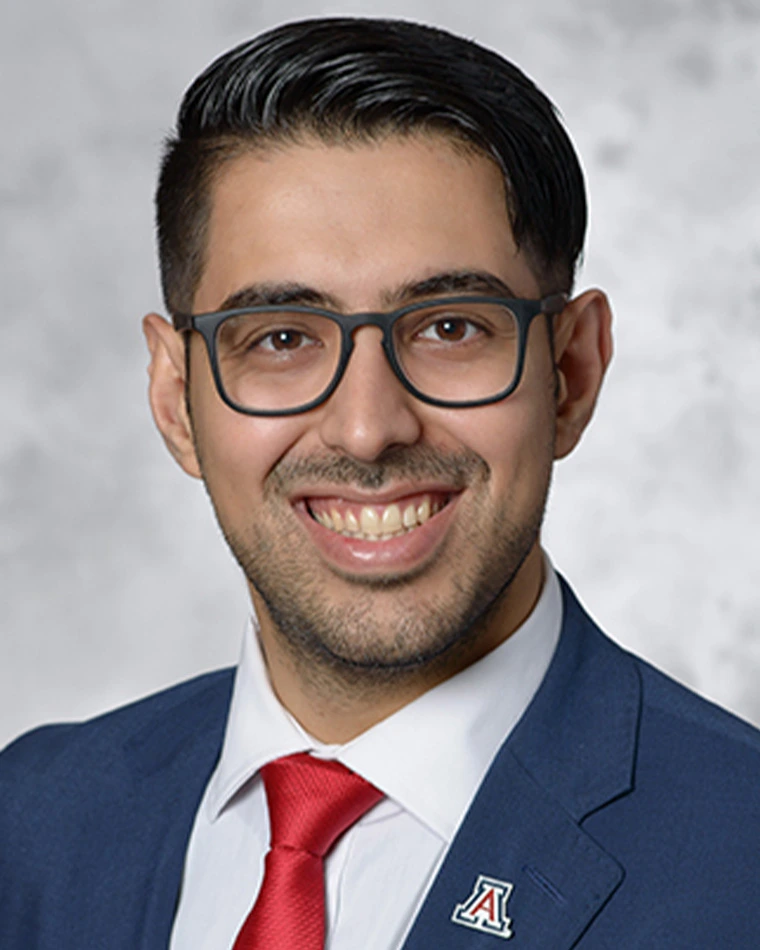
Soheil Salehi is a tenure-track Assistant Professor in the Department of Electrical and Computer Engineering at the University of Arizona, with a joint appointment in Systems and Industrial Engineering. He is the Director of the Privacy-preserving, Intelligent, and Secure Computing (PRISM) Lab, established in August 2022. Prior to this, he was an NSF-Sponsored Computing Innovation Fellow and Postdoctoral Research Fellow at the University of California, Davis. Ph.D., Electrical and Computer Engineering, University of Central Florida, 2020 M.S., Electrical and Computer Engineering, University of Central Florida, 2016 B.S., Isfahan University of Technology, Iran, 2014 Dr. Salehi's research focuses on the intersection of hardware, AI, and security. His work spans hardware and AI-enabled security in IoT , Generative AI for hardware design and security , neuromorphic and biologically-inspired AI hardware , emerging spin-based devices , reconfigurable architectures , low-power VLSI circuits , and digital twins and mixed reality for semiconductor workforce development . He also explores the application of Generative AI in personalized education . His recent publications, spanning 2023–2025, reveal a strong trend toward integrating AI and machine learning into hardware security and design. Key themes include automated secure IC design flows , AI-driven hardware obfuscation , firmware and side-channel attack analysis , security in neuromorphic and spiking neural networks , and educational frameworks using digital twins and generative models . His work appears in top venues like DAC, ICCAD, USENIX Security, IEEE TCAS-I, and ISCAS. Outstanding Reviewer Award, IEEE/ACM Design Automation Conference (DAC), 2023 Best Presentation of the Symposium Award, UC Davis Postdoctoral Research Symposium, 2021 UCF Excellence by a Graduate Teaching Assistant (University-Level), 2016 Nominated for 30-under-30 Award, UCF, 2020 Nominated for Postdoctoral Research Excellence Award, UC Davis, 2022 Dr. Salehi has secured significant research funding as PI and Co-PI, including a $300K NSF SaTC EAGER grant on Generative AI-based Personalized Cybersecurity Tutor, a $174,000 University of Arizona PIF Award, and multiple RII grants totaling over $198K. He has also received industry funding from CHEST. He actively mentors students and leads the PRISM Lab, which focuses on privacy-preserving and intelligent secure computing. His service includes roles as Technical Program Committee (TPC) Member and Session Chair at premier conferences such as DAC, ICCAD, CCS, NDSS, and GLSVLSI. The PRISM Lab, under his direction, conducts cutting-edge research in secure and intelligent hardware systems, with applications in IoT, edge computing, and workforce development. The lab emphasizes interdisciplinary collaboration and innovation in both research and education.