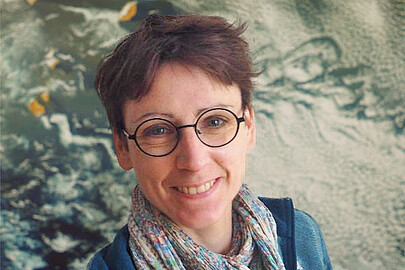
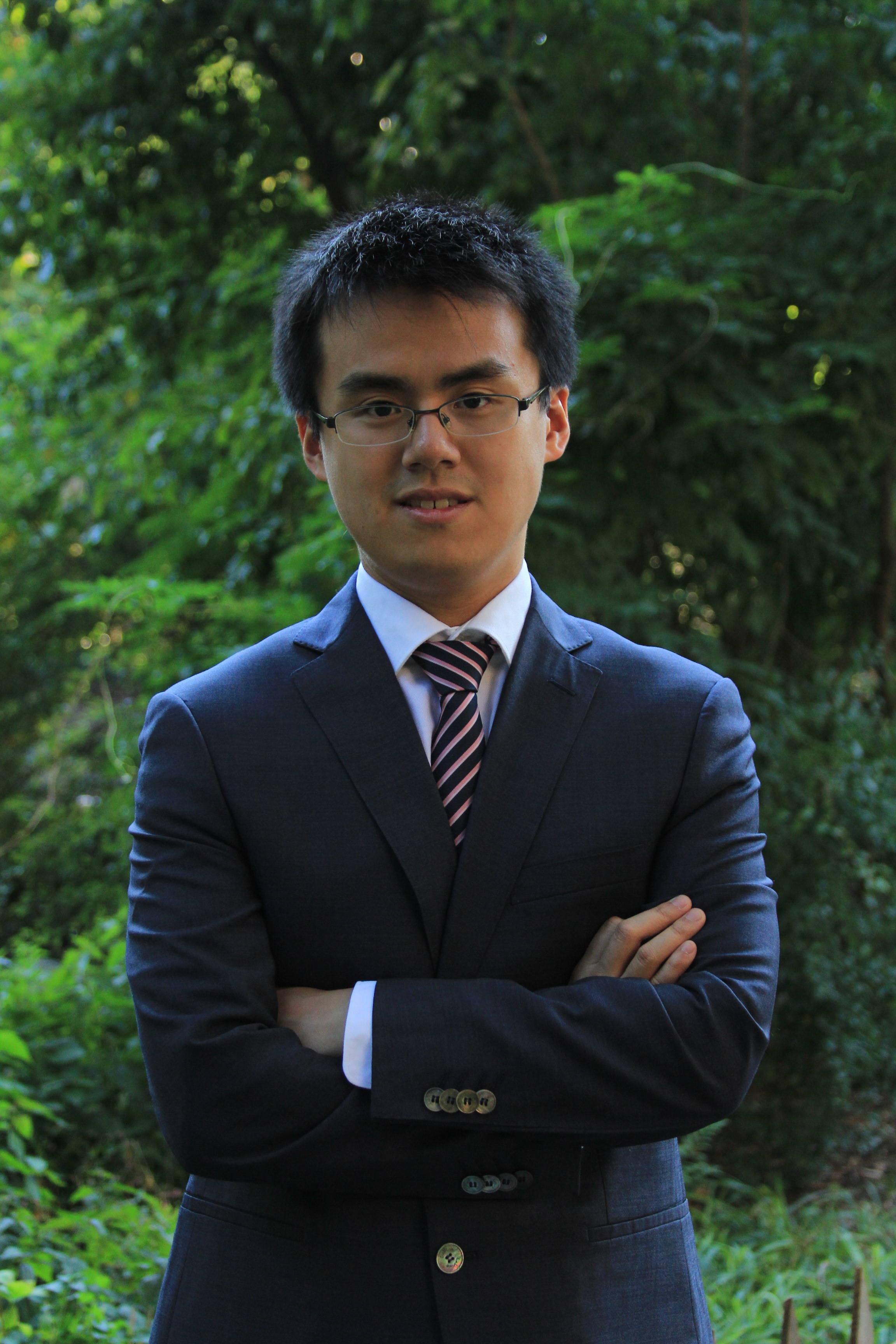
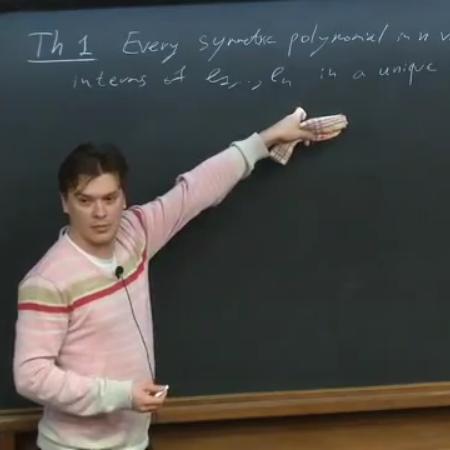
Steven N. Evans is a Distinguished Professor at the University of California, Berkeley , affiliated with the Department of Statistics and the Center for Computational Biology . With over three decades of service since 1987, his work bridges probability theory , stochastic processes , and their applications in mathematical biology , computational genetics , and phylogenetics . His research spans: Probability on Algebraic Structures , including random matrices and local fields. Measure-Valued Processes and coalescent models in population genetics. Phylogenetic Inference in historical linguistics and ecology. Stochastic Models for gene expression, fitness landscapes, and mutation-selection balance. Markov Processes and their applications in phylodynamics. Recent publications highlight his contributions to phylogenetic networks , Frechet mean sets , and Levy process analysis , with keywords spanning Probability , Computational Biology , and Population Genetics . He has mentored 10 PhD students, including Boyan Xu (2024) and Nicholas Bhattacharya (2022). His email is evans@stat.berkeley.edu .
Andrew Li is an Associate Professor of Operations Research at Carnegie Mellon University's Tepper School of Business since 2024, previously serving as Assistant Professor since 2018. His research bridges statistics, optimization, and machine learning with applications to healthcare operations and retail management. Current teaching: Optimization, Business Analytics Capstone, and Topics in Optimization and Statistics PhD from MIT's Operations Research Center (2018), BS in Operations Research/Applied Mathematics from Columbia University (2012) Research Focus: Dr. Li develops data-driven decision frameworks for complex systems. Key areas include: Experience-based learning models with fairness constraints (organ allocation) Anomaly detection in low-rank matrices (retail inventory accuracy) Nanoparticle-based diagnostic systems for CAD and Alzheimer's Nonstationary demand forecasting in supply chains Publication Trends: Recent work combines bandit algorithms with healthcare applications (split liver transplants, CAD detection) and retail operations (inventory accuracy). Theoretical contributions include regret-optimal policies and entrywise anomaly detection guarantees. Scientific Honors: INFORMS Nicholson Award (2018) INFORMS Pierskalla Award (2021) NSF CAREER Award (2023) Professional Leadership: Active in INFORMS and CMU committees including MBA Analytics Curriculum, Thompson Award, and ENAiBLE AI-driven retail collaborative co-founder since 2021.
Mehdi Yazdi is a Lecturer in Pure Mathematics at King's College London, part of the Department of Mathematics within the Faculty of Natural, Mathematical & Engineering Sciences. His research focuses on low-dimensional topology, geometry, and dynamics, with particular emphasis on 3-dimensional manifolds, foliations, mapping class groups, and algorithmic aspects of topology. He holds a PhD from Princeton University (2017) and has held postdoctoral fellowships at the University of Oxford, including the Glasstone Research Fellowship in Science, Titchmarsh Research Fellowship, and a UKRI Postdoctoral Research Fellowship. Education: PhD in Pure Mathematics from Princeton University (2017). Prior to King's College, he was at Oxford from 2017–2021. Research interests include the study of geometric structures on manifolds, algorithmic problems in topology, and the interplay between dynamics and geometry. His work has contributed to understanding foliations, knot theory, and computational aspects of topological invariants. Publications span topics like the stability of foliations, Thurston norms, and computational complexity of knot genus, reflecting his expertise in both theoretical and algorithmic dimensions of geometry and topology. He is a member of the Geometry Group at King's, which explores areas such as algebraic geometry, cohomology theories, and symplectic geometry. His research also engages with broader questions in geometric analysis and low-dimensional dynamics.
Rasmus Kyng is an Assistant Professor in the Department of Computer Science at ETH Zurich, where he has been since 2019. His research focuses on fast algorithms for graph problems, convex optimization, and their applications in machine learning. He has received grants from the Swiss National Science Foundation, including project grants and a starting grant. Education: B.A. in Computer Science from the University of Cambridge (2011), PhD in Computer Science from Yale University (2017), advised by Daniel A. Spielman. Postdoctoral positions included Harvard University (2018–2019) and a research fellowship at the Simons Institute, UC Berkeley (2017). Research Interests: Development of nearly linear-time algorithms for fundamental graph problems (e.g., maximum flow, minimum-cost flow), dynamic graph algorithms, discrepancy theory, and fine-grained complexity. His work bridges numerical linear algebra and combinatorial optimization, emphasizing practical implementations such as the Laplacians.jl package. Awards: FOCS Best Paper Award (2022), Inaugural ICBS Frontiers of Science Award (2022), Machtey Award (Best Student Paper, FOCS 2017). Teaching: Advanced Graph Algorithms and Optimization (ETH Zurich, 2020–2023), Algorithms, Probability, and Computing (ETH Zurich, 2020–2022). Supervised numerous PhD students and mentored postdocs in theoretical computer science. Labs/Teams: Co-leads a research group with Maximilian Probst Gutenberg, focusing on dynamic graph algorithms and optimization. Collaborations include work on sparsification, spectral graph theory, and machine learning applications.
Piotr Zwiernik is an Associate Professor in the Department of Statistical Sciences at the University of Toronto's Faculty of Arts and Science, with a cross-appointment in the Department of Mathematics. Currently on leave from the University of Toronto, he is based in Barcelona following his return in July 2025. His academic journey includes a PhD in Statistics from the University of Warwick (2011), research positions at prestigious institutions including Mittag Leffler Institute, IPAM, TU Eindhoven, UC Berkeley, and the University of Genoa, and an Assistant Professorship at Universitat Pompeu Fabra in Barcelona (2016-2021). His research spans the intersection of statistics, mathematics, and computational methods, with particular emphasis on graphical models, covariance matrix estimation, convex analysis, tensors, and algebraic and combinatorial methods in statistics. Zwiernik's work demonstrates a consistent focus on high-dimensional statistics, mathematical statistics, and elegant theoretical frameworks that bridge abstract mathematics with practical statistical applications. His recent publications reveal a deepening exploration of tensor analysis, algebraic statistics, and the geometric properties of statistical models. Zwiernik serves as an associate editor for leading journals including Biometrika, Scandinavian Journal of Statistics, and Algebraic Statistics. His research program includes the development of the GOLAZO R package for asymmetric regularization of log-likelihood in Gaussian graphical models. As an academic leader, he has served as Associate Chair for Research in his department and actively participates in numerous international conferences and workshops, reflecting his significant standing in the statistical community. His recent publications show a strong trend toward algebraic and geometric approaches to statistical problems, with increasing focus on tensor methods, positivity constraints in statistical models, and the theoretical foundations of graphical models. The work demonstrates remarkable continuity in exploring the mathematical structures underlying statistical models while adapting to emerging challenges in high-dimensional data analysis. Zwiernik is committed to mathematical accessibility and education, guided by Federico Ardila's four axioms which emphasize equitable distribution of mathematical potential, joyful mathematical experiences, mathematics as a malleable tool, and treating every student with dignity and respect. He actively seeks PhD students with strong mathematical backgrounds for research at UPF or the Institute of Mathematics of UPC.
Daniel B. Szyld is a Professor in the Department of Mathematics at Temple University's College of Science and Technology. He is co-Director of the High-Performance Computing for Scientific Applications Professional Science Master’s program and a member of the Center for Computational Mathematics and Modeling. He holds leadership roles as President of the International Linear Algebra Society (ILAS, 2020–2026) and as a Board of Trustees member at ICERM (2024–2028), and previously served as Vice-President of SIAM (2014–2015). His research interests include Numerical Analysis , Scientific Computing , Numerical Linear Algebra , Iterative Methods , Preconditioning , Domain Decomposition , and High-Performance Computing . His work often focuses on Krylov subspace methods like GMRES, block solvers, and asynchronous algorithms, with applications in large-scale scientific simulations. The 15 most recent publications reflect a strong focus on enhancing the stability, convergence, and performance of iterative solvers, especially GMRES variants and domain decomposition methods. Topics include random sketching, deflation, weighted norms, multisketching in QR factorization, and asynchronous Schwarz methods. These works appear in top journals such as SIAM Journal on Matrix Analysis and Applications , Numerische Mathematik , and Electronic Transactions on Numerical Analysis , often in collaboration with leading researchers in the field. Scientific Awards and Recognitions: Commemorative medal, Charles University of Prague, 1997 Featured in Hall of Fame by Henk van der Vorst, SARA, 2010 Dean's Distinguished Award for Excellence in Research, Temple University, 2011 Fellow, American Mathematical Society, 2017 Fellow, Society for Industrial and Applied Mathematics, 2017 Achievement in Mathematics Award, Temple University, 2018 Faculty Senate Outstanding Service Award, Temple University, 2021 Daniel B. Szyld has served on the editorial boards of numerous prestigious journals, including Mathematics of Computation , Linear Algebra and its Applications , Numerical Linear Algebra with Applications , and was Co-Editor-in-Chief of Electronic Transactions on Numerical Analysis (2005–2013) and Editor-in-Chief of SIAM Journal on Matrix Analysis and Applications (2015–2020). His research has been supported by the National Science Foundation and the Department of Energy. He has advised students and postdocs, though specific names are not listed in the provided text. He is also involved in professional service through societies such as SIAM, AMS, ILAS, and NAM, and advocates for equity and ethical engagement in mathematics. Labs and Research Groups: He is a member of the Center for Computational Mathematics and Modeling at Temple University and co-Director of the High-Performance Computing for Scientific Applications Professional Science Master’s program, indicating active leadership in computational research and training.
Cameron Musco is an Assistant Professor in the Manning College of Information and Computer Sciences at the University of Massachusetts Amherst. He is affiliated with the Theory Group and conducts research at the intersection of theoretical computer science, numerical linear algebra, and machine learning. His work focuses on randomized algorithms, streaming, and distributed computation, with applications in data science. Education: PhD in Computer Science, MIT (2019) BS in Computer Science and Applied Mathematics, Yale University Research Interests: Musco's research emphasizes algorithm design for large-scale data analysis, including fast randomized methods for linear algebraic problems. He explores topics such as low-memory computation, matrix approximations, and graph algorithms, driven by applications in machine learning and distributed systems. Publications: His recent work spans advancements in hierarchical matrix approximation, graph-based nearest neighbor search, and fair resource allocation, reflecting expertise in both theoretical foundations and practical algorithmic innovation. Awards: He has received an NSF Career Award, Google Research Scholar Award, and recognition for anti-racism leadership. He actively reviews for top conferences in theoretical computer science and machine learning. Advising & Grants: Musco advises multiple PhD students and has grants from NSF and Google. His lab collaborates on projects like low-rank matrix approximation and causal discovery. Labs/Teams: He is part of the Theoretical Computer Science Group and the Center for Data Science at UMass.
Yingli Qin is an Associate Professor in the Department of Statistics and Actuarial Science at the University of Waterloo, part of the Faculty of Mathematics. His research focuses on high-dimensional statistics and random matrix theory, with applications to covariance matrix analysis and hypothesis testing. He holds a PhD in Statistics from Iowa State University, alongside MA and BSc degrees in Mathematics and Statistics from Iowa State University and Northeast Normal University, China. Education : PhD in Statistics, Iowa State University, USA MA in Statistics, Iowa State University, USA BSc in Applied Mathematics, Northeast Normal University, China Research Interests : Qin’s work emphasizes high-dimensional statistical methodologies, including covariance matrix estimation, spectral distribution analysis, and the application of random matrix theory to address challenges in large-scale data. His contributions include developing bias-reduced estimators and testing frameworks for high-dimensional datasets. Publications : Qin has published extensively in top-tier journals such as the Annals of Statistics , Journal of Multivariate Analysis , and Biometrika , with a focus on advancing statistical theory for high-dimensional settings. Teaching : He teaches advanced courses including Multivariate Analysis (Stat 923), Estimation and Hypothesis Testing (Stat 850/450), and Mathematical Statistics (Stat 330).
Dr. Gaël Kermarrec is a researcher at the Boundary Layer Meteorology Group , part of the Institute of Meteorology and Climatology within the Faculty of Mathematics and Physics at Leibniz University Hannover . His work focuses on atmospheric turbulence, GNSS applications, and remote sensing for environmental monitoring. Boundary layer meteorology Turbulence theory GNSS signal processing Terrestrial laser scanning Climate change impacts Geodetic time series analysis His research integrates advanced mathematical models like LR B-splines and Matérn covariance with large eddy simulations to study: Atmospheric turbulence effects on optical/GNSS signals Hydrospheric mass loading Deformation analysis of terrain/port infrastructure Climatic sea-level changes Machine learning for remote sensing The 15 most recent articles (2025-2023) demonstrate his focus on: GNSS-based turbulence detection AI-enhanced climate mapping Advanced surface approximation techniques Multi-sensor data fusion Stochastic modeling of geodetic observations Environmental impacts on optical measurements He has developed tools like the Klimascanner QGIS plugin for urban climate resilience and contributes to: Understanding atmospheric scale lengths Improving TLS/GNSS deformation monitoring Analyzing hydrospheric changes Wavefront modeling Ionospheric corrections
Tao Mei is a Professor of Mathematics at Baylor University, joining in August 2015. Prior to Baylor, he held faculty positions at Wayne State University (2010-2015) and the University of Illinois at Urbana-Champaign (2006-2010). He earned his Ph.D. in Mathematics from Texas A&M University in 2006 under Gilles Pisier. Research Focus: Analysis and probability, particularly noncommutative analysis, free probability, harmonic analysis, and operator algebras. Grants: Supported by NSF awards DMS-2247123 and DMS-2400113. Mei's work bridges operator theory, functional analysis, and quantum probability. His recent publications emphasize Fourier multipliers, maximal inequalities, and noncommutative harmonic analysis. He has mentored PhD students including Chian Y. Chuah, Zhen C. Liu, and Sebastian Vargas Loaiza. He co-organizes international seminars such as the Virtual Noncommutative Analysis Weekly Seminar and leads the Brazos Analysis seminar, supported by NSF DMS-2400113. His invited lectures span institutions like UCSD, Ohio State University, and Ghent University, highlighting his contributions to quantum information theory and operator analysis.
Steven Neil Evans is a Professor in the Departments of Statistics and Mathematics at the University of California, Berkeley, with a joint appointment since 1999. His research spans stochastic processes, probability on algebraic structures, and applications in population biology, phylogenetics, and computational biology. BSc (Hons I & University Medal) in Statistics, University of Sydney (1983) PhD in Mathematics, University of Cambridge (1987) Research Interests: Evans works on random matrices, Lévy processes, measure-valued stochastic processes, coalescent models in biology and chemistry, phylogenetics (including invariants), biodemography, mutation-selection balance, and stochastic models in population genetics. His recent work connects probability theory with computational biology, focusing on metagenomics and transcriptional regulation. He also explores computational algebra in modeling biological systems. Articles Trends: His publications reveal a trajectory from foundational work in stochastic processes and Lévy processes to interdisciplinary applications in phylogenetics, population genetics, and computational biology. Key subfields include mutation-selection models, random tree structures, stochastic differential equations, and algebraic probability. Recent work addresses phylogenetic networks and Frechet mean sets in metric spaces. Scientific Awards: Rollo Davidson Prize (1990) Presidential Young Investigator Award (1991) Alfred P. Sloan Foundation Fellowship (1993) G. de B. Robinson Prize (1997) Miller Research Professor (2002) Fellow, American Mathematical Society (2012) Member, National Academy of Sciences (2016) Advising and Grants: Evans has advised over 30 PhD/Master's students since 1993. He has received continuous NSF grants (1988-2019), NIH funding (2016-2018), and international fellowships. His academic service includes editorial roles at major journals and organizing conferences in probability and mathematical biology.
Sandra Keiper is a Lecturer at the Institute of Mathematics within Faculty II - Mathematics and Natural Sciences at Technical University of Berlin. She has held academic positions since at least 2011, including roles as Tutor, Assistant, and Lecturer, with teaching responsibilities in Analysis, Linear Algebra, and Partial Differential Equations for both mathematicians and engineers. Research interests include: Compressed Sensing and Sparse Signal Recovery Numerical Linear Algebra with applications to high-dimensional data Wavelet and curvelet transforms for geometric multiscale analysis Approximation theory for finite-valued and cartoon-like functions Deep learning and graph approximation techniques Professional activities : Active in teaching since 2011 (Analysis I-III, Functional Analysis, Integral Transforms) Supervising theses since 2015 on topics like Compressed Sensing and Deep Learning Invited lectures at Caltech, ETH Zurich, and Alan Turing Institute Research stays at Hausdorff Institute, ETH Zurich, and Duke University
Anru Zhang is the tenured Eugene Anson Stead, Jr. M.D. Associate Professor with joint appointments in Biostatistics & Bioinformatics, Computer Science, Electrical and Computer Engineering, and Statistical Science at Duke University. He holds a Ph.D. from the University of Pennsylvania (2015, advised by T. Tony Cai) and a B.S. in Mathematics from Peking University (2010). Current roles: Associate Professor at Duke (2024–present), previously Assistant Professor at UW-Madison (2018–2021) Research focus: Tensor learning, high-dimensional statistics, EHR analysis, and healthcare applications Mentorship: Supervises active research team including postdocs (Jianbin Tan, Qiuyi Wu) and PhD students (Runshi Tang, Yinrui Sun) Research Trends : His recent publications emphasize tensor methods in biomedical data (EHR, microbiome, Alzheimer’s), Riemannian optimization for high-dimensional problems, and hybrid statistical-computational approaches. Key themes include healthcare AI, EHR analysis, and non-convex optimization. Scientific Awards : COPSS Emerging Leader Award (2024) IMS Tweedie New Researcher Award (2022) ASA Gottfried E. Noether Junior Award (2021) NSF CAREER Award (2020) AMIA Data Science Outstanding Paper Award (2023) Advising & Grants : Mentored 16+ students/postdocs, including Yuetian Luo (IMS Lawrence D. Brown Award) and Yuchen Zhou (IMS Hannan Travel Award). Current grants include NIH-funded projects on sepsis detection, mental health AI, precision genetic testing, and telehealth interventions, plus NSF CAREER funding for statistical inference in high-dimensional structures. Labs & Teams : Leads a research group at Duke focusing on tensor learning, statistical theory, and healthcare AI applications. Collaborates with Duke’s AI Health initiative and serves as Associate Editor for leading journals like Annals of Statistics and JASA.
Anton Mellit is an Associate Professor in the Faculty of Mathematics at the University of Vienna. He holds a Doctor of Natural Sciences from the University of Bonn (2008) and completed postdoctoral positions at institutions including the Hausdorff Center for Mathematics (Bonn), Scuola Internazionale Superiore di Studi Avanzati (Trieste), and the Institute of Science and Technology Austria (Klosterneuburg). His research focuses on algebraic geometry, enumerative geometry, and their connections to representation theory, combinatorics, and number theory, with particular emphasis on moduli spaces, categorification, and character varieties. Education: Doctor of Natural Sciences (2008), University of Bonn Master in Applied Mathematics (2004), National Technical University of Ukraine Bachelor in Applied Mathematics (2002), National Technical University of Ukraine Research Interests: Investigates Poincaré polynomials of moduli spaces, Higgs bundles, and character varieties Studies Khovanov-Rozansky homology and torus knots Explores connections between Macdonald polynomials and affine Springer fibers Develops combinatorial approaches to algebraic geometry via Hilbert schemes and categorification Grants & Projects: ERC Consolidator Grant: Macdonald polynomials and related structures in geometry FWF Standalone Project: Refined invariants in combinatorics, low-dimensional topology, and geometry of moduli spaces Labs/Teams: Collaborates with researchers in geometric representation theory, quantum cohomology, and algebraic combinatorics, including notable co-authors like Erik Carlsson, Eugene Gorsky, and Maxim Smirnov.
Alexander Müller-Hermes is an Associate Professor at the Department of Mathematics, University of Oslo. His research focuses on quantum information theory with emphasis on mathematical questions in quantum Shannon theory and entanglement. He also explores functional analysis and convex geometry inspired by quantum phenomena. Before joining UiO, he held a Marie Skłodowska-Curie fellowship at University Claude Bernard Lyon 1 and was a postdoc at the Centre for Mathematics in Quantum Theory (QMATH), University of Copenhagen. He earned his PhD in Mathematics from Technical University Munich in 2015. Teaching includes advanced courses like Quantum Information Theory (MAT4430) and Linear Algebra (MAT1120). His research interests span quantum communication, entanglement theory, operator algebras, and functional analysis, with over 20 peer-reviewed publications since 2014. His work on fault-tolerant quantum coding and entanglement monotones has advanced theoretical foundations in quantum information. He collaborates with the Operator Algebras research group at UiO and is part of the QOMBINE project on quantum computation and many-body theory.