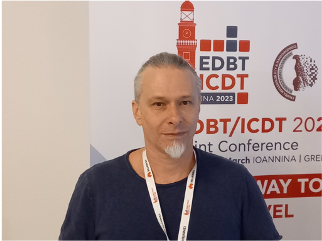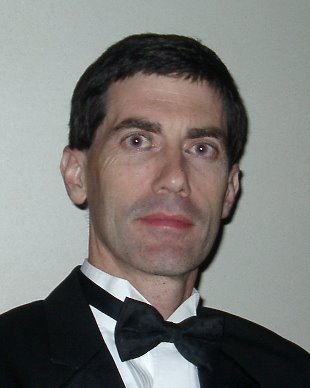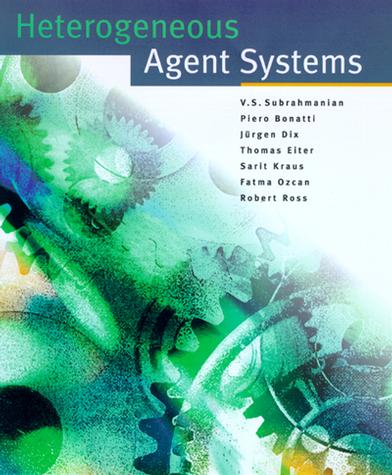
Thomas Eiter is a Full Professor at the Institute of Logic and Computation, Technical University of Vienna (TU Wien), where he serves as Head of Research Unit. He is a Full Member of the Division of Mathematics and Natural Sciences since 2022 and holds leadership roles within the university. His research focuses on knowledge representation and reasoning, computational logic, algorithms and complexity in AI, declarative problem solving, nonmonotonic logic programming and databases, and reasoning about actions and change. His work bridges theoretical foundations with practical applications in artificial intelligence, particularly in logic programming and knowledge-based systems. He has made significant contributions to Answer Set Programming (ASP), developing frameworks like DLV and HEX programs that enable sophisticated reasoning capabilities. His recent publications demonstrate a strong focus on stream reasoning (LARS framework), knowledge forgetting, modular reasoning systems, and the integration of logic programming with ontologies. His research shows consistent contributions to both theoretical foundations and practical implementations of AI systems over several decades. ACM Fellow (2020) Fellow of the European Association for AI (2006) Distinguished Paper Award of the 17th International Joint Conference on Artificial Intelligence (IJCAI, 2001) Prominent Paper Award of the Artificial Intelligence Journal (2013) Test of Time Award (10 years) of the International Conference on Logic Programming (2013) Eiter has led and participated in numerous research projects, both internationally funded (such as LogiCS@TUWien, Humane AI, AI4EU) and nationally funded (including projects like BILAI, TAIGER, and several FWF-funded initiatives). His research unit has received substantial support from European Commission programs (H2020) and Austrian funding agencies (FWF, FFG, WWTF). He is actively involved in the academic community as a member of the Austrian Academy of Sciences (ÖAW), Academia Europaea, and has served on the Executive Council of AAAI. His research unit maintains strong connections with international collaborators and has developed influential systems like the DLV answer set programming system.