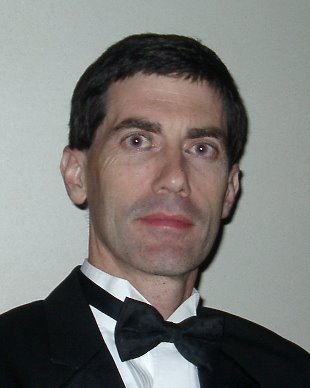
Christoph Koch is a Full Professor in the School of Computer and Communication Sciences at EPFL (Ecole Polytechnique Federale de Lausanne) , Switzerland. He has held academic positions at Cornell University (2007-2010, 2006), Saarland University (2005-2007), and TU Vienna (2001-2005). His research focuses on database systems, logic, programming languages, and data management.
Emanuel Sallinger is a Full Professor at TU Wien's Databases and Artificial Intelligence Group and Vice Dean of Academic Affairs for Business Informatics and Data Science. He leads the Knowledge Graph Lab, focusing on scalable knowledge-based systems, reasoning in knowledge graphs, and AI integration. His research spans computational logic, database theory, and blockchain applications. Education: PhD in Computer Science (awarded 'sub auspiciis praesidentis rei publicae'), Master's degrees in Computational Intelligence and Informatics Management, and a Bachelor's in Software and Information Engineering. Research Interests: Knowledge graphs (construction, reasoning, scalability), logic-based systems, AI/ML integration with databases, enterprise architecture modeling, and financial knowledge systems. His work emphasizes practical applications like enterprise modeling, sustainable waste management, and regulatory compliance. Grants & Projects: Lead Vienna Science and Technology Fund (WWTF)-funded Knowledge Graph Lab. Involved in projects like 'Knowledge Graph-driven Tour Management' (sustainability), 'SustainGraph' (waste processing), and 'Enterprise Architecture Knowledge Graphs'. Teaching: Offers courses on Knowledge Graphs, Generative AI, Database Systems, and research methodology. Supervises doctoral and master's students in AI, databases, and knowledge representation. Labs/Teams: Knowledge Graph Lab at TU Wien, collaborating with industry on blockchain-based systems, financial AI, and enterprise architecture frameworks.
Hans Tompits is an Associate Professor in the Department of Knowledge-Based Systems at Technische Universität Wien (Vienna University of Technology). His research focuses on computational logic, declarative logic programming, and formal methods, with a particular emphasis on Answer-Set Programming (ASP). He coordinates the Master's program in Logic and Computation and leads projects in areas such as formal methods for optimization, fault-tolerant autonomous systems, and algorithmic composition. His work bridges theoretical advancements with practical applications, including tools like SeaLion (an ASP IDE with debugging support) and dlvhex (an ASP-based semantic web reasoner). He has contributed to foundational topics like program equivalence, debugging techniques, and integration of ASP with external systems. His recent projects address challenges in autonomous vehicle architectures, music composition algorithms, and safety-critical system design. Tompits has published extensively on topics ranging from nonmonotonic reasoning and modal logics to the development of declarative programming tools. His interdisciplinary approach spans computer science, mathematics, and AI, with applications in both academic and industrial contexts.
Gerhard Friedrich is a Full Professor at the University of Klagenfurt, leading the Institute for Artificial Intelligence and Cybersecurity. He previously served as Dean of the Faculty of Technical Sciences (2013–2021). His roles include Coordinator for International Relations of the Faculty of Engineering and Member of the Faculty Conference of Technical Sciences. He holds a PhD in Computer Science from Vienna University of Technology and has extensive industry experience, including heading departments at Siemens Austria and research roles at Siemens Corporate Research and Stanford Research Institute. Research focuses on knowledge-based systems, recommender systems, configuration and planning, and production informatics. His work bridges theoretical AI with practical applications in manufacturing, software development, and business processes. He has authored a book on recommender systems (translated into Japanese and Chinese) and contributed to prestigious journals like Artificial Intelligence and IEEE Transactions . He has organized major conferences such as the German Conference on Artificial Intelligence (2016) and served as editor and program committee member for leading venues. His awards include Fellowships from the European and Asia-Pacific AI Associations (2012, 2023). His advising and grants include leadership in applied AI projects and international collaborations. He directs the Intelligent Systems and Business Informatics research group, emphasizing interdisciplinary innovation.
Thomas Eiter is a Full Professor at the Institute of Logic and Computation, Technical University of Vienna (TU Wien), where he serves as Head of Research Unit. He is a Full Member of the Division of Mathematics and Natural Sciences since 2022 and holds leadership roles within the university. His research focuses on knowledge representation and reasoning, computational logic, algorithms and complexity in AI, declarative problem solving, nonmonotonic logic programming and databases, and reasoning about actions and change. His work bridges theoretical foundations with practical applications in artificial intelligence, particularly in logic programming and knowledge-based systems. He has made significant contributions to Answer Set Programming (ASP), developing frameworks like DLV and HEX programs that enable sophisticated reasoning capabilities. His recent publications demonstrate a strong focus on stream reasoning (LARS framework), knowledge forgetting, modular reasoning systems, and the integration of logic programming with ontologies. His research shows consistent contributions to both theoretical foundations and practical implementations of AI systems over several decades. ACM Fellow (2020) Fellow of the European Association for AI (2006) Distinguished Paper Award of the 17th International Joint Conference on Artificial Intelligence (IJCAI, 2001) Prominent Paper Award of the Artificial Intelligence Journal (2013) Test of Time Award (10 years) of the International Conference on Logic Programming (2013) Eiter has led and participated in numerous research projects, both internationally funded (such as LogiCS@TUWien, Humane AI, AI4EU) and nationally funded (including projects like BILAI, TAIGER, and several FWF-funded initiatives). His research unit has received substantial support from European Commission programs (H2020) and Austrian funding agencies (FWF, FFG, WWTF). He is actively involved in the academic community as a member of the Austrian Academy of Sciences (ÖAW), Academia Europaea, and has served on the Executive Council of AAAI. His research unit maintains strong connections with international collaborators and has developed influential systems like the DLV answer set programming system.
Thomas Eiter is a Full Professor of Knowledge-Based Systems and Computer Science at Vienna University of Technology (TU Wien), where he has served as Head of the Institute of Information Systems since 2004. His work bridges artificial intelligence, computational logic, and knowledge representation, with significant contributions to nonmonotonic reasoning and declarative problem-solving. He has led major international conferences and projects, including the Vienna Summer of Logic (2014), and received accolades like the Prominent Paper Award (AIJ 2013) and Test of Time Award (ICLP 2013). Education Habilitation in Information Systems (1995, TU Wien) M.Sc. (Dipl.-Ing.) in Computer Science (1989, TU Wien) Ph.D. (Dr.techn.) in Computer Science (1991, TU Wien) Research Interests Eiter’s research focuses on knowledge representation and reasoning , computational logic , and nonmonotonic logic programming . He explores algorithms and complexity in AI, declarative problem-solving frameworks, and reasoning about actions and change, often integrating intelligent agents and database systems. Scientific Leadership Chair-elect of IJCAI (2019) President of KR Inc. (2014–2015) Board Member for Computer Science at the Austrian Science Fund (FWF) (2005–2014) Co-chair of Vienna Summer of Logic (2014) Honors and Memberships Fellow of the European Association for AI (EurAI) Fellow of the Asia-Pacific AI Association (AAIA) Member of the Austrian Academy of Sciences (ÖAW) Member of Academia Europea Senior Member of ACM and IEEE Computer Society
Daria Stepanova is a researcher at the Institute of Information Systems , Technische Universität Wien. Her work focuses on Answer-Set Programming (ASP), inconsistency resolution in hybrid knowledge bases, and optimization algorithms for scheduling and scene generation. Education: PhD (Dr.techn.) in Technical Sciences, MSc in Computer Science. Research Interests: Answer-Set Programming for scheduling and optimization Inconsistency handling in Description Logic Programs Hybrid reasoning systems combining logic and semantic methods Applications of automated reasoning in manufacturing and gaming Publications highlight trends in ASP-driven scheduling, inconsistency repair techniques, and semantic scene generation using contextual reasoning and algebraic measures. Labs & Teams: Active member of the Network Lab at TU Wien Collaborator on projects like ALASPO and Angry-HEX
Thomas W. Reps is a Professor in the Department of Computer Science at the University of Wisconsin, holding the position since 1985. He has served as President and Co-founder of GrammaTech, Inc. since 1988, and held visiting roles including Guest Professor at the University of Paris 7 (2007-08), Visiting Researcher at CNR in Pisa, Italy (2000-01), and Guest Professor at the University of Copenhagen (1993-94). He previously served as Associate Chairman of the Computer Sciences Department at Wisconsin (1990-93) and held postdoctoral roles at Cornell University and INRIA. Reps' research spans programming languages, software engineering, and computer security, with a focus on static program analysis, machine-code analysis, and program slicing. His work in model checking, software maintenance, and analysis techniques for information security has significantly impacted the field of computer science. 2017 ACM SIGPLAN Programming Languages Achievement Award 2015 WARF Named Professorship 2005 ACM Fellow 2000 Guggenheim Fellowship 1986 NSF Presidential Young Investigator Award Reps' publications highlight advancements in interprocedural dataflow analysis, weighted pushdown systems, and symbolic computation. His work bridges theoretical foundations with practical applications in software verification and security, creating tools that have shaped modern program analysis techniques. He has collaborated extensively with researchers like Somesh Jha, Mooly Sagiv, and Gogul Balakrishnan across institutions in Europe and the U.S.
Alice Tarzariol is a Researcher at the Institut für Artificial Intelligence und Cybersecurity within the Faculty of Technical Sciences at Alpen-Adria-Universität Klagenfurt. She specializes in computational logic, optimization algorithms, and their applications in artificial intelligence. Her research focuses on advancing Answer Set Programming (ASP) techniques for complex problem-solving, including production scheduling, symmetry breaking, and constraint learning. She also explores interdisciplinary applications such as cancer data analysis through logic programming frameworks. Her work emphasizes improving algorithmic efficiency and developing tools for combinatorial optimization, formal verification, and bioinformatics. She contributes to projects like the institute’s efforts to strengthen regional knowledge transfer and serves on the Curricularkommission für das Erweiterungscurriculum Gender Studies. Her research spans both theoretical advancements in computational logic and practical implementations in industrial and medical domains. Key themes in her publications include symmetry detection and lifting, constraint satisfaction, and inductive logic programming. Recent work highlights declarative approaches to production scheduling and efficient symmetry-breaking methods. Her research has implications for automated decision-making, systems modeling, and data-driven healthcare solutions.
Michael Morak is a Professor at the Department of Artificial Intelligence and Cybersecurity, Alpen-Adria-Universität Klagenfurt, affiliated with the Faculty of Technical Sciences. He holds the titles Privatdozent, Diplom-Ingenieur, and Doctor. His research focuses on artificial intelligence, cybersecurity, and computer science, with notable contributions in logic programming, answer set programming, and algorithmic methods. He has led and contributed to multiple research projects funded by entities like the Austrian Research Promotion Agency (FFG) and the Austrian Agency for International Cooperation in Education (OeAD), addressing topics such as multi-agent systems, radar simulation, and educational technology. His work spans theoretical advancements, including reversibility in planning and dynamic programming, as well as practical applications like interactive SQL learning tools (aDBenture). He collaborates with industry partners, including Infineon Technologies, and has published extensively in top-tier conferences and journals. Morak’s teaching emphasizes innovative methods in computer science education, leveraging game-based learning and interactive platforms to enhance student engagement. Key areas of research include formal methods in AI, algorithmic complexity, and the integration of logic programming with real-world systems. His projects often bridge academia and industry, aiming to solve complex challenges in cybersecurity, robotics, and educational innovation.
Konstantin Schekotihin is an Associate Professor at the Institute of Artificial Intelligence and Cybersecurity , part of the Faculty of Technical Sciences at Alpen-Adria-Universität Klagenfurt. His research focuses on AI-driven solutions for semiconductor manufacturing, failure analysis, and multi-agent systems. He specializes in reinforcement learning, scheduling optimization, and neuro-symbolic AI applications. His work bridges theoretical advancements with industrial challenges such as semiconductor fab automation and real-time process monitoring. He has collaborated with organizations like the Austrian Research Promotion Agency (FFG) and Infineon Technologies. Key research areas include: AI for semiconductor failure analysis workflows Reinforcement learning in manufacturing scheduling Multi-agent systems in immersive VR environments Neuro-symbolic AI for defect routing Predictive modeling for equipment maintenance Recent projects involve optimizing ion implantation processes, developing FA ChatBots, and improving social presence in VR simulations. His work emphasizes scalability, explainability, and real-world applicability of AI systems.
Aleksandar Pavlović is a researcher at the Institute of Computer Sciences specializing in knowledge graph technologies and Datalog-based systems. His work bridges semantic web standards with machine learning methodologies to advance knowledge representation and query processing efficiency. Research interests focus on: Knowledge graph embedding techniques with spatial and geometric interpretations Datalog optimization for SPARQL query evaluation Integration of graph neural networks with symbolic reasoning systems Interoperability solutions for semantic web technologies Recent publications (2023-2024) demonstrate consistent innovation in knowledge graph completion and reasoning, featuring novel embedding architectures like ExpressivE and region-based neural networks. His work shows strong alignment with database community priorities while pushing boundaries in neural-symbolic integration. Collaborations span international institutions through co-authorships with researchers including Sallinger, Schockaert, Angles, and Gottlob. He actively contributes to academic discourse through conference presentations, including recent work on AI-supported language services for long-term care systems.
Ulrich Neumerkel is an Assistant Professor in the Department of Compilers and Languages at Technische Universität Wien (TU Wien). He holds academic titles of Dipl.-Ing. (FH) and Dr.techn. His primary research focuses on programming languages, logic programming, and constraint programming, with significant contributions to Prolog optimization, garbage collection, and formal methods. He is also actively involved in educational initiatives, developing declarative programming tools and curricula. Neumerkel teaches courses such as Logic Programming and Constraints, Advanced Logic Programming, and Programming 2. He leads research in formal semantics of Prolog, constraint solver design, and memory management techniques. His work includes contributions to ISO/IEC Prolog standards and the development of tools like the Vienna Abstract Machine (VAM) and the GUPU environment for Prolog education. His research interests span compiler design, termination analysis, and program transformation. He has supervised students, including M. Seidl, on diploma theses related to virtual machine comparison and other topics. Neumerkel's affiliations include the Compilers and Languages group within TU Wien's Institute for Information Systems Engineering.
Christoph Koch is an Associate Professor at Technische Universität Wien specializing in databases and artificial intelligence. His research spans database theory, complexity theory, and logic in computer science, with a focus on XML processing, query optimization, and parallel data science techniques. Lead projects: KnowledgeGraph (2020–2028), HINT (2012–2017), Weblearn (2005–2008) Developed the Lixto visual extraction system and contributed to DLV knowledge representation framework Supervised T. Lukasser's diploma thesis on XPath query processing
Ingo Feinerer serves as an Associate Professor at Vienna University of Technology's Faculty of Informatics, specifically within the Institute of Information Systems Engineering (E192-02). His research bridges theoretical computer science and practical applications in database systems, artificial intelligence, and text mining, with significant contributions to configuration management and formal methods. His educational background includes: PhD Dissertation (2007): A formal treatment of UML class diagrams as an efficient method for configuration management Diploma Thesis (2005): Formal program verification: a comparison of selected tools and their theoretical foundations Feinerer's research focuses on database theory (particularly schema mapping and dependencies), AI-driven configuration systems using integer linear programming, and text mining infrastructure development in R. His work combines theoretical rigor with practical tool development, notably through the textcat and tm packages. The integration of formal methods in software engineering remains a consistent thread throughout his publications. Analysis of his 15 most recent publications reveals strong specialization in database constraints (40%), text mining applications (30%), and software configuration systems (30%), with increasing interdisciplinary work connecting computer science to digital humanities. His notable recognition includes: INiTS Award (2007) for technology commercialization potential Feinerer has supervised doctoral research including F. I. Chertes' work on schema mapping languages and diploma theses on UML semantics and probabilistic databases. He led major research projects HINT (2012-2017) and SEE (2012-2016) focusing on database technologies and information systems. His work demonstrates consistent funding through Austrian national research programs. As a core member of the Databases and Artificial Intelligence research group, he collaborates extensively on R package development for text analysis and contributes to international workshops on theoretical aspects of software engineering.