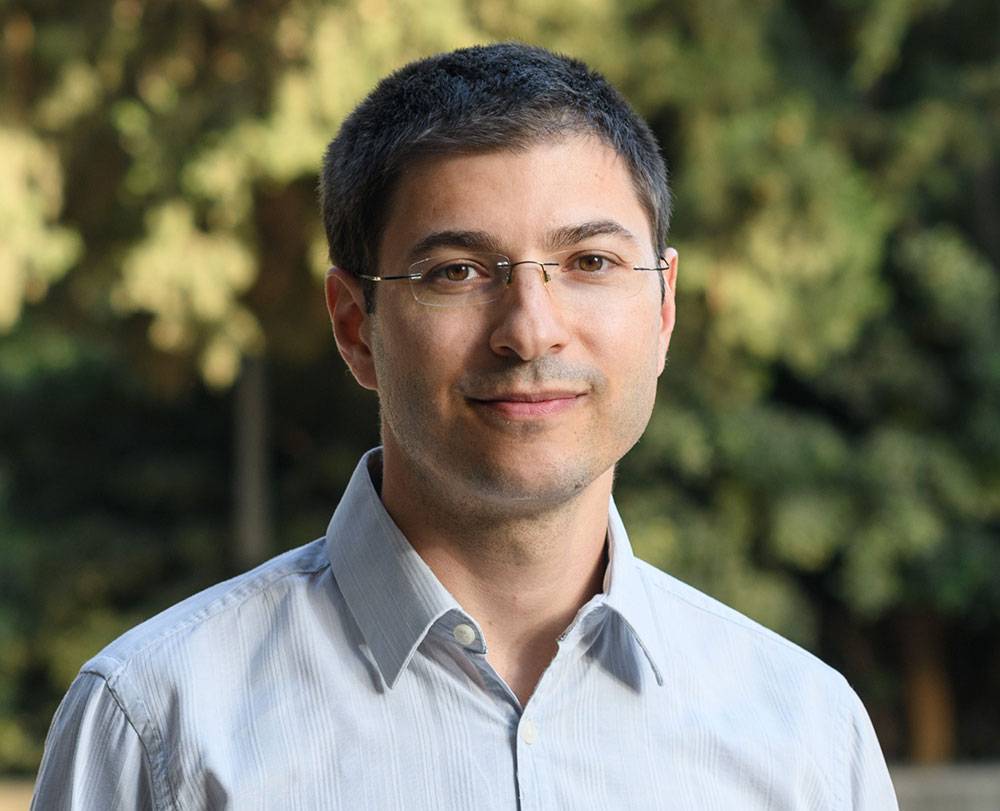
Emmanuel Levy is a Full Professor at the Department of Molecular and Cellular Biology, University of Geneva. His research focuses on the self-organization of proteins, integrating computational and experimental approaches such as structural biology, proteomics, and synthetic biology. Using budding yeast as a model organism, his lab investigates principles of protein assembly, phase separation, and evolutionary constraints. Full Professor University of Geneva Department of Molecular and Cellular Biology Research interests include: Protein Structure and Assembly Synthetic Biology applications Proteomics and Evolutionary Biology Biomolecular Condensates Structural and Computational Biology Recent publications highlight work on: Protein complex alignment Co-translational assembly Evolution of oligomeric states Coiled coil analysis Stickiness and condensate recruitment Phase separation dynamics Laboratory name: Explorers and Architects of Cells' Proteome
Dr. Christine Grundig is a Researcher at the University of Zurich's Institute of Art History, where she has contributed to the SNSF research project 'Heinrich Wölfflin's Collected Works' since October 2017 under Prof. Tristan Weddigen's chair. She plays a pivotal role in advancing Digital Humanities through both research and teaching, currently contributing to the swissuniversities P8 project (2021-2024) focused on systematic integration of digital skills into humanities education. Her academic journey began with studies in German and English for teaching at grammar schools at Julius-Maximilians-University of Würzburg, where she earned a Master's degree specializing in Older German Literature. She completed her dissertation on 'On Making a Fool. Authorship and Paratextuality in European Ships of Fools around 1500' under Prof. Dr. Joachim Hamm, scheduled for publication in 2023. Prior to Zurich, she held teaching and research positions at the University of Würzburg (2013-2017). Dr. Grundig's research bridges computational methods with humanities scholarship, focusing on digital editions, text/image processing, and OCR for historical documents. Her work demonstrates how digital tools can transform traditional humanities research while maintaining scholarly rigor. She has particular expertise in applying OCR4all and Transkribus to analyze medieval literary traditions, especially the 'Ship of Fools' corpus across European contexts. Her publication record reveals a clear interdisciplinary trajectory, with her 2019 Applied Sciences paper on OCR4all representing significant methodological contribution to historical document processing, while her literary studies publications demonstrate deep engagement with paratextuality and adaptation in medieval literature. This dual focus makes her work valuable to both computer scientists developing humanities applications and traditional scholars seeking new analytical approaches. Co-developer of OCR4all open-source tool for historical document processing Key contributor to digital edition of Heinrich Wölfflin's works Developer of curriculum for Digital Humanities education across multiple institutions Specialist in medieval literature with focus on the 'Ship of Fools' tradition Through her teaching modules, Dr. Grundig systematically introduces humanities students to essential digital skills including relational databases, automatic text recognition, and digital scholarly editions. Her approach emphasizes both practical application and critical reflection, helping students understand not just how to use digital tools but also their limitations and implications for humanities scholarship. Her work represents an important bridge between traditional humanities disciplines and emerging digital methodologies.