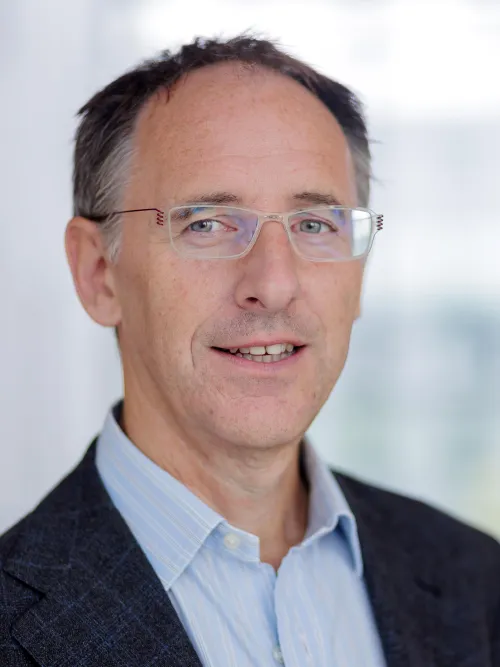
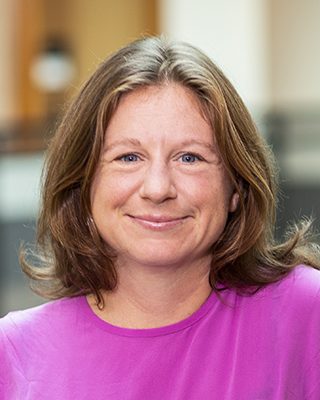
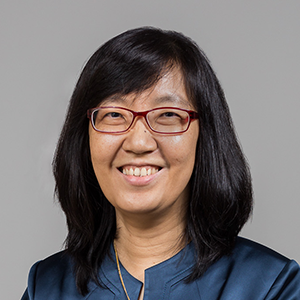
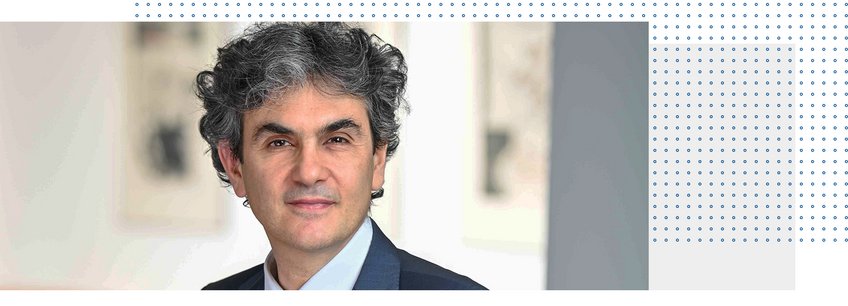
Robert Kosowski is Professor of Finance and Head of the Department of Finance at Imperial College Business School, Imperial College London. He holds a Ph.D. from London School of Economics, M.Sc. in Economics from London School of Economics, and B.A./M.A. in Economics from Trinity College, Cambridge University. His research examines asset management, risk management, machine learning applications in finance, hedge funds, and performance measurement. He has published in top finance journals including Journal of Finance, Journal of Financial Economics, and Review of Financial Studies. Awards include European Finance Association Best Paper Award (2007), four INQUIRE best paper awards, and British Academy Mid-Career Fellowship (2011-2012). Recent publications focus on machine learning in finance, regulatory impacts on funds, and innovative risk management approaches. Articles demonstrate consistent methodological rigor across quantitative finance topics with practical applications for investment management. Professor Kosowski is co-author of 'Principles of Financial Engineering' and directs executive education programs in Risk Management. He has industry experience as Head of Quantitative Research at Unigestion and previously worked at Goldman Sachs and Deutsche Bank.
Professor Jes Sammut is a faculty member at the University of New South Wales (UNSW) in the School of Biological, Earth & Environmental Sciences . He serves as Deputy Dean for External Engagement and leads the UNSW Aquaculture Research Group , while also holding the position of Deputy Director (International) at the Centre for Marine Science & Innovation. Additionally, he is an Honorary Research Fellow at ANSTO , where he uses nuclear tools to study seafood provenance. His research spans biological, physical, and social sciences, focusing on aquaculture solutions across Australia, Vietnam, Papua New Guinea, Indonesia, India, Thailand, and the Philippines.
Dr. Martin Stürzlinger is a Part-Time Professor for Digital Archiving at the Department of Information Sciences, University of Applied Sciences Potsdam. He also operates his consulting firm Archiversum, advising organizations on long-term information storage (www.archiversum.com). His work bridges academic research with practical applications in digital preservation. Research Interests: Dr. Stürzlinger specializes in digital archiving, focusing on the OAIS model, life-cycle management, and archival description standards like Records in Contexts (RiC). His research addresses organizational challenges in digital preservation, legal compliance (e.g., GDPR), and metadata design for accessibility. Recent Publications: His selected works explore OAIS implementation, the impact of GDPR on private archives, and the evolution of archival description standards. These contributions highlight trends in digital preservation, emphasizing interoperability, sustainability, and cross-institutional collaboration. Collaboration & Standards: He actively contributes to international working groups, including ICA-EGAD (Archival Description) and nestor's certification standards for digital archives. His efforts in standardization include the Austrian implementation of ISAD(G) and ISDIAH, as well as Swiss guidelines for electronic records management. Teaching & Outreach: Dr. Stürzlinger has lectured extensively, including courses on archive management at BFI Vienna and IT applications in archives at the University of Vienna. He has delivered over 40 lectures globally, addressing topics like cost estimation for digital archiving and the role of corporate archives in business efficiency.
Jamie Morgenstern is an Associate Professor at the Paul G. Allen School of Computer Science & Engineering , University of Washington . She was previously an assistant professor at Georgia Tech and a Warren Center Fellow at University of Pennsylvania . Expertise: Ethics & Fairness, Human-Centered AI, Machine Learning Education: PhD in Computer Science from Carnegie Mellon University (2015) Her research examines the social impact of machine learning and ensuring ML models do not exacerbate societal inequalities. She investigates robustness to human-generated training data, fairness in clustering and active learning, and algorithmic equity in recommendation systems. Recent publications focus on interactive ML systems , fairness constraints , and privacy-preserving methods across conferences like NeurIPS, ICML, and AIES. Key subfields include multimodal learning , membership inference attacks , and data equity . Scientific Awards: NSF Career award for "Strategic and Equity Considerations in ML" Simons collaboration project Simons Award for Graduate Students in Theoretical Computer Science (2014-2016) NSF GFRP fellowship Microsoft Research Graduate Women's Scholarship Spotlight presentation at NeurIPS 2015 Mentoring: She advises current PhD students Rachel Hong , Jie (Claire) Zhang , and Yuanyuan (Chloe) Yang . Former advisees include Daniel Jiang (MS), Bhuvesh Kumar (PhD), and Angel (Alex) Cabrera (BS). Grants: Funded by NSF Career award and Simons collaboration projects. Previously supported by Simons, NSF, and Microsoft Research fellowships. Labs & Collaborations: Collaborates with researchers like Michael Kearns , Aaron Roth , and Avrim Blum . Affiliated with the Allen School's Artificial Intelligence research group.
Staal A. Vinterbo is a Professor at the Department of Information Security and Communication Technology within the Faculty of Information Technology and Electrical Engineering at the Norwegian University of Science and Technology (NTNU). His research focuses on privacy-preserving technologies, cryptography, and their intersections with machine learning, bioinformatics, and medical informatics. He has contributed to advancements in differential privacy, data anonymization, and secure computational methods.
LEE Mong Li is a Professor of Computer Science at the National University of Singapore (NUS) and serves as Director of the NUS Centre for Trusted Internet and Community. She holds a Ph.D., M.Sc., and B.Sc. (First Class Honours) in Computer Science from NUS, where she was awarded the IEEE Singapore Information Technology Gold Medal as the top Computer Science student in 1989. Her academic career includes a visiting fellowship at the University of Wisconsin-Madison (1999) and consultancy with QUIQ USA (2000). Her research spans Data Management, Spatio-temporal Databases, Biomedical Informatics, and Retinal Image Analysis . She has pioneered work in data cleaning, data fusion, and analysis of semistructured data, with applications in social media analytics and healthcare. Her recent publications demonstrate strong interdisciplinary focus, particularly in AI-driven medical diagnostics including diabetic retinopathy screening and chronic kidney disease detection from retinal images. She co-authored foundational books on 'Designing Semi-structured Database' and 'Temporal and Spatio-Temporal Data Mining'. Her 150+ publications in major database conferences and journals reflect leadership in both theoretical and applied research. Recent work shows significant emphasis on Medical AI applications (retinal analysis, kidney disease prediction) Temporal fact verification systems Misinformation detection in multimodal environments Privacy challenges in large language models Key honors include: Singapore's President Technology Award (2014) for co-inventing an AI system screening eye conditions IEEE Singapore Information Technology Gold Medal (1989) She actively contributes to government-funded multidisciplinary projects building practical deployable systems. Her leadership extends to program committees of prestigious database conferences and directing the NUS Centre for Trusted Internet and Community. She teaches BT5110 Data Management and Warehousing and has co-developed an AI system for diabetic retinopathy screening deployed in Singapore's national teleophthalmology program.
Lucio Baccaro is Director at the Max Planck Institute for the Study of Societies (MPIfG) and was Full Professor of Macrosociology at the University of Geneva, where he also served as Deputy Dean for Research (2016–2020). He has held academic positions at MIT, Case Western Reserve University, and visiting roles at the University of Turin and the University of Vienna. His primary affiliations are with MPIfG and the University of Geneva, both central to his research in political economy and sociology. Education: PhD in Management and Political Science, Massachusetts Institute of Technology (MIT), 1999 Doctorate in Labor Law and Industrial Relations, University of Pavia, 1997 Master of Business Administration, Stoa' (IRI-MIT joint venture), 1991 Laurea in Philosophy, summa cum laude, University "La Sapienza", Rome, 1989 Lucio Baccaro’s research focuses on comparative political economy, labor relations, global worker rights, and deliberative governance . His work integrates economic sociology and political sociology to analyze institutional change, social dialogue, and the impact of globalization on labor and welfare systems. He has led major comparative studies on employment models, pension reforms, and international labor standards. His scholarship emphasizes the interplay between institutions, ideas, and power in shaping economic governance. His recent publications reveal a consistent focus on institutional change, deliberative processes, labor market reforms, and global justice . Themes include path dependence in international organizations, the transformation of collective bargaining, and the role of expertise in democratic governance. His interdisciplinary approach bridges sociology, political science, and economics, with strong methodological rigor in comparative and qualitative analysis. Scientific Awards and Honors: Honorary Professor, University of Duisburg-Essen (2023) Professeur honoraire, University of Geneva (2020) International Geneva Award (2011) Outstanding Young Scholar Award, IRRA (2003) Founder's Prize, SASE (2001) Maurice F. Strong Career Development Chair, MIT (2006–2009) Multiple fellowships from SSRC, Harvard, MIT, and CUNY Alfiere del Lavoro, awarded by the President of Italy (1984) Advising and Grants: While specific student advisees are not listed, Baccaro has supervised research and mentored scholars through his roles at MPIfG and the University of Geneva. He has secured substantial research funding, including grants from the Swiss National Science Foundation (SNF) and the Swiss Network for International Studies (SNIS), supporting projects on post-Fordist growth models, employment policy, and deliberative governance. His leadership in co-principal investigator roles highlights his collaborative research approach and institutional influence. Labs and Research Teams: As Director at MPIfG, Baccaro leads a major research institute focused on the study of societal and economic institutions. He has been instrumental in shaping research agendas on political economy and governance, fostering interdisciplinary collaboration and international scholarly exchange.
Emin Gün Sirer is an Associate Professor at the Department of Computer Science , College of Engineering , Cornell University . He co-directs the Initiative for Cryptocurrencies and Smart Contracts and leads the Meridian and HyperDex projects. Research in operating systems, networking, and distributed systems Focus on secure operating systems, high-performance cloud infrastructure, and peer-to-peer networks Developed systems like Nexus (secure OS), OpenReplica (Paxos implementation), and Trickles (stateless network protocol) Prominent Projects : Meridian - Lightweight network location service without virtual coordinates Cubit - Decentralized peer-to-peer search Kimera - Network-centric Java verification SPIN - Extensible microkernel for application-specific services Scientific Contributions : Leading work in blockchain security and peer-to-peer systems Patents in executable content rewriting and distributed virtual machines Advising & Collaborations : Advises projects in network positioning and content distribution Collaborates with institutions like Usenix , SIGCOMM , and NSDI Personal Background : Ph.D. and M.S. in Computer Science from the University of Washington B.S.E. in Computer Science from Princeton University High school at Robert College
Nuno Santos is an Associate Professor in the Department of Computer Science and Engineering at Instituto Superior Técnico (IST), University of Lisbon, and a senior researcher at INESC-ID Lisbon. He leads the SysSec team, focusing on systems security and privacy. His research spans secure enclaves, network security, and censorship-resistant systems. Education: Ph.D. in Computer Science (2013) from Max Planck Institute for Software Systems (MPI-SWS) in affiliation with Saarland University. Visiting research stints at Vrije Universiteit Amsterdam (2018) and Technical University of Munich (2024). Research Interests: Systems security, privacy, trusted execution environments (TEEs), network security, censorship resistance, AI security, and secure cloud computing. He has pioneered work on mitigating vulnerabilities in TrustZone-based TEEs and enhancing confidential computing. Publications: Over 30+ peer-reviewed articles in top-tier venues like S&P, USENIX Security, CCS, and NDSS. Recent trends focus on AI-driven security (e.g., automated exploit generation, prompt-to-SQL injections) and confidential computing (e.g., AMD SEV-SNP analysis). Awards: IST Outstanding Teaching Award (2019/2020), 2024 Prémio Científico Universidade de Lisboa/Caixa Geral de Depósitos. Advising & Grants: Supervised MSc theses in areas like AI-powered vishing attacks and confidential VMs. Active in conference organization (e.g., USENIX Security’25 Vice Chair, IEEE EuroSP’26 Co-Chair). Labs/Teams: Leads the SysSec team at INESC-ID Lisbon, collaborating on projects like AnyTEE (TEE framework) and FlowLens (network security tool).
Hui Wang is a Professor and Associate Chair for PhD Studies and Research in the Department of Computer Science at the Charles V. Schaefer, Jr. School of Engineering and Science, Stevens Institute of Technology. She also serves as the Director of the Data Science PhD Program and holds leadership roles in multiple institutional committees, including the Doctoral Committee, Faculty Mentoring Program, and Strategic Planning initiatives at both departmental and university levels. Research Interests: Dr. Wang's research focuses on building trustworthy machine learning systems by integrating privacy, fairness, and accountability . Her work aims to fortify ML models against privacy attacks, eliminate algorithmic biases, and ensure auditable decision-making. She explores intersections between machine learning, data mining, and cybersecurity, with applications across domains requiring ethical and secure AI deployment. Recent Research Trends: Her recent publications and funded projects reflect a strong emphasis on privacy-preserving machine learning , fairness-aware systems , and verifiable computing . Themes include securing graph embeddings, federated learning with fairness guarantees, and audit mechanisms for black-box models. Supported by NSF, Cisco, and Google, her work bridges theoretical rigor with practical system design. Scientific Awards: NSF CAREER Award, 2014 Advising and Grants: Dr. Wang actively mentors PhD students and hosts visiting scholars. She leads multiple NSF-funded projects, including Securing Network Embedding against Privacy Attacks and Privacy for All: Ensuring Fair Privacy Protection in Machine Learning . Her research is supported by substantial grants from the National Science Foundation, Cisco, and Google, reflecting her leadership in trustworthy AI. Labs and Teams: While not explicitly named, Dr. Wang leads a research group focused on trustworthy machine learning, advising students and collaborating with industry partners. She is deeply integrated into the Data Science PhD program and CS faculty leadership, shaping research and academic strategy at Stevens.
Alexandros Daglis is an Associate Professor of Computer Science at the Georgia Institute of Technology, with an adjunct appointment in the School of Electrical and Computer Engineering. His research focuses on blurring boundaries between network and compute for high-performance, scalable microsecond-scale services in datacenters, particularly through network endpoints and memory-centric computing. Primary Affiliation: Georgia Tech College of Computing, School of Computer Science Adjunct Affiliation: School of Electrical and Computer Engineering Key research areas include: Rack-scale computing and network-compute co-design CXL-based memory systems Low-latency datacenter architectures Transactional memory and concurrency control Edge-cloud continuum and geo-distributed infrastructures He has received prestigious awards including the NSF CAREER Award, Google Faculty Research Award, and Georgia Tech's Outstanding Junior Faculty Teaching Award. His students include Marina Vemmou (network-compute co-design), Albert Cho (memory system design), and Peidi Song (microsecond-scale scheduling). Grants: NSF, IARPA, Intel, Samsung Teaching: High Performance Computer Architecture, Systems and Networks, Datacenter Design
Abhishek Santra is a Senior Lecturer in the Department of Computer Science and Engineering at The University of Texas at Arlington. He holds a PhD in Computer Science from UT Arlington (2020), and earlier degrees from the University of Delhi (BS 2011, MS 2013). His research focuses on multilayer networks, graph mining, and data analysis, with contributions to complex data modeling and visualization tools like MLN-geeWhiz and ModViz. He is also a Post-Doctoral Research Scholar in the Information Technology Lab (ITLab), led by Dr. Sharma Chakravarthy. Teaching interests include Discrete Structures, Database Systems, and DBMS Models. He has advised numerous students on research projects and thesis work, such as substructure discovery in multilayer networks and video content analysis. Recent grants include REU-funded projects for dashboard development (2022–2025). His service roles include committee memberships in the CSE department and organizing technical workshops like QVC and MLN-DIVE. Key research areas involve analyzing multi-source data through multilayer network frameworks, with applications in healthcare monitoring, big data analytics, and visualization systems. Publications span conferences like BDA, IC3K, and IEEE BigDataService, emphasizing algorithmic innovation for network-centric data problems.
Dr. Hongwei Wang is a Senior Researcher at Tencent AI Lab Seattle , specializing in applied machine learning for Natural Language Processing and Interconnected Systems . His work bridges Knowledge Graphs , Recommender Systems , and Graph Neural Networks , with a focus on large language models and retrieval-augmented generation. Ph.D. (2018), B.E. (2014) in Computer Science from Shanghai Jiao Tong University Postdoctoral Researcher : Stanford University (2019-2021), University of Illinois Urbana-Champaign (2021-2022) Dr. Wang’s research explores integrating Knowledge Graphs with Graph Neural Networks to enhance recommendation systems, language models, and information retrieval. His work spans Retrieval-Augmented Generation , Representation Learning , and GAN-based Graph Modeling , with recent papers on State-Space Exploration for LLM agents and Semantic Watermarking . His 15 most recent publications (2022-2024) focus on Retrieval Granularity , Interactive Memory , and Agent Systems , with keywords spanning Computer Science , Machine Learning , and Knowledge Graphs . Trends highlight advancements in Token-Level Semantic Matching , Schema-Guided Event Prediction , and Multi-Document Summarization . Scientific Awards: 2020 CCF Outstanding Doctoral Dissertation Award 2018 Google Ph.D. Fellowship Dr. Wang contributes to open-source projects like DKN and RippleNet , with 11 repositories on GitHub. He actively engages in Knowledge Graph Conferences (KDD, WWW, AAAI) and studies Chinese Classical Poetry and Film Arts .
Prof. Dr. Matthias Weidlich is a faculty member at Humboldt University of Berlin within the Institute of Computer Science under the Faculty of Mathematics and Natural Sciences . His research focuses on Process Mining , Complex Event Processing , and Data Privacy with applications in Business Process Management and Scientific Workflows . Research Interests: Business Process Management and Process Mining Complex Event Processing and Stream Data Analysis Data Privacy and Security in Process Systems Scientific Workflow Systems and User Behavior Heterogeneous Network Embeddings Algorithm Design and Optimization Recent Publications (2023-2025) demonstrate expertise in: Efficient stream processing techniques Privacy-preserving process mining frameworks Scientific workflow analysis tools Graph neural network applications Multi-modal data integration Adaptive querying systems Contact: Office: Unter den Linden 6, 10099 Berlin Phone: 030 2093-41277 Email: matthias.weidlich@hu-berlin.de Web: hu.berlin/data
Raul Castro Fernandez is an Assistant Professor of Computer Science at the University of Chicago, where he researches data ecology, a concept he created to study how data shapes our world and how we can shape it back. He is the faculty co-lead of the Data Science Institute's Data Ecology Research Initiative and a member of ChiData, the data systems research group at the University of Chicago. He is also co-founder and Chief Research Officer at invocate and co-runs Chicago Data Night, a forum connecting industry and academia in Chicago. Castro Fernandez's research focuses on data ecology, data discovery, data markets, and data integration. He develops both theory and systems that help people and organizations find, evaluate, and use data effectively. His work often uses techniques from data management, statistics, and machine learning. He has pioneered concepts in data market design, understanding the economics of data, and building platforms to support markets of data. His research on data ecology frames how data moves through and transforms technological, economic, and social systems—and how to design interventions to make those ecosystems more valuable, equitable, and resilient. His publications reveal a strong focus on data markets, data discovery, and LLM applications for data management. Recent work includes Pneuma (leveraging LLMs for tabular data), Solo (data discovery using natural language), and Nexus (correlation discovery for spatio-temporal data). His research spans theoretical foundations of data value to practical systems for data sharing and discovery. SIGMOD Test of Time Award (2023) NSF CAREER Award (2024) Sloan Research Fellowship (2025) Castro Fernandez has advised numerous PhD, Master's, and undergraduate students who have gone on to pursue PhDs at institutions like University of Washington and Stony Brook, joined companies like Google, Anthropic, and Citadel, or founded startups. His teaching includes courses on The Value of Data, Ethics in Data Science, and Introduction to Databases. He serves on program committees for major conferences including SIGMOD, VLDB, and CIDR, and has been recognized as a Distinguished Reviewer by multiple venues.