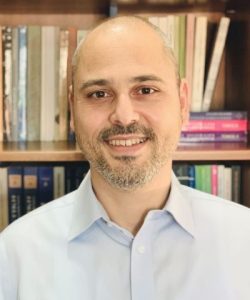
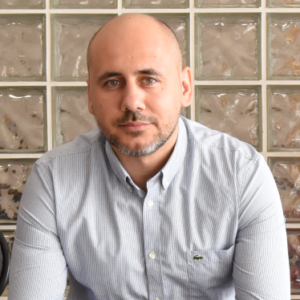
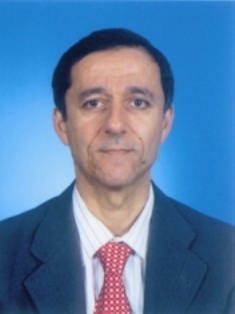
Stelios Timotheou is an Associate Professor at the Department of Electrical and Computer Engineering and faculty member at the KIOS Research and Innovation Center of Excellence, University of Cyprus. He holds a Dipl-Ing from National Technical University of Athens, and MSc/PhD from Imperial College London. His research focuses on developing real-time distributed methodologies using mathematical optimization, machine learning, and computational intelligence to enhance efficiency in critical infrastructure systems. Research interests center on data-driven decision making for urban mobility management, traffic control systems, and energy optimization. Key areas include: Intelligent UAV-based sensing for traffic monitoring Cooperative control algorithms for multi-agent systems Optimization of renewable energy integration Robust infrastructure protection strategies Recent publications demonstrate strong focus on traffic state estimation (76%), energy system optimization (16%), and UAV applications (8%). Awarded the Cyprus Research Award (2017) and ERC Consolidator Grant for URANUS project. Secured multiple research grants focusing on real-time control systems.
Marios Polycarpou is a Professor of Electrical and Computer Engineering and Director of the KIOS Research and Innovation Center of Excellence at the University of Cyprus. He holds honorary positions at Imperial College London and is a member of Academia Europaea. His expertise spans intelligent systems, adaptive control, machine learning, and critical infrastructure. Education: B.A. Computer Science (Rice University, 1987) B.Sc. Electrical Engineering (Rice University, 1987) M.S. Electrical Engineering (University of Southern California, 1989) Ph.D. Electrical Engineering (University of Southern California, 1992) Research Focus: Polycarpou’s work emphasizes fault diagnosis in cyber-physical systems, water distribution networks, and adaptive control. He pioneers digital twin technologies for infrastructure resilience and develops algorithms for real-time anomaly detection and system optimization. Article Trends: His recent publications address adaptive control strategies, cybersecurity in networked systems, and AI-driven solutions for water management. Key themes include distributed control, event-triggered mechanisms, and transformer-based anomaly localization. Awards: 2023 IEEE Frank Rosenblatt Technical Field Award 2016 IEEE Neural Networks Pioneer Award Fellow of IEEE and IFAC Grants & Leadership: He secured prestigious grants including ERC Advanced and Synergy Grants. He led KIOS CoE’s Horizon 2020 projects and served as IEEE Computational Intelligence Society President (2012–2013). Labs & Teams: Directs the KIOS CoE, a hub for AI in critical infrastructure. Collaborates on projects like ERC Water-Futures, focusing on long-term water system transitions and contamination mitigation.
Professor Ioannis Katakis is a Faculty Member at the University of Nicosia, where he is affiliated with the School of Sciences and Engineering and the Department of Computer Science. He has held various academic positions across multiple institutions including Aristotle University of Thessaloniki, University of Cyprus, Cyprus University of Technology, Open University of Cyprus, Hellenic Open University, Athens University of Economics and Business, and National and Kapodistrian University of Athens. His educational background includes a PhD in Machine Learning for Automated Text Classification (2005-2009), a Master's in Information Systems (2005-2007), and a Bachelor's in Computer Science (2000-2004), all from Aristotle University of Thessaloniki. Professor Katakis specializes in several cutting-edge areas of computer science and data analysis. His primary research interests include Mining Social, Web and Urban Data , Sentiment Analysis and Opinion Mining , Data Streams , and Multi-label Learning . His work bridges theoretical machine learning approaches with practical applications in social media analysis, healthcare informatics, privacy protection, and smart city technologies. He has published extensively in top venues including CIKM, ECML/PKDD, IEEE TKDE, and ECAI. His recent publications demonstrate a clear trend toward applying machine learning techniques to real-world problems with societal impact. He has focused on areas such as GDPR compliance in smart devices, sentiment analysis in crowd-sourced content, healthcare applications including drug reaction classification and brain disease monitoring, and privacy protection in wearable technologies. His work often involves multi-modal data analysis and addresses challenges in data streams and multi-label classification. Professor Katakis has made significant contributions to his field, with his research cited over 4,200 times. He serves as an Editor for the journal Information Systems and has edited four special issues in journals such as DAMI and InfSys. He regularly contributes to the academic community by serving on program committees for major conferences including ECML/PKDD, WSDM, DEBS, and IJCAI, and by reviewing for prestigious journals like TPAMI, DMKD, TKDE, TKDD, JMLR, TWEB, and ML. He has been actively involved in European research projects, notably serving as Quality Assurance Coordinator and Senior Researcher for projects such as VAVEL (www.vavel-project.eu) and INSIGHT (www.insight-ict.eu). His grant activities demonstrate a strong focus on collaborative, interdisciplinary research with practical applications in urban data management, social media analysis, and healthcare informatics. He has organized three workshops at major conferences (ICML, ECML/PKDD, EDBT/ICDT) and has extensive experience translating research into practical applications through his involvement in European projects.
Professor Mohammed Salamah is a distinguished faculty member in the Computer Engineering Department at Eastern Mediterranean University's Faculty of Engineering. He maintains an office in room 114 and can be contacted at +90 392 630 1149/1334 or via email at muhammed.salamah@emu.edu.tr. His academic website provides additional resources for students and colleagues. Dr. Salamah earned his BS, MS, and PhD degrees in Electrical and Electronics Engineering from Middle East Technical University in 1988, 1990, and 1996 respectively, establishing a strong foundation for his career in network communications and wireless systems. His research interests span multiple critical areas in modern networking, with particular expertise in Wireless Sensor Networks, Internet of Things (IoT) security, Mobile Communications, and Energy Efficiency in network protocols. Professor Salamah has made significant contributions to the understanding of network security mechanisms, trust management systems, and optimization of wireless communication protocols. An analysis of his recent scholarly output reveals a strong focus on security challenges in IoT communication systems, controller placement optimization in software-defined wireless sensor networks, and trust-based malicious node detection schemes. His work demonstrates consistent attention to practical network performance issues while addressing emerging challenges in next-generation communication technologies. Throughout his academic career, Professor Salamah has demonstrated exceptional commitment to student mentorship, supervising numerous graduate students through their research journey. His administrative contributions include service as an associate editor, reviewer, and session chair for academic conferences. His laboratory work focuses on practical implementations of wireless communication protocols, with emphasis on energy efficiency, security mechanisms, and performance optimization for various network architectures including cellular networks, cognitive radio systems, and wireless sensor networks.
Dr. Michael Georgiades is an Assistant Professor at Neapolis University of Pafos, specializing in computer networks. He holds a BEng (First Class Honours) from King’s College London, an MSc from University College London, and a PhD from the University of Surrey. His career includes roles as R&D Manager at Primetel PLC, Research Fellow at the Centre of Communication Systems Research (CCSR), and Systems Development Engineer at INSIG Ltd. He has contributed to EU-funded ICT projects, holds patents, and authored IETF standards. His research focuses on Tactile Internet, Mobile Edge Computing, Vehicular Networks, IoT, and Edge Intelligence. Research Interests: Tactile Internet Mobile Edge Computing Vehicular Networks IoT Edge Intelligence Awards: Nokia Prize for Research Excellence Primetel Awards for Excellence EPSRC and British Council Studentships Publications span cutting-edge topics like adversarial ML attacks on IoT networks, cryptocurrency market analysis, and satellite-backhauled 5G systems. His work bridges theoretical advancements with practical applications in healthcare, agriculture, and transportation systems.
George Pallis is a Professor in the Department of Informatics at the University of Cyprus, affiliated with the School of Science. He holds a BSc and PhD from Aristotle University of Thessaloniki. His research focuses on Distributed and Network Computing, Big Data Analytics, and Cloud/Edge/Fog Computing. He leads the Master's Program in Data Science and has secured over €5.5M in research funding from the EU, Cyprus, and industry partners like Google. Education: BSc (2001), PhD (2006) from Aristotle University of Thessaloniki. Research Interests include Internet technologies, large-scale network environments, and cloud computing. He has published over 100 articles in top-tier journals and conferences (e.g., IEEE TKDE, ACM TOIT, WWW, ICDCS) and contributed to international standards (DIN, CEN). His work spans topics like fake news detection, edge computing frameworks, and energy-efficient micro-data centers. Key Achievements: Editor-in-Chief Emeritus of IEEE Internet Computing, recipient of multiple best paper awards, and contributor to projects like RAINBOW (H2020), UNICORN, and ICARUS. His research explores cutting-edge areas such as LLM manipulation, polarization detection, and carbon-aware computing. He has supervised five PhD students and served as General Chair for IEEE/ACM SEC 2024 and IEEE IC2E 2024. His work bridges academia and industry through collaborations on AI, IoT, and sustainable computing.
Panos K. Chrysanthis is a Professor of Computer Science at the University of Pittsburgh and an adjunct Professor at Carnegie-Mellon University and the University of Cyprus. He holds a BS in Physics with a Computer Science concentration from the University of Athens, Greece, and MS and PhD degrees in Computer and Information Sciences from the University of Massachusetts Amherst. He has been affiliated with the University of Pittsburgh since 1991, serving as Director of the Advanced Data Management Technologies (ADMT) Lab. His research focuses on database systems, mobile and pervasive data management, distributed computing, and real-time systems, with recent emphasis on data streams and energy-efficient data management for IoT and sensor networks. Chrysanthis has authored over 100 peer-reviewed publications, including a book on transaction processing and consistency in distributed databases. He has received the NSF CAREER Award (1995) and the University of Pittsburgh's Provost Award for Excellence in Mentoring (2015). He has held editorial roles at the VLDB Journal, IEEE TKDE, and DAPD, and has organized major conferences like ICDE and MDM. His work bridges theoretical database research with practical applications in urban informatics, healthcare, and sustainability. Chrysanthis has advised numerous students, contributed to grants focused on big data and healthcare analytics, and co-developed tools like the ADMT Lab's experimental platforms for urban mobility and congestion. He is a Senior Member of IEEE and an ACM Distinguished Scientist.
Prof. Dr. Hadi Işık Aybay is a distinguished Professor of Computer Engineering at Eastern Mediterranean University (EMU), North Cyprus. He has held academic roles including Department Chairman of Computer Engineering (1994–2004 and 2013–present) and Director of EMU's Distance Education Institute (2000–2013). He earned his PhD in Electrical and Electronic Engineering from METU (1989) and served as an Assistant/Associate Professor before becoming a full Professor in 2013. His research spans neural networks, distributed systems, and e-learning technologies. Education: PhD, Electrical and Electronic Engineering, Middle East Technical University (1989) M.Sc., Electrical and Electronic Engineering, METU B.Sc., Electrical and Electronic Engineering, METU Research Interests: Prof. Aybay's work focuses on computer engineering innovations, including neural network hardware, distributed multimedia systems, and wireless communication protocols. He pioneered EMUOnline, a blended learning platform, and contributed to science park development in North Cyprus. His research also addresses challenges in video streaming optimization and adaptive resource allocation in cellular networks. Key Achievements: He led over 15 projects, including EU-funded initiatives like 'Deep Farm' (2024–2025). His publications (80+ papers) span IEEE journals and conferences, with 281 Google Scholar citations. Awards include the 1973 National Project Contest First Prize and the 1990 Best Thesis Award (supervised). Grants and advising: Supervised 3 PhD and 28 MSc students. Current projects include AI-driven agriculture (Erasmus+). Grants include EU funding (€1M) and Turkish Republic of Northern Cyprus initiatives. Labs/Teams: Active in the EMU Computer Engineering Department's research groups, focusing on distributed systems and e-learning infrastructure.
Elias Allayiotis is an Associate Lecturer in the Department of Computing at the School of Sciences, University of Central Lancashire Cyprus. He holds a PhD in Computer Science (2017) and has professional certifications in Information Systems Auditing and Linux Administration. His research focuses on enhancing mobile user Quality of Experience (QoE) through context-aware systems and mobile-to-cloud computing architectures. Education: PhD (UCLan, 2017), MSc & BSc (Roosevelt University, 2004–2007) Certifications: ISACA, LPI, HEA His research interests include modeling mobile QoE using context-aware approaches, optimizing mobile-to-cloud data offloading, and developing adaptive systems for user-centric experiences. He has published in venues like IEEE PIMRC and IWCMC. Awards: AWS Research Grant (2015), UCLan PhD Scholarship (2013) Professionally, he has held roles as CTO/VP of Product Development at Competitive Analytics Professionals and Managing Director at UVIA Technologies. He teaches the Masters Project module (CO4804) and is a member of ACM, IEEE, and ICSC.
Irini Stamatoudi is a Professor at the Department of Law, University of Athens. She specializes in Copyright Law, Intellectual Property, and Cultural Heritage Law. Her work contributes to UN Sustainable Development Goals, particularly in fostering innovation and protecting cultural assets. She has held leadership roles including President of the EU Council's Working Party on Copyright (2014), Director of the Hellenic Copyright Organization (2007–2018), and academic roles at the WIPO Academy. Education: EU TMR Marie-Curie Research Fellow at the University of Leicester (1997–1999). Research focuses on digital cultural heritage, information technology law, and cross-border intellectual property disputes. Recent projects include 'Blue Shield Greece' (cultural heritage protection) and a sustainability model for heritage preservation. Her publications in 2024 address informatics in heritage management, dubbing rights, and repatriation of cultural artifacts. She advises on EU programs for law students and leads initiatives to integrate technology with legal frameworks.
Oshan ULUŞAN is an Assistant Professor at the Department of Journalism, Faculty of Communication, Near East University. He also works as a Research Assistant in the Sustainability Office under the Quality and Accreditation Coordination at the same institution. Education: BA in Journalism (2017), MA in Media and Communication Studies (2019, 4.0 GPA), PhD in Communication Sciences (ongoing). His research focuses on political communication , cultural studies , and data journalism , with a particular emphasis on disinformation in social media, post-truth dynamics, and sustainable media practices. Recent publications explore fake news during the Russia-Ukraine war, filter bubble effects on streaming platforms, and crisis communication in digital contexts. His scholarly work intersects with broader themes in media ecology, identity politics, and digital journalism ethics. He has contributed to academic discourse through empirical studies and theoretical analyses of contemporary communication challenges in Northern Cyprus and Turkey.
Professor Marios Dikaiakos is a faculty member at the University of Cyprus Department of Computer Science, where he also served as Head of Department (2010-2014) and founded the Centre for Entrepreneurship (2014-2021). He holds a Ph.D. and M.A. in Computer Science from Princeton University and a Dipl.-Ing. in Electrical Engineering from the National Technical University of Athens. His research focuses on Cloud Computing systems performance and dependability, and Online Social Network analysis. Research Interests: Professor Dikaiakos leads the Laboratory for Internet Computing, directing numerous EU-funded projects. His work spans network-centric systems, cloud computing infrastructure, and social media analytics, with over 160 peer-reviewed publications. Recent work explores energy efficiency in edge computing and misinformation detection in polarized media environments. Publication Trends: His recent articles show a strong focus on sustainable computing, edge AI systems, and social media analysis, with emerging work on LLM ethics and industrial IoT. Methodologies include benchmarking frameworks, federated learning, and unsupervised NLP techniques applied to large-scale datasets. Collaborations & Labs: As Principal Investigator of the Laboratory for Internet Computing, he oversees multiple research projects and has held visiting positions at Rutgers University, Université de Paris Cité, and National Technical University of Athens. He serves as Associate Editor for Springer's Computing journal.
Christos Panayiotou is a Professor in the Electrical and Computer Engineering Department at the University of Cyprus (UCY) and serves as the Deputy Director of the KIOS Research and Innovation Center of Excellence. He holds a B.Sc. and Ph.D. in Electrical and Computer Engineering from the University of Massachusetts Amherst (1994 and 1999), as well as an MBA from the Isenberg School of Management. Prior to joining UCY in 2002, he was a Research Associate at Boston University's Center for Information and System Engineering. His research focuses on modeling, control, optimization, and performance evaluation of discrete event and hybrid systems, with applications in intelligent transportation systems, cyber-physical systems, machine learning, wireless networks, and smart buildings. His work has secured over €45 million in funding from national/EU agencies, governments, and private entities. He has published over 290 papers and received the 2014 Best Paper Award in Building and Environment . Editorial Roles : Associate Editor for IEEE Transactions on Intelligent Transportation Systems, IEEE Control Systems Society, and others. Leadership : General Chair of EWGT2020, Co-Chair of ECC2018, and Chair of IEEE Computational Intelligence Society subcommittees. Key projects include UAV swarm coordination for maritime surveillance, digital twin architectures for smart buildings, and resilient traffic demand management systems. His grants emphasize cyber-physical systems, energy grids, and disaster response technologies.
George Pallis is a Professor in the Department of Computer Science at the University of Cyprus, where he also serves as Associate Director of the Laboratory of Internet Computing. He is a programme director for the Master in Data Science and leads major international research initiatives funded by the European Commission, national agencies, and industry partners such as Google. His academic foundation includes a BSc and PhD in Informatics from Aristotle University of Thessaloniki, Greece. PhD, Department of Informatics, Aristotle University of Thessaloniki, Greece, 2006 BSc, Department of Informatics, Aristotle University of Thessaloniki, Greece, 2001 Dr. Pallis’s research focuses on Distributed and Internet Computing , with specialized interests in Big Data Analytics, Cloud/Edge/Fog Computing, Content Delivery Networks, and Online Social Networks . His work bridges theoretical innovation and practical deployment, particularly in scalable and energy-efficient computing infrastructures. He has contributed to international standards through the German Institute for Standardization (DIN) and has developed frameworks for cloud elasticity, fog emulation, and misinformation detection. His 15 most recent publications reflect a strong trend in edge and fog computing, AI-driven analytics, privacy-preserving data processing, and misinformation detection . These works span high-impact venues such as IEEE IC2E, IEEE/ACM SEC, IEEE CloudCom, and IEEE BigData, with increasing integration of machine learning and human-in-the-loop systems. Dr. Pallis has received multiple scientific awards, including: Best Paper Award, IEEE CloudCom 2024 Best Paper Award (2nd place), IEEE/ACM UCC 2023 Best Paper Award, IEEE IoTDi 2022 Best Student Paper, IEEE ISCC 2022 Best Paper, IEEE BigData 2016 Best Paper, ICSOC 2014 Best Demo Award, ACM/IEEE SEC 2020 World’s Top 2% Scientists (Stanford) Golden Core Member, IEEE Computer Society He has supervised several PhD students in areas such as fog computing emulation, big data in entrepreneurship, and polarization detection. His research is supported by over 5.5 million euros in grants from the European Commission (e.g., RAINBOW, UNICORN, ICARUS), the Research Promotion Foundation in Cyprus, and industry. He has served as General Chair of IEEE/ACM SEC 2024 and IEEE IC2E 2024, and as Editor-in-Chief of IEEE Internet Computing (2019–2023), now holding the Emeritus title. He is currently Associate Editor for the Computing Journal (Springer). Dr. Pallis leads the Laboratory of Internet Computing, a hub for research in cloud, edge, and social computing. The lab develops tools like Fogify for emulation, RAINBOW analytics, and Check-It for fake news detection, fostering collaboration across academia and industry.
Professor Alexander Chefranov is a distinguished faculty member in the Department of Computer Engineering at Eastern Mediterranean University's Faculty of Engineering in Famagusta, North Cyprus. He has been serving at EMU since 2002, initially as a Visiting Associate Professor until 2009, then as Associate Professor until 2021, and has held the position of Professor since 2021. Originally from Russia/USSR, he earned his Engineer-Mathematician diploma from Taganrog Radio-Engineering Institute in 1978, followed by his PhD (Candidate of Engineering Sciences) in Computer Engineering in 1984, and later his Doctor of Engineering Sciences in 1998. Professor Chefranov's research spans multiple interdisciplinary fields with remarkable breadth. His primary research interests include fluid dynamics and hydrodynamics (particularly vortex dynamics, flow instability, and Navier-Stokes equations), cryptography and information security (with numerous publications on Hill cipher modifications and NTRU-like cryptosystems), image processing and steganography, and machine learning applications in scene recognition and medical imaging. His work demonstrates exceptional versatility across both theoretical mathematics and practical computer science applications. His recent publications through 2025 reveal a continued active research trajectory across all his interest areas, with particular emphasis on hydrodynamic instability theories, advanced cryptographic techniques, and deep learning applications. His work bridges fundamental mathematical physics with cutting-edge computer science applications, demonstrating unusual interdisciplinary range. Professor Chefranov is actively supervising graduate students, currently overseeing two PhD candidates (OLALEKAN EBENEZER IHINKALU and BEHNAM BOJNORDI ARBAB) and one Master's student (AMIRALI HATAMI), whose work focuses on steganalysis using deep learning approaches.