Özlem Özgöbek is an Associate Professor at the Department of Computer Technology and Informatics, Norwegian University of Science and Technology (NTNU). Her research spans artificial intelligence, machine learning, and recommender systems with a focus on privacy, fake news detection, and educational technology. NTNU - Department of Computer Technology and Informatics Her work explores multimodal fake news detection, privacy implications in recommender systems, and technology-enhanced classroom interaction. Recent publications analyze digital education trends and classroom tools. Özgöbek collaborates with international researchers and contributes to news recommendation workshops. Her projects address ethical AI, environmental sustainability, and real-time information processing.
Adín Ramírez Rivera is a Professor in the Digital Signal Processing and Image Analysis (DSB) group at the Department of Informatics, University of Oslo. His research focuses on representation learning and computer vision, particularly exploring machine learning methods to describe and understand visual data. He is a Senior Member of the IEEE and a member of the ELLIS Society. Education : PhD from Kyung Hee University's Image Processing Lab, South Korea; Bachelor's degree in Engineering from Universidad de San Carlos de Guatemala, majoring in Computer Science and Systems Engineering. Ramírez Rivera's research spans diverse computer vision tasks including facial analysis, object detection, image enhancement, and vision transformers. His work emphasizes self-supervised learning, fair representation learning, and novel neural network architectures for image segmentation and classification. Recent publications highlight trends in vision transformers, crowd counting, facial expression recognition, and fair representation learning. His articles frequently address statistical modeling, feature extraction, and deep learning techniques for visual tasks. Scientific Awards : Senior Member of the IEEE, Member of the ELLIS Society. He collaborates with researchers across institutions, contributing to projects involving anomaly detection, multilingual translation, and astrophysical modeling. His lab affiliations include the Digital Signal Processing and Image Analysis group and the Section for Machine Learning at the University of Oslo.
Anne Danielsen is a Professor and Deputy Head at the RITMO Center for Interdisciplinary Studies of Rhythm, Time, and Motion at the University of Oslo. Her research bridges musicology, cognitive science, and interdisciplinary studies, focusing on rhythm, music production, and the intersection of music, media, and technology. University: University of Oslo Role: Professor Projects: TIME (NFR TOP RESEARCH), RITMO (NFR Center of Excellence) Danielsen’s work explores microrhythm , groove , and temporal perception in music, with a particular emphasis on popular and African-American music . She investigates how music cognition interacts with sonic features and body posture in performance, integrating psychological and acoustic analysis . Her recent projects include MusicLab Copenhagen , a dataset for interdisciplinary concert research, and studies on beta oscillations and pupil responses in groove perception. Danielsen collaborates across disciplines, examining how personality traits and genetic factors influence musical sensibility through twin studies. In music production , she analyzes how digital audio workstations transform rhythmic structures and investigates acoustic chamber design for sound experiments. Her research also addresses gender patterns in music mediation and the cultural implications of rhythmic aesthetics.
Dag Johansen is a Professor in the Department of Informatics at UiT The Arctic University of Norway, Tromso campus. His work spans multiple research areas at the intersection of computer science, sports science, medicine, health technology, and nutrition science. He leads the interdisciplinary "Corpore Sano" research center and is actively involved in several research groups including the Cyber Security Group (CSG) and Crime Control and Security Law. Professor Johansen's research focuses on developing fundamental software solutions for secure and error-free data processing in heterogeneous distributed systems, ranging from lightweight "Internet of Things" devices and mobile phones to large-scale cloud solutions. His work particularly emphasizes applications in sports technology, edge computing, and compliance technology. His research interests include distributed systems, cybersecurity, sports technology, edge computing, data privacy, AI for sports analytics, multimedia forensics, and compliance technology. His recent publication trends show a strong focus on AI applications for sports video analysis, particularly in soccer and ice hockey, where his team has developed AI-based cropping systems for social media representations. He also has significant work in data privacy and GDPR compliance, especially regarding the "third country problem," as well as applications of AI in sustainable fishing practices. His 2024-2025 publications demonstrate continued work in self-healing microservices, lightweight encryption for video feeds, and virtual reality training environments. Professor Johansen is actively involved in mentoring students and research collaborators, as evidenced by his extensive publication record with numerous co-authors including doctoral students and postdoctoral researchers. His work has received funding through various research projects focused on data analytics, privacy technology, cybersecurity, and sports technology applications. He leads the interdisciplinary "Corpore Sano" center, which brings together researchers from computer science, sports science, medicine, health technology, and nutrition science. His work also involves collaboration with the "Njord" project focused on sustainable fishing through AI applications, and he's involved in developing the "Áika" distributed edge system for AI inference.
Sergej Stoppel is currently a researcher (PostDoc) in the visualization group at the University of Bergen. His academic background includes a Mathematics master's degree (2014) and a PhD in 2018, both from the University of Bergen. His research focuses on visual data science, with an emphasis on interactive visualization techniques, human-computer interaction, and physical visualization systems. He has authored/co-authored numerous papers on topics such as hexagonal map enhancements, spatio-temporal data interaction, and low-cost physical art generation. Education: M.Sc. Mathematics (2014), University of Bergen PhD in Visualization (2018), University of Bergen Research Interests: His work spans data visualization, scientific visualization, and interactive techniques. Notable contributions include Vol²velle (printable interactive volume visualization widgets), Firefly (virtual illumination drones), and LinesLab (low-cost art generation systems). He explores methods to bridge the gap between virtual and physical visual representations, emphasizing user-centric design. Publications: His recent work includes advancements in hexagonal map visualization (2022), spatio-temporal selection techniques (2020), and illumination automation (2019). These contributions highlight his focus on enhancing data interpretation through novel interaction paradigms. Labs/Teams: Active member of the VisGroup at the University of Bergen, collaborating on projects like MetaVis and VIDI. His work is supported by grants involving visualization and medical imaging applications.
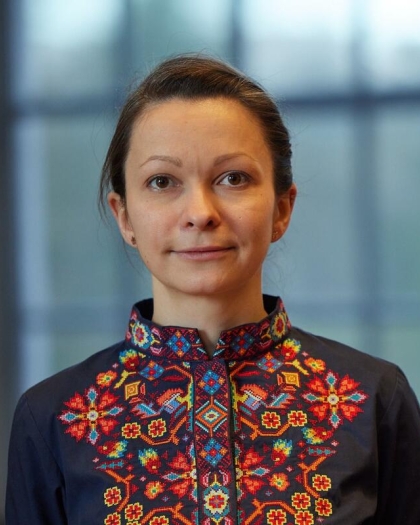
Liliia Oprysk is a Professor at the Faculty of Law, University of Bergen. She specializes in EU Intellectual Property law, digital content regulation, data protection, and IT law. Her research also explores Ukrainian legal harmonization with EU acquis and war-related legal challenges. Affiliation: Faculty of Law, University of Bergen Research Interests: EU Copyright Law, Digital Economy Regulation, EU-Ukraine Legal Integration Her research focuses on: EU copyright harmonization Digital content distribution and consumer rights Data protection in digital markets Ukraine's legal alignment with EU standards Impact of war on legal systems AI and emerging technology regulation Publications highlight her work on: Copyright exhaustion in digital markets Legal implications of streaming services War crimes accountability Ukrainian children deportation analysis EU acquis harmonization Digital consumer contract law She teaches EU Copyright Law (JUS2314/JUS3514) and GDPR & Privacy (DIGI113/DIGI613), serving as course coordinator for JUS2314 since 2025. Her practical experience includes IT operations, digital compliance, and technology contract negotiations.
Anders Olof Larsson is a Professor at the School of Communication, Leadership and Marketing at Kristiania University College in Oslo, Norway. Originally from Sweden, he specializes in digital political communication, with particular expertise in social media platforms' role in political processes, journalism, and election campaigns. His research takes a strongly comparative approach across countries, platforms, and time periods. Professor Larsson's research interests focus on political communication in digital environments, with particular attention to how political actors use social media platforms for campaigning and public engagement. His work examines cross-national differences in digital political communication, platform-specific affordances, and longitudinal changes in how political actors utilize emerging technologies. He has conducted extensive research on Facebook, Twitter, Instagram, and newer platforms like TikTok, with special attention to comparative Scandinavian contexts. His recent publications reveal a strong focus on comparative digital political communication across multiple dimensions - comparing different countries' approaches, analyzing various social media platforms' unique characteristics, and examining longitudinal changes in digital campaigning. His work spans theoretical, methodological, and empirical contributions to understanding how digital technologies reshape political communication globally. Professor Larsson actively supervises research and has sought both master's level research assistants and PhD candidates for projects including the 'Scandinavian Political Communication During the Pandemic' initiative. He has organized academic events including the 'Comparative Digital Political Communication' preconference for the International Communication Association. His research is conducted through several collaborative projects including the DigiWorld project and CamforS (Campaigning for Strasbourg), which conducts cross-national comparisons of campaign mobilization in social media. These projects adopt comparative approaches to studying political communication across different contexts and platforms.
Amir Taherkordi is a Professor in the Networks and Distributed Systems group at the Department of Informatics, University of Oslo, Norway. His research focuses on resource-efficiency, scalability, adaptability, and mobility in distributed systems for emerging technologies like IoT, Fog/Edge/Cloud Computing, and Cyber-Physical Systems (CPS). University: University of Oslo Department: Informatics Academic Rank: Professor His research spans IoT, Edge/Fog Computing, and Cyber-Physical Systems, emphasizing energy efficiency, privacy preservation, and self-adaptive architectures. Key areas include network traffic classification, computation offloading, and federated learning applications in vehicular systems. Recent publications highlight advances in latency-aware IoT data transmission , federated vehicular networks , energy-efficient wireless charging , and privacy-preserving data integration . These works often integrate machine learning with network optimization. Projects include the CPS Lab at UiO, DILUTE (Fluid Service Abstraction), and the Gemini Centre on IoT . He collaborates on initiatives like PACE for energy informatics curricula development.
Dilip K. Prasad is a Professor at the Department of Informatics, UiT The Arctic University of Norway. His work bridges Artificial Intelligence and Medical Imaging , with a focus on Interpretable AI , Scalable AI , and Life Science Applications . He has contributed to Maritime Technology and Biomedical Engineering . Ph.D. and B.Tech from Nanyang Technological University and IIT Dhanbad Senior Research Fellow at NTU (2015-2019), Research Fellow at NUS (2012-2015) Industry experience at IBM, Infosys, Mediatek, Philips His research explores Image Processing , Machine Learning , and AI Applications in Biomedicine . Recent work includes Dense Video Captioning , 3D Mitochondrial Modeling , and Physics-Guided Loss Functions . Articles span Neurocomputing , Optics Express , and top AI conferences like CVPR and NeurIPS . Prasad has received the Rolls-Royce Inventor Award (2016) and Best Paper Award (IJCIE 2017) . He has reviewed for 50+ journals and 30+ conferences, serving as Area Chair for NeurIPS 2022-23 and Organizer Chair for ICCV Workshop 2023 .
Krishna Agarwal is a Professor in Ultrasound, Microwaves and Optics at the Department of Physics and Technology, UiT The Arctic University of Norway. His research spans multiple interdisciplinary fields including optical nanoscopy, quantitative phase imaging, and computational imaging techniques. He is an active member of the Ultrasound, Microwaves and Optics research group, with specialized focus on Optical Nanoscopy, and participates in research projects including VirtualStain and NanoAI. Professor Agarwal's research interests center on advanced imaging techniques, particularly in optical nanoscopy and quantitative phase imaging. His work bridges physics, computer science, and biology, developing novel computational methods for microscopy enhancement. His research focuses on applying deep learning to improve imaging resolution, developing frameworks for quantitative phase reconstruction, and creating new methodologies for 3D imaging of biological specimens. His work has significant applications in biomedical imaging, cellular analysis, and diagnostic technologies. Recent publications demonstrate a strong trend toward integrating artificial intelligence with traditional optical techniques, with increasing emphasis on computational approaches to solve longstanding challenges in microscopy. His research shows consistent progression from theoretical optical methods toward practical applications in biological imaging and medical diagnostics, with numerous publications in high-impact optics and imaging journals. Professor Agarwal teaches Optisk nanoskopi (Course FYS-3029) at UiT, contributing to advanced optics education. His research group appears to collaborate extensively with international researchers across multiple institutions, suggesting active grant funding and collaborative research efforts. Based at Teknologibygget Tromsø 3.058, Professor Agarwal leads research in the Optical Nanoscopy group, focusing on developing next-generation imaging technologies that combine optical physics with computational methods. His team appears to work at the intersection of physics, computer science, and biology, developing tools that push the boundaries of what's possible in cellular and sub-cellular imaging.
Kristian Hoelscher serves as Research Director at the Peace Research Institute Oslo (PRIO), where he leads interdisciplinary research at the intersection of cities, markets, politics, conflict, and development in the Global South. His work spans Sub-Saharan Africa, South Asia, and Latin America, employing both quantitative and qualitative methodologies to examine urban political transformations and peacebuilding processes. Hoelscher earned his PhD in Political Science from the University of Oslo, complemented by an MSc in Population and Development Studies from the London School of Economics and Political Science, and dual undergraduate degrees (BA in Business and BSc Honors in Psychology) from the University of Queensland, Australia. His multilingual capabilities include fluency in English and Norwegian, with working knowledge of Portuguese and Spanish. His research agenda centers on understanding how urbanization shapes political change in the Global South, with particular focus on African cities. A distinctive thread throughout his work examines small and medium enterprises (SMEs) as critical actors in conflict-affected urban environments, exploring how businesses navigate insecurity while contributing to community resilience and peacebuilding. His approach integrates political science, urban studies, development economics, and peace and conflict studies to address complex urban challenges in rapidly transforming cities across the Global South. Analysis of Hoelscher's recent publications reveals three interconnected research streams: 1) Urban political transformations in Africa, examining how demographic shifts reshape state-society relations; 2) SME resilience in conflict zones, documenting business strategies for navigating polycrises in cities like Kampala and Beirut; and 3) Digital peacebuilding, critically assessing technology's role in conflict resolution. His work consistently emphasizes place-based approaches that account for local context while identifying broader patterns across regions. Hoelscher has secured significant research funding including: Young Researcher Talent Funding from the Research Council of Norway for the Political Change in African Cities (PACE) project Funding for The Crime-Reducing Effect of Education project (CREED) He leads multiple collaborative initiatives including Peace Positive Private Sector Development in Africa (P3A), Working Through Violence; SMEs and the SDGs in Fragile Urban Spaces, and Critical Perspectives on Digital Peacebuilding. These projects involve partnerships with researchers across Africa, Latin America, and Europe, reflecting his commitment to globally engaged scholarship that bridges academic research with practical peacebuilding applications.
Thomas Erich Zinner is Professor at the Department of Information Security and Communication Technology, Norwegian University of Science and Technology (NTNU), a position held since August 2019. Previously, he served as visiting professor and head of the FG INET research group at TU Berlin, and led the 'Next Generation Networks' research group at the University of Würzburg's Communication Networks chair. His educational background includes a diploma (2006) and Ph.D. (2012), both from the University of Würzburg. His research spans network architecture performance evaluation with emphasis on SDN/NFV and QoE-centric management approaches for emerging networks. Zinner's recent publications reveal strong trends toward intelligent 6G architectures integrating AI in the user plane, QoE-aware 5G resource allocation, and autonomic management of softwarized networks. His work combines theoretical modeling, simulation frameworks like OMNeT++, and practical implementations focused on real-world applicability in beyond-5G systems. He leads the Networking Research Group at NTNU working on the TeraFlow project, developing secure cloud-native SDN controllers for autonomic traffic management at massive scale. This initiative addresses critical challenges in next-generation network infrastructure through innovative controller architectures and flow management techniques.
Carla Schenker is a Postdoctoral Fellow in the Department of Data Science and Knowledge Discovery at Simula Metropolitan, specializing in advanced tensor decomposition methods for multi-modal data analysis. Her research bridges machine learning, optimization, and neuroimaging applications, with a focus on interpretable pattern discovery from complex datasets. Her educational background includes: PhD from Oslo Metropolitan University, Norway (Thesis: A Flexible Framework for Data Fusion Based on Coupled Matrix and Tensor Factorizations for Interpretable Pattern Discovery) Dr. Schenker's research centers on Matrix and Tensor Factorizations , where she develops constrained optimization frameworks for PARAFAC2 and coupled decompositions. Her work enables Data Fusion across dynamic and static sources, with critical applications in neuroimaging biomarker discovery and temporal pattern tracking . She pioneers methods for handling incomplete temporal data while maintaining model interpretability, advancing both theoretical foundations and real-world implementations in multi-way data analysis. Analysis of her 11 publications (2019-2025) reveals a clear evolution: early work established optimization frameworks for regularized tensor factorizations (2019-2021), while recent breakthroughs (2023-2025) focus on temporal dynamics, interpretable evolving patterns, and constrained PARAFAC2 variants. Her research consistently bridges Machine Learning theory with applications in neuroscience and signal processing, demonstrating increasing sophistication in handling heterogeneous, multi-modal datasets. No scientific awards are documented in available sources. Public records indicate no formal student advising or grant leadership, though her collaborative publications involve significant interdisciplinary partnerships with institutions like Oslo Metropolitan University and international research teams. As a core member of Simula Metropolitan's Data Science and Knowledge Discovery department, she contributes to Norway's national research infrastructure for digital engineering, working within teams focused on algorithmic innovation for complex data challenges in healthcare and industrial applications.
Stefano Basso is an Associate Professor at the Norwegian University of Science and Technology (NTNU), Department of Geography and Social Anthropology. His research focuses on hydrology, environmental hazards, and the water-energy-ecosystems nexus. He has held roles including Senior Scientist at the Norwegian Institute for Water Research (NIVA) and Research Group Leader at the Helmholtz Centre for Environmental Research (UFZ), Germany. His work emphasizes predicting extreme floods and understanding climate adaptation impacts. Education and Career Highlights: PhD from Eawag (Swiss Federal Institute of Aquatic Science and Technology), 2016 Visiting Research Scholar at Duke University, USA (2014–2015) Supervised multiple PhD candidates and postdocs, including recipients of prestigious awards. Research Interests: Extreme flood prediction using hydrograph dynamics Landscape-based climate adaptation Hydropower and biodiversity interactions Solute and sediment fluxes in river basins His methods link ordinary hydrologic data to extreme event analysis, with applications in Norway, Germany, and beyond. Awards and Recognition: Water Resources Research Editors’ Choice Award (2020) 2020 Supervision Award, Helmholtz Centre for Environmental Research Grants and Advising: Main supervisor for PhD student Hsing-Jui Wang (Glory Foundation-funded) Co-supervisor for Larisa Tarasova (completed 2020) Recipient of grants for hydropower and ecosystem studies. Outreach and Labs: Collaborates with Norwegian agencies like NVE on flood risk. Active in international projects like ClimDesign for climate services.
Hajnalka Vaagen is an Associate Professor in the Department of Ocean Operations and Civil Engineering at the Faculty of Engineering, Norwegian University of Science and Technology (NTNU), with an additional affiliation as Associate Professor II at the Norwegian School of Economics (NHH). Her research bridges theoretical and applied aspects of operations management, decision-making under uncertainty, and sustainable transformation. Her educational background includes a PhD in Quantitative Logistics from Molde University College (2009). She has held senior researcher roles at SINTEF Industry and SINTEF Technology and Society, contributing to operations research and industrial applications. Her research interests focus on: Risk and uncertainty management in project-based production systems, particularly in engineer-to-order contexts. Portfolio and assortment optimization in consumer goods, using stochastic modeling. Lean and flexible project delivery, integrating mathematical modeling with empirical data from lean construction. Circular economy initiatives in maritime industries, including ocean plastic pollution mitigation and sustainable supply chains. Industrialization of advanced 3D knitting technologies through digital platforms. The trends in her recent publications reflect a strong interdisciplinary focus combining operations research, sustainability, and behavioral insights. Her work frequently applies stochastic optimization to real-world challenges in shipbuilding, construction, and supply chains, emphasizing both technical and social dimensions of performance. She collaborates internationally, notably with the University of California, Berkeley’s Project Production Systems Laboratory. She has supervised multiple Master’s theses at NTNU, contributing to education in lean principles and ship design planning. Her outreach includes academic lectures at international conferences such as APMS, IFAC, and IGLC. Her research is supported by involvement in EU-funded projects like Blue Circular Economy (BCE) and CIRCNETS, as well as national initiatives such as SuSDesign and Sweet Spot under NTNU’s SusRes program. These projects aim to enable sustainable transformation through innovation ecosystems and policy-oriented operations management.